sidewalks across alleys

Note: Please see post on City of Sacramento Street Design Standards. It turns out that there are at least two different sets of design standards.

The City of Sacramento has Standard Specifications and Drawings that require certain designs for the public right-of-way. There were last revised April 2020, and are available on the Utilities: Development Standards page. It is not clear why these are part of Utilities rather than Public Works or Community Development, but they are. Though I haven’t done an element by element comparison, they seem to be a considerable improvement over the previous standards, which seem to be June 2009.

There are designs which are not being followed, and others that should be eliminated. Today, I’ll address sidewalks crossing alleys. Alleys are only common in the central city, but they do exist other places throughout the city.

The city design standard is below (pdf of entire page). The detail is hard to see, but the alleyway, sidewalk, and alley driveway are all concrete, none are asphalt. The T-11 Standard Alley Entrance Detail page says “Portland Cement Concrete (PCC) is the city standard pavement for alleys.”

SacCity Specification detail alley entrance

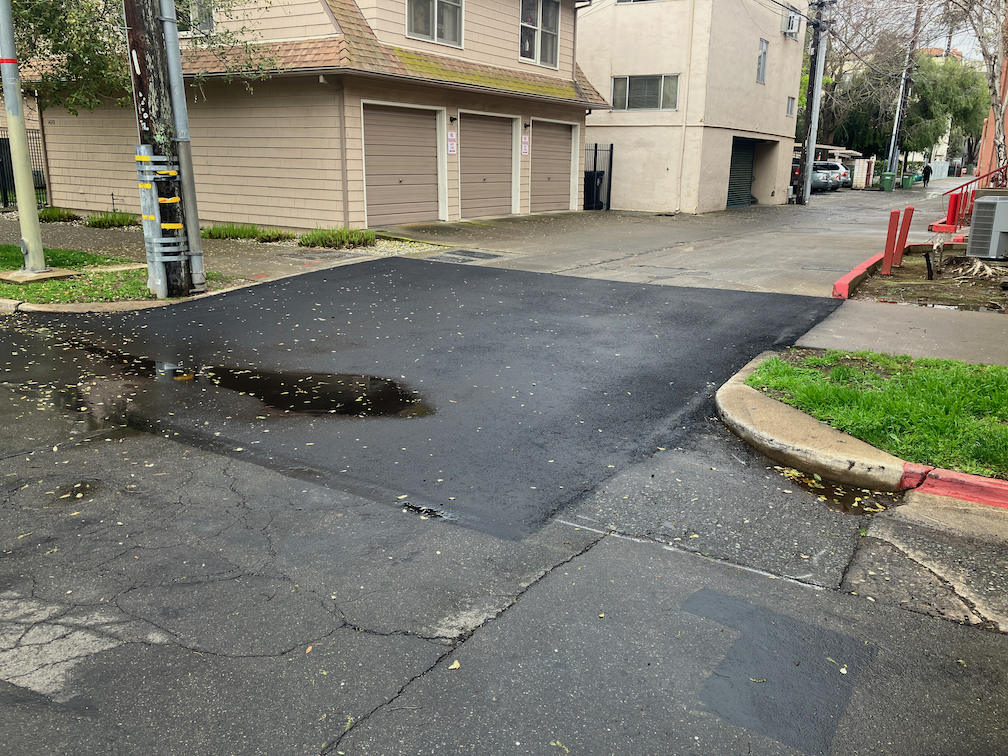
Of course there are many alleyways that are asphalt, and some that are unpaved gravel. I don’t know when the city standards changed to require pavement, or when to require concrete, but those are the current standards. That means that if an alley, or a sidewalk, or the alley driveway is changed, it must meet current standards. Below is a photo of Neighbors Alley at 17th Street, which was just redone within the last two months. It clearly does not meet city standards. Both the driveway and the sidewalk are asphalt, not concrete. Though I noticed this work being done, I failed to notice who was doing it. City? Private? Private utility? Not sure.

photo of Neighbors Alley at 17th Street
Neighbors Alley at 17th Street
Read More »

SacCity red light cameras and crashes

A follow on to red-light-running bullies. I’ve created a map that shows the eleven right light camera (automated enforcement) locations under the City of Sacramento’s Red Light Running Program. The city has 907 signalized intersections. These locations are (listed alphabetically by the intersection entry in the Traffic Signals GIS layer):

  • 16th Street & W Street X
  • 21st Street  & Broadway X
  • 5th Street & I Street X
  • Alhambra Boulevard & J Street
  • Arden Way & Challenge Way X
  • Arden & Exposition Boulevard & Ethan Way X
  • El Camino Avenue & Evergreen Street X
  • Fair Oaks Boulevard & Howe Avenue X
  • Folsom Boulevard & Howe Avenue/Power Inn Road X
  • Mack Road & Center Parkway X
  • Mack Road & La Mancha Way/Valley Hi Drive X

The map (pdf) shows each location, with the red signal icon, and a heat map of the crash severity for crashes occurring at intersections. Yellow means high collision severity, with severity being a weighting of the individual types [1 – Fatal; 2 – Injury (Severe); 3 – Injury (Other Visible); 4 – Injury (Complaint of Pain)]. But it does show the pattern, and you can clearly see the intersections along arterial roadways, where most crashes occur. The crashes are not necessarily red light running crashes. There is a PCF Violation category (VIOLCAT) 12 – Traffic Signals and Signs, and another Intersection (INTERSECT_), but that would not distinguish red light running from stop sign running. It might take looking at individual incident reports, but that is beyond my capacity.

There are certainly high crash severity locations in the city that are beyond the map coverage area, and there are plenty of locations without cameras.

It would be interesting to know if these red light camera locations have a lower rate of red light running crashes that comparable intersections without cameras, but that will require quite a bit more thinking an analysis.

Read More »

solving traffic violence with: yes, and

It is common among many transportation advocates to posit that we can only really solve the traffic violence problem by redesigning roadways to reduce the opportunity for drivers to speed, and many other driver behaviors which endanger walkers, bicyclists, and other drivers (not to mention sign posts, street furniture, and business fronts). It is true that we have designed our roadways to encourage fast driving, and to passing through rather than stopping, which is to say mobility instead of access. All of this is true. Everything from roadway design standards (federal, state and local), traffic law, signing, widening, and removal of street trees, makes roadways more dangerous and less usable by anyone not in a motor vehicle. So, yes, we need to redesign roads.

Yes, and. At the same time, we need to hold drivers accountable. The focus on fixing roads tends to ignore the contribution of reckless (sociopathic and psychopathic) driving to traffic violence. Every decision to go faster than is safe, to fail to yield to walkers, to pass a bicyclist too close, to use your motor vehicle to intimidate others, to disrupt people’s lives with intentionally loud exhaust and sound, to make unnecessary trips, is a decision. It could be decided otherwise.

I acknowledge that the trend towards blaming roadways, and the engineers who designed them, is a reaction to law enforcement using traffic law as an excuse for pretext stops, where the intent is not traffic safety but the identification and oppression of people of color and the poor. That is demonstrably true, for anyone who reads the research data on traffic stops, or for anyone out on the street paying attention, for that matter. So I am absolutely not advocating for traditional law enforcement, and in fact think that law enforcement has no place in Vision Zero efforts.

But there are other ways of holding drivers accountable. Automated traffic signal enforcement is already in place, though at far too few locations. Automated speed enforcement could be in place if CHP and other law enforcement agencies stopped killing it at every legislative session, with complicity of our windshield perspective governor. Automated enforcement of failure to yield to pedestrians is more complicated, but achievable. I continue to believe that it is a small though very significant portion of drivers who most egregiously violate the law, and kill the most people. If we can control those people, then we can eliminate much death and destruction. Not all, but most.

But how do we control those people? In my experience, most of those people are high income, entitled people, driving expensive cars and SUVs. They are often the people that others consider leaders in business and government. These are not people whose behavior will be controlled by a traffic ticket. We must up our game on them. First, base fines for violation of traffic law on the value of the vehicle being driven. That has the advantage of removing the valid concern about the effect of enforcement on lower income people. Second, impound the vehicle after a certain number of tickets. Third, confiscate the vehicle, sell it off, and use the proceeds to improve roadway safety.

So, after three rants about drivers (red-light-running bullies, Yield to walkers? Nah., and this one), I’ll go back to roadway design. Yes, that is where the ultimate solution lies.

Yield to walkers? Nah.

This is essentially the second part of my red-light-running bullies post. Except that it applies to every intersection, not just signalized intersections.

This is another driver behavior that accelerated with the pandemic. But it didn’t start there. It primarily started with the election of Donald Trump. There was a noticeable change in driver behavior immediately after the election. Many drivers apparently thought, well if the president can say and do whatever he wants without consequence, so can I. It was really noticeable to me how belligerent drivers became. I’m guessing that it was because many drivers see people walking and bicycling as ‘other’, people with different values and political views. Used to be communists, then it was “lib’rels”, and I won’t use the current round of words here. If you are walking or bicycling, you are ‘other’ and if you are walking or bicycling and black or poor, you are truly the enemy. God meant us to drive, and anyone who thinks otherwise or gets in my way is against both God and me. That may sound outlandish, but it does accurately reflect how many drivers view the world.

But back to the driver behavior. Most drivers no longer yield to people using crosswalks. Of course most drivers are not aware that there is a crosswalk at every intersection, whether marked or not. And the DMV is complicit in this, they make no effort to educate drivers about pedestrian right-of-way. The law doesn’t require a driver to stop until the walker steps off the curb (or ramp) and into the street. Common decency would mandate yielding to waiting walkers, but common decency is not common among drivers. Once the walker has stepped into the street, they have the right of way. But most drivers will not stop. They may change lanes to avoid the blood splat on their car, but they won’t stop.

There are drivers who do stop, but when I look at them, I see the fear in their eyes, that they are going to get rear ended by an inattentive driver, or that on a street with more than one lane in the same direction, another driver in another lane will fail to stop or even slow, and they will have to see someone die right in front of their eyes. I understand that fear, because both these things happen with disturbing frequency.

Read More »

red-light-running bullies

If you go stand at any busy intersection in Sacramento, you will see drivers running red lights on almost every single signal cycle. Of course this problem is not unique to Sacramento, but it is where I live and walk and bicycle, and I see it every day, at every signalized intersection. I am not talking about drivers entering the intersection on the yellow light, and not making it through before it turns red. I am talking about drivers entering the intersection when the light is already red. And quite often, they accelerate into the red light, making sure they can get through.

I call this bullying behavior. It says that I (the driver) is more important than anyone else. Me (the driver) making this light is more important than anything else in the world, which translates to my (the driver’s) convenience is more important than anyone else’s life. I (the driver) know that this is dangerous behavior, but I (the driver) don’t care.

My preferred word for this is actually terrorism. Terrorism, however, implies actions by individuals against states, or more often by states against individuals (state-sponsored terrorism). This is not that. But the intent is the same, to change other people’s behavior by the threat of violence, or actual violence. This is traffic violence perpetrated by entitled drivers against everyone else on the road. Terrorism may not be technically correct, but it sure sounds right.

Most drivers have adjusted to this by not starting into the intersection on the green, but waiting until the run light running driver has cleared. Same for people bicycling and walking. Most walkers know it is not safe to enter the crosswalk until all the cars have stopped, because usually they will not stop. But not all drivers, walkers or bicyclists know, and these are the people being killed or seriously injured at intersections.

Red light running has always been a problem, but it has gotten much worse. It accelerated, I think, during the pandemic, when there was less traffic, and drivers started to gamble with running red lights. Now that the traffic is mostly back, they are still doing it. In my observation, it gets worse by the month.

Many people think that the solution to traffic violence is to change road designs so as to prevent dangerous driver behavior. I’m of course in favor of this. But in this instance, re-design does not prevent this bullying behavior.

Having near-side traffic signals, as many advanced countries do, would help a little because a driver who chose not to stop loses information about how late on the red they are and therefore is less likely to run the red light. See Near Side Signals: Thinking Outside the Pedestrian Box for more info on near side signals. But this alone would not solve the problem.

Slowing speeds would help, as the red light running driver would be a little less likely to kill the walker, bicyclist, or other driver and passengers than at higher speeds. But the red light runners are in my observation the same people who are driving well over the speed limit, adjusting their risk tolerance for to the highest possible level that won’t get them killed. Of course, these are not drivers who are much concerned about killing other people.

The City of Sacramento has a Red Light Running Program. The page says there are 11 cameras in the city. Out of 4000 plus intersections. This is not a serious response to a serious problem. It is in fact the typical city response to any transportation issue, to do the absolute minimum possible to avoid being called out for doing nothing.

I believe from extensive observation (I walk a LOT), though I have no data to prove it, that red light running is done by a fraction of drivers, and those drivers do it again and again and again. They’ve gotten away with it, so far, and will continue. At least 3/4 are drivers of expensive cars, high income, entitled people. If that is so, it would not take much to greatly reduce this behavior. Ticket them again and again and again, whether directly by law enforcement officers or by automated cameras, and their behavior would gradually change. Of course if we set ticket fines based on the value of the vehicle rather than flat rates, and impounded and/or confiscated vehicles upon repeated infractions, it would change even quicker.

Law enforcement is complicit in this red light running. I have never seen a driver stopped for running a red light. Ever. And in fact, law enforcement drivers are just as likely to run red lights as any other. Law enforcement doesn’t like automated enforcement, because it reduces the opportunity for them to do pretextual stops. It also is seen as reducing the need for officers, though since they don’t do this enforcement anyway, I can’t see how it actually reduces the need.

Many people have called on the city to install more leading pedestrian interval (LPI) lights in the city, where the pedestrian indicator turns to walk 3 seconds or more before the parallel traffic signal turns green. These of course help, but even where they already exist, the interval is now taken up by the time a walker must wait for the red light running drivers to clear the intersection before proceeding. Much less effective at promoting walking and safety than it could be.

Solutions:

  • The city could recognize that this is a serious traffic violence issue, and respond forcefully, with more enforcement and more automated cameras. The city’s Vision Zero policy obligates them to take traffic violence seriously, but they do not.
  • The CA-MUTCD could be changed to require near side traffic signals instead of far side traffic signals.
  • The state legislature and judicial council could change fines for violation of California Vehicle Code (CVC) to be based on the value of the vehicle. People often talk about basing fines on income, as some first world countries do, but income is not easily available to the law enforcement officer or processor of the red light camera mailed ticket, whereas the value of vehicles is available in the DMV database. If you run a red light in your $1000 clunker, the fine would be $1, and if you run a red light in your $200,000 trophy car, it would be $2000. To start.
  • Along with higher fines for drivers of fancy cars, the vehicles of these drivers should be impounded for the third violation of the same CVC within a year. Impound means you get the vehicle back after a certain period of time, maybe three months. And for those drivers that doesn’t control, then the vehicle should be confiscated, meaning you don’t get it back and the agency sells it. Maybe for more than six violations of the same CVC within a year, or ten within three years.
  • Walkers and bicyclists could equip themselves with paint ball guns so as to mark the vehicles of these bully drivers, so at least other people could see them coming. And perhaps other drivers would them start enforcing social pressure on them. It worked for smoking, when people who smoked in buildings and on transit were publicly shamed.
  • And of course, in the long run, we do need to re-design streets to that red light running is less likely, and less likely fatal due to lower speeds.

downtown or midtown?

I attended the State of the City event last week put on by the Downtown Sacramento Partnership. It was interesting, and the talk I was primarily there for, Brent Toderian, was good (more about that later). But the boosterism of downtown got way out of hand, in the sense that the picture of economic success that everyone was promoting revolved around the Golden One Center and all the other big projects that were underway or promised. This model of big projects bringing big success is fragile. I will admit that the Golden One Center and DOCO seems to have largely worked. It took a dead mall in the center of a dead part of the city and brought it back to life. But now all city leaders can talk about is the next big project, and the bigger the better. But everyone knows that big projects can fail spectacularly.

It is interesting that Downtown Sacramento Partnership, and city leaders, claim credit for midtown when it is to their advantage, such as the claim that most of the economic productivity is downtown, when it is really more spread out than that, but act as though midtown doesn’t exist in the next breath because it is not downtown. It is true, midtown and downtown are unique from each other. But not in the way DSP would like you to think.

Midtown is full of smaller buildings, old Victorian houses, apartment buildings, businesses. And in particular, for me, coffee shops (I drink tea, but the social benefits of coffee shops apply to tea drinkers too). About half the former empty lots in midtown now have construction on them. ADUs are going in, and lot splits are happening. There are a few larger projects, like the half block of affordable multi-family at S Street and 17th, but most are much smaller. There are a lot of small independent businesses, and only a few chains. There are a few, which is many too many, parking garages and surface parking lots. But midtown is the land of infill. There is a reason all but one of the night life areas in the central city is in midtown and not downtown.

In contrast, downtown is an area of block-size or multi-block developments. A significant percentage of the land area is parking garages, parking garages below offices, or surface parking lots, the very lowest of the low of land uses. Downtown is the land of big projects, and big dreams. But if there isn’t something going on at Golden One Center, downtown is largely dead. There are more closed businesses and boarded up buildings in a few blocks of downtown than in the entire midtown.

Midtown is a model built on people who live there and the services they need. Not perfect, but good. Downtown is a model built on people from elsewhere, who may or may not come and spend their money.

Of course before the 1960s, downtown was not much different from midtown. But the city and the state did not like the people who lived there (poor, people of color), so they tried to erase downtown and replace it with office buildings for the suburban workers. Sadly, they largely succeeded.

My choice is midtown. Yes, I live a short way across the line in downtown, but at least I live in an old apartment complex (CADA) and only 2-1/2 blocks from a great coffee shop. So I still get the best of midtown. When I go walking to the west, all I see are big buildings and empty parking lots, and almost no people. When I go walking to the east, I see people and construction and successful businesses. Downtown is dead. Midtown is alive.

Freeport Blvd to council today

The Freeport Blvd Transportation Plan is on the Sacramento City Council Agenda today. I failed to notice this, and submitted my comment late, so will have to attend in person or on Zoom. The item is on the consent calendar, so it is particularly important that people comment on the item so that the city recognizes there is significant opposition. You might also contact your council member to request that they remove the item (#6) from the consent calendar.

You may read my previous blog posts at https://gettingaroundsac.blog/category/city-of-sacramento/freeport-blvd/. You may read other’s comments on the agenda item at https://sacramento.granicusideas.com/meetings/4599-5pm-city-council-closed-session-begins-at-4-00-pm-updated-02-slash-21-slash-2023-at-1-30-p-dot-m/agenda_items/63eeca6df2b670376d010289-6-freeport-boulevard-transportation-plan-final-dr

H St bicycle fixes

H Street is commonly used by bicyclists leaving Sacramento Valley Station, and others as well. It has decent bicycle facilities except for some gaps.

H Street has a bike lane on the south side from 5th Street to 16th St, except one block, 7th Street to 8th Street. There is absolutely no reason for this gap. This is the section between the Sacramento County Administration Building on the south and a decked parking garage on the north. The parking seems to be there for the convenience of people working in the building, as there does not seem to be turnover of the parking spots. There is ample parking in the garage. This parking should be removed and a bike lane painted IMMEDIATELY. No excuses. A common quote in the bicyclist community is “sharrows are bullshit”, and this is the case here, where the city has preferenced motor vehicle drivers over bicyclist safety.

H St parking and sharrows from 7th St to 8th St

There is a bike lane on the north side between 7th Street and 13th Street. Bike lanes on the left side of one-way streets are much less used than right side bike lanes, but are useful.

Read More »

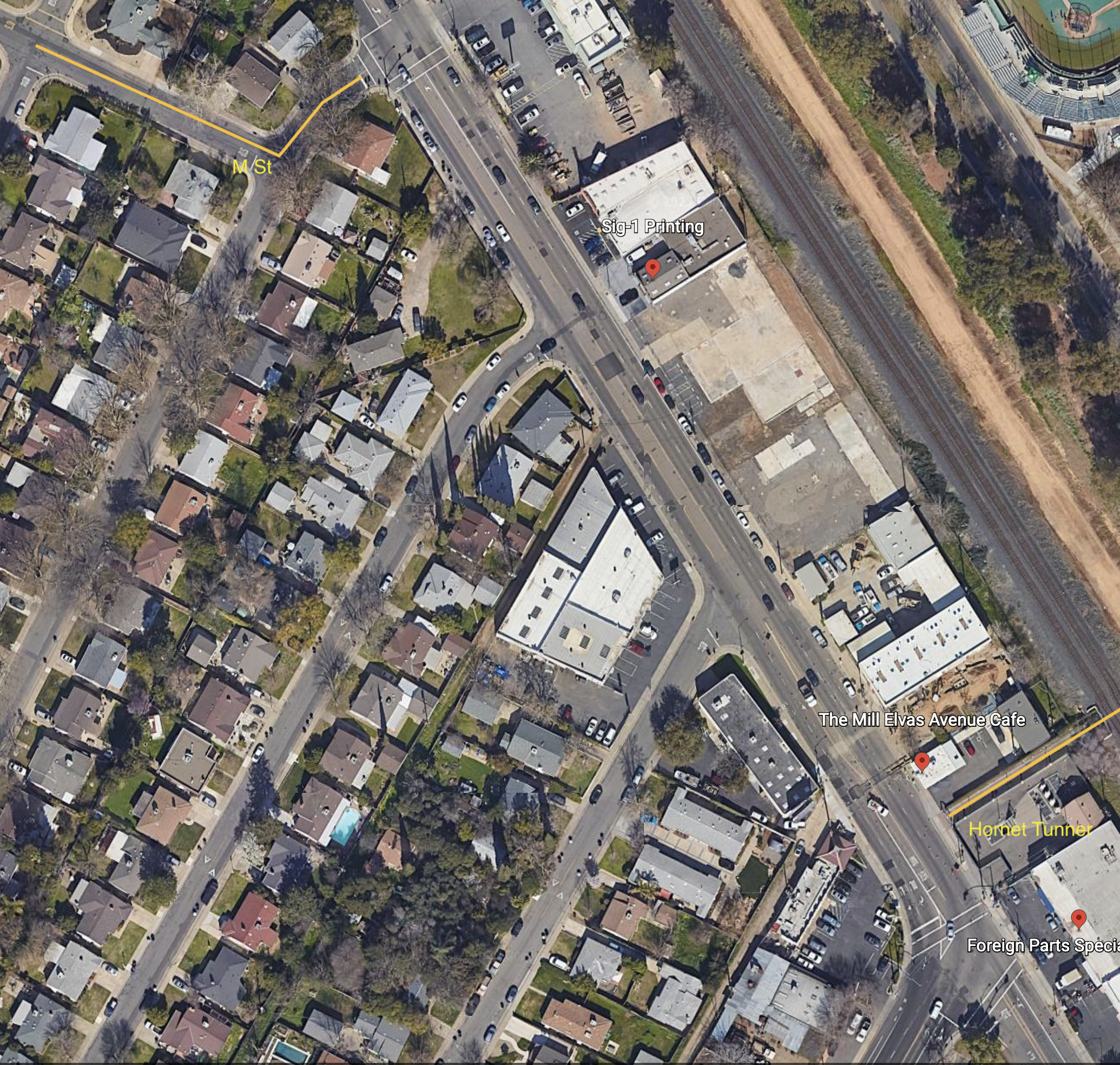
M Street to Hornet Tunnel

I have long been planning to write about the extremely poor bicyclist facilities from M Street to Hornet Tunnel, which is a major access point for Sac State.

M Street is a major east-west bicycle route, with some but not all of it marked as a bicycle route. If the city used the bicycle boulevard designation, it would be designated a bicycle boulevard. M Street forms an uncontrolled T-intersection with 62nd Street, which leads a short way left to a signalized T-intersection with Elvas Ave.

Hornet Tunnel is a major access point to Sac State campus, probably second only to the Guy West bridge access on the north side.

The map below shows M Street, 62nd Street, Elvas Ave, and Hornet Tunnel, as it exists.

The route from M Street to Hornet Tunnel is heavily used by bicyclists, both students and people passing through to the American River Parkway paths. It would be much more heavily used if it were safe, but it is not.

Eastbound to campus, one must cross over four lanes somewhere between 62nd Street and the median along Elvas Ave, and then ride on the wrong side of the street to reach Hornet Tunnel. Westbound, it is not bad, only having to merge over the northbound lanes to a dedicated left turn lane to 62nd Street. The signal here is surprisingly responsive to bicyclists, so the wait is usually short.

At the 62nd Street & Elvas Ave intersection, Elvas is 62 feet wide, 70 feet with sidewalks. There are shoulder stripes setting off unofficial parking, one southbound lane, one center turn lane, and two northbound lanes. At 64th Ave, Elvas is 68 feet wide, 76 feet with sideewalks. At Hornet Tunnel, Elvas is 63 feet wide, 77 feet with sidewalks, with two northbound lanes and three southbound lanes, two of which are dedicated right turn lanes to 65th Street. Elvas was formerly wider at Hornet Tunnel, but some sidewalk was added there to ease crowding at the tunnel entrance/exit. Given the city-preferred, though unnecessarily wide 11 foot travel lanes, there is room for six lanes of traffic here! That means there is ample room for bicycle facilities. But there are none present.

Some bicyclists take the striped shoulders to be bike lanes, but they are not. The city’s 2018 Bikeway Master Plan shows this section of Elvas between 65th Street and Hornet Tunnel as a Class 2 (on-street) bike lane, but this is false. It is not indicated as such with either pavement markings or signage. Though the shoulder stripe southbound has the dashed marking often used to indicate a bike lane approaching an intersection, this is a fake. It is NOT a bike lane. People park along this stretch, so even if it were a bike lane, it would not be safe nor meet minimal standards for a bike lane.

Solutions

What street redesign and reallocation would make is safer for bicyclists?

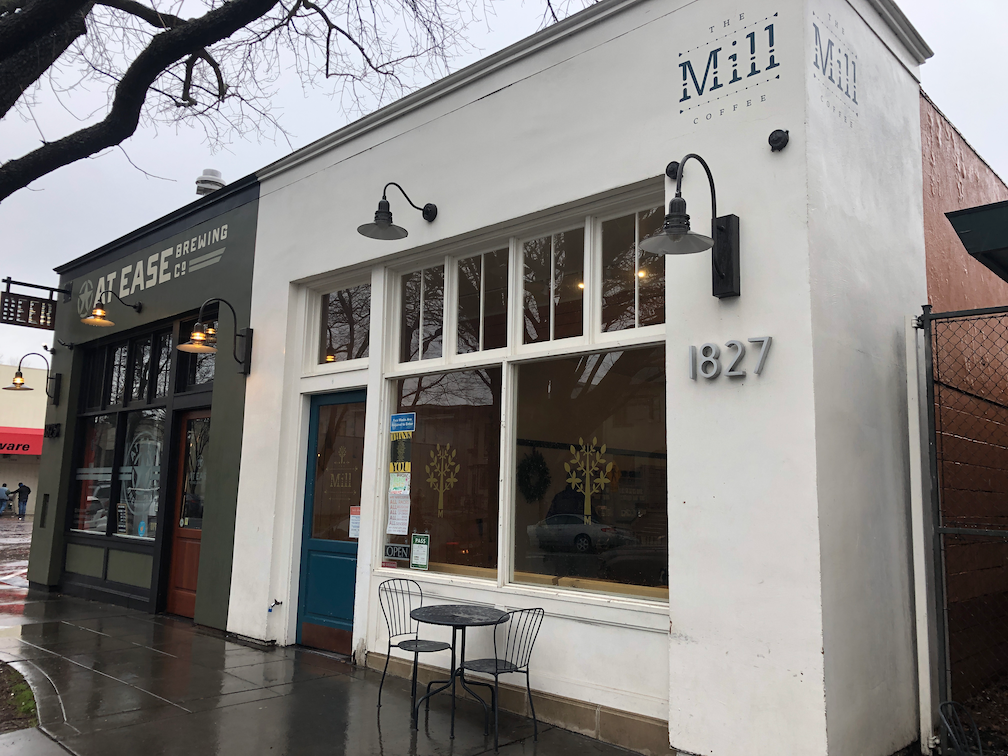
First, for northbound bicyclists, there should be a separated bikeway on the right side of the street. Along this section, there are four driveways and a stretch of street-oriented perpendicular parking (where vehicles enter directly into parking spaces from the street). There is a section of 270 feet with no existing buildings. Though there could be parking protected bikeway along here, I don’t think the parking is even needed. Instead, this is probably a good location for a curb separated bikeway, with hard curb to prevent encroachment on bicyclists. The curb would be cut only for driveways which are currently in use. The existing parking along this stretch is used mostly by students to avoid paying on-campus parking fees. All the businesses have onsite parking. The one business that might reasonably need short-term parking on Elvas is The Mill coffee shop. Separated bikeways work best with long stretches without driveways, but one here is workable.

Southbound is more complicated. If there were a bike lane or separated bikeway on the southbound side of Elvas, bicyclists would still need to cross to Hornet Tunnel, at a location where there is currently no way to do so. I see three options:

  1. First, have bicyclists ride south to the existing 65th Street & Elvas Ave intersection, and use the crosswalk on the north side to cross over and then go north to the tunnel. This is very awkward, out of the way, and encourages bicyclists to use a crosswalk, which is not illegal but poor practice.
  2. Second is to create a two-way separated bikeway (often called a cycletrack) on the east side of Elvas, from 62nd Street to the tunnel. A separate bicyclist signal phase would need to be created for northbound bicyclists to cross to 62nd Street, and southbound bicyclists to cross to the east side of Elvas Ave. An advantage to this solution is that parking on the west side of Elvas does not need to be changed, though it can be reasonably argued that there should be at least a regular bike lane here for bicyclists who are not going to the tunnel, but continuing south on Elvas or south on 65th Street.
  3. Third, have bicyclists continue southbound on Elvas, but create a clear zone for crossing to the tunnel by signalization. Northbound motor vehicles would be held by the existing signal at the intersection of 65th Street and Elvas Ave, while southbound motor vehicles would be held at a stop line just north of the tunnel by new signal heads. Bicyclists would cross to the tunnel during the red phase. There would need to be queuing area for southbound bicyclists, since they would exceed the stacking capacity of the bike lane during busy times. This option probably slows motor vehicle throughput more than the other options.

No matter which solution, the sidewalks along Elvas Ave should be repaired and widened, and street trees should be planted. And of course the street needs to be repaved.

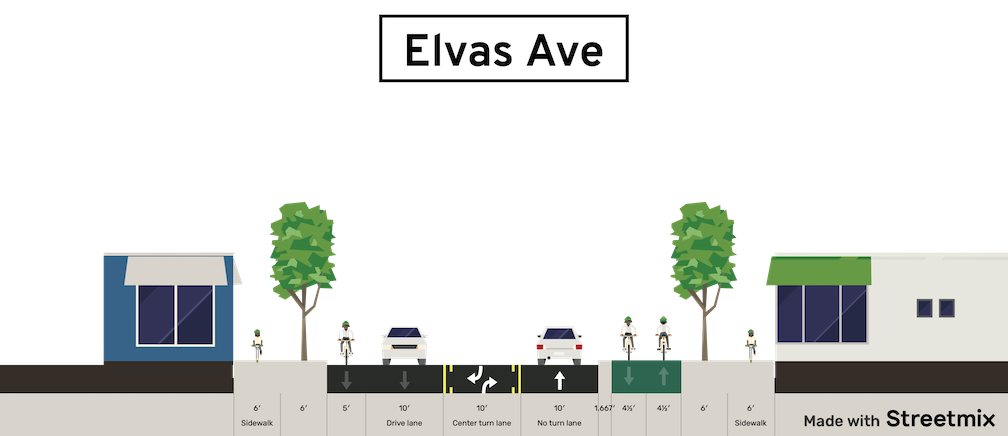
Below is a Streetsmix diagram showing one possible configuration (looking north) with a two-way separated bikeway (cycletrack) on the east side, along with wider sidewalks and trees in a planing strip, and a southbound regular bike lane. And yes, all this fits in the existing over-wide Elvas Ave right-of-way!

SacCity should remove crossing at alleys prohibition

City of Sacramento code prohibits pedestrians from crossing streets at alleys.

10.20.030 Crossing at alleys.
     No pedestrian shall cross a through street at an intersection with an alley except within a marked crosswalk. (Prior code § 25.03.052)

https://library.qcode.us/lib/sacramento_ca/pub/city_code/item/title_10-chapter_10_20-10_20_030

While this code has always been an attempt to prioritize motor vehicle drivers over people walking, it is becoming increasing problematic as housing and businesses are now located along alleyways in the central city. ADUs and lot split housing are often accessed through alleys and not from the street. This code makes it so that anyone living or doing business in an alley must go out of the way to cross the street, and it prohibits people who just want to walk alleys to avoid busy streets.

The code should be excised.