Local Street Typology is the sixth post by Strong SacTown to improve and promote the City of Sacramento update to its Street Design Standards. Other posts at tag: street design standards.
“Local Streets are an extension of the adjacent land uses and provide space for people to socialize, play, and even loiter, and will be designed and managed as places primarily for people. People are likely to spend most of their time in or near Local Streets, since these are where to find most destinations. As such, it should feel natural and comfortable to dwell in or stroll through a Local Street. Parents should feel comfortable letting their kids play unsupervised, and noise levels are low enough to hold a conversation.”
Modal Filters is the fifth post by Strong SacTown to improve and promote the City of Sacramento update to its Street Design Standards. Other posts at tag: street design standards.
“Also known as traffic diverters, or permeable filters, modal filters hold the key to bringing back the pre-1920 sense that streets are for everybody and can be a shared space where all traffic can safely and slowly mix. They do this by reducing the number of cars on a given street or in a neighborhood via bollards or other physical barriers.”
Additional posts on Streets for People Active Transportation Plan are at category: Active Transportation Plan.
The City of Sacramento held the Streets for People Citywide Virtual Workshop #1 yesterday. Though the city may eventually post the slideshow, it is not on the program page Streets for People Active Transportation Plan yet, so I’m posting them here. These are low-ish resolution screen captures, so you won’t be able to see detail in them, but I hope they are still useful to you. I did not capture every single slide, but I hope the ones of interest are here. Of course the slides do not capture the presenter comments that went with each slide, which are important.
The next workshop, Streets for People Citywide Virtual Workshop #2, will be tomorrow, July 11. Please see the program web page for registration link. I assume the presentation will be the same.
The first workshop was poorly attended. I don’t know how many people, but the presenters mentioned several times how few people were on the webinar. My question/comment is that the Traffic Calming tab of the Neighborhood Connections storymap has the best examples of traffic calming measures, with many of the photos local, whereas the visual glossary pedestrian and visual gallery bikeways examples provided as part of the interactive map are of poorer quality, not local, and in a few cases should not be recommended at all. These two sources should use the same examples, where they overlap.
The second workshop will be followed by a series of focus groups for particular neighborhoods or areas of the city, and walk audits in those same areas. I hope that people will participate in one or more of them.
Additional posts on Broadway Complete Streets are available at category ‘Broadway Complete Streets‘.
Green Paint
Green paint has been added to parts of the Broadway Complete Streets project, mostly to the west of Riverside Drive/11th Street, and some to the west of Land Park Drive/16th Street. I did not see any green paint east of Land Park Drive/16th Street. Several areas marked for green paint have not yet been painted, so this aspect of the project is certainly not complete. Where it has been completed, it is pretty nice, well done.
Broadway at 3rd St, bike lane with skipped green marking
Several bus stops have been or will be marked with extra wide green paint, indicating a shared bus and bike area. For most of Broadway, the bus is SacRT Route 51, with a frequency of 15 minutes, but from 9th Street to Riverside Drive/11th St, SacRT Route 11 is also present. Shown below is the bus stop just before 10th Street, which is the only transfer point between routes 11 and 51, and was destined to be removed by the city before SacRT complained. The bus stop should have been moved to just beyond 10th Street, and served with a bus boarding extension, but this is better than nothing.
Broadway at 10th St, shared bus stop and bike lane green marking
It is worth remembering that green paint has no legal meaning. It is informational, meant to mark potential conflict areas between motor vehicles and bicyclists. As such, it is worthwhile, but bicyclists should always remember to be situationally aware and to not think of green paint (or any paint) as protective.
16th Street Conversion
The block of 16th Street between Broadway and X Street has been converted from one-way to two-way. This may have happened a while ago, and I missed it, but below is a photo from today. The conversion is an attempt to encourage drivers to use X Street eastbound to access Broadway to the east of 16th Street, or Land Park Drive.
conversion one-way to two-way, 16th St between Broadway and X St
Confusion approaching 16th Street
I spent time today observing driver behavior, turning right from Broadway westbound onto 16th Street. Some drivers pulled to the curb, over the bike lane. This is actually the correct legal behavior under California law, to turn from as close to the curb as reasonable, however, many drivers are not aware of this law. Other drivers stuck to the general purpose lane and turned from it. Of course turning from the lane risks right-hooking bicyclists who have the right-of-way in the bike lane (straight traffic always has the right-of-way over turning traffic). There are similar situations all over the city, where drivers don’t know the legal behavior, and bicyclists are at risk. But at this location, with frequent right turns from Broadway to 16th Street (which the city wants to encourage to get motor vehicles off Broadway if they are not continuing to a destination on Broadway), but city has failed to make it clear what the proper behavior is, and has failed to make it safer for bicyclists. The best solution would be to install a bicycle signal here, and provide bicyclists their own safe passage through the intersection. The next best would probably be to modify the markings so that the double white line is broken, indicating that this is a mixing zone and not an exclusive bike lane. As it is, it will lead to conflict and danger for bicyclists.
Broadway westbound at 16th St, confusing bike lane and motor vehicle mixing
Photos
Photos on Flickr. An album of photos of the Broadway Complete Streets project, during and after construction. No promise is made that the album will be kept up to date.
Additional posts on Broadway Complete Streets are available at category ‘Broadway Complete Streets‘.
On Broadway eastbound at Land Park Drive, there is a bicycle signal face, shown below. The signal is permanently red, it never changes to green. The presence or absence of bicyclists makes no difference; it does not change from red. This is confusing both motor vehicle drivers and bicyclists. Bicyclists wait for it to change, and it never does. Drivers wonder why bicyclists are proceeded along Broadway with the green ‘car’ light when the signal clearly says that they should not be proceeding. I have seen drivers yelling at bicyclists for going when it is not their turn, and this has been reported to me by a number of people.
This issue has been reported to the city, twice by myself, and multiple times by other people. It has been this way for at least two weeks, perhaps longer. The city has decided to ignore these reports and to not fix the issue. The city is endangering bicyclists, and is in fact legally liable for knowing that a safety hazard exists and doing nothing to respond. This is criminal behavior on the part of the city. Sorry to be so blunt, but when city employees, or contractors acting on behalf of the city, ignore a known and easily solvable safety problem, that is criminal behavior. Period.
This would be so easy for the city to temporarily solve, by covering the bicycle signal face so that it is not visible. The pedestrian crossing sign over Broadway at the east side of the intersection is covered, due to the construction on the corner closing the crosswalk. Beyond a temporary fix, the city needs to determine why the bicycle signal face is not working, and make it work.
This week at the legislature, the Assembly Transportation Committee is hearing SB 960 (Wiener) Transportation: planning: complete streets facilities: transit priority projects, Monday, July 1, 2:00 PM in Room 1100 at 1021 O Street in Sacramento (StreetsblogCA: Complete Streets Bill Hearing Next Week). This bill would force Caltrans to follow its own policy on Complete Streets, which is seldom does, and could have a beneficial impact on all street redesign in California as many transportation agencies look to Caltran for guideance.
The Assembly Privacy and Consumer Protection Committee is hearing SB 961 Vehicles: safety equipment (Wiener), Tuesday, July 2, 1:30 PM, in Room 126, State Capitol. The bill would implement Intelligent Speed Assistance for all vehicles except emergency vehicles. Though considerably weakened from the original version, with passive rather than active control, it is still a valuable step forward, and would encourage NHTSA to speed up their policy process, which they have been slow walking (to preserve fast driving).
If you live in Sacramento and can attend, please do. All you can do at legislative hearings is ‘support’ or ‘oppose’, but since most speakers are paid lobbyists, hearing from actual citizens can be powerful.
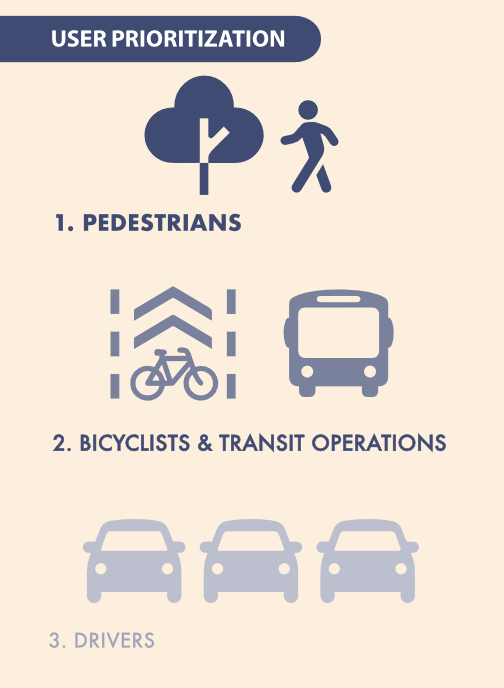
This is a follow-on to my 2016 post back to the old ways? Since that time I have watched several streets in downtown being torn up for utilities. Under the asphalt pavement on several of them are cobblestone and brick streets, covered over by asphalt to provide a smooth and fast ride for car drivers, and a less safe street for everyone. There are also a number of streetcar tracks that have similarly been buried beneath asphalt. Car drivers have won the battle for our streets, so far, but the trend is starting to reverse, even in Sacramento. The City of Sacramento, in its new general plan, has decided that walkers are more important than drivers!
The Strong SacTown street design standards team has identified four roadway typologies, Local Streets, Active Streets, Transit Streets, and Roads. Every redesign of Local Streets should consider installing rougher pavement to slow motor vehicles. Of course if a street is used by bicyclists, the pavement can be only moderately rough, not like the cobblestone pavement on Front Street in Old Sacramento Waterfront. Sidewalk level bike lanes, separated from the roadway and smooth, solve this for some kinds of streets, but local streets usually will not have bicycle facilities because they are low speed and low volume safer streets.
Rough pavement slows drivers, not just where there are traffic calming features such as curb extensions and chicanes, but for the entire block. Rough cobblestones like Front Street limit motor vehicle speeds to 10-15 mph, but a moderately rough street can enforce 20 mph or less, which is the goal for all local streets.
Brick streets do cost more to install than asphalt (the cheapest, in both senses of the word) and concrete streets. But they last much longer, according to The Planning Lady: It Pays to Save Your Brick Streets. “A concrete street will be replaced 3 times and asphalt 6 times over that time period.” Brick laying machines, originally invented in the Netherlands (of course), but now available from many companies, reduce the cost of creating brick streets considerably. I don’t know the range of brick roughness that can be laid by machine, but it should be sufficient for moderately rough streets. The roughness of historical cobblestone like Front Street might not be affordable today, with the material harder to source and labor more expensive, but many cities are using cobblestone for slow streets and gateway treatments.
Photos below of Clay Street in San Francisco cobblestone, Front Street in Sacramento cobblestone, and Liestal Alley in Sacramento brick.
San Francisco, Clay St, cobblestone pavementSacramento, Front St, cobblestone pavementSacramento, Liestal Alley, brick pavement
The fourth post by Strong SacTown to improve and promote the City of Sacramento update to its Street Design Standards. Other posts at tag: street design standards.
To help support the design or redesign of stroads into either streets or roads, and to enhance the comfort and safety for all road users, we recommend a new, simplified street typology:
In lieu of Sacramento’s current seven typologies, ours comprises only four: Local Street, Active Street, Transit Street, and Road.
Local streets are the core of our street network, serving a built environment with multiple uses where most of the home, work, commercial and social needs of people are within walking or short bicycling distance. Motor vehicles are guests, safety is primary, and economic and social vibrancy are promoted. Some local streets may have no private motor vehicles traffic at all, or such use be limited to certain times of day. A majority of roadways in the city should be local streets. Local streets will have a maximum design speed of 20 mph.
Active streets have features that allow bicyclists and mobility device users to travel at somewhat higher speeds over somewhat longer distances. However, the local street function is not compromised. Active streets will have a maximum design speed of 20 mph.
Transit Streets have features that allow effective transit use including higher frequency buses, streetcars and possibly light rail. However, the local street function is not compromised. Transit streets will have a maximum design speed of 20mph for streets with transit priority and 30 mph for exclusively transit.
Roads are designed to allow longer distance travel at somewhat higher speeds, by transit and private motor vehicles. The safety of all users is still paramount. Roads should be a minor component of the transportation network, occurring at intervals of one to two miles. Roads will have a maximum design speed of 30 mph.
Streets for People Active Transportation Plan has posted an interactive map on which people may make comments on proposed projects, or add their own points or lines. There are visual galleries for pedestrian infrastructure and bicycle classes, but they overlay the map so can’t be viewed while viewing the map. The visual galleries have been captured and made available here. This post is the pedestrian infrastructure gallery, next will be the bicycle classes gallery.
These elements are not exhaustive. There are several elements in the Streets for People Neighborhood Connections storymap traffic calming tab which can be used on the interactive map as well. And you may add your own.
Note: Photos are not from Sacramento. These galleries and the elements they contain are re-used from projects in other cities.
Provide an area for people walking to travel separated from vehicle traffic. Typically constructed out of concrete and separated from the roadway by a curb or gutter and sometimes a landscaped buffer.
Streets for People Active Transportation Plan has posted an interactive map on which people may make comments on proposed projects, or add their own points or lines. There are visual galleries for pedestrian infrastructure and bicycle classes, but they overlay the map so can’t be viewed while viewing the map. The visual galleries have been captured and made available here. This post is the classes of bikeways gallery.
These elements are not exhaustive. There are several elements in the Streets for People Neighborhood Connections storymap traffic calming tab which can be used on the interactive map as well. And you may add your own.
Note: Photos are not from Sacramento. These galleries and the elements they contain are re-used from projects in other cities.
Paths shared by people walking and biking completely separated from motor vehicle traffic. These facilities tend to be comfortable for people of all ages and abilities.