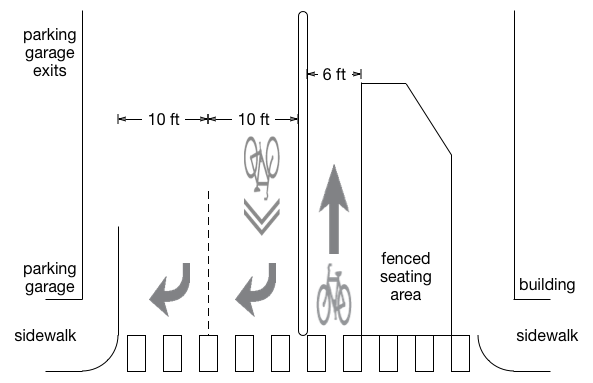
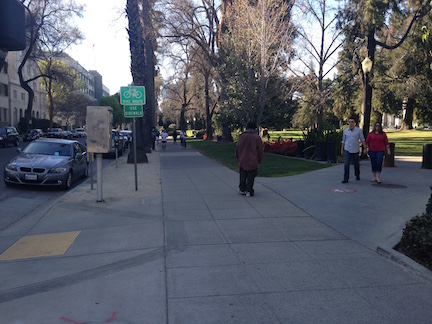
I wrote previously about the The I Street Mess. A small change has taken place here, with a new sign that says “Bicycles Must Turn Right” on the bike lane midway between 6th and 5th. Basically, this is a warning to bicyclists who missed the “Thru Bikes Merge Left” sign at the beginning of the block that they are truly screwed. By this point, bicyclist will have a very hard time merging across four lanes of high speed traffic to reach the left side bike lane that takes one to Old Sacramento or 3rd Street. At a minimum, the warnings need to occur earlier, in the block between 7th and 6th. Better yet would be slowing the traffic on I Street so that a bicyclist could actually maneuver through the traffic lanes. Best would be an alternate route for bicyclists who don’t wish to ride vehicularly, that avoids the I Street Mess completely.
News summary 2015-02-08
- Brown seeks money for fixing roads as gas tax value plunges (SacBee 2015-02-08)
- Another View: Caltrans making progress, but funding lags (SacBee 2015-02-08)
- Opinion: California’s roads need costly repair (SacBee 2015-02-06)
- Should Sacramento’s streetcars be modern or vintage looking? (SacBee 2015-02-05)
- Road user fee drives California Assembly Speaker’s transportation plan (SacBee 2015-02-04)
- Sacramento police investigating possible hit-and-run after man found lying in street (SacBee 2015-02-03)
- Feds on board with Sacramento streetcar (SacBee 2015-02-02)
walking the streetcar route

Today I walked the route of the proposed Sacramento Riverfront Streetcar. No, this is not part of the argument about whether pedestrians or streetcars are faster, going around the Internet recently, but I just wanted to see it all from a walking viewpoint, not on my bicycle. There is a map of the probable route on the website above, though oddly it leaves out some streets.
I picked up the route at L and 16th, just two blocks from my home, and headed west between Capitol Park and the brutalist Community Center Theater. The route turns north on 13th Street and apparently goes through the pedestrian plaza over to 12th where is would then use the SacRT light rail tracks (light rail would be routed to the north along H Street). The further west on K Street, the more depressing things are, with most buildings not only empty but abandoned. But, this is part of the reason for the streetcar, to support the economic redevelopment of this area. At 6th it heads north along the existing light rail tracks to H, and then west to Sacramento Valley Station (Amtrak).
improving SacRT
The condition and future of Sacramento Regional Transit (SacRT), particularly the light rail system, has been much in the news recently:
- Back-seat Driver: Tug of war at Sacramento transit agency
- Regional Transit working on improvements, in response to business community
- Editorial: Arena provides spark for fixing Regional Transit
- Sacramento transit officials agree their light rail service needs improvement
- Sacramento business leaders challenge RT: Clean up your act
Everyone these days seems to want a better transit system. The problem is that no one wants to pay for a better transit system. The business leaders who suddenly want a modern, appealing, well-maintained light rail are the same ones that have worked over the years to suppress efforts at increasing the tax base for operation of the system.
14 foot lanes
There has been a discussion on the Association for Pedestrian and Bicyclist Professionals (APBP) listserv for the last two weeks on what to do with an outside lane of 14 feet (without on-street parking), particularly when there is a seam between the asphalt pavement and the gutter pan. Several people encouraged the use of narrow, substandard bike lanes in an effort to get something on the street, rather than using sharrows in the wide lane, or just leaving the lane unmarked. I believe we need to be very careful to not create “bike lanes at any cost,” and to carefully consider the actual roadway conditions before specifying anything that does not meet or exceed standards. The diagrams below are from the NACTO Urban Bikeway Design Guide. The first shows a high quality bike lane adjacent to a curb; the second one shows sharrows rather than a bike lane where there is not sufficient roadways width.


Riverfront streetcar makes FTA budget list
The list of transit projects put out by the Federal Transit Administration (FTA) as part of President Obama’s proposed 2016 budget includes $75,000,000 in Small Starts funding for the Sacramento Downtown Riverfront Streetcar. The FTA Project Profile is available with some detail that may be of interest.
Rangeland conversion threatens GHG goals

A research paper posted on PLOS entitled Whither the Rangeland?: Protection and Conversion in California’s Rangeland Ecosystems highlights the problem that exists everywhere but is a particular concern in the Sacramento area. Though the paper is pretty science-y, and does not emphasize the carbon impact of rangeland conversion, it is worth a read for all the other impacts and loss of public resources and ecosystem services entailed when rangelands are converted. It say this about Sacramento:
“The vast majority of the development in the Sacramento Metro region occurred in the grasslands and woodlands leading to the Sierra Nevada foothills east of Sacramento, with large conversions directly adjacent to the existing urbanized area (Figure 5).”
The SacBee article “Lost California rangeland is said to pose greenhouse gas risk” puts this rangeland loss in the context of greenhouse gas (GHG) reduction goals required by A.B. 32, the California Global Warming Solutions Act of 2006. From the SacBee article:
A study by UC Davis plant scientist Louise Jackson found that conversion from rangeland to irrigated cropland correlated to a threefold increase in greenhouse gas emissions per unit of land. When rangelands were converted to development, that number increased exponentially. Urban areas account for 217 times more greenhouse gas emissions.
I’ve asked Louise Jackson for more information on this statistics quoted, but so far no response.
My take on all of this is that we cannot possibly meet our climate change goals if we continue to convert rangelands to exurbs. This development form, which Sacramento so dearly loves, and the surrounding counties like as well, is simply not tenable if we are to have a future free of traumatic climate instability and warming. Every greenfield development, which in this area is almost always a conversion of rangelands, must be stopped. Now.
News summary 2015-02-01
- Let’s take the train – all the way to the Sacramento Zoo (SacBee 2015-02-01)
- Opinion: A young man revives Sacramento’s old downtown (SacBee 2015-02-01)
- Another bait bike theft, another arrest, Sacramento police say (SacBee 2015-02-01)
- Risk and reward: Natomas building ban will be lifted soon, but flood danger remains (Sacramento Business Journal 2015-01-30)
- Back-seat DriverTug of war at Sacramento transit agency (SacBee 2015-01-29)
- Twin Rivers housing project vying for federal money to redevelop (Sacramento Business Journal 2015-01-29)
- Sacramento County approves controversial low-income apartments in Arden Arcade (SacBee 2015-01-28); County approves contentious Butano Apartments project in Arden-Arcade (Sacramento Business Journal 2015-01-28)
- Sacramento treasurer: Arena borrowing solid, but city near debt limit (SacBee 2015-01-27)
- Broadway Triangle developer working on another Oak Park project (Sacramento Business Journal 2015-01-27)
- What’s in store at McKinley Village? (Sacramento Business Journal 2015-01-26)
- Redfin: Curtis Park one of hottest neighborhoods in the country (Sacramento Business Journal 2015-01-26)
- Sacramento streetcar rolling fast, but financing questions unanswered (SacBee 2015-01-26)
- New App Latest Move in Sacramento, Calif.’s Parking Overhaul (GovTech 2015-01-22)
State school bonds are a subsidy to sprawl

Californians for Quality Schools, led by the development community, is proposing a new statewide school bond issue for the November 2016 election. Many people would assume this is a good thing: schools are good, schools are needed, so a bond issue is needed. The last school bond issue from 2006 is nearly exhausted. See two local articles about the school bond effort: California school builders, others to gather signatures for November 2016 bond measure (SacBee 2015-01-13) and Builders to gather signatures for $9 billion school bond (Sacramento Business Journal 2015-01-13).
I think that the school bond issue is a transportation issue, and is a huge mistake. Though I’m part of the educational system, I am opposed to this bond. Why?
Statewide bond issues largely pay for new schools in developing areas. They could be used to pay for reconstructing existing schools (modernization), or for building new schools to replace old ones in urban areas (new construction), but they generally are not. They could be used to level the playing field between low-income or disadvantaged communities (partially the critically overcrowded schools program), but they generally are not. Local school districts are expected to largely pay for reconstruction and replacement from their own school bonds and developer impact fees.
Though it is difficult to track down the allocation of funds to new construction versus modernization, one six-month allocation totaling $337.2 million had only $2.8 million for modernization. There have been a large number of criticisms of the current funding formulas that seem to allocate much more to high income school suburban districts rather than to students who need higher quality classrooms.
So where are these new classrooms that are being paid for? Nearly all are in greenfield developments in the suburbs and exurbs. As such, they are a huge subsidy by state taxpayers (who have to repay the bond issues and interest) to development interests. It is yet another taxpayer subsidy to suburban sprawl. It is no surprise that the leading advocates for the new bond are corporations that build schools (through Coalition for Adequate School Housing) and corporations that build greenfield developments (through California Building Industry Association). An interesting acronym, CASH for Coalition for Adequate School Housing, which sees the taxpayers as a cash cow for lucrative contracts.
We do need a solution, given that greenfield development is still happening. The best solution is that development impact fees pay for 100% of new schools: land, buildings and contents, and that new development pay into a school district reserve account that will fund normal maintenance on the school for a period of ten years. This of course would be strongly opposed by proponents of the bond issue. They don’t want to pay their own way. But full funding from impact fees and a maintenance reserve would ensure that existing students and residents are not harmed by new development. And it would greatly reduce the financial incentive for greenfield development, which is my primary purpose after all because greenfield development to the greatest block to rational transportation planning.
If we pass the bond, we will perpetuate sprawl. Please do not sign the petitions to place the bond issue on the ballot, and if the issue does make it to the ballot, please do not vote for it. Of course additional reform is needed so that state monies do go to solving specific problems, particularly in underserved communities, but at least stopping the bond issue will stop the gravy train and allow us to focus on reform.
Foxx challenges mayors, but not funding
Secretary of Transportation Anthony Foxx challenged the nation’s mayors to reduce pedestrian and bicyclist fatalities and injuries on his Fast Lane blog and detail. The challenge has been repeated many places, including Streetsblog USA. Though I’m happy that the secretary is bringing attention to the issue of rising pedestrian and bicyclist fatalities (while motor vehicle driver fatalities are declining), I have to see this campaign as disingenuous. Of his seven challenge activities, not one of them mentions funding. Yet a significant contribution to pedestrian and bicyclist fatalities and injuries is that we continue to spend transportation dollars on motor vehicles and not on pedestrians and bicyclists. Though pedestrian and bicyclist fatalities are now 17.3% of the total, we spend only about 2% of our transportation funds on protecting pedestrians and bicyclists.
Foxx says “Unfortunately, in the five years from 2009 to 2013, bicyclist deaths were up 15 percent and pedestrian deaths are up 16 percent. In 2013, more than 5,000 pedestrians and bicyclists were killed, and more than 100,000 were injured.” More significant is that pedestrian and bicyclist fatalities are have continued to be an increasing portion of total fatalities. In the chart at right, the blue trend line, of total fatalities is clearly down, and NHTSA (National Highway Traffic Safety Commission) and others have tooted this horn at every chance. What they rarely talk about, and in fact try to hide in their reports, is the other trend, shown by the red bars, that the percentage of fatalities for pedestrians and bicyclists has continually climbed. These are not two unrelated trends. We have spent tremendous amounts of transportation money, and imposed increasing requirements on car manufacturers, in order to reduce the fatality and injury rate of motor vehicle drivers. But this reduction has led to an increase in pedestrian and bicyclist rates. They are inversely correlated to a remarkable degree. This data in the chart is from the NHTSA Fatality Analysis and Reporting System (FARS).
If Foxx were serious in his commitment to pedestrian and bicyclist safety, he would do everything in his power (considerable but not complete) to shift transportation funding to the protection of pedestrians and bicyclists, and would be before Congress daily supporting this change (for the portions he cannot control).
So, here is Dan’s challenge to Secretary Foxx: Take pedestrian and bicyclist fatalities seriously by immediately shifting the federal portion of transportation funds to match the fatality rate of 17.3%.