SacRT gets grant for light rail car refurbishment

In the recently announced round of grants under the CalSTA Transit and Intercity Rail Capital Program, SacRT received funding to refurbish the remainder of light rail vehicles from San Jose. The money is from the Greenhouse Gas Reduction Fund using proceeds from the state’s cap-and-trade auctions. The statewide total was $224M.

7. Sacramento Regional Transit District (RT) – Refurbishment of Seven Light Rail Vehicles
Award: $6,427,000
Refurbishment of the last 7 of 21 vehicles acquired from Santa Clara Valley Transportation Authority in order to support 15 min peak hour service frequencies throughout the RT light rail system and enable future limited stop service on the RT Gold and Blue Lines during the next 15 years. The project will result in increased ridership, eliminate impacts from the overhaul program needed on the rest of RT’s fleet, and connect residents in disadvantaged communities to jobs. Improved service on the system also increases the attractiveness of connectivity to Amtrak services and future High Speed Rail service at the Sacramento Intermodal Facility.

News summary 2015-06-28

News summary 2015-06-21

News summary 2015-05-14

In the time I’ve been creating these weekly news summaries, I have been linking to articles about bicyclist and pedestrian fatalities and serious injuries. I’m going to stop doing so. The real carnage that happens on our roadways involves motor vehicles. Research indicates that the motor vehicle crash rates per mile and per trip are actually much higher than for bicyclists and pedestrians, though it is also true that crashes often have higher consequences for bicyclists and pedestrians. Linking to bicyclist and pedestrian involved crashes while not covering motor vehicle crashes (with other vehicles and with fixed objects) gives the impression that bicycling and walking are dangerous, which discourages people from those modes of transportation. It is also true that only some crashes show up in the Sacramento Bee and on the local media, when the crash is spectacular, is a hit-and-run, or occurs on a slow news day. So the links never accurately represented what was going on out on the roadways. I will continue to cover transportation and development issues.

I am also staring into my summer vacation, some of which will be in wilderness far from Internet access, so the posts this summer will be erratic until August.

Transportation

Development

Rancho Cordova achieves bronze Bicycle Friendly

RanchoCordova_wayfinding2The City of Rancho Cordova was awarded bronze level status in the League of American Bicyclist’s Bicycle Friendly Community (BFC) program. Rancho is the first of the communities within the new Bicycle Friendly 50 effort, though Folsom had earlier achieved silver status.

The Bicycle Friendly 50 group, including 50 Corridor TMA and the city hosted two Traffic Skills 101 courses and a League Cycling Instructor (LCI) Seminar in 2014, training two city employees and a number of community members. An education program is one of the requirements for achieving BFC status.

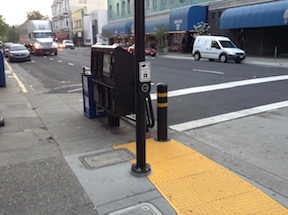
Above is a wayfinding sign in Rancho Cordova, which seems to have installed more than other communities in the Sacramento region.

News summary 2015-06-07

Carnage

Streetcar

Other

News summary 2015-05-31

News summary 2015-05-24

Other

Transportation

Development

News summary 2015-05-17

Carnage

Other

I don’t want a transportation bill

As the “deadline” approaches for passage of a transportation bill, and the balance in the highway trust fund is in free fall, everyone seems to be falling in line behind the idea that we must pass a bill. I disagree.

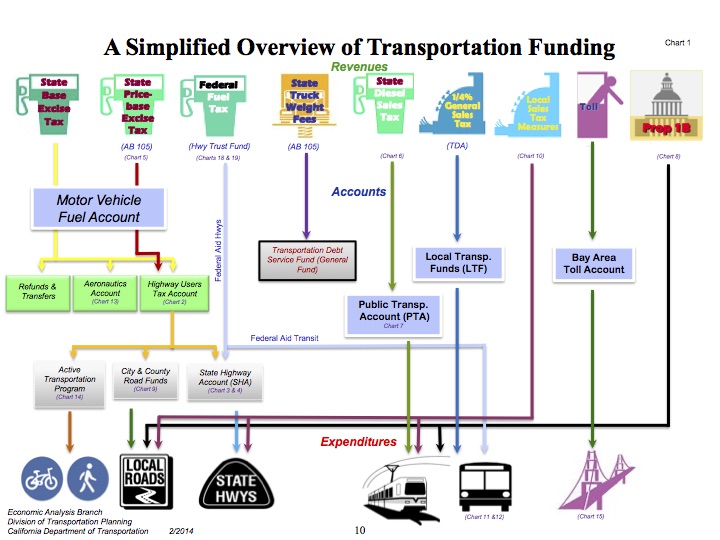
The federal transportation funding system strongly favors motor vehicles, with a small amount set aside for transit, and a pittance for walking and bicycling. Patching up funding for the existing system will only serve to prolong its life, and prolong the damage it does to our communities and our economy. I think a failure of the highway trust fund is in order. Before we can figure out what sort of transportation system we need, we have to stop funding the one we have. Yes, I agree that maintenance is important, but we already seriously underfund maintenance, and continuing to do so for a little while will be no worse a crisis than what we already have. I think the preference for passing a transportation bill, any bill, is akin to what a drug addict thinks – just one more hit and then I’ll be able to figure out how to get off this stuff.

What if we don’t pass a bill, or an extension, and federal funding stops? Well, then we have the opportunity to do the following:

  1. Institute a moratorium on all construction and widening on the federal aid highway system.
  2. Agree that our highway system is built out and that not a single lane mile will be added with federal funding, ever again.
  3. Develop criteria for determining the economic productivity of roads and highways. Since the system has never been challenged to do this before, it will take some time, bringing together expertise and data that has not been part of transportation decisions.
  4. Determine the size (in lanes) necessary for the Interstate and federal aid highways to carry traffic between economically productive places, and then fund maintenance of that minimal system from the federal level. The states, therefore, would have to fund maintenance of excess lanes, those that were built to accommodate commuting and do not serve to connect economically productive places. All roads and highways that are not part of the minimal system would be returned to the states who would then be fully responsible for maintenance. That means that many freeways would no longer be a federal responsibility.
  5. Develop criteria for determining the economic productivity of the freight and passenger rail network. We know somewhat more about this, but it will still take time.
  6. Designate a national rail network similar to the federal aid highways system that serves economically productive places and uses, and funds both construction and maintenance. Over time, right of way and tracks would be transitioned to public ownership, and both passenger and freight would rent space on that network, paying fees that fund all necessary maintenance, and expansion to meet national needs. This does not mean that rail could not or would not be subsidized, but that it would be done in a transparent manner that would allow us to adjust subsidies based on productivity and the national interest in a connected passenger network. (Note: Amtrak is subject to the same soviet-style thinking that plagues the rest of our transportation network, the difference being that they never received the huge subsidies that motor vehicles and airlines did.)

Would the temporary cessation of federal funding to public transit have a negative impact. You bet it would. There would be no new projects for several years, just when we need new projects to shift our transportation to more economically and ecologically (carbon) modes. Projects already underway might have to be modified, dropping some elements or shortening routes. I’m not oblivious to this impact, and it would impact me directly in a number of ways, including the local light rail expansion and improving capacity on the Capitol Corridor trains.

None of this would impose anything on the states. However, the states, long accustomed to  “free” money (our tax money) from the federal government, would start making different decisions once the gravy train stops.

I’ve written many times before about the disfunction in our transportation system, but my post today was triggered by a post from Kaid Benfield, Do Freeways Belong Inside Cities? on HuffPost Green.