News summary 2016-07-31
- I Street Bridge Replacement on pace to start in 2018 (Sacramento Business Journal 2016-07-27)
- Bringing order to the grid, one sidewalk at a time (SacBee 2016-07-29); Sacramento will ban bikes on some sidewalks, but details undetermined (SacBee 2016-07-26); Keep Sacramento sidewalks safe for everyone (SacBee 2016-07-25)
- Back-Seat Driver: Can traffic engineers teach old drivers new tricks? (SacBee 2016-07-25)
- Will downtown Sacramento be bright and safe enough for its big arena debut this fall? (SacBee 2006-07-25)
- Group heads to court over high-rise condos planned for midtown (SacBee 2016-07-20)
- Back-Seat Driver: Gotta catch ’em all, Pokémon, but don’t miss the train (SacBee 2016-07-18)
News summary 2016-07-17
- Cyclist versus pedestrian turf wars (SacBee 2016-07-16)
-
Should rule-breaking cyclists be sent to bike traffic school? (SacBee 2016-07-16)
- Back-Seat Driver: California launches test of per-mile road use fee for drivers (SacBee 2016-07-11)
people out walking!
Last evening I went for a walk, heading north to the Sac Northern trail, then the American River Parkway to Discovery Park, then across the Jibboom Bridge and into old town. I’d certainly seen bicyclists and a few walkers, but when I got to old town, there were hundreds of people walking around. I noticed they almost all had cell phones in hand, not that unusual, but still. I headed south along the river and saw yet more people. Then back along R Street where there were few people, until I got to the main part of R Street, and then into Fremont Park where there were yet more people. Remember, this was a Monday night largely after sunset, when I might see 10 people out walking in an evening, and I’d already seen at least 300. What was going on?
Well, you more culturally/technologically literate already know, but it took me some time to figure out. Pokemon GO! All of these people were playing the game on smart phones, looking for pokemons (is that the correct plural?).
I had heard a bit about the game, but didn’t realize it was taking the country by storm. Today, there were more prominent articles on all the media, even showing up on my main two news sources, Streetsblog and Strong Towns. I sat at Karma Brew with a Rasputin, and observed the goings-on in the park and along the streets.
So, what I saw, that I liked:
- People were out walking on a night when I would not usually see anyone. This means these people were getting physical activity when they would otherwise be in front of TV or computer.
- People were walking, looking at their smart phones, but they had their heads up, looking around, with the phone in their field of view but not their sole focus. Unlike most users whose heads are down and completely oblivious to what is around them. I’m not going to claim walking with a phone is safe, but I will say what I saw last night is significantly safer than what many people already do.
- People were talking to people in other groups, interacting with people they didn’t know. This is quite unusual. Even at bars and coffee shops, where people theoretically to to socialize, most people hang with their own group and do not interact much if at all with others.
- I heard people making comments like “I never knew that was there,” and “I always wondered what that was.” They were seeing things with new eyes. I am not sure how much of this discovery is designed into the app, but whatever is there results in people looking.
- People were hanging out in gathering places, old town, the promenade, R Street, Fremont Park. Again, whatever the design, this is where the pokemons were.
- People were not drinking. I have no problem with drinking, as long as you don’t drive, but I have to admit is was great to see so many people having such a good time without drinking.
As with any new technology, and any new social media, there will be hiccups. But on the whole I can see so many positives to this latest fad. I think I’m going to try it myself, though obviously not on my backpack trips. No pokemons out there!
News summary 2016-07-10
- New phone app lets you snag a parking spot near new Sacramento arena (SacBee 2016-07-08)
- Back-Seat Driver: Is Sacramento ready to solve its bike vs. pedestrian sidewalk fight? (SacBee 2016-07-10)
News summary 2016-07-03
- How Sacramento’s transit chief landed a pension that exceeds federal limits (SacBee 2016-07-03)
- It’s time to rethink Sacramento’s riverfront (SacBee 2016-07-03)
- How do you break down Sacramento’s bureaucratic silos? (SacBee 2016-07-03)
- All Neighborhoods Deserve Safe Streets (Sacramento News & Review 2016-06-30; not available online, so grab a paper copy!)
- Regional Transit trims some sweeteners from Mike Wiley’s exit deal (SacBee 2016-06-28)
- Back-Seat Driver: California law lets you fiddle with phone while driving – sometimes (SacBee 2016-06-27)
News summary 2016-06-26
- ‘You left my wife laying in a ditch,’ says husband of hit-and-run victim (SacBee 2016-06-26)
- RT chief’s retirement deal gets chopped, but anger remains (SacBee 2016-06-24)
- Sacramento not walkable? Au contraire! (Sacramento Business Journal 2016-06-24)
- Sacramento RT’s attempts to balance budget stirs union outcry, claims of discriminatory firings (Sacramento News & Review 2016-06-23)
-
More California drivers driving while texting, talking on cellphones (SacBee 2016-06-22)
- Will a golden parachute sink Regional Transit? (SacBee 2016-06-20)
News summary 2016-06-19
- Cities’ sprawl comes with a price in transit costs, commute time (SacBee 2016-06-19)
- Sidewalk strife: Sacramento bicyclists face stiffer fines under proposed ordinance (Sacramento News & Review 2016-06-16)
- Editorial: Details, details on Sacramento railyard plan (SacBee 2016-06-16)
- Walking club launches in south Sacramento neighborhood (SacBee 2016-06-15)
- Sacramento County sales tax measure heads to November ballot (SacBee 2016-06-15)
- Sacramento Regional Transit eliminates administrative jobs, cancels bus cuts (SacBee 2016-06-14)
- Back-Seat Driver: Sacramento ponders after-hours parking and higher rates for arena events (SacBee 2016-06-13)
No more urbs in the county?
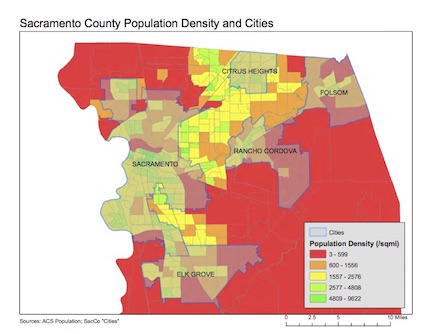
In Sacramento County, there are suburban areas in both the county and in the various cities. Northern Sacramento (the area north of the American River) is largely city. Eastern Sacramento is largely county, with the exception of Citrus Heights, Folsom, and Rancho Cordova. Southern Sacramento is largely Sacramento City, except for a finger of county suburbs that intrudes into the city, and of course Elk Grove. I suspect most people who don’t own property even know whether they live in county or city because the development pattern is very similar, and the deterioration of infrastructure in the county is only slightly ahead of the cities.
Sacramento County is not able to keep up with what it already has. Potholes are everywhere. Neighborhoods are deteriorating, businesses are boarded up, or are replaced with low-quality businesses such as tattoo parlors and liquor stores. Sacramento County wants to be a place with low taxes, but low taxes equal deterioration. So what the county does to try to make up for a lack of sufficient tax income is to push greenfield developments that will bring in a shot of property tax, and perhaps sales tax, but in the long run will just be more of the same, a drain on the government and economy. Greenfield development never pays for itself in the long run, it is just a transfer of wealth from the future (future taxpayers) to the present (mostly developers, but to some degree government and current taxpayers).
So, a modest proposal (modest in the Swiftian sense). All urban and suburban areas must be in a city. If a new greenfield development occurs, it must either be joined to an existing city, or become its own city (though I think we’ve seen the last of the mega-projects that would support a new city). All existing suburbs in the county will be moved into the nearest city, or form a new city. At the same time, all undeveloped or very sparsely populated areas should be moved outside the cities and back to the county. The map below (also pdf SacCo_pop-density-cities) shows population density with an overlay of the cities. Citrus Heights is the only city that does not contain any significant undeveloped land. Rancho Cordova, Folsom, Elk Grove and the City of Sacramento all contain undeveloped land which should revert to the county. The break points shown are not magical or legally defined. Clearly red (very low density) areas should not be in a city, but orange (low density) is not as clear. Yellow, light green, and dark green are clearly urban or suburban and belong in cities. (Apologies for leaving out Galt and Isleton, but they are not significant in this discussion.)
It is likely to take some time to figure out boundaries, particularly since the Sacramento Local Agency Formation Commission (LAFCo) would have to negotiate boundaries and approve changes. I am not sure what to do with the exurbs, though in some ways it doesn’t matter since they will die out of their own accord.
Once the re-balancing happens, then it should become nearly impossible to move lands between the cities and counties. Greenfield development does not serve anyone except greenfield developers and politicians currently in office, and it impoverishes the future. We already have an overabundance of these types of sprawl subdivisions, enough probably to meet any possible demand and lasting for the foreseeable future. All development would shift to infill. The county would therefore be largely rural, and the county could focus on the far lower level of infrastructure needed to support rural uses. Taxes in the county would drop to a fraction of what they are currently, though of course taxes in the cities would probably increase to nearly counterbalance that reduction.
Some things would be better, some things remain the same. There would likely be less greenfield development, since the county is the largest driver of greenfield development. But there would still be some. North Natomas, south Rancho Cordova, and south Folsom are classic examples of greenfield development. Cities would, I believe, spend their money in a more efficient manner, and would not have to sacrifice tax money to the inefficient county government. By the way, no more deals where the county gets to keep property tax income without having to provide any services. Though it is admirable that the new cities, and their citizens, felt strongly enough about getting out from under the burden and mismanagement of the county that they were willing to give up property tax for a period of time, this should never be allowed again.
The big challenge for existing and new cities would of course be taking on these non-productive medium density areas. The cities will have nearly as hard a time funding infrastructure maintenance and repair as did the county, but at least they will be able to make decisions about where to invest in a more rational manner than the county.
News summary 2016-06-12
- Is Sacramento’s ‘city within a city’ ready to rise? (SacBee 2016-06-10)
- El Dorado voters pass one growth limit, reject another amid $1 million in spending (SacBee 2016-06-10)
- Locks and chains: Sacramento police laud bait-bike program as justice for cyclists—but concerned residents question the real target (Sacramento News & Review 2016-06-09)
- Back-Seat Driver: State auditor digs into questions of disabled placard abuse (SacBee 2016-06-06)

