55% threshold for transportation maintenance

State Senator Scott Wiener has introduced SCA 6, a constitutional amendment that would change the threshold for transportation measures from 2/3 (67%) to 55%. While I understand the desire to make funding of transportation easier, I am also scared by possible outcomes. The Sacramento County Measure B would have passed under this new threshold, but it failed with 65% when 67% was required. Measure B was chock full of bad projects, including Capital Southeast Connector (a new freeway), widening of Capital City Freeway, new interchanges throughout the county (mostly to serve new and planned greenfield developments), and additional road widening and extension. It also had some good things, such as fix-it-first and light rail car replacement with low-floor/level boarding cars.

I am concerned that if this amendment were adopted, there would just be more and more investment in the same old infrastructure solutions that got us into this mess in the first place, and still less dedicated to what we really need for the time being, which is maintenance.

Read More »

transportation development impact fee

The City of Sacramento is working on a Transportation Development Impact Fee (TDIF) for the entire city, and with somewhat different requirements for subareas including downtown, river district, and North Natomas. The Sacramento Bee clued me into the proposal with Sacramento asks developers to open wallets to keep city streets from clogging (SacBee 2016-12-08). My initial guess was that this is in response to the failure of Measure B, but this proposal has been worked on since at least August, so that is not the case. The city has a webpage on development impact fees, with two documents specifically about the transportation DIF. I have not had the time to delve into the details, nor do I have any expertise in this area, so these are my initial thoughts.

Read More »

Missing the message on Measure B

This is a letter I sent to my representative on the Sacramento Transportation Authority (SacTA) board of directors.


I read the Measure B report from Executive Director Jeffrey Spencer, item 12 on Thursday’s agenda, and I have to say I’m rather disturbed by it. (here, or page 41 of the SacTA agenda packet)
In paragraph one, he is completely incorrect about the voter turnout. It was 74.5%, similar to past elections, both on-year and off-year.

In paragraph three, he claims $35K spent by Measure B opposition, and though he doesn’t provide any reference for this, I will give him the benefit of the doubt that he did an FPPC records request and used that info. However, he does not mention political spending by the pro-B group, as well as “educational” spending by SacTA, SacRT, Sacramento County, and the cities such as the glossy mailers that clogged my mailbox. His implication is that pro-B got outspent, but that simply cannot be true.

In paragraph three, he also stated “These news releases and reports are not always factual and can rely on conjecture. Although providing untrue statements, the general public cannot decipher the facts and may rely on this group’s opinions.” That is a pretty amazing statement coming from a public official. Is he really accusing anti-B of lying? He fails to mention that the pro-B glossy mailers had a number of factual errors, mis-statement, straw-men, and questionable implications.

In paragraph four, he says “Discussions with voters after the election…” What voters, whose discussion? I would think there would be documentation here. Though I’m certainly not claiming anything but anecdotal evidence, I heard two things from voters after the election: 1) anti-tax sentiment, and 2) opposition to a measure that spent so much on roadway expansion and so little on transit. Voters got that there was a focus on fixing roadways, and the pro vote was probably in large part due to that, but they also recognized that there was unnecessary roadway expansion larded onto the measure.

You can’t solve a problem if you misidentify what that problem is, and in my opinion, Mr. Spencer has failed to admit failure, has mis-identified the reasons for that failure, and therefore, cannot solve the problem.

If SacTA is to have any chance of moving forward WITH the community to address transportation issues, they need to a) listen to the public, and b) come up with innovative solutions rather than the 1970s thinking represented by the failed Measure B.

roads in California and Sacramento County

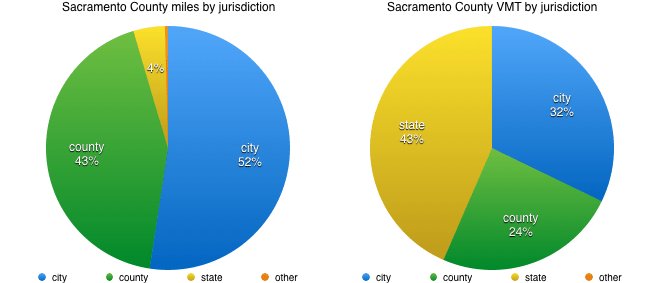
In preparation for some exploration of funding sources for roads, it helps to see what the situation is with the jurisdictions and types of roads, for mileage and VMT.

Jurisdiction means the level of government responsible for the road. This is not always clear from simply looking at a road. If there is a federal or state highway sign, it is pretty clear, but there are roads that are part of the state highway system that are not signed as such.

The types of roads, here, means functional classification, which is a federal designation of Interstate, Principal Arterial – Other Freeways and Expressways, Principal Arterial – Other, Minor Arterial, Major Collector, Minor Collector, and Local. Again, it is not always easy to distinguish classification, but as a generality, freeways fall into the first two, major roads such as Folsom Blvd and Watt Ave fall into the third, busy wide streets are the next three, and residential streets are the last. Another useful classification is that the first six categories are roads, meant to move motor vehicle traffic, and the last is a street, meant to provide access to residences and small businesses. Unfortunately, we build far too many of the road variety and then put business on them so they no longer function well to move cars. See Strong Towns for a more detailed explanation of roads, streets, and stroads.

Read More »

Measure B and air quality

Warning: nerdy detail ahead, but nerdy detail of critical importance to acheiving air quality goals in the region.

In the April 2016 draft Measure B included the following language:

Federal Air Quality Requirements. Measure_ Expenditure Plan funds programmed for a project construction phase that must be included in a federally approved air quality conformity determination to either the Metropolitan Transportation Plan (MTP) or Metropolitan Transportation Improvement Program (MTIP) shall have consistent project descriptions to the listing in the MTP & MTIP before the Authority allocates construction funding for the project phase.

The final Measure B language is:

Federal Air Quality Requirements. Measure_ Expenditure Plan funds programmed for a project construction phase shall not impair the ability of the region’s Metropolitan Transportation Plan (MTP) and Metropolitan Transportation Improvement Program (MTIP) to meet federal air quality conformity, as determined by the Sacramento Transportation Authority Governing Board.

The difference may seem subtle at first glance, but it is not! The original language meant that:

  • projects must be considered as a whole, not piecemeal
  • all projects must meet federal air quality goals
  • SACOG would make the determination of whether the project met federal air quality goals

Instead:

  • projects can be considered piecemeal
  • a specific project need not meet air quality goals as long as the overall program does
  • the Transportation Authority rather than SACOG will determine whether a project meets air quality goals

Why is this important?

The Capital Southeast Connector! The Capital Southeast Connector, at full build-out, would be an environmental disaster for the region. It will induce traffic, create more long distance commuters and further separation between housing and jobs, and very likely prevent the region from meeting greenhouse gas reduction goals.

How did it happen?

The language was changed at the Sacramento Transportation Authority board meeting on April 28. Region Business, which is a front group for greenfield developers, and California Alliance of Jobs, which represents employers who build roads, threatened board members with loss at the next election if they did not kowtow to the demands of the developers. This is not speculation: Kerri Howell, board chair, specifically said that the threat was made that candidates would be put up against her at the next election, and many other board members reported similar threats or nodded their heads in assent. And sadly, the board caved to these threats. After considerable non-public negotiation (the board members gather behind the dais), including discussion with the board members who had supported the original language and SACOG staff, compromise language was developed and passed, and is now part of Measure B ballot text.

What does it mean?

It means that Measure B has been tailored to the needs of greenfield developers. It was clear from the beginning that project allocations followed the old and discredited model of sprawl and cars-first development, but with this change it is now clear that Measure B will damage air quality in the region and prevent us from reaching greenhouse gas reduction goals.

Myth: driving is supported by user fees

Another myth promulgated by people who support roads over transit is that transit has to be subsidized while motor vehicles pay their way. “Transit, particularly rail transit, is very expensive to build, operate, and maintain. While driving is pretty much self-supporting through user fees, transit must be heavily subsidized by taxpayers.”

Roads for motor vehicles are anything but self supporting. For the state and federal highway system (from the interstates all the way down to some arterial streets that many people don’t realize are designated highways), gas taxes pay for roughly half of constructing those roads. Where does the other half come from? Out of our pockets, from the general fund, through income taxes and other fees. You may have heard that the federal highway trust fund is out of money, but highways are still being built. How is that possible? Well, money keeps getting dumped into transportation to make up for the lack of gas tax income. Though it is now down to 50%, if the gas tax is not raised, it will be a continually declining percentage until nearly all of our transportation funds come out of the general fund.

So if the gas tax doesn’t pay for maintaining roads, what does? Nothing! Very little money is being spent on maintenance, and our roads have deteriorated in a way that is obvious to anyone who drives, or rides a bike, or even walks. Politicians give lip service to fixing roads, but when it comes to spending money, it is all about big new roads and ribbon-cutting opportunities. Or even big new transit projects and ribbon-cutting opportunities.

For local roads, those paid for by counties and cities, very little comes from the gas tax. Counties and cities in California do not have gas taxes nor income taxes (though they do in some other states). So where does the money come from? Sales tax, and out of the general fund, which is mostly property tax. Self supporting? Hardly. Counties and cities do get some state and federal funds, some of which comes from gas taxes, but it usually is only for new construction (not that it has to be, but that is what is asked for and given), and it is a small part of what it takes to build and maintain local roads.

And then there are the externalties of a car-centric transportation system. Climate change, air pollution, sprawl, unemployment or underemployment for people who can’t afford to get to jobs, death and severe injury on our roads ($80 billion per year, for just injuries, not including fatalities), high portions of both family income and family wealth devoted to just one purpose, the car, deteriorating infrastructure, foreign wars for oil (if you think the war in Iraq was about freedom rather than oil and profit for Halliburton and Dick Cheney, you haven’t been paying attention).

All forms of transportation get some subsidy. Motor vehicles, bicycles, buses, trains, airplanes (the subsidy here is probably the highest percentage of any), all get subsidized. Though rail freight is subsidized far less than other modes, which is why it seems to not be competetive with road and air, when it would be if the playing field were level. The real question is whether the subsidies result in a transportation system that serves all citizens, and not just those who choose to drive or are forced to drive by a lack of choice. My opinion is that we have our priorities all wrong.

So why do we still keep spending money we don’t have on highways and roads, rather than a rational transportation system? The “asphalt lobby” as it is called. This is a network of engineers, construction companies, government workers, and politicians who profit incredibly from continuing to spend our money on their pet projects. AASHTO (American Association of State Highway and Transportation Officials) and ASCE (American Society of Civil Engineers) are probaby the most prominent proponents, but there are organizations and lobbyists too numerous to list. OK, I can’t resist: the Asphalt Paving Alliance, the Asphalt Institute, the National Asphalt Paving Association. Not to mention: the American Concrete Pavement Association, the American Concrete Institute.

Time to stop!

transit and rail grants to Sacramento region

  California State Transportation Agency (CalSTA) announced the recipients of its Transit and Intercity Capital Program (TIRCP) grants. Sacramento benefits from two projects:

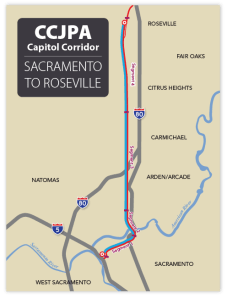
  • $9M to Capitol Corridor Joint Powers Authority for expanded service to Roseville and related rail improvements
  • $30M to Sacramento Regional Transit District for a new streetcar

These grants of course are only a fraction of the cost of the projects, but every bit helps, and it is likely that these projects will now move forward though both were formerly stalled or moving very slowly.

From Streetsblog California, some more detail:

CCJPA_3rd-map2

2. Increased Rail Service to Roseville and Rail Improvements
$8,999,000 to Capitol Corridor Joint Powers Authority

The project includes:

  • Extending rail service to Roseville, building eight miles of a third track, a new bridge, station improvements, and more.
  • Creating a service optimization plan to connect with Altamont Corridor Express and Amtrak San Joaquin passenger rail services.
  • Adding standby electric train power to enable more trains to utilize grid electricity at the Oakland Maintenance Facility.

Capitol Corridor’s website News & Alerts page has more detail.
modernstreetcar-300x206
10. Sacramento Streetcar

$30,000,000 to Sacramento Regional Transit District

Funds go to the planned Downtown/Riverfront Sacramento-West Sacramento Streetcar (pending the project’s federal full-funding grant agreement expected by early 2017) including nineteen stations and six streetcars.

Measure B moves forward

As was no surprise, the board of the Sacramento Transportation Authority passed the Transportation Expenditure Plan and related language yesterday afternoon. All of the public speakers were in favor of less for road expansion and more for transit, walking, and bicycling. The board seems to feel that gaining the votes of the suburbs is important to passing the ballot measure, but other than Steve Hansen, seemed to forget that without the votes of the urban core which favors multi-modal transportation, the measure also won’t pass. Nevertheless, the vote was not a surprise.

What was a complete surprise was the opposition of two organizations, Region Business, a front group for greenfield developers, represented by Robert Abelon, and California Alliance of Jobs, a promoter of highways, represented by Michael Quigley. They wanted removal of paragraph H from the implementation guidelines section of the measure. Paragraph H said:

Federal Air Quality Requirements. Measure _ Expenditure Plan funds programmed for a project construction phase that must be included in a federally approved air quality conformity determination to either the Metropolitan Transportation Plan (MTP) or Metropolitan Transportation Improvement Program (MTIP) shall have consistent project descriptions to the listing in the MTP & MTIP before the Authority allocates construction funding for the project phase.

Both lobbyists threatened to derail the measure if they didn’t get their way. Apparently they and their supporters had sent threatening emails to board members in the last hours before the meeting. Why are they opposed to paragraph H? They are strong defenders of the Capital Southeast Connector, and strong opponents of everything that SACOG does. SACOG is responsible for the MTP and MTIP, though it is composed of requests from the counties and cities which are seldom really questioned. Their strong opposition to paragraph H is an admission on their part that the connector, at least in its full buildout, could never meet air quality requirements, and so they want to eliminate any mention of air quality, the MTP, and the MTIP from the measure. Tom Zlotkowski, the Executive Director of the Capital Southeast Connector JPA (Joint Powers Authority), also objected, again, with the clear implication that the project could not go forward if air quality requirements were met.

The board, after well over an hour of discussion, and a long break to negotiate and regroup, decided with go with compromise language provided by SACOG counsel, Kirk Trost, and SACOG Director of Transportation Services, Matt Carpenter.

The substitute language is, in my opinion, significantly weaker and also vaguer. Not a good sign. Steve Hansen had earlier said that the existing paragraph H was part of the guarantee of accountability the authority was making with the public, and that not having a high level of accountability would result in a lower level of support at the ballot box. Yet, in the end, all board members except Roberta MacGlashan voted in favor of the TEP and language with the “compromise” change.

The new paragraph H says:

Federal Air Quality Requirements. Measure _ Expenditure Plan funds programmed for a project construction phase shall not impair the ability of the region’s Metropolitan Transportation Plan (MTP) and Metropolitan Transportation Improvement Program (MTIP) to meet federal air quality conformity, as determined by the Sacramento Transportation Authority Governing Board.

For all of you who may question or be opposed to the Capital Southeast Connector, I urge you to get in touch with your representatives to ask why a very narrow interest group was allowed to significantly weaken the measure by making threats.

An earlier post of mine: No to the Capital Southeast Connector

Measure B projects

So, where would the money from Measure B go? It is impossible to really say, as the current option Transportation Expenditure Plan (TEP) focuses more on government entities than types of projects. But here is a summary, with the TEP (SacTA_2016-04-28_agenda-item6-TEP) also available:

  • Citrus Heights: $117M, mostly fix-it-first and complete streets projects, mostly good
  • Elk Grove: $235M, fix-it-first, new and widened road, new interchange, mostly bad
  • Folsom: $115M, fix-it-first, two new interchanges, road widening, mostly bad
  • Galt: $36M, fix-it-first, new interchange, mostly bad
  • Isleton: $2M, fix-it-first, great
  • Rancho Cordova: $110M, fix-it-first, interchange, several widening, mostly bad
  • City of Sacramento: $683, fix-it-first, American River bridge, OK
  • County of Sacramento: $901M, fix-it-first, one interchange, several complete streets but many road capacity expansions, mostly bad
  • Capital City Freeway: $200M, all bad
  • Capital Southeast Connector: $125M, all bad
  • SacRT replacement and operations: $393M, mostly fix-it-first with low floor modern light rail cars, all good
  • SacRT new light rail: $180M, mixed bag, but issue not addressed is which routes should be extended and how far on what priority
  • SacRT Gold Line express: $20M, good
  • SacRT Blue Line to Elk Grove and SMART: $126, mostly good, but same issue as above with priorities
  • Paratransit: $126M, good, though needs to emphasize transport to transit rather than point to point

Notice that most of the items say fix-it-first as the first line item, however, there is language in the ballot measure that would allow all agencies to squirm out of that requirement if they so chose.

So, to reiterate and summarize these recent posts, I am not against a sales tax for transportation, but I am against the way funds have been allocated in the TEP, and the length of the tax measure. I probably will not have time for any more posts between now and the Thursday meeting of SacTA.

transportation funding “balance”

“We’re doing what we think is best … so we can actually get this done,” [Sacramento Transportation Authority Board Chair Kerri] Howell said. “If we don’t get it passed, no one gets anything.”

The Sacramento Transportation Authority (SacTA, as I call it, rather than STA, to distinguish it from the State Transportation Agency, or CalSTA) is claiming that their proposed Transportation Expenditure Plan (TEP) is balanced, and that it reflects the desire of the citizens as expressed through the survey that they conducted.

The proposal might be considered balanced if it were the only source of transportation funding, but it is not. There is funding from the federal government, the state, and the existing Sacramento County sales tax, Measure A. Most of this funding goes to building new roads and expanding existing roads. As examples, the recent major widening of Interstate 80, the “Across the Top” project, that added significant capacity to the freeway, and several new interchanges in the region have been added or are under construction. The I-80 project serves commuters from Roseville to downtown. It does nothing for freight traffic, for air quality, or for a multi-modal system. The interchanges serve new greenfield developments, not existing residential and commercial areas. Any tax measure that funds new roads cannot be called balanced, because it does not bring an overall balance. We still have a cars-first transportation network, and a cars-first funding mechanism. The only answer to this is #NoNewRoads.

The survey that SacTA performed showed that people overwhelmingly support fixing roads, which is called fix-it-first. I support that. Deteriorated roads serve no one. However, too often transportation agencies use fix-it-first as a cover for widened roads. The assumption is that if a road is too narrow, and/or is congested, then it needs to be “fixed” to be wider. An example is the Hazel Ave widening going on right now. More lanes, more traffic, more air pollution, less livability. While on one hand agencies are building “complete streets” with sidewalks and bike lanes, with the other hand they are increasing capacity for motor vehicles. Having a sidewalk and bike lane does not change a roadway from a cars-first, high speed, unfriendly status to a multi-modal, serves all users part of the transportation network.

What the survey did not do is ask questions such as “Given that almost all of your tax money is already going to new construction and widening roads, do you want us to spend new tax money on the same thing?” The answer from most people would have been no. Or, “Given that we have in the past neglected to maintain roads, do you want us to continue to build new roads that we don’t have the funds to maintain. (We’ll ask you for that money later)?” The answer would have been no. The survey did not ask “Given that the level of funding for transit is Sacramento is the lowest of any major county in California, do you wish us to continue to give transit less than it needs?” The answer would have been no.

The idea that if we don’t do this tax measure then we have nothing is pernicious. We have existing funding sources, and though those sources are declining somewhat and don’t meet the needs for maintenance, we do have the ability to operate our transportation system on them, if need be. This is the same story that we have been hearing for at least 20 years, and probably back to post World War II. That story is, if you give us free rein to spend most of the money on cars, we will give you some bread crumbs to keep you happy. Some transit. A tiny bit for walking and bicycling. In my opinion, it is time to just say no. This allocation has not only been unfair to transit users, walkers and bicyclists, it has been used to create transportation system that is actively hostile to those uses. Just say no. #NoNewRoads

Please understand that I am not against increased taxes for transportation. What I am for, strongly for, is a transportation system that servers all users in an equitable manner. We don’t have that today, and we can only reach that if we spend our tax funds on undoing the damage of the past, and making sure we do no damage in the future. #NoNewRoads