Capital Southeast Connector sneaks another one in

Please see the Streetsblog California post today on transportation projects which increase VMT (vehicle miles traveled): California Will Continue Funding Projects that Induce Driving, Despite State Policy. The post in particularly calls out the Capital Southeast Connector highway project in Sacramento County as inducing VMT (not to mention greenfield developing), in direct violation of the principles of California’s Climate Action Plan for Transportation Investments (CAPTI).

When CTC (California Tranportation Commission) member Darnell Grisby raised questions about the project, the project representative tried to gaslight Grisby and the commission by saying the JPA did not have land use authority and the development to be induced is not their problem. But the JPA does, indirectly, because highway projects promote sprawl and directly reduce the effectiveness of walking, bicycling, and transit projects.

Having been shot down in the recent Measure A sales tax, which failed in large part because it included controversial Capital Southeast Connector projects, the JPA (joint powers authority) is trying other back-door methods. The ultimate outcome desired by the JPA is a full freeway from El Dorado Hills and Highway 50 to Elk Grove and Interstate 5. The public has rejected this idea, so the JPA is working to sneak the project through in segments, by nickel and dime-ing the taxpayers until it is ultimately finished. In case you aren’t aware of the Capital Southeast Connector, I have written about it many times: Measure 2022: Southeast Connector exceptionalism, No to the southeast connector, Measure 2022: greenfield developer sponsors, and many others on the failed Measure A 2022.

SACOG has repeatedly refused to put the project as a whole into the regional MTP/SCS (metropolitan transportation plan / sustainable communities strategy) updates and specifically said it will not be in the upcoming Blueprint.

The Capital Southeast Connector JPA is a rogue agency. It serves the needs of greenfield developers and politicians who see the future as even more motor vehicle dominated than the present. The JPA should be disbanded. This probably wouldn’t completely kill off the project, since the county and cities might continue to waste taxpayer dollars on inducing sprawl and travel, in order to gain campaign contributions, but it would certainly help.

No Capital Southeast Connector highway, now or ever, in pieces or as a whole!

SACOG ATP awards

Ten projects were awarded ATP (Active Transportation Program) funding in the SACOG region for 2023-2027. Brief descriptions follow. All are full funding of the grant request, unless otherwise noted.

  • Citrus Heights – Arcade Cripple Creek Extension. Construct a 0.5 mile Class I multi-use trail following the Arcade Creek alignment between Sayonara Drive and Mariposa Avenue. $7,155,000
  • El Dorado County – El Dorado Trail / Missouri Flat Road Bicycle/Pedestrian Overcrossing. Construct a Class I multi-use grade-separated crossing over Missouri Flat Rd, closing a gap in the El Dorado Trail. $3,271,000
  • Elk Grove – Laguna Creek Inter-Regional Trail Crossing at State Route 99. Construct Class I Bikeway across State Route 99 and adjacent class I trail gap closure. $6,874,000
  • Folsom – Folsom-Placerville Rail Trail Gap Closure Project. Install curb ramps, sidewalk connections, curb extensions, pedestrian refuge islands, curb & gutter, raised medians, pavement markings, signage, striping, and asphalt overlay. $1,700,000
  • Roseville – Dry Creek Greenway East Trail, Phase 2. Construct a Class I multi-use trail and Class II buffered bike lanes. $6,063,000
  • Sacramento County DOT – Bell Street Safe Routes to School. Construct new sidewalks and curb ramps. Relocate signal poles and straighten sidewalks. Install pedestrian signal, RRFB, new signs, bike lanes and bike detectors. $8,808,000
  • Sacramento County Regional Parks – Dry Creek Parkway Trail. Construct a paved Class1 multi-use trail, including dg shoulder, plus two bridges and roadway crossing evaluation. $7,704,000
  • Sacramento – 9th Street Separated Bikeway Project. Construct a Class IV bikeway and a Class II bikeway. [This would extend the Central City Mobility Project from Q St to Broadway, which is not part of the current project.] $2,564,000
  • West Sacramento – North 5th Street Complete Streets & Connectivity Project. Project will install bike lanes, intersection enhancements, and new sidewalks, and an ADA ramp connection from 5th Street/A Street to Riverwalk Trail. $3,131,000 (partial funding)
  • West Sacramento – West Capitol Avenue Regional Connection Bicyclist and Pedestrian Safety Improvements. Construct vertical delineators to create separated bike lanes, Class II bike lanes , intersections improvements, and improve Westacre Rd underpass. $735,000

I am particularly pleased about Bell Street Safe Routes to School and Arcade Cripple Creek Extension, as these were projects that I promoted when I was Safe Routes to School Coordinator for San Juan Unified School District. Bell Street is used by many students attending Howe Avenue Elementary, Encina Preparatory High, and Greer Elementary, as well as several private schools in the area. The Arcade-Cripple Creek trail project serves both students at a number of schools and promotes active transportation for the entire community.

Capitol Corridor gets more TIRCP funds

Capitol Corridor has received more funds from the TIRCP (Transit and Intercity Rail Capital Program) for some projects in the Sacramento region. It includes full funding of the Sacramento Valley Station transit hub, additional funds for the Sacramento-Roseville third track project, and contactless readers for Thruway buses (presumable the same readers that have been installed on the trains, which will allow direct payment for trips once the Tap2Ride pilot is complete).

https://www.capitolcorridor.org/blogs/get_on_board/capitol-corridor-awarded-42-million-from-california-state-transportation-agency

What’s Next? – SacMoves Coalition

An earlier post covered the Mayor’s Environmental Advocates Roundtable.

SacMoves is a coalition of transportation advocacy organizations and environmental and climate advocacy organizations, primarily, though it does include some other interests such as housing. There are also a number of interested individuals who participate in the meetings. I am not speaking for the coalition. I represent one organizational member of the coalition, Sacramento Transit Advocates and Riders (STAR), and serve on the Process Committee of the coalition, but otherwise don’t have position or authorization to speak for the coalition. I am relaying information that I think will be of interest to others.

SacMoves decided not take a position on the Measure A transportation sales tax. Most organizational members were opposed to the measure, some very strongly, and there were a few members that did not want the coalition to take a position. As a result, several individuals and some organizations formed the MeasureANotOK group, assisted by Climate Plan, and were primarily responsible for defeat of the measure (though there is of course always an anti-tax contingent). And it was a resounding defeat!

SacMoves Coalition held a special meeting on March 9 to discuss What’s Next?, and more specifically whether SacMoves would take a key role in formulating future transportation funding, or would wait and respond to what others proposed. The group meeting that day confirmed that the coalition would take a key role, and the next regular meeting confirmed that. A one-page summary of the special meeting is here: https://gettingaroundsac.blog/wp-content/uploads/2023/03/sacmoves_2023-03-16_planning-summary.pdf.

The regular meeting on March 17 formed three working groups to start developing background information towards providing a model for transportation goals and funding, which are policy, funding, and communications. The coalition also decided to work more closely with housing and particularly affordable housing interests to see how each can contribute to the best solutions. Transportation and housing cannot stand in siloes, or they both fail.

The coalition does not see itself as the only group working on transportation funding. Organizational members and individuals are following and participating the other efforts, including the Mayor’s roundtable. Perhaps eventually the efforts will coalesce behind a single proposal which will move forward through the efforts of all the interested organizations and individuals.

Unfortunately, SacMoves does not have a website, so I can’t direct you there for more information or contacts, but if you contact me, I will pass you along to the right people.

What’s next? – Mayor’s Environmental Roundtable

After the failure of Measure A transportation sales tax measure, everyone who was for it, and everyone who was against it, asked ‘What’s next?’ It is clear there is a need to fund at least some types of transportation infrastructure, including transit, active transportation, and repairing the potholes. It is also clear to me, at least, there there is absolutely no need to fund roadway capacity expansion. We have all of the roadways we will ever need – we need less capacity, not more. But that is not clear to everyone. A lot of people initially were saying things like “we just need to improve the measure a bit, perhaps by removing the Capital Southeast Connector, and then it will pass in 2024. Fortunately, that view has faded. We need something much better than the failed Measure A, and it is not obvious that more transportation sales tax is the right solution. So, What’s next?

One of the groups working on that question is the Mayor’s Environmental Advocacy Roundtable (the mayor being Mayor Darrell Steinberg). A premise of the group is that there might be a role for the city in defining how to fund transportation, and perhaps creating a sales tax or other measure focused on the city. This group has met four times. I was able to attend the last meeting on March 22, and have a brief report. Please keep in mind that these are my notes about what I found interesting, not minutes of the meeting. First, two documents were available, shared here, the agenda, and the overview. Jennifer Donlon Wyant gave a presentation on the city’s transportation planning and funding, which I do not have available. The remainder of the meeting was discussion. So, my notes:

Read More »

more Measure A mapping

The is a follow-on to the post Measure A fails, and mapping. with a map focusing on just the City of Sacramento precincts. The map (pdf):

Measure A results by precinct for City of Sacramento

I have created an interactive ArcGIS Online Instant Web App for the county, for those who want to zoom in on areas, or look at the detailed election data for each precinct. Empty precincts had no voters in this election on this measure. Three bookmarks (icon on the left of the map) allow you to zoom to county, city, or active precincts. Comments about usability and content are welcome.

Measure A fails, and mapping

Measure A, the transportation sales tax for Sacramento County, failed spectacularly, 44% yes and 55% no. Advocates for a better, safer, more equitable transportation, and better investment of our transportation dollars, celebrate this failure. Final election results were released on December 8, 2022.

Sacramento County Measure A 2022 results

More analysis of the results and significance to come, but for now, some maps.

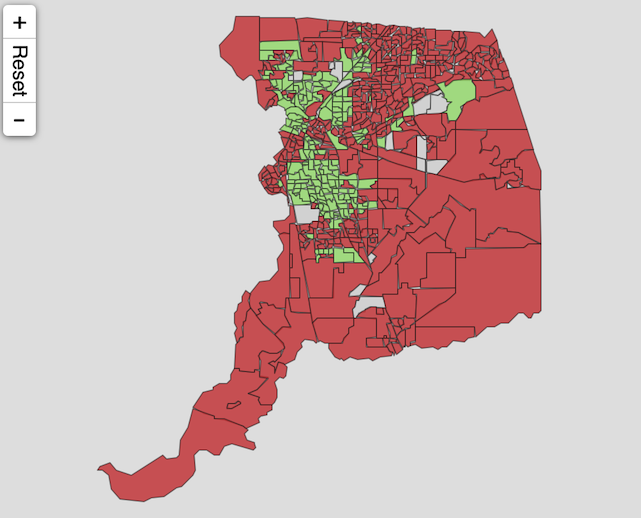
Sacramento County Elections provided a map of the Measure A results.

Sacramento County Elections, Measure A 2022 map

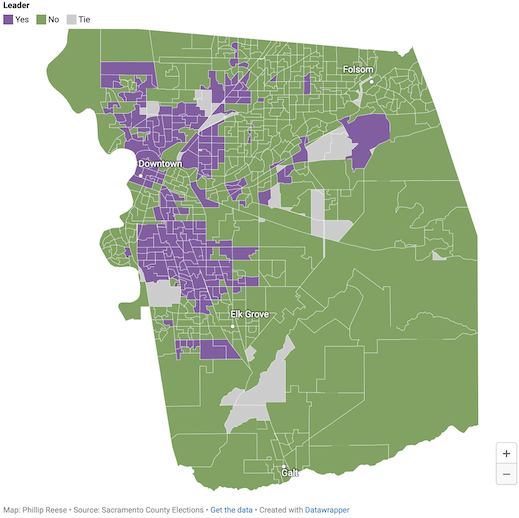
Sacramento Bee provided a similar though not identical map.

SacBee Measure A 2022 map

Both these maps indicate whether a precinct voted yes or no, but no indication of the number of voters or the proportion of the vote yes or no. There is a movement towards better election reporting maps, called ‘Land Doesn’t Vote, People Vote’. A few references are U.S. election maps are wildly misleading, so this designer fixed themElection graphics 2020: Land (still) doesn’t vote, and Land Doesn’t Vote, People Do: This Electoral Map Tells the Real Story, but you can find many more.

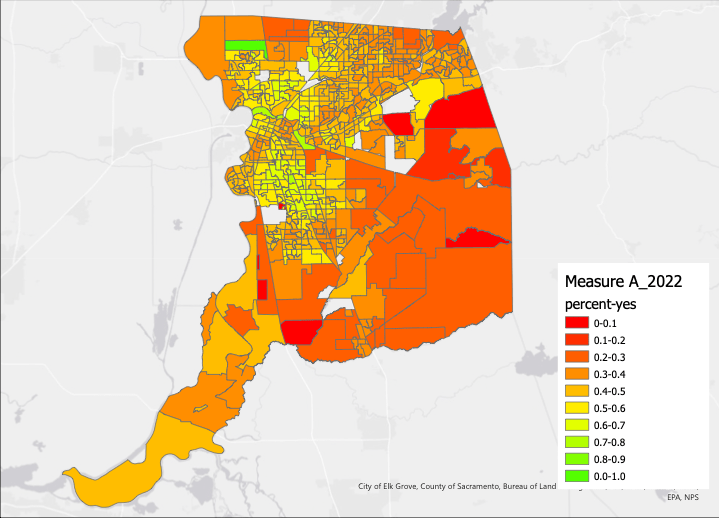
Below is my first attempt at producing a better map for Measure A. Click on the graphic for a linked pdf, which allows you to zoom in on specific areas. What’s different? I used a range of colors, from red (no) to green (yes) votes (ArcGIS: graduated colors, equal interval, 10 classes). You can see there is much more subtle detail. There were a few precincts which voted entirely no or entirely yes, but very few. Most were somewhere in between. For elections (other than the antique federal electoral college), votes count, precincts do not.

The map still over-emphasizes precincts with large area and few voters (some precincts have as few as one person who actually voted). If you look (unfocus your eyes), you would think that there were almost no ‘yes’ votes in the county, but that is not accurate.

The data I used, modified from the Sacramento County Elections data, is here.

Measure A 2022 mp by Dan Allison, graduated colors

Some of the other map alternatives, which are better, require ArcGIS techniques and skills that I’m just looking into, so I expect I’ll have better maps soon. Stay tuned!

Sac region does well on ATP grants

The California Transportation Commission (CTC) adopted the staff recommendations for funding Active Tranportation Program (ATP) grant applications. The Sacramento region did well, with seven grants awarded. Sacramento County received two, City of Sacramento two, Rancho Cordova one, West Sacramento one, and Placerville one. More detailed descriptions of these projects will be available on the CTC ATP or Caltrans websites.

CTC ATP awards for Sacramento region

The SACOG announcements will be made later, and there may be additional projects awarded that did not make the state-level cutoff of 89/100.

Measure A, Not OK

A committee of transportation and equity advocates have come together to oppose the Sacramento County Measure A transportation sales tax measure. Measure A, Not OK!

The new website is https://measureanotok.org. The home page identifies the measure proponents, which are greenfield developers (greenfields are former agricultural and open space lands which these developers want to convert to low density housing) and representatives of large construction companies who will profit from the unnecessary large infrastructure projects the measure proposes. It also addresses six of the worst aspects of the measure. A list of organizations and individuals against the measure is also available, 25 and growing.

The new Twitter handle is @MeasureANotOK. No tweets yet, but there will be soon.

If you want to catch up on all the reasons to vote NO on Measure A in November, please take a look at the posts here: https://gettingaroundsac.blog/category/transportation-funding/measure-a-2022/
and
https://star-transit.org/category/transportation-funding/measure-a-2022/ (for more transit-specific information).

Both of these blogs will provide additional information. If you have issues you would like addressed, questions about the details of the measure including the Transportation Expenditure Plan, or proponent arguments you’ve heard, please reply.

real transportation solutions

Measure A 2022, which will be on the ballot this November, is a bundle of old ideas and a commitment to doing things the old way, the way that has dominated our transportation system since World War II. It does not address current transportation challenges. It proposes building more freeways, more interchanges, and widening roadways. It proposes to continue and increase the motor vehicle dominance of our transportation system. Sure, there is a weak commitment to fix-it-first, for the first five years of the 40 years. Sure, there are some complete streets, but that won’t make a dent in the pedestrian and bicyclist-hostile roadways that traffic engineers have built for us.

When Measure A fails, we have a chance in Sacramento County to identify and implement progressive and effective transportation projects and systems. What would a better transportation system look like?

  • One not so dependent on sales taxes. Sales taxes are regressive – low income people spend a much higher percentage of income on sales tax than do higher income people. Property taxes and congestion charges are a much fairer way to fund transportation. We have been too dependent on sales tax, for not just transportation, but many government functions.
  • One that recognizes and works to overcome the disinvestment that low income and high minority communities have suffered. Our transportation system is largely designed to ease the commutes and travel of high income individuals, not of society as a whole. The light rail system was designed with the needs of suburban, largely white commuters. So too were our freeways. At least 70% of transportation expenditures should be in and for the benefit of disinvested communities.
  • We have all the lane miles and pavement we will ever need. It is time to stop adding lanes miles and stop adding pavement. Not just because of the climate implications, but because these are low-return investments. Instead, transportation expenditures should support walking, bicycling and transit.
  • Big transportation projects such as freeways and interchanges claim big job benefits, but they are in fact much less efficient at generating high paying jobs than many other types of infrastructure investments. New construction spends most of its funds on materials, not on labor. The construction companies make large profits on large projects, but little of that filters down to workers. Small to moderate projects would employ many more people.
  • A transportation system dependent on motor vehicles, whether they are fossil fueled or electric, has strongly negative impacts on our places: direct air pollution, tire dust pollution, noise, traffic violence, loss of land to parking and roadways rather than productive development, and probably most important, it intimidates people out of walking and bicycling. A transportation system based on walking, bicycling, and transit eliminates most of these negatives.
  • A car dominated transportation system pushes everything further apart, jobs and housing and shopping and medical far away from each other. Cars not only encourage but largely demand low density development, so that there is space reserved for cars, all the parking and roadways that take up a large portion of our cities. It requires a car to participate in society, and thereby requires low income people to expend an unsustainable percentage of their income on transportation. A transportation system that relies much more on walking and bicycling allows things to be closer together, so that cars are not necessary for most daily travel.
  • Transportation investment should depend much less on state and federal funding, and much more on local funding. Large portions of the Measure A funds are intended to be matches for grants. But grants cause planners to focus on what the state and the federal government want, not on what the county or cities need. When the income from taxes or fees is close to the people, the solutions are much more likely to be what is desired by the people.
  • Private vehicle travel does little to contribute to making our places and our lives better. A innovative transportation system would focus on access to services, and make those services available nearby. It would reduce vehicle miles traveled, both by changing our development pattern and by actively working to reduce motor vehicle travel.
  • Our current transportation system has destroyed a lot of natural and agricultural lands, paving it over with roadways and low density housing. The best way of preserving nature and agriculture is to focus our attention and our funding on already higher density areas, which means infill.
  • None of the projects in Measure A are designed to support infill development. A progressive transportation system would focus nearly all investment on infill areas. It would cost much less money, and be much more productive.
  • Measure A calls out and essentially requires completion of the Green Line light rail to the airport. But who will use it? Unless service hours are 24 hours a day, it won’t be usable for many of the airport workers, who work before and after peak travel times. Instead, it may become yet another very expensive service for high-income travelers, just like our freeways system. Instead, we need to rethink our transit system to determine what citizens want and will use, and build a more efficient system around that. We know that frequency is freedom, so we must shift spending towards that, even while maintaining a reasonable level of areal coverage.

I’m sure you can think of many other things that an innovative, equitable transportation system would accomplish. Please suggest!