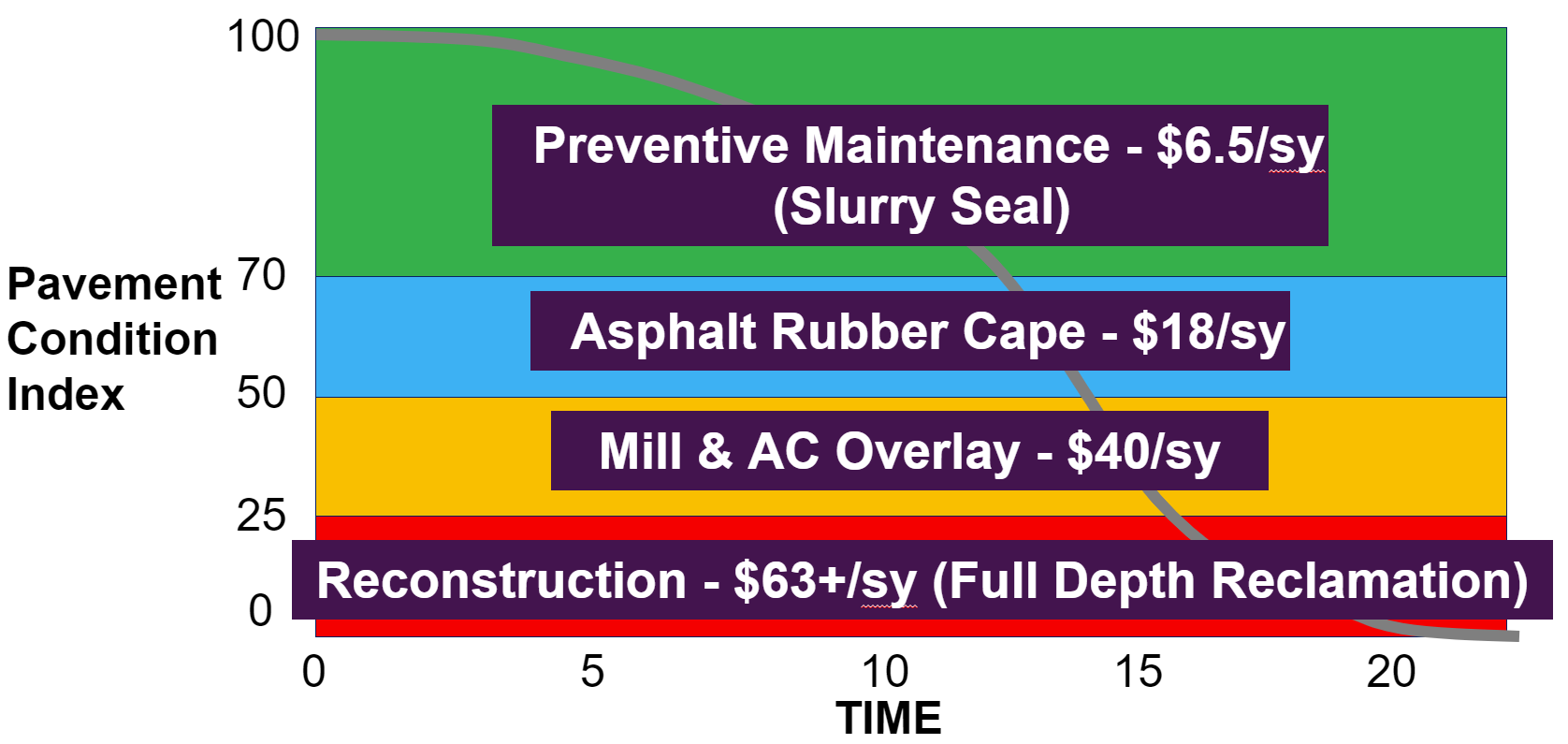
Yuba City will be placing on the November ballot Measure D sales tax that includes ‘Roads – tackling the $150 million in deferred maintenance on our local roads’. It is a general purpose sales tax measure, so the city can change how funds are allocated after it passes (as happened with some of the City of Sacramento Measure U funds), but it is interesting that a small city in the Sacramento region is taking the initiative to fix its roads, when others are not.
Elk Grove passed Measure E, a one-cent sales tax measure, also a general measure, which includes ‘Maintaining Streets and Improving Traffic’. Rancho Cordova passed Measures R and H to ‘to improve city streets’ among other general purposes. There may be others. Sacramento County has been unable to pass a sales tax measure for transportation since 2009’s Measure A, which is in effect through 2039, though there may be a ballot measure in 2026. The City of Sacramento has not passed a sales tax measure for transportation. Measure U did not include a call-out for transportation, though as a general measure, funds could be used for transportation.
Yuba City chart on the increasing costs of deferred roadway maintenance
While attending the Sacramento Transportation Authority meeting last Thursday, and hearing the long painful discussion about how there isn’t, and never will be, enough money to fix our roads to the level that the public desires, a thought occurred to me. Keeping roads in good shape is often called ‘fix-it-first’ or ‘state of good repair’.
What about a sales tax of a quarter cent, JUST for maintaining roads? It would have a short term, perhaps 10 years, with language included that it could not be extended. It would only be for fixing pavement. It would not includes complete streets or sidewalks. It could include the addition of regular bike lanes as the street is re-striped after paving, but would not include high quality bike facilities. It would include language to ensure that it is not used to expand roadway capacity or to build new roads.
I know that many of my transportation advocacy friends are cringing. What about all the other things that need to be fixed? What about missing sidewalks? What about complete streets? What about traffic calming? Yes, all of those are important, and must be funded in some way. But useable streets are the base of everything else we do for mobility and access. Sacramento area streets are certainly not the worst in California. I know that Los Angeles, and San Francisco, and parts of Oakland, are much worse.
There would also be a tremendous question of fairness. The tax would be collected from all citizens of the county, but most of it would be spent in unincorporated Sacramento County. The county has a long, long history of underinvesting in its roads, building new but not maintaining. That keeps taxes lower, which is in part why there are so many anti-tax people in unincorporated county, but it does not create useable roads. Should the rest of the county be responsible for fixing the county’s underinvestment? Its a fair question.
STAR and SABA have already signed on to the campaign, and individuals are encouraged to send letters to their elected representatives. For me, living in Sacramento, the letter goes to Governor Gavin Newsom, State Senator Angelique Ashby, Assemblymember Kevin McCarty, Representative Doris Matsui, Senator Alex Padilla, and Senator Laphonza Butler.
The CalBike People-First Mobility Budget shifts significant funds from the standard Caltrans budget, which is focused on build more, but don’t maintain what we have, to a state of good repair. The typical Caltrans budget, which the governor’s proposed budget continues, is what has gotten us into our horrible transportation mess. Time for a new paradigm! Thank you, CalBike.
I, of course, would go further. I’d spend 100% of Federal Trust Fund and the California State Highway Account (SHA) on VMT reduction, and I’d fund Active Transportation Program at $1B. I completely support the 50% to historically marginalized areas. These are the places that have been intentionally isolated, divided, and polluted by our current highway system. Nevertheless, I recognize the CalBike proposal as a very practical one, and hope that legislators will integrate all these ideas into the state budget.
I woke up this morning with thoughts about how Governor Newsom could largely solve the budget deficit. And shortly thereafter ran across the CalBike-led letter, co-signed by 25 organizations, to the governor about shifting budget priorities: Stop Fueling Climate Change: Coalition Challenges Governor to Shift Transportation Spending. In the Governor’s initial budget proposal, there is no reduction in highway building whatsoever. It is as though this is the sacred mission of the state, to fund and build highways at the level desired by Caltrans, and the asphalt lobby, no matter what else is going on in the state, with budget or climate. This is called the ‘Infrastructure Cult’ by Strong Towns.
The letter’s four asks are:
Consider any proposed reductions in General Fund spending on transportation infrastructure in the context of our climate and equity goals
Backfill any General Fund cuts by leveraging the existing statutory flexibility of federal highway formula funds as well as funding from the State Highway Account.
Suspend California state investment in new highway capacity
Develop a multi-year funding commitment that ensures at least 50% of the State Highway Account (SHA) funds go to VMT-reducing projects while prioritizing investments in California’s most burdened communities.
I support all of these ideas, but of course would go further:
Suspend SHOPP funding, the funding which is supposed to maintain and improve (but not expand) our highway system until an audit of the SHOPP program is complete. This would take at least a year, maybe more. SHOPP is the biggest part of the Caltrans budget, so the savings for this year would be considerable.
Suspend all STIP funding, the funding which is used to build new infrastructure, indefinitely, except for the TIRCP (rail and transit) and ATP (walking and bicycling) programs. This is much the same as the letter’s third action.
Propose to the legislature a bill that would convert all HOV (high occupancy vehicle) lanes (which are worthless in practice because so routinely violated), to tolled lanes, statewide, within five years. This effort would include state funding to accelerate creation of tolling authorities where they don’t exist, and to study merging of tolling authorities into regional entities.
Propose to the legislature a bill that would not only allow but encourage and/or require the conversion of general purpose lanes to toll lanes. For the time being, this would preserve two general purpose lanes on highways with more than two lanes per direction, but ultimately, all lanes would be tolled. Highways are incredibly expensive to build and maintain, and general funds should never be spent on highways because they are not used by a significant portion of the population. And if all users are tolled in all lanes, the tolls would be reasonable and equitable.
Propose a bill to the legislature that assigns CalSTA (California State Transportation Agency) a study of the charter and organization of Caltrans. Caltrans is an outmoded legacy agency which should be reoriented towards meeting the needs of citizen access and climate action, and most specifically maintaining what we have and not continuing to build new.
On November 9, 2023, the boards of four agencies met together for the first time: SACOG (Sacramento Area Council of Governments), SacRT (Sacramento Regional Transit District), SMAQMD (Sacramento Metropolitan Air Quality Management District), and SMUD (Sacramento Municipal Utilities District). This is probably the largest gathering of elected officials in one room in Sacramento history. Of course the number was not as great as you might think, because many officials serve on multiple boards. The SMUD board is independently elected, while the other three boards are composed of elected officials appointed to the boards by their own boards or councils.
The agenda for this meeting and the resolution that was passed are available here. The reason for the meeting was to advance collaboration among the boards to further mutual objectives, and to pass a resolution stating that. The staff of these agencies already collaborate to some degree, but also don’t on some important issues.
There was a long discussion period before passing of the resolution. No surprise, many of the smaller cities dominated the discussion, as is the case with SACOG board meetings. Several electeds used the time to promote commercial concerns that they benefit from, which is a really sad statement on the quality of our elected officials. Probably 90% of the discussion was devoted to electric vehicles, and in fact it looks as though seeking grant funding for more electric vehicle infrastructure was the real reason for the meeting. Grant applications with multiple agencies on board are more likely to receive funding. There was also discussion of managing forest lands for carbon sequestration and need to manage forests to reduce severe wildfire carbon release. And a few other topics. Active transportation was not one of them.
The boards tried to cut off public comment, but this caused an uproar and several citizens were allowed to speak (if they had been prevented, it would have invalidated the whole meeting under the Brown Act). Of course I spoke, and made the following points:
Where is Sacramento Transportation Authority? SacTA probably has more effect on carbon emissions that any other agency in the region, but was not represented. I later learned they were not invited.
The discussion and collaboration is about money, money, money, but should be about policy, policy, policy. What are the policies that the agencies can agree on? Money should follow policy, not control it.
The strong focus on motor vehicle electrification is techno-glitter, and results in deemphasizing:
safe walking: no mention was made of the needs of walkers for safety from motor vehicles
bike share: no mention was made of bike share, or scooter share for that matter
electric bikes: no mention was made of electric bikes during the discussion; bikes are the most important solution to the climate crisis, but one that the agencies seem particularly disinterested in
reducing VMT: the discussion was mostly about electrification, with very little about reducing VMT (vehicle miles traveled), though all reputable sources indicate that it will be necessary to reduce VMT along with electrification
land use: no mention was made of land use; though none of these agencies have direct control over land use, their expenditures affect land use and are affected by land use; the climate crisis cannot be solved without changing our land use patterns, but all of the smaller cities, and the counties, want and hope to ignore this fact
I finished up by talking about my experience with bike parking at the venue, which was the Sacramento State Alumni Center. When I rode up, there was no bike rack on the north side of the building, so I locked up to a parking sign. Exploring around I noticed a wave rack on the south side of the building. Wave racks received a ‘not recommended’ status from the Association for Pedestrian and Bicycling Professionals, which is the national standard, about ten years ago. Yet that is all the university provides. There are acres of car parking north of the building, and acres of parking south of the building. The university does have two dedicated bike parking compounds, but neither are close to the alumni center. The pathway along the south side of College Town Drive is nice, though substandard, but it ends at the intersection with Stadium Drive, where the alumni center is located. This is what we get when we focus on the needs of motor vehicle drivers, and place them above other users of the public space. This is what got us into the climate crisis, and we will not get out of it until we change that focus.
I attended the Sacramento Transportation Authority (SacTA) last Thursday (2023-09-14). Though I really wanted to complain about the continuing funding of the climate arson Capital Southeast Connector, I held my tongue, to concentrate on the voter survey presentation. The presentation was a brief version of the whole document (see SacTA hears voter survey), highlighting the most critical parts. The jist of the presentation is that a measure on the 2024 ballot would probably fail at about 55%, well below the 67% necessary for passage of an agency-sponsored measure.
The SacTA board members accepted the bad news, and were discouraged, but seemed fairly fatalistic about it. There was a recognition for some board members and a staff person that the failed 2022 Measure A (‘citizens measure’ sponsored by developers) had lessened the chances for future transportation measures even though this one was not sponsored by SacTA. A board member expressed hope that maybe a new and true citizen measure might come up, and other board members nodded. There was general agreement that another ‘same old, same old’ measure was never going to pass. There was also voiced resistance from at least two board members against any taxes, though that is not the consensus of the board. The item was up for presentation and discussion, not for decision.
I encouraged, and several board members supported, looking in more detail at Mayor Steinberg’s proposal once there is enough detail to clearly understand.
My statement to the board was (not word for word):
Transit needs more funding in order to meet air quality and GHG reduction targets in MTP/SCS, so doing nothing is not a good answer. SacRT is the lowest funded transit agency in California for a city of its size.
Low public support is due in part to the horrible 2022 Measure A, which the public recognized was designed as a gift to greenfield developers and freeway builders, and did not address the transportation needs of the county
The public has never seen a measure or proposed measure that was designed to establish and meet goals for transportation investment, so they are leery of any new measure
Mayor Steinberg’s proposed housing and transportation measure is something different, it addresses real needs in the county, with 1/3 to affordable housing, 1/3 to transit, and 1/3 to active transportation and safe streets
If the public were aware of an innovative and progressive measure, I believe voters would be much more supportive
Though no organizations have formally come out in favor of the mayor’s, it is likely that support would be present. At the same time, if another business as usual measure is proposed by SacTA, it will be opposed. The transportation advocacy community knows how to kill bad measures, and will again.
My previous post on Mayor Darrell Steinberg’s transportation measure proposal was based on the August 25 press conference and panel discussion which included Elk Grove Mayor Bobbie Singh-Allen, Steve Cohn of SMART (Sacramento Metro Advocates for Rail and Transit), Cathy Creswell, Chair of Sacramento Housing Alliance, Luke Wood, President of Sacramento State, and Gabby Trejo of Sacramento Area Congregations Together (SacACT).
For affordable housing, there are three sub-programs:
Creation of new affordable housing on vacant or underused infill sites and along existing commercial corridors and/or transit lines: infill housing rather than greenfield development (which can never be affordable because lower housing costs are more than counterbalanced by higher transportation costs)
Preventing displacement and homelessness: keeping people in their homes so they don’t become homeless
Green Means Go: enhancing infrastructure needed to support affordable infill housing
For public transportation, it would fund high priority public transit improvements, with four elements:
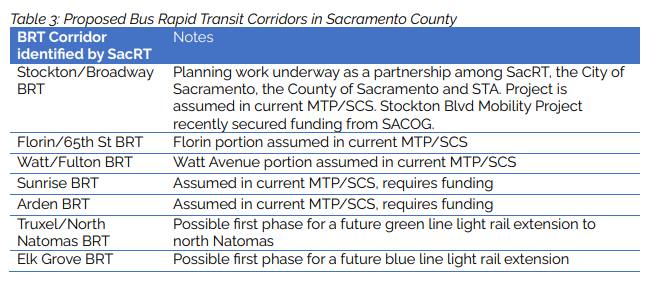
Bus rapid transit countywide. This element was important enough to Steinberg that he highlighted it on his webpage, table below. Note that light rail extension is a possible future enhancement to BRT to Elk Grove and the airport, but it does lock in these extensions are other proposals have.
Expanding service & frequency on existing transit lines
Light rail fleet replacement and station renewal
Regional (Intercounty) Transit Network/ express bus services
For safe streets and active transportation, there are two sub-programs:
Fixing the roads and active transportation
Innovative mobility: unfortunately, the focus is on motor vehicle electrification, and not e-bikes and shared mobility devices
Note that though the documents calls for a half-cent sales tax, Steinberg said he is open to other funding ideas including property tax. He also implied that if the rest of the county is not on board with an innovative investment strategy or tries to water it down with the traditional road building and widening methods, the city would go its own way.
Certainly we need more detail, but I support the vision that Steinberg’s proposal puts forth. Almost of all of our transportation expenditures in the past have disinvested in, or active harmed, communities of low income and people of color. They have continuously widened and extended roadways, mostly for the benefit of high income suburban commuters. They have built and over-built transportation infrastructure that we will never have enough money to maintain, and insisted on building more rather than taking care of what we have. They have actively discriminated against people who walk and bicycle. They have ignored the established fact that adding roadway capacity induces more travel, so that ‘congestion relief’ is always out of reach.
It is time for a new approach, and I believe that Steinberg’s proposal is an important step along the way to a better future.
This afternoon (2023-09-14, 1:30PM), the Sacramento Transportation Authority (SacTA) will hear from consultants about a survey of likely voters and attitudes toward a transportation sales tax measure. Agenda item 13 is available (the entire agenda packet is so long that it is hard to find this item; this is a low resolution version).
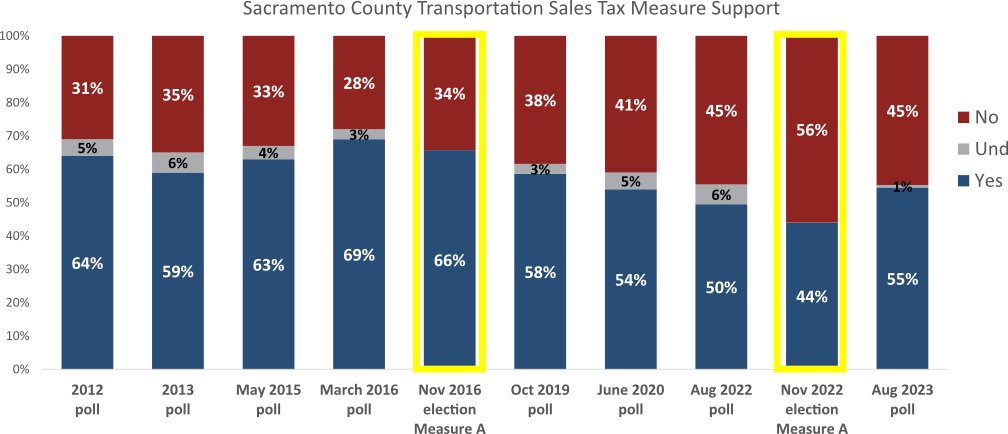
The survey indicates that only 54% would vote yes, which is less than the 67% required for passage, assuming that the measure is sponsored by SacTA, and not a citizen initiative.
There are a lot of interesting bar charts, in the presentation. Below is just one, showing the level of support in various surveys and actual elections over time. I recommend you take a look at the whole document to see what jumps out for you.
Sales Tax Measure Support over time
The presentation does not really address what I think is a key factor, which is the cynicism developed by voters over time when the same failed policies get presented again and again. The 2016 Measure A, the withdrawn 2020 Measure A, and the landslide failure of 2022 Measure A presented transportation investments that are more of the same: more highways, more interchanges, more roadway capacity, more air pollution, more greenhouse gas emissions. The voters have never been offered an alternative that does not represent the interests of traffic engineers who always want more: more cars, more concrete, more ribbon cuttings, more money. Particularly after the 2022 developer-sponsored ‘citizen initiative’, voters don’t trust that sales taxes will be spent on what they actually need for livability and economic vibrancy. 2022 Measure A was just more money in the pockets of greenfield developers and highway builders. Money out of the voters pockets.
But there is now an alternative, Mayor Darrell Steinberg’s proposal. I wonder if that were presented to the public, what the level of support would be. More about that in the next post.
The number of $5 billion (or more) has been bandied about recently as the amount of money we need to fix all the poorly designed and dangerous roads in the City of Sacramento. The number seems reasonable, and I myself have estimated that sidewalk repair alone is $1.5 billion. This is just the city, let alone the county or region. The county and region are in most cases much worse off than the city. I support more funding for this work, some via sales taxes, but more via property taxes. After all, it is property that requires our transportation infrastructure and benefits from a good system.
But what if there is a better way? A less expensive way?
I encourage you to watch the latest (August 24) episode of Not Just Bikes (by Jason Slaughter), titled ‘Even Small Towns are Great Here (5 Years in the Netherlands)‘. He has collected video clips from visits to small towns across the Netherlands. He has two main points about small towns: almost all of them are served by good rail service, and many of the small towns and suburbs don’t need extensive bike structure because there are so few motor vehicles that it is safe and comfortable to ride on any street. My favorite quote from the video is:
“To make a place friendly for cycling, it was more important to restrict cars than it was to build a bunch of expensive bicycle infrastructure. After all, protected bike lanes are just an extension of car infrastructure, right. You don’t need bike paths if you don’t have a lot of cars.”
Not Just Bikes (Jason Slaughter)
A related quote, that I will have to paraphrase, since I can’t find the original source is: We have plenty of space for bikes on our streets, its just that it is currently occupied by cars.
The point, for me, is that we could make much more effective investments if we greatly reduced the number of cars on the road rather than trying to make all our roads safe for bicycling and walking. We need to make car drivers pay the true cost of their transportation choice: fossil fuel extraction, climate change, air pollution, expensive highways, foreign wars and fossil fuel subsidies, and a long list of others. Yes, and making it necessary to build protective infrastructure for walkers and bicyclist to protect them from those drivers. We need to make is more expensive and less convenient to drive, so that people will make other choices.
If we actively and directly reduce car dominance, we might only need $1 billion to fix everything. Still a lot of money, but not out of reach.
Jason moved to the Netherlands from Canada, but the car dominated ‘no places’ that he left are the same car dominated ‘no places’ of the United States, and of Sacramento. In fact, Canada tried to imitate the US, and left themselves impoverished, both economically and mobility wise.
Imagine for a moment, someone saying “Carmichel, where there are so few cars that it is safe to bicycle and walk on any street, and the are great transit connections to all the regional destinations.” They would be laughed out of the room. Yet Carmichael, and unincorporated town in Sacramento County, is about the same size as many of the small cities called out in the Not Just Bikes video. We have designed a horrible world in service of the idea that we can and should drive everywhere. We if we flip that and make it hard and expensive to drive everywhere, places will begin to heal. Even Carmichael.


 Getting Around Sacramento