street design and land use

Street design and land use are intimately connected. Street design should support surrounding land use (not land use somewhere else), and land use should take advantage of the best characteristics of streets. But in most of Sacramento, street design and land use do not support each other.

At the regional level, SACOG (Sacramento Area Council of Governments) has transportation authority but does not have land use authority. They must rely on encouragement of local governments to implement better land use, and is able to use transportation investments to a small degree to support better land use. But the City of Sacramento does have both transportation and land use authority, and could and should be planning the two in unison to accomplish a more sustainable and livable built environment.

Many of our streets are designed to allow people to pass through at high speed, not to stop for living. In some cases, this is an historical artifact because some of our major streets were at one time state highways. But other streets were designed in the same way in more recent times. The city has allowed and encouraged business development along these former highways, with more driveways, more parking, more intersections, more congestion that reduces transit effectiveness, and fewer safe crossings. At the same time, the city has widened roads and widened lanes, creating or maintaining high speed limits which are completely incompatible with the function of streets as places, or as Strong Towns puts it, places for building wealth.

The roadways which try to combine the functions of high speed and throughput with local productivity are called ‘stroads’, a street/road combination. These roadways fail at both. They must be healed by conversion to either streets or roads.

Stroad to Road

In order to bring street design and land use into alignment, the city must either redesign these stroads (a street/road hybrid) toward road function by:

  • Greatly reduce driveways and eliminate on-roadway parking
  • Eliminate signals that serve shopping centers, and replace major signalized intersections with roundabouts
  • Provide on-demand safe crossing at moderately frequent intervals for walkers and bicyclists
  • Discourage homes and businesses along these roadways

Stroad to Street

Or, redesign these stroads toward street function by:

  • Change roadway design to enforce motor vehicle speeds of 20 mph or less
  • Encourage homes and small businesses along streets
  • Create space for living in the public right-of-way by temporary or permanent closure of some streets, and street or sidewalk dining areas (with ADA-compliant routes).

In most cases it is more cost effective to change a stroad to a street, but both transformations are possible and necessary. We need fewer roads and more streets in our transportation system.

Land Use

An effective land use pattern offers the opportunities of daily life (jobs, businesses, dining, entertainment, groceries and shopping) within walking or bicycling distance of home. In Sacramento, the midtown section of the central city already offers this type of land use, because it was developed before the primitive concept of zoning pushed all uses further away. A few other places in Sacramento offer widely scattered examples of such land use.

Relatively few trips outside the neighborhood would be necessary if we had this type of mixed use and diverse land use. Though both land use and streets in midtown could be even better, it is an example which other neighborhoods could emulate. Of course streets must support this land use, with slow speeds which do not endanger people walking and bicycling, and where parking is sufficient but not in excess.

The city should support small businesses in every reasonable way. It need not prohibit larger businesses, but let them succeed or not on their own, without promotion or subsidy from the city.

Small parcels, often called fine-grained development, best support a diversity of housing types and businesses. The city should preserve small parcels, prohibiting consolidation except under compelling public interest, and where large parcels exist, consider purchase, division into small parcels, and sale to small scale infill developers.

Street and Land Use Supporting Each Other

Below is a photo of K Street in midtown Sacramento. The street design, one lane each way, low volume and low speed, temporary curb extensions to calm traffic, painted crosswalks, some on-street parking but reduced to increase walker safety. Of course it could be even better. The land use, a mix of storefront retail and housing, in turn supports good road design. This is a street. This is a place where people want to spend time, and spend money, and feel welcome.

photo of street design and land use that support each other, K St, midtown Sacramento
street design and land use that support each other, K St, midtown Sacramento

Street and Land Use Working Against Each Other

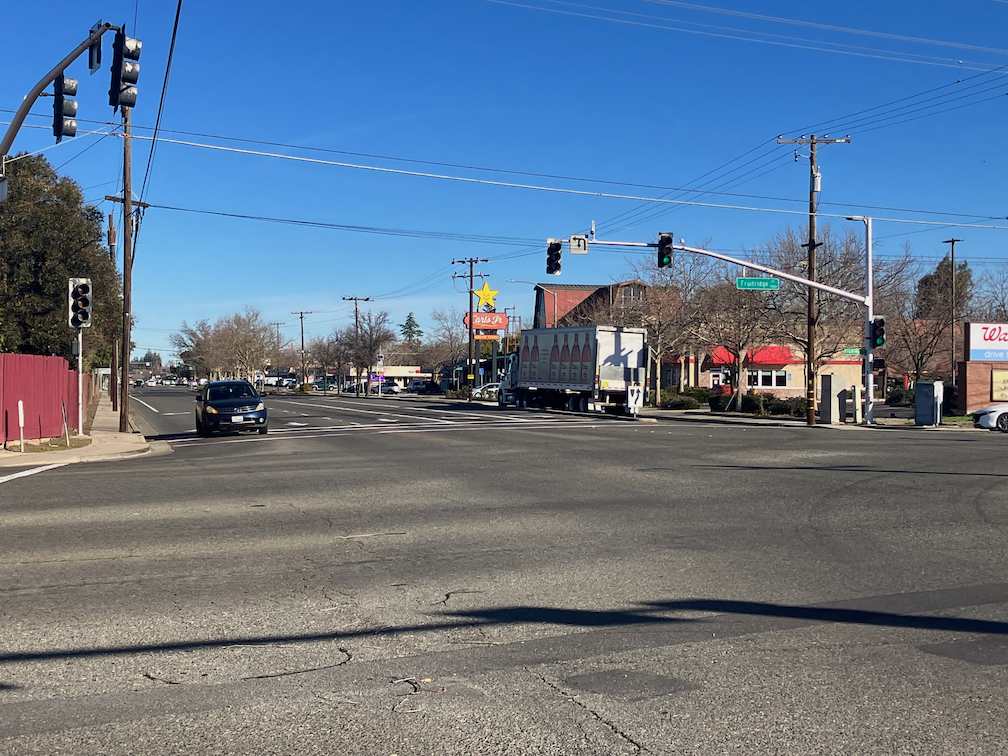
Below is a photo of Freeport Blvd at the intersection with Fruitridge Rd in south Sacramento. The street is designed for high speed travel, accommodating high volumes of motor vehicles. Bike lanes are present in some places, but dropped when necessary to promote motor vehicle flow. Dual left turn lanes endanger everyone on the road, and right turn lanes present a hazard to bicyclists. The crosswalk has faded to near invisibility. And the land use reflects those problems. Fast food businesses oriented to drivers and excluding walkers and bicyclists. A blank fence to try to isolate residences from the roadway, but of course it does not reduce exposure to noise and air pollution. Parking lots facing the street rather than storefronts. This is not a place where people feel welcome.

Freeport is NOT the worst stroad in town, by any means, but it is typical. Does the roadway encourage poor land use? Yes. Does the land use encourage the poorly designed roadway? Yes.
we are all just trying to get somewhere

Yesterday a local politician spoke about how adding bicycle facilities to our roadways is what got us into the pavement condition crisis, implying that if we made bicyclists ride on sidewalks, everything would be fine.

My alternate title for this post is: ‘the pernicious arrogance of car drivers’.

There is a common belief that people driving cars are doing something important, and that people walking and bicycling are not doing anything important. It is true that this attitude is most prevalent in upper income white males, but it certainly exists to some degree with others. A related idea is that if you aren’t driving, you are poor, and its your fault, a very common bias against people who use transit. Bicyclists are most likely to come in for criticism because a common view is that bicycling is just for recreation, or for kids. All of this is wrong. It is not factual, and it is arrogant.

I do not drive. I haven’t owned a car in 13 years. When I started this blog, my tag line was (and still is) ‘BY FOOT, BICYCLE, AND PUBLIC TRANSIT (CAR-FREE!)’. I get everywhere by walking, bicycling and transit. I prefer walking, but bicycling and transit are useful when I need to get somewhere faster or a longer distance. It is true that I walk for pleasure most mornings, and ride for pleasure on occasion, but nearly all of my trips are purposeful. Yesterday I walked to the Chavez Plaza farmers market for some produce, then rode my bike to a public meeting, and then walked to have a beer. Today I’m walking to a meeting, and then riding my bike to Davis for the Davis Music Fest, and then taking the Capitol Corridor train home. When I do my grocery shopping, I walk or bicycle. When I go to medical appointments, I walk or bicycle. When I travel, I take the train, often with my bicycle, and then walk or bicycle or transit at the other end.

My trips are just as important as anyone driving a car. I am just as important as anyone driving a car.

Though I don’t want to overstate the case, my trips are actually more important in several ways. I am supporting a dense urban environment (I live in the central city) and the businesses and organizations located here. I am not endangering other people by my mode of travel. I’m a respectful bicyclist who always yields to walkers, which irritates the hell out of many drivers who have to wait while I wait for someone to cross the street. My walking and bicycling trips have almost zero carbon footprint, and my transit and train trips have a very low carbon footprint. I have never injured another person while walking or bicycling (though occasionally myself). I rarely take single-purpose trips, rather I chain errands.

I worked in the suburbs for many years. Three frequent driver behaviors I observed there that irritate me:

  • People drive from their work or house to get coffee, and back again. Just for a cup of coffee. It is true that the suburbs are a coffee desert, with few coffee shops and even fewer locally owned coffee shops. There are 12 local coffee shops within walking distance of where I live, and about 30 within bicycling distance.
  • People shopping at Trader Joe’s, and coming out with a small bag of groceries to their car. The groeries could easily be carried on a bike, and in many cases by walking. People seem to think that are doing good by shopping at Trader Joe’s, or Whole Foods, or Spouts, but the carbon impact of their driving trip undoes all the good of shopping there.
  • Parents driving their kids to school, and often pickup, when they live within easy walking or bicycling distance of school. I realize that it is not safe to cross many arterials, but rather than working to make things safe, or taking the time to go with their children, parents just default to driving without thinking about it.

This list could be very long, but the point is that people driving are NOT doing something more important than people walking and bicycling.

So why do people drive? Because we have built low-density places with destinations far away, so for many people driving seems the logical solution. Did we force people to prefer driving by making everything so far apart? Yes. Are people happy with this situation? Mostly not. Is there another way? Yes! Urban areas with moderate density allow people to make many trips by walking, bicycling and transit. It is time to stop the insanity, stop investing in long distance driving and commuting, and create places where everyone making trips will be seen as equal.

Grids are Good

This post was inspired by one on Strong Towns: Grids are Good. I’ve written about grids before (re-gridding Sacramento, trenching and decking Interstate 5, Sacramento Riverfront Reconnection, Phase 1) but it is a topic worth repeating.

The Sacramento central city is a complete grid, and so are some areas to the east and south of the central city, but the grid is broken by Hwy 50 to the south and Business 80 (Capitol City Freeway) to the east. The further from the central city one gets, the less likely there is to be a grid. Often major arterials still are on a grid, but not always, even some of them are broken. All of the freeways limit crossings. Local streets that used to go through do not. In general, the lower the income of the neighborhood, the fewer streets are carried through by underpasses or overpasses. This was an intentional design by Caltrans, intended to break up lower income neighborhoods and to isolate them from higher income neighborhoods. The principles of redlining were not just about home loans.

In a region with two major rivers, the American and Sacramento, the grid will of course be limited. However, I will point out that the Sacramento region has three bridges across the Sacramento and nine bridges across the American. Portland, a city of similar population but a bit less sprawling, has 12 bridges over just one river, the Willamette.

I worked for several years in the City of Citrus Heights. The saying was ‘it doesn’t go through’. Very few streets are through streets, and there is really nothing resembling a grid at all. This is not an accident, it was an intentional design decision by the county and developers to create street system that didn’t connect, because it was thought to provide a feeling of ruralness, of a peaceful suburb. Of course to get anywhere, everyone has to drive everywhere, so every street has too much traffic, and the major roads are congested much of the time. Ironically, the one remaining historically rural/agricultural part of the county, Orangevale, has a better street grid that any other suburb in the county.

Railroads also break up the grid. In many cases, though, the railroad alignments predate most of the development.

The lack of a grid is why our transportation system does not work well, why our transit system does not work well. Though there are opportunities here and there to reconnect or create a grid, the lack of a grid is something we will have to live with, forever, or at least until the ungridded suburbs die of their own weight (meaning not enough tax income to sustain them).

This is a superficial analysis. I would like like to get more specific about locations where the roadways network was intentionally broken or designed to be broken, and where the grid could be healed.

parking instead of housing

I am working on a project to find some of the land in the central city that could be housing instead of empty land, or surface parking lots. To me, every surface parking lot is a crime against the climate because it spreads out housing and other amenities to the point where driving becomes preferred if not necessary. But while comparing the county parcel map to the current land use, I was struck by what a sad, sad loss of housing there has been, particularly in the downtown section of the central city. To highlight this, I picked a block very close to where I live, the block bounded by P Street, Q Street, 11th Street, and 12th Street. On this entire block, there is one temporary building, a state child care center, and a small power facility related to the SacRT light rail tracks on 12th Street.

The image below shows the county parcels, labeled with addresses, overlaid on up-to-date ESRI Imagery layer. The child care building is in the lower right corner, at the intersection of 12th Street and P Street, and the SacRT facility is on the unlabeled square on 12th Street. The entire remainder of the block is parking. Some of the parking is state-owned, some privately owned. Every single one of these parcels at one time had either housing or business, or both, though there is some indication that the northwest corner large lot may have been a gas station for a period of time.

Sacramento parcels overlaid on imagery, P Street to Q Street, and 11th Street to 12th Street

I first looked at Google Earth historical imagery, but the only fact from that is that in 1993 all of the block had been converted to parking, and the child care center was probably there (the photo is fuzzy). Then I looked through Center for Sacramento History photos. I have only started through the archive, but did find some photos of the block or nearby blocks. One things that surprised me is that in the early 1950s homes were already being torn down to build state buildings. The photo below shows 1116, 1118, and 1124 P Street in 1949. If I’m able to get a better image, I will replace this one. It shows what seems to be typical of housing in this area, single-family and multi-family mixed in.

The Sacramento Redevelopment Agency was established by 1951, and its mission was to remove all housing that didn’t meet its standards, which meant all housing occupied by lower income and people of color, centering on Japantown.

CADA (Capitol Area Development Authority) was established in 1978 to save what little was left of housing in downtown, so it is probable that the housing had been torn down by the state or city well prior to that. If so, that means that this block has been a parking lot for at least 43 years. Probably much longer, perhaps back into the 1950s. What used to be homes and businesses, has been essentially worthless for that entire time. So, so sad.

For more info on the destruction of downtown, I recommend any books by local author Bill Burg (in local bookstores for paper copies or on Amazon for Kindle copies). You can also find a number of papers and research documents on the Internet by searching ‘Sacramento redevelopment’. I have hardly scratched the surface.

There are several entire blocks of parking in downtown, and many, many blocks that are mostly parking. What a waste!

I ask that the state transfer all surface parking lots under its control to CADA. The state has as many office buildings as it will ever need, but there is no housing to support the office workers, and particularly the lower income maintenance workers that support these office buildings. More to come on that idea.

I welcome historians, particularly Bill Burg, to correct or amplify my information.

corner retail, part two

My earlier post on corner retail was in preparation for talking about an idea that corner retail should be acknowledged, supported, and promoted in the upcoming Sacramento 2020 General Plan. The general plan tentatively promotes higher density by allowing a reasonable floor area ratio for properties throughout the city, while removing development constraints that add nothing to safety or livability. Assuming the plan and the resulting code to support it does significantly increase the number of homes and people able to live in the city, if the city remains as car-centric as it is, the result will just be less parking availability and more congestion (both of which I’m in favor of, but I recognize most people are not). It would go towards solving the housing issue, but do little for livability and climate change issues.

So what is the solution? A place where people can perform most of their daily activities without driving. In other words, corner retail. The jobs issue is a separate one, though corner retail would also increase the number of jobs within walking distance.

Karma Brew, my neighborhood bar, on the corner of P St & 16th St, 2-1/2 blocks from my house

I am not sure exactly how to accomplish this, but I’ll throw out an idea. I don’t think rezoning corner lots from residential to commercial is necessarily the answer, because that might encourage entirely new buildings replacing existing buildings. Obviously many existing buildings would need to be changed to serve as retail, but I don’t think wholesale replacement is good, and it is not respectful of that claim of ‘neighborhood character’ (which is often a cover for concerns not voiced, but is nevertheless a consideration).

Rather, I think a by-right conditional use permit (is that an oxymoron?) is the better solution. That way the building remains similar to what is there now, but becomes functional as a retail location.

Where? I’m partly of mind to say everywhere, every corner. Much of the existing corner retail predates zoning (grandfathered in) or is already under a conditional use permit. But I’m also of mind to limit it to fewer locations, which would be any corner fronted on at least one side by a collector or arterial street. In the lower density parts of Sacramento, I don’t think much corner retail would show up, because it takes a certain density to make retail viable, but there would certainly be more than there is today. Wouldn’t you like to be able to walk to a coffee shop in your neighborhood. Or walk to the market for a few items?

Note that I’m not clearly defining what corner retail is. Does it mean there is only one business present, or allowed, or could it be a few small footprint businesses clustered together? Some of the locations I’ve identified are not on actual corners, but they have the feeling of corner retail. The general plan and the supporting code would have to define corner retail.

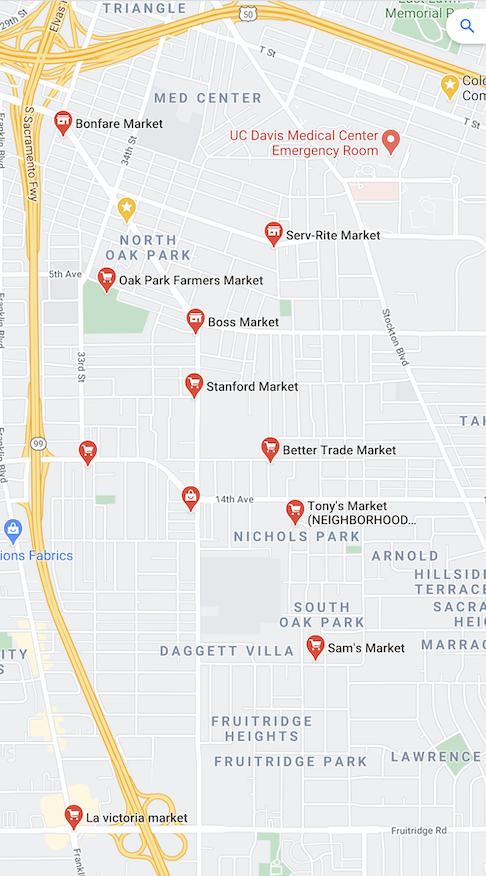
Below are two maps of Oak Park, on the left, arterials and collectors, and on the right, GoogleMaps with markets selected. The scales are similar but not identical. As you can see, some corners on arterials or collectors already have corner markets, and there are other corners with retail that is not a market, but there are a number of locations that could have corner retail under my proposal, but do not. I picked Oak Park just because I’d spent time there recently looking for markets and other corner retail (photos below).

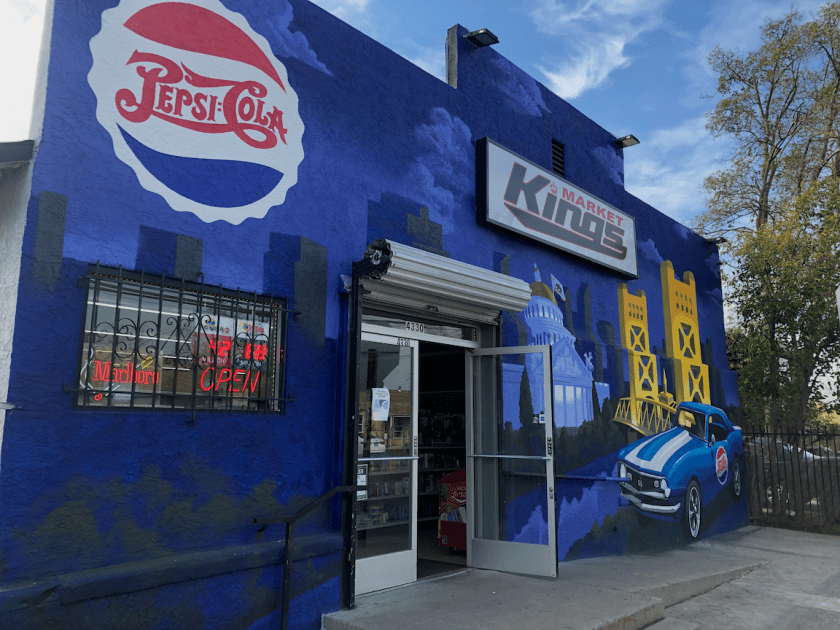
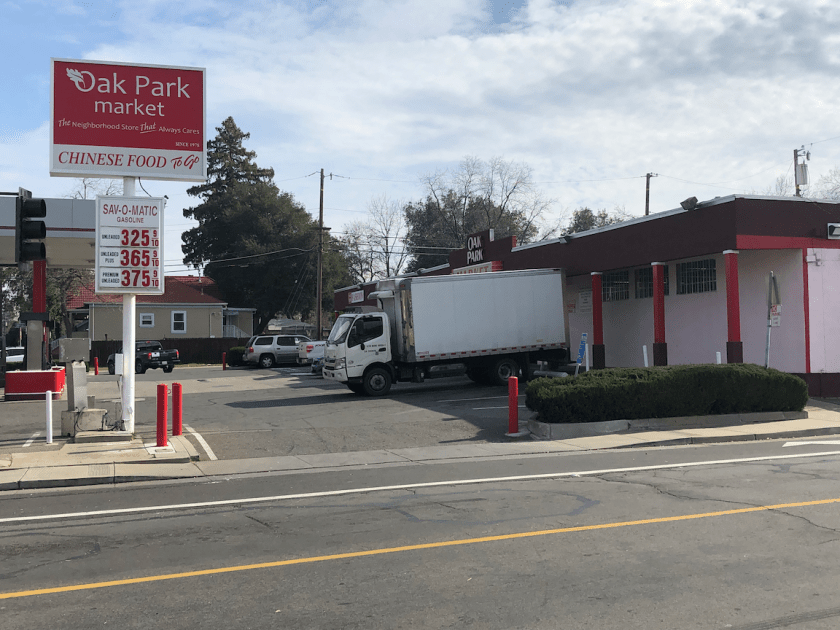
The slideshow below shows some of the corner retail, mostly markets, in Oak Park. Note that in general these locations are much more car-oriented than the ones I showed in the central city, because the area is much more car dominated. I will say more about that in the future. It does not include the many, many businesses that are part of commercial zones along Broadway and Martin Luther King. If you zoom in on Google Maps, a commercial area overlay shows up as pale yellow. I am gradually collecting photos of retail in other areas of Sacramento and will eventually post them.