SacCity design speed

Note: A reader asked how a driver would know whether they are on a street where the design speed is well above the posted speed, or whether they were on a street where the design speed was equal to the posted speed. That is a reasonable question. A safely designed street communicates through design what the intended speed is. However, our traffic engineering profession has trained drivers very well with the expectation that it is safe to exceed the posted speed. There will be a transition period as drivers learn 1) to pay attention to the street and what it signals, not just what the sign says, and 2) that new and reconstructed streets are designed for safety of all users, and therefore the design speed equals the posted speed. But in the meanwhile, drivers will need to know. So, I’ve added a sign below that could be used to signal design = posted, with a red border. The color of the sign itself can’t be changed because in our sign system (MUTCD), white is regulatory.

Part of an ongoing series of posts to support better streets in the City of Sacramento during their 2023 update of Street Design Standards. New standards must be innovative, safe, and equitable, and it will take strong citizen involvement and advocacy to make them so.

Streets are designed for a specific speed limit, which is almost always well above the posted speed limit. The original theory was that designing for higher speeds would protect drivers who drive over the posted speed limit. This is outmoded thinking, for two reasons. One is risk compensation, that most drivers will drive at a speed that feels slightly unsafe, so they are driving just over the design speed. Two is that even if the design speed is safe for drivers, it is not safe for walkers and bicyclists.

The points below are policy, not specifically designs. I have realized that it is not just the design standards that need to be updated, but the policies that determine what design will be used in various context. A lot of city policies are not documented, but reside in the minds of the planners and engineers. Because they are not documented, the public can’t evaluate them and ask for changes.

  • Design speed = posted speed; a street will never be designed or reconstructed for a higher design speed than the posted speed limit
  • Design and posted speed limits will be set at a level that ensures safety for all street users including walkers along and crossing the street, and bicyclists
  • All projects that reconstruct or reallocate a street must consider a reduction in the design and posted speed
  • Lane widths must match design speeds; lane widths will be limited to 9 or 10 feet except that one lane on truck routes, bus routes with 15 minute or better frequency, or dedicated bus lanes may be 11 feet
  • Local streets will have a design and posted speed of no more than 20 mph
  • Streets intended for both local and through traffic may have a design and posted speed of up to 30 mph
  • Streets will not be designed or posted for 40 mph unless the design reduces intersections, and reduces or eliminates driveways and turning movements
  • No street in an urbanized area will be designed or posted over 40 mph

street design contexts

People have commented on my series of street design posts, online and Twitter and in person, with many questions about how to fix existing streets. My focus so far has been on new and reconstructed streets. Obviously fixing existing streets is a critical issue, and I’m not wanting to neglect it, but part of my approach is summed up as “don’t build stupid”, in other words, don’t ever again design or construct a single transportation infrastructure that prioritizes motor vehicle traffic over access and safety for walkers and bicyclists. The best time for better design was 50 years ago, the second best time is today. But the City of Sacramento, and most cities and counties and state agencies, are continuing to build things that are hostile to people walking and bicycling. Traffic engineering is a remarkably regressive profession, sticking with what was once thought to work, even though it never did, and even though it is absolutely clear that it does not meet our needs today. Transportation infrastructure is meant to last 30 to 50 years, and may be in place longer than that, so everything we do wrong today will be around for a long time. We won’t ever have the money to fix everything (a lot of our transportation investment is basically money we’ve flushed down the toilet), and the Vision Zero or Safe Systems approach of identifying and fixing the locations with the highest fatality and severe injury crashes is right.

My thinking about street design has four contexts:

Read More »

street trees in the parking lane

Note: Added two photos to the bottom, or integrated parking and trees.

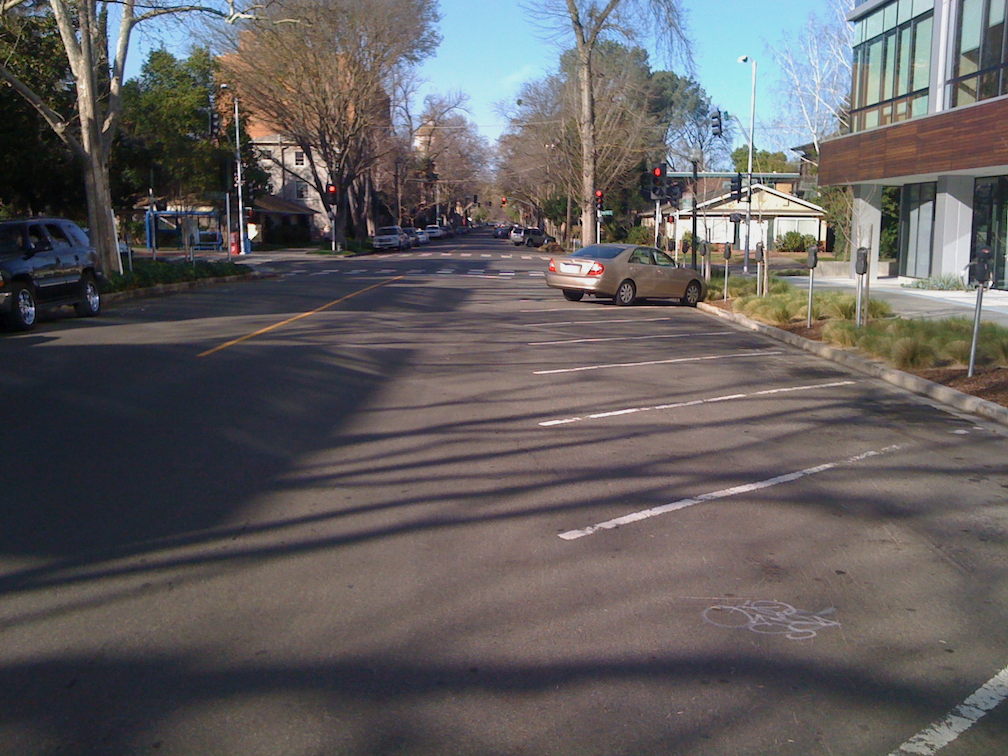
In situations where there isn’t any space for trees along the street, usually where a sidewalk buffer (planting strip) was never provided and where a reconstruction of the street to add sidewalk buffers is not in the budget or possible in the right-of-way, trees can be placed in the parking lane. I am not suggesting here that the entire parking area be replaced with trees, but there some trees and their associated shade for walkers and traffic calming effects could be provided on any street with existing parking.

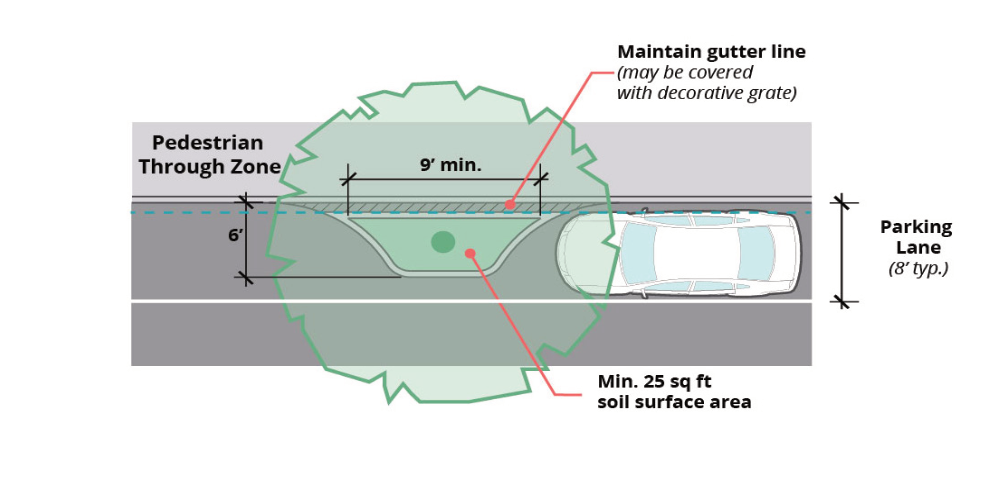
Portland (PBOT) has a sheet about street tree enhancements, which includes Tree Planting in the Curb Zone:

Tree planting in the curb zone allows for encroaching into the on-street parking zone to increase planting widths. This offers an alternative method for increasing tree well size without negatively impacting people walking.

This new tool provides an opportunity to plant trees along curb tight sidewalks or where the furnishing zone is too narrow for large street trees, locations where tree planting would not be possible under current guidance.

PBOT Pedestrian Design Guide
PBOT Pedestrian Design Guide trees in the parking lane diagram
PBOT Pedestrian Design Guide trees in the parking lane

San Francisco has a Parking Lane Planter page:


Parking lane planters are landscaped sidewalk extensions placed between parking spaces at regular intervals or at specific locations. They provide space for street trees and landscaping on streets with narrow sidewalks, where tree planting is limited by conflicts with utilities or driveways, or where there is a desire to visually narrow the roadway.

SF Better Streets

It does not seem as though most cities have policies about placing trees in the street, and those that do, do not seem of long standing, but certainly the practice exists. Street trees in general, though, are of long standing, with every city having policy and design guidance. Sometimes urban forestry and transportation policies and transportation are well integrated, but as often, not.

The City of Sacramento does have an inventory of trees on city property, which includes planting strips (sidewalk buffers). I don’t know of any trees in the parking lane in Sacramento.


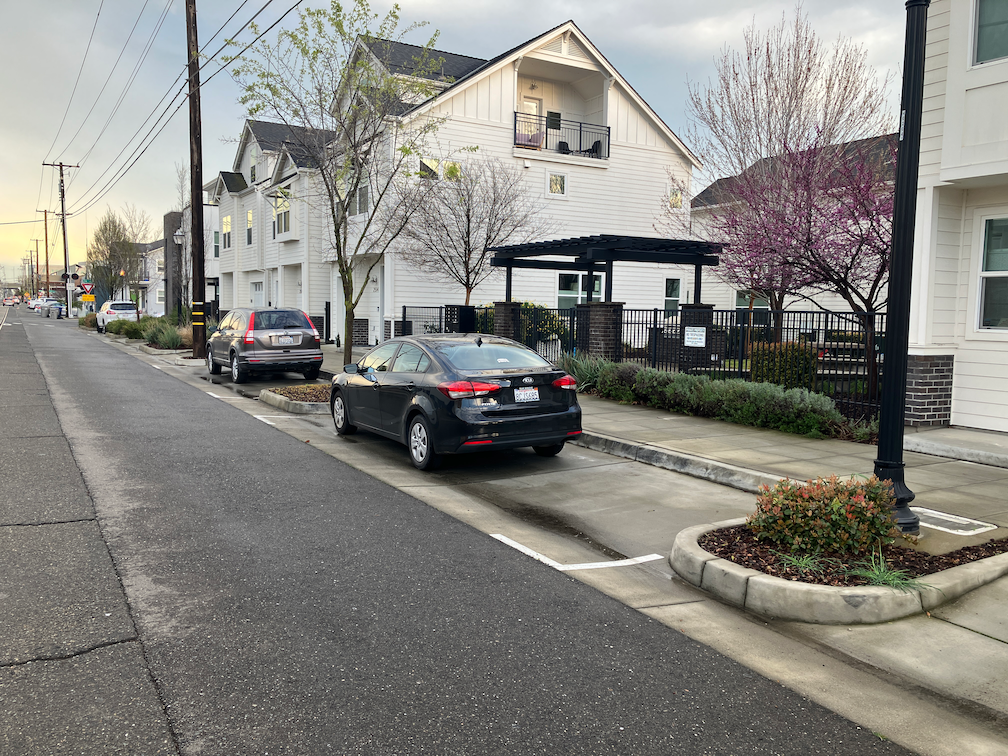
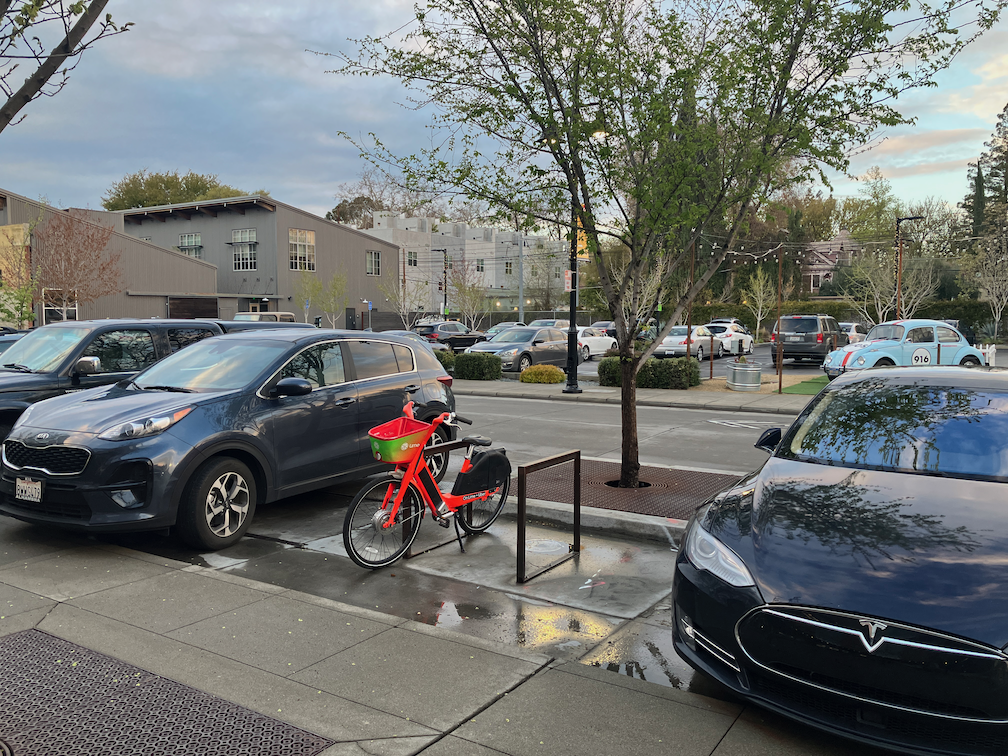
Two readers pointed out locations in Sacramento where parking and street trees are mixed in. Both of these were designed this way; the trees were not added later. Both are on R St, the first with a housing development, with parallel parking, the second with housing and commercial development, with perpendicular parking.

R St between 25th & 26th, south side, parallel parking and trees
R St between 16th & 18th, south side, perpendicular parking and trees

separated bikeways and bus routes

The City of Sacramento started a design with protected bikeways on streets with significant bus traffic on P Street and Q Street in downtown Sacramento. I live on P Street, so see use of the bikeway on a daily basis. It works OK. P and Q are not heavily biked streets, and the separated bikeways are not heavily used, but they are OK. And actually, P Street doesn’t work well for buses. Since much of the bus traffic is commuter buses, a lot of them over a short period of time, there is often a stack-up of buses blocking traffic and interfering with each other at a stop opposite me on P Street at 13th Street.

Note: I’m using the term separated bikeway here because it is the term in state law, and therefore planning and engineering documents. Most people call these protected bike lanes, or sometimes cycletracks, though the term cycletrack is more commonly used for two-way bike facilities. Use whatever term you’d like!

On Q Street eastbound, the separated bikeway transitions to a bike lane at 14th Street. Since there are bike lanes on both sides of Q Street to the east, a bicyclist a decide where to transition to the right side of the street. This works OK.

On P Street westbound, however, it is a completely different story. The separated bikeway ends at 9th Street. To the west there are no bicycle facilities of any sort. It is a three lane traffic sewer (what I can three or more lane roadways, the purpose of which is solely to flush traffic in and out of downtown). With the construction going on all through downtown, P Street is and has been reduced to two lanes is several places, and with state workers mostly working from home, there is much less traffic in downtown. Nevertheless, the design is fatally flawed. I use the term ‘fatally’ on purpose – it is a design likely to result in bicyclist fatalities.

Read More »

SacCity intersections of local streets

Part of an ongoing series of posts to support better streets in the City of Sacramento during their 2023 update of Street Design Standards. New standards must be innovative, safe, and equitable, and it will take strong citizen involvement and advocacy to make them so.

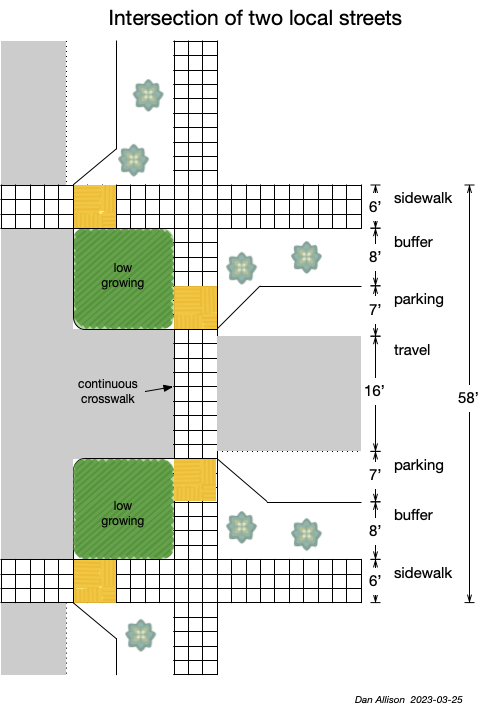
When two local streets intersect, the priority should be for people walking. I’ve created a diagram of what such an intersection might look like, and measure. Notice that the travelway, the area used by moving motor vehicles, is much narrower than is true on most existing streets. This is intentional. Drivers are slowed by their perception that there is a limited space to pass other motor vehicles, or bicyclists for that matter, and limited shy distance from parked cars. Not only does this make the street safer, it also makes it more pleasant for everyone. Drivers traveling any distance will leave these streets in favor of wider/faster streets. Bicyclists can mix with other traffic due to the slow speeds, and do not need a dedicated area. Design and posted speed (if posting is even needed) would be a maximum of 20 mph, and might be less.

Parking is present and welcome, both because it is probably needed, and because it slows motor vehicle traffic. Every corner has a curb extension to shorten the crossing distance for people walking, to increase visibility between walkers and drivers, and to further calm traffic.

Sidewalks of at least six feet, and sidewalk buffers of at least eight feet are included.

Most significantly, sidewalks are raised and extended, with concrete, across the intersection. This enforces the perception that this is a place for walkers, where drivers and motor vehicles are guests. And it is a place where kids could play in the street, as used to be the right of every kid before we let cars dominate our streets. There is still significant pavement for motor vehicles (and bicyclists), but it no longer dominates the neighborhood.

I will address what kinds of streets these are in the future, but what I envision for now is a street with about 80% or more residential, multi-family and single-family. Small businesses on single parcels would be allowed, particularly on corners, but there would be no large commercial or retail, and there would be no surface parking lots.

diagram of intersection of two local streets
Read More »

sidewalk buffer widths

One of the elements of street design is the width of sidewalk buffers, and how these are presented in design standards. The sidewalk buffer is the area between the curb and the sidewalk. The city calls sidewalk buffers ‘planting strips’, and this is often how they are used, but it is not the only use, and in more urban areas, there are often multiple uses of the sidewalk buffer.

I did a sampling of sidewalk buffer widths in the central city, and a few other parts of Sacramento. I am not claiming any insight into the overall pattern. The city does not have a publicly available database or GIS layer of sidewalk locations and widths, let alone locations and widths of the buffers. I have heard rumors that they are developing one, but I have been hearing that rumor for the last ten years, so I’ve become doubtful.

Typical buffer widths in the central city range from six feet to nine feet, with seven feet being the most common. With huge mature trees, the narrower buffers are too narrow of the trees, and the sidewalks have had to be modified. The photo below shows an example, and these situations are everywhere.

sidewalk narrowed for tree roots, Q St near 14th St
Read More »

a graphic for transportation mode share

As I am working on ideas about the City of Sacramento update of Street Design Standards, I am realizing that though details are important, the most important of all, and what should be completed before getting back down to the details, is a statement of values about our transportation system, which we do not have. And there should be a clear, concise graphic that the public can easily grasp, to go with that. So, some ideas.

I’ll start with my favorite of all time, from Complete Streets Chicago. Finding this graphic a number of years ago gave me a framing for what I want to see in our transportation system, and really changed how I think about and communicate about transportation.

Chicago Complete Streets mode share graphic

I just modified this for Sacramento. Why the switch between transit and bicycling? Until the county and region fund transit at a level that allows it to be effective, it is not going to be number 2. I wish it were, but meanwhile, I think bicycling takes number 2.

Chicago Complete Streets mode share graphic modified for Sacramento
Read More »

has SacCity forgotten about climate?

I reviewed the Sacramento City Council agendas for this calendar year, 12 meetings, looking for the word climate. One mention in three months, seeking authorization to submit a Climate Adaptation Planning Grant Program application. That’s it. Has there been a report on the Mayor Climate Change Commission (2020) recommendations and implementation strategies? No. Has there there been an update on the city’s declaration of a climate emergency (2019)? No. Has there been an update on the Preliminary Draft Climate Action Plan, and progress towards a final? No. Has there been an update on Climate Change Adaptation? No.

There have been quarterly climate reports (scroll down to Climate Workplan) to the council from the Office of Climate Action and Sustainability, which are provided to council, but without looking at each council meeting video, I don’t know whether these generated any significant council discussion, or any requests for followup action or information.

The city has said we are in a climate emergency. But it doesn’t seem to be acting like it. I realize that housing and homelessness are very high priorities, and should be, but ignoring climate can’t end well. Particularly since climate and transportation and housing are so closely linked.

how to classify streets?

Obviously there are different kinds of streets that serve different purposes. One of the simplest is street-stroad-road, the Strong Town concept that there should be only streets and roads, and the combination is a failure which they have labeled stroads. But a two-category classification is probably too simple.

The existing City of Sacramento Street Design Standards (2009) offers the table below.

City of Sacramento street design classification
functional classification system

Both of these classification systems were developed for and reflect motor vehicle throughput. The more vehicles and the more speed, the higher the classification. This is the wrong way to go about designing roadways. It assumes that the primary purpose of roadways is to move motor vehicles. We know that is not true, or at least shouldn’t be true.

Portland (PBOT) uses a street classification system with eleven street designs, which are supplemented by five pedestrian classifications, four bicycle classifications, six transit classifications, and nine freight classifications. Yow! An advantage of the Portland system is that it includes details about each category, including land use, lanes, width, function, curb zone, separation, design elements, design treatment, and utilities. The Pedestrian Design Guide, simplifies down to eight classifications, shown below (pdf).

First, I believe that it is critically important that the city drop use of functional classification from its updated street design standards. Not only does the public not understand this classification system, it leads to roadways dominated by motor vehicles. That is not what we want in the city.

I don’t yet know what street classification system might work well for Sacramento, but I am certainly thinking about it, and researching for it. Probably not more than five classifications, for simplicity of understanding by the public, and so that the number of different designs are limited.

I have written about a three-classification system based on speed. That is a useful concept, and easy to understand, but it does not illuminate the surrounding land use nor the feeling and livability of the street. So rather than being a classification, speed limits (design and posted) should be set for each street classification, after the classification description is developed.

street design from outside in

Streets should be designed from the outside in. They have traditionally and still are designed from the inside out, which means first deciding how much motor vehicle traffic to allow or encourage, and at what speed, then working outward to parking, transit, bike facilities, and sidewalks. This approach has given us the transportation system we have, which is rapidly changing the climate while not meeting the needs of most citizens.

If we plan outside in, we can have a better design, in every way. I don’t mean starting with the sidewalk, I mean starting with the land use. What land use is already there, or do we know will be there in 10-30 years, or most importantly, do we want to be there? What types of livable, economically vibrant places do we want? Then, and only then, what sort of design do we want to accommodate walkers (and rollers) who will access those land uses? What trees do we need to shade and shelter those walkers (and reduce utility bills for the buildings), and what other sidewalk-related amenities do we need for those walkers, and that land use? Benches, bioswales, dining, bike and scooter parking? What sort of bicycle facilities do we need to allow people using bicycles, bike-share, scooter-share, etc. to access that land use? What sort of transit facilities such as bus stops and dedicated transit lanes (bus or rail) do we need to serve those land uses? And lastly, what sort of motor vehicle facilities do we need? Do we need parking? What number and width and direction of general purpose travel lanes do we need? There may be some space left over for motor vehicles, once all the other needs have been met.

You might think I am being facetious, that motor vehicles should be accommodated in left over space. But I am serious. In most cases we don’t need motor vehicles on many streets. We think we do because we have designed streets that way, and encouraged people to think that way, that cars are the main mode of transportation. But there are examples of streets all over the world, and even a few in the US, that don’t allow motor vehicles at all, or if so, under very controlled circumstances. These include car-free or car-light boulevards, all the way down to woornefs, where motor vehicles are guest subservient to all other uses.

A Google search for ‘photos boulevards without cars’ interestingly produces hundreds of photos of streets with cars, and cars on streets, and mostly, car crashes. But Wikipedia has photos of woonerf, and Google did find one photo of a proposed street redesign for NYC produced by PAU architecture practice.

woonerf street in Utrecht, Netherlands
proposed people street design for NYC