SacATC April 18

The monthly meeting of the Sacramento Active Transportation Commission (SacATC) will be this Thursday, April 18, 2024, starting at 5:30 PM in the city council chambers. You can comment on these items, or on topics not on the agenda, ahead of time via eComment, or in person at the meeting. I encourage people to attend these commission meetings. There are usually very few members of the public in attendance, which means that your voice is important. Though eComments are valuable, in-person comments carry a lot more weight. The city’s planning staff is usually progressive and innovative, but Public Works in general is not, so it is important the citizens show up to push for progressive and innovative projects and policies. With some new appointments to the commission, and support of the public, the commission itself has been much more progressive than in past years.


The agenda includes three discussion items:

  1. Traffic Signal Safety Project
  2. Kastanis Way Shared Use Path
  3. Grand Avenue Sidewalk Infill

Kastanis Way Shared Use Path looks like a great project, connecting two dead-end streets for walkers and bicyclists, but not motor vehicles. These are the kinds of projects that should be implemented everywhere the opportunity exists.
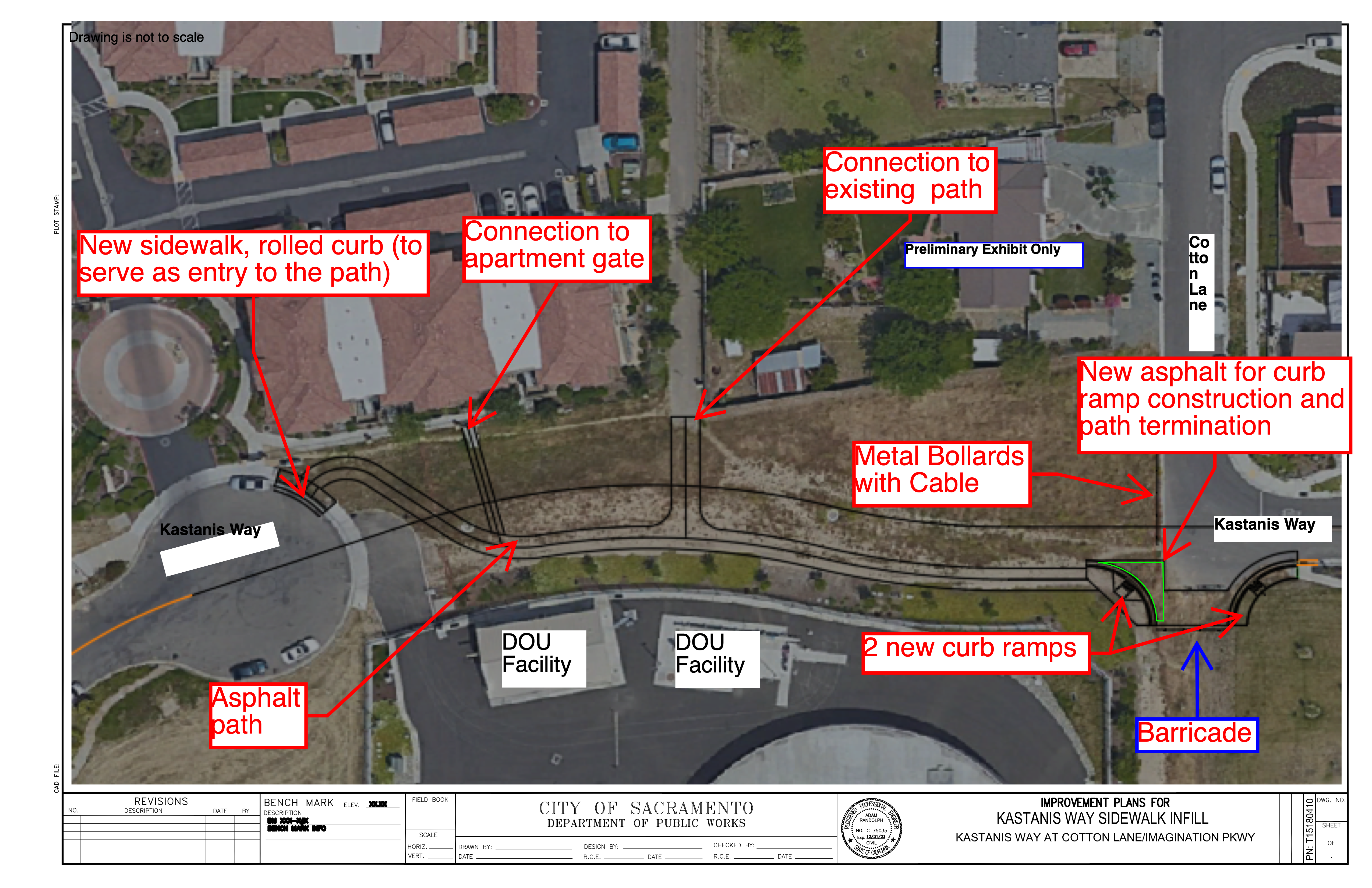
diagram of Kastanis Way shared use path
Kastanis Way shared use path

Grand Avenue Sidewalk Infill also looks good, providing improvements to the crossing Grand Avenue by the Sacramento Northern multi-use path.

diagram of Grand Avenue Sidewalk Infill project
Grand Avenue Sidewalk Infill project

The Traffic Signal Safety project is questionable. There are nine locations:

  1. 16th Street at D Street (Traffic Signal)
  2. Franklin Boulevard at 36th Avenue (Traffic Signal)
  3. Freeport Boulevard at Kitchner Road (Traffic Signal)
  4. Fruitridge Road at 60th Street (Pedestrian Signal)
  5. Rio Linda Boulevard at Harris Avenue (Rectangular Rapid Flashing Beacon)
  6. Stockton Boulevard at 11th Avenue (Pedestrian Signal)
  7. 24th Street at 25th Street (Pedestrian Signal)
  8. Munroe Street at Latham Drive (Traffic Signal)
  9. Rio Linda Boulevard at Roanoke Avenue (Rectangular Rapid Flashing Beacon)

I haven’t had a chance to look at each of these proposals, though I will note that the city traffic engineers love to install traffic signals. At $100K to $500K per intersection, these are major investments. Many of the new signals the city has installed, for example on 5th Street and S Street, are unneeded, and waste of money. They have also converted a number of pedestrian signals from auto-recall (the pedestrian signal comes on at every signal cycle) to beg buttons (the person walking or rolling must activate the sensor, or the pedestrians signal will never come on). The city has a number of unnecessary signals, 60 in the central city alone. Maybe a one-for-one program is called for, install a new signal, take out an existing signal.

I don’t trust city traffic engineers. They label projects as safety projects for walkers and bicyclist, when they are really motor vehicle infrastructure projects. So-called pedestrian and bicyclist safety projects are often motor vehicle enhancements in disguise.

I cross 16th Street at D Street several times a week on bicycle, and occasionally walking, most often to access the American River bike trail via Sacramento Northern path over the river. Yes, I have to wait for a gap in traffic on 16th Street, which sometimes takes a while. But rarely longer than I would have to wait for a traffic signal, given that the arterial street (16th Street) always has a long green and the cross street (D Street) has a short green. I think that funds would be better spent slowing motor vehicle traffic on 16th Street, or adding bike facilities to 16th Street, or reducing the travel lanes on 16th Street, which is a four-lane traffic sewer. Traffic signals do not calm traffic. They irritate drivers, and cause them to quickly accelerate out of the signal to make up for time lost at the signal. They may allow for safer pedestrian crossing, or at least would if red light running were not an epidemic in Sacramento. The fact is, many drivers do not stop for red lights, and certainly don’t stop for people walking in crosswalks. Measures other than traffic signals are necessary to solve the issue.
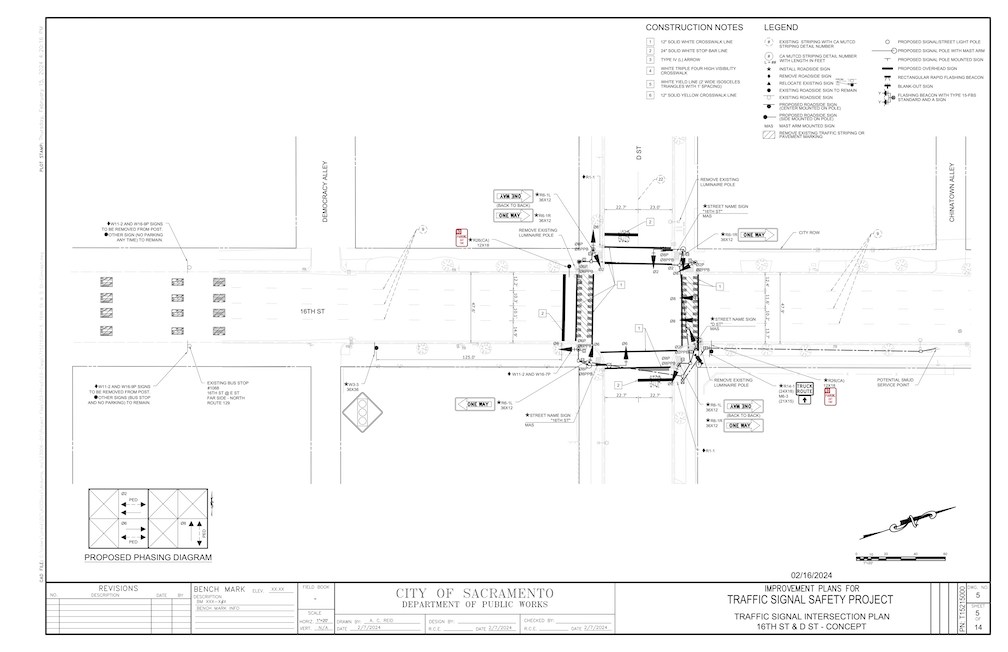
diagram of traffic signal at 16th St & D St
traffic signal at 16th St & D St

The proposal for an RRFB (Rectangular Rapid Flashing Beacon) for Rio Linda Blvd at Roanoke Avenue is inappropriate. The posted speed limit in this section of Rio Linda Blvd is 40 mph, meaning that actual speeds are more like 50 mph. This is too fast for an RRFB to have any effect on drivers. Even at slower speeds drivers often ignore RRFBs. If there is to be a safe crossing at Roanoke, there must be a HAWK signal, or a full traffic signal. Again, funds would be better expended slowing traffic on Rio Linda. At this time, there is no connection between Roanoke Avenue and the Sacramento Northern Bike Trail, so it isn’t clear why this location has been picked for a signal.

diagram for RRFB for Rio Linda Blvd & Roanoke Ave
RRFB for Rio Linda Blvd & Roanoke Ave

I will leave it to others to examine the other seven locations. Are signals needed? Are they the right kind of signal for the context, particularly the speed and volume of motor vehicle traffic? Are there projects that would improve safety for walkers and bicyclists more than expensive traffic signals? Are these the best locations, the ones that best serve routes of travel for walkers and bicyclists? I have doubts that these questions were considered.

Note: Readers Sean Rogers has suggested a better, and less expensive, solution for Monroe and Latham, in comments. The solution may be calming traffic, not just installing a signal.

Freeport Blvd grant is a loser

It pains me to oppose a grant application that the city is making for transportation improvements, in this case, an application to Active Transportation Program Cycle 7 (ATP7), for Freeport Blvd, to implement the Freeport Blvd Transportation Plan.

When the plan came out, many, many people pointed out the flaws in the plan. To simplify:

  • the plan did not reflect the desires of the community, both the adjacent community and the larger Sacramento community, for safety and trees
  • the plan neglected to include space for and planting of trees, a top priority of the community
  • the plan maintained a roadway of four lanes, two each way, throughout the project, even though only a short stretch, from Sutterville Road to the east to Sutterville Road to the west, has enough traffic to even come close to justifying four lanes

If Freeport were a major bus route, it might make sense to reserve a lane for buses, but it is not a major route and is not a roadway being studied for Bus Rapid Transit (BRT).

The plan was recommended by SacATC to the council, which was a mistake, and then approved by the council. I wasn’t too worried, because I figured the city would take the criticism by myself and many, many others to heart and improve the plan before seeking grant funding for it. I was wrong. There was almost no one outside the city staff who supported the plan. The city now wants to submit a grant application for engineering design and environmental clearance, based on the flawed transportation plan.

The city’s priorities for transportation modes, under the new General Plan 2040, are below. The plan does not meet that criteria.

I have written many times about the plan:

These posts are included under the category Freeport Blvd. If you have time on your hands, you can read one or more of the posts, but what they do is build a case, and I feel clear about the case. No grant applications until the plan itself is significantly improved.

I hope that you will attend the SacATC meeting this Thursday, March 21, starting at 5:00 PM, in city council chambers, and will speak in opposition to the inclusion of Freeport Blvd in agenda item 6, part (b), for the Freeport Blvd grant application.

SacATC March 21

Update: Diagrams were added for agenda item 3 streetcar-related bikeway on 3rd Street and agenda item 5 T Street bikeway improvements with unneeded parking.
Update 2: Information added about Envision Broadway in Oak Park, one of the project applications desired for ATP7.

The monthly meeting of the Sacramento Active Transportation Commission (SacATC) will be this Thursday, March 21, 2024, starting at 5:30 PM in the city council chambers. You can comment on these items, or on topics not on the agenda, ahead of time via eComment, or in person at the meeting. I encourage people to attend these commission meetings. There are usually very few members of the public in attendance, which means that your voice is important. Though eComments are valuable, in-person comments carry a lot more weight. The city’s planning staff is usually progressive and innovative, but Public Works in general is not, so it is important the citizens show up to push for progressive and innovative projects and policies. With some new appointments to the commission, and support of the public, the commission itself has been much more progressive than in past years.


The agenda includes four discussion items:

  1. Downtown Riverfront Streetcar Project – Active Transportation Elements
  2. Draft Parks Plan 2040 Public Release
  3. T Street Bikeway Gap Closure Rehabilitation Project (R15200030)
  4. Active Transportation Program Cycle 7 Grant Applications 

Item 6 is mislabeled as a discussion item since it says: “Pass a Motion to recommend to City Council the approval of applications to the Active Transportation Program Cycle 7 grant applications for the following projects: a) Envision Broadway in Oak Park; b) Freeport Boulevard Safety and Mobility Project; and c) Northgate Boulevard Safety and Mobility Project.”

The Downtown Riverfront Streetcar Project, for a streetcar or light rail extension from Sacramento Valley Station to Sutter Health Park in West Sacramento, with an alignment over Tower Bridge, south on 3rd Street, east on N Street to 7th Street (southbound) and 8th Street (northbound), and along existing tracks to Sacramento Valley Station. Class IV bikeway is proposed on 3rd Street southbound, off or left side, and N Street eastbound, off or left side. There is no detail about what kind of Class IV bikeway, which can be: ““A bikeway for the exclusive use of bicycles and includes a separation required between the separated bikeway and the through vehicular traffic. The separation may include, but is not limited to, grade separation, flexible posts, inflexible posts, inflexible barriers, or on-street parking.” Since the bikeway is not parking protected, a high level of protection and separation is appropriate. Both the map and StreetMix diagram are too fuzzy to determine bikeway and buffer width, but it appears the bikeway buffer is narrow and without vertical delineators. The three general purpose lanes are 11 feet, unnecessarily wide and unsafe, so there is additional space that could be allocated to the bikeway or buffer.

StreetMix diagram of 3rd St, excerpted from agenda item

The Parks Plan 2040 (to align with the General Plan 2040) includes many mentions of trails, particularly in the context of Parkways: “Parkways: There are 14 parkways across the city. All parkways contain multi-use trails; some have artwork, gardens, river/beach access, and picnic areas. A select few offer sports recreation facilities such as basketball, soccer, and volleyball.” Key Direction 6, Foster Nature and Trail Connections includes “Collaborate to Improve Trail Connections: As noted in Appendix D, YPCE will continue to coordinate and collaborate with Public Works, other City departments, Sacramento County, and other agency partners to improve trail connections to parks, parkway use, and recreation via trails. While YPCE is not the primary provider of the City’s shared use paths, the Department brings an important perspective to conversations regarding priorities for shared use paths that support recreation and park access in addition to active transportation. Going forward, YPCE will proceed with the development of planned future parkways, especially where these provide access to rivers, connect missing trail links, and provide access to new parks and neighborhoods.” The Community Voices section (04) indicates strong community support for trails.

The T Street bikeway improvement project is needed, from 34th Street to Stockton Blvd. I bicycle this section regularly, on my way to Trader Joe’s and other destinations. The bike lane comes and goes, and drivers often refuse to yield to bicycles taking the lane, trying to force them to the side, and then right-hooking them at Stockton Blvd. The included diagrams seem to indicate there will be parking along the north side of T Street between 35th Street and 34th Street, which is completely unnecessary since the north side is entirely a Caltrans corporation yard with no need for parking. About two-thirds of the south side is also Caltrans property under the freeway, again with no need for parking. T Street is reduced from four travel lanes to two travel lanes from 34th Street to 36th Street, which is a great traffic calming improvement over the overly wide street that exists (or did, before the Hwy 50 construction narrowed it). The right hand lane approaching Stockton Blvd should be right turn only, so that T Street drops to one lane east of Stockton, without the need for a merge which endangers bicyclists. My observation is that at least half the eastbound traffic on T Street turns right onto Stockton, rather than continuing straight onto T Street or turning left onto Stockton. There are also bike lane improvements on the section of 34th Street approaching T Street.

Google map of T St between 34th and 35th streets, showing unneeded parking
T St between 34th and 35th streets, showing unneeded parking

The city is proposing to submit three applications to the Active Transportation Program Cycle 7: a) Envision Broadway in Oak Park; b) Freeport Boulevard Safety and Mobility Project; and c) Northgate Boulevard Safety and Mobility Project.

I have not looked in any detail at the Envision Broadway in Oak Park project, which lies to the east of the current Broadway Complete Streets project. If the same street cross-section and neglect of sidewalks is continued east, it will be a bad project, but perhaps this is an opportunity to correct the design mistakes built into Broadway Complete Streets.

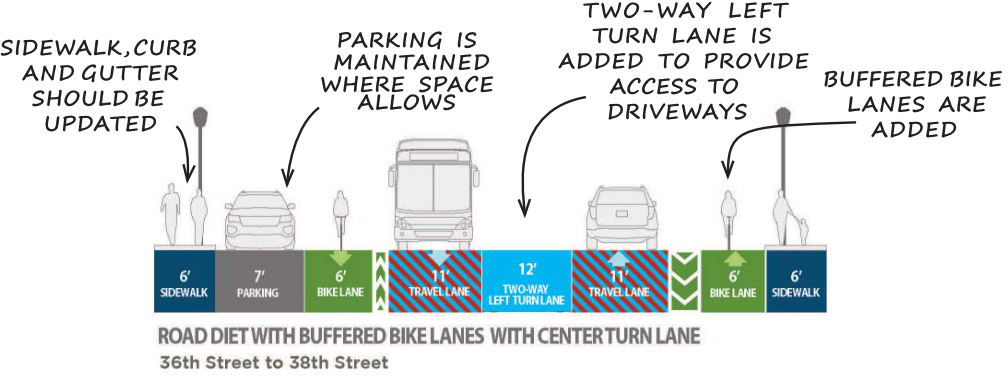
Added information on Envision Broadway. Overall, the plan looks good. Of concern is the section from 36th Street to 38th Street, where the right-of-way is narrower, and existing sidewalks are mostly 5 feet, which is unacceptably narrow for this corridor. The plan says “South of 36th St the rolled curb and gutter and attached sidewalks should be replaced with vertical curbs and wider sidewalks where feasible”. The phrase ‘where feasible’ is concerning. Would we say that general purpose lanes would be installed ‘where feasible’? Of course not. Sidewalks must be a minimum of 6 feet throughout this section, even if other modes are reduced. The sidewalks will not have sidewalk buffers for planting trees, so this section will be unshaded, except for a very short area between 36th Street and 4th Street, where there is a buffer, and a few trees on private property.

The project should still be recommended by SacATC, but with recognition that the plan falls short in facilities for walkers.

The initial Freeport Blvd Transportation Plan was deeply flawed, but perhaps this preliminary engineering and environmental clearance phase can correct some of those flaws. If not, then Freeport will stand as an example of how the city still prioritizes motor vehicles over all other users, and over trees. If the the city does not make a commitment to significantly improving the plan during this phase, then I believe the community should oppose this grant application, at SacATC, and California Transportation Commission, and at SACOG.

Previous posts on Freeport Blvd: Freeport Blvd to council today, Freeport ideas from Kevin, Freeport Blvd as a failure of vision and possibility, Freeport roundabout(s), Freeport trees and sidewalk buffers, Where are the trees on Freeport?, Freeport Blvd photo essay, Freeport & Fruitridge intersection, make Freeport 3 segments, wide lanes on Freeport, Freeport Blvd Transportation Plan, Freeport Boulevard Transportation Plan Emerging Design Concepts. These posts are included under the category Freeport Blvd.

The Northgate Blvd Mobility Plan was much better, with just a few areas of improvement, so this application should be supported.

Freeport Blvd to council today

The Freeport Blvd Transportation Plan is on the Sacramento City Council Agenda today. I failed to notice this, and submitted my comment late, so will have to attend in person or on Zoom. The item is on the consent calendar, so it is particularly important that people comment on the item so that the city recognizes there is significant opposition. You might also contact your council member to request that they remove the item (#6) from the consent calendar.

You may read my previous blog posts at https://gettingaroundsac.blog/category/city-of-sacramento/freeport-blvd/. You may read other’s comments on the agenda item at https://sacramento.granicusideas.com/meetings/4599-5pm-city-council-closed-session-begins-at-4-00-pm-updated-02-slash-21-slash-2023-at-1-30-p-dot-m/agenda_items/63eeca6df2b670376d010289-6-freeport-boulevard-transportation-plan-final-dr

Freeport Blvd as a failure of vision and possibility

Another post on the Freeport Blvd Transportation Plan. See the category Freeport Blvd for other posts.

It should be obvious, if you have been reading, that the City of Sacramento’s Freeport Blvd Transportation Plan is a failure of vision and possibility. How so?

The city removes from all planning efforts the possibility of reducing speed limits on streets that are reconstructed, usually complete streets projects. Whatever the speed limit is before the project will be the speed limit after the project. I’ve written about this before: lower speed limits on complete streets in Sac. I get that changing posted speed limits without changing roadway design has only limited effect in lowering speeds. But we are talking about reconstructing streets, the very design changes that are necessary to effectively lower motor vehicle speeds. Yet the city refuses to consider lowering speed limits when planning reconstructed roadways. Posted speed is like a rachet, it can only increase but never decrease. Some planners and engineers go so far as to claim that the law prevents lowering of speed limits on reconstructed streets. That is a lie.

The city also refuses to consider lane reductions (also called road diets, roadway reallocation, or right-sizing) when average daily traffic counts (ADT) are above certain thresholds. It will not consider that ADT is above what it should be because the city earlier widened roadways and induced the travel that is now resulting in high ADT. Again, lane counts are like a rachet that goes only one direction. You can increase lanes, but you can’t decrease lanes, except in situations where the roadway is so obviously overbuilt that it would be ridiculous to suggest maintaining that number of lanes.

The city has a responsibility to reduce vehicle miles traveled (VMT) in the city, under state law, under SACOG guidance, and its own policy in the Mayor Climate Change Commission Report and Climate Emergency declaration. Yet in transportation planning, the city seems to be fully committed to maintaining the current levels of VMT by ensuring that the current levels of traffic are not reduced. This is climate arson.

Community input to the Freeport Blvd planning process provided high priorities: safety, economic vitality, and walkability. Yet the plan maintains motor vehicle capacity, ensuring that the community priorities will be only partially met. This is not a compromise between drivers and walkers and bicyclists. It is throwing crumbs to the walkers and bicyclists so that drivers may eat nearly the entire cake.

Freeport Blvd, today, is a suburban form. Uninviting streets, hostile walking and bicycling, many small businesses in strip malls and a few big box stores (some of them closed or failing). The built environment is an artifact of the time and way in which Sacramento grew in this direction. It is a fact. But the city, in its transportation plan, makes no effort to change or mitigate that fact. In no way does it even suggest transformation to a more vibrant and interesting place. At the simplest level, it just adds bike lanes and changes nothing else. I’m not against bike lanes, and certainly not against separated (protected) bikeways, but they are not transformative. What would be transformative is shifting Freeport towards a walking-first transportation corridor, a destination for people who live there and people who travel to there.

The city intends to add a number of new crosswalks to the corridor. That is good news, as distances between safe crossings are too great. The problem is, most of these will require extensive signalization to protect the people crossing there, because speed limits are such that a person hit by a motor vehicle will be seriously injured or killed. Lower speed limits, not just posted but enforced by design, would allow much less expensive crossings. Money matters. The city will put very little of its own funds toward these changes, depending mostly on regional, state and federal funds, which will always be too little and too slow.

This plan is only the first step in changing the roadway. Grants will be solicited for major project work. A few critical locations will be improved in the near term. But the plan as a whole is decades away from completion, particularly if the probably unnecessary section south of 35th St is included. The city has done pretty well obtaining grants for complete streets, but with an entire city full of streets needing improvement, Freeport Blvd can’t be and won’t be the only priority. Once the plan projects are complete, the street won’t likely be changed for 30 years. So 50 years from now, more or less, the roadway will look like what the city has planned today. Will it meet the needs of citizens at that time? Very, very unlikely. In the future, VMT will be and must be much lower than it is now. A much higher percentage of trips will be made by walking and bicycling. The built environment will densify, with more small businesses, though some stretches won’t make it and will fail. That’s OK. Properties with failed businesses are good candidates for infill housing, which will support those businesses remaining. But housing along a dangerous traffic sewer, as Freeport Blvd currently is and will largely remain under the city plan, is a disservice to everyone who lives there. Who wants to live on a busy arterials stroad, where you can’t let your kids outside because the risk of traffic violence is too great, and the air hazardous to breathe, and the noise of traffic is a constant psychological and health danger? Riding to the grocery store may be slightly more pleasant and somewhat more safe, but many people still won’t want to because they aren’t comfortable with regular bike lanes beside high speed traffic, and complicated intersections. People won’t want to walk during the summer because the city failed to plan for and install trees along the sidewalks.

Enough said for now. I may write some more or post others if people point out important issues that I have not addressed. Otherwise, the next post will be just before the plan goes to city council, in hopes that citizens will urge the council to reject this plan as too flawed for use. I was very disappointed that the City of Sacramento Active Transportation Commission rubber-stamped the plan and passed it along to council, but that is water under the bridge.

The city can do better, but only if a significant number of citizens press their council members to set a higher standard for transportation planning than is exhibited in the final draft plan.

Freeport roundabout(s)

Another post on the Freeport Blvd Transportation Plan. See the category Freeport Blvd for other posts.

The city has proposed a roundabout for the intersection of Freeport Blvd and Sutterville Rd E. This is a good location for a roundabout, in part because there is so much space here already that a roundabout would not encroach on other uses.

Notes: I am calling the section of Sutterville Rd to the east of Freeport ‘Sutterville Rd E’ and the section to the west of Freeport ‘Sutterville Rd W’, but these names do not reflect street addresses, since this is all East Sutterville Rd. This post introduces the idea of protected intersections along Freeport, which apparently were not considered by the city in their planning process. For more information on this design, see protected intersections and Davis protected intersection.

First, what it looks like today. As you can see, there is a huge area of wasted space in the intersection

Freeport - Sutterville E intersection existing
Freeport – Sutterville E intersection

Second, the roundabout proposed in the plan.

Freeport - Sutterville E roundabout proposed
Freeport – Sutterville E roundabout proposed, north is to the right
Read More »

Freeport trees and sidewalk buffers

Another post on the Freeport Blvd Transportation Plan. See the category Freeport Blvd for others.

So, given the need for trees to shade sidewalks along Freeport, where do they go? The answer is in the sidewalk buffer or planting strip. At one existing location along Freeport, there is an example of street trees in a sidewalk buffer, where the new Raley’s shopping center is. The photo below is from the photo essay. I don’t know whether the city required the developer to put in sidewalk buffers and wider sidewalks, or whether the developer knew this was the right thing to do and did it on their own. In any case, this is the only part of Freeport that has them, other than a short section along the airport north of Blair Ave.

The one situation in which sidewalk buffers may not be appropriate is where buildings come to the curb in dense retail areas. But there are virtually no instances of this along Freeport. Almost all buildings are set back from the sidewalk a little, or a lot. In several cases there are massive parking lots adjacent to the sidewalk, creating the kind of place where no one wants to be. So buffers and trees at least mitigate the blandness to some degree.

Freeport Blvd sidewalk buffer and trees
sidewalk buffer and trees along Freeport Blvd at Raley’s

As with any post, I look for example photos and diagrams. So I searched Google for ‘sidewalk buffer’. Lo and behold, the second item is my own post about this! It is experiences like this that make me realize the value of this blog, when other people are using my advocacy work in their advocacy work.

So, so rather than re-write the post, I’ll link to it here: sidewalk buffers. I encourage you to take a read. Trees, and the sidewalk buffers that would allow them, are probably the most important aspect of Freeport Blvd, and the most important topic that the city has neglected.

Where are the trees on Freeport?

Another post on the Freeport Blvd Transportation Plan. See the category Freeport Blvd for others.

If you take a look at the Freeport Blvd Transportation Plan, including Appendix F Design Layout, you will see that most of the existing trees are preserved. But there is no information about new trees, not in the diagrams, not in the text. In fact, the only text mention of trees, other than existing trees, is in the Community Vision (page 20, 23 in the pdf), where it says “4 IMPROVE SHADE AND COMFORT: Enhance the walking and bicycling experience along the corridor by integrating street trees to provide shade and comfort from the sun and rain”. Certainly, that is the community’s vision, but it does not seem to be the city’s vision. If it were, the plan would have addressed trees.

Given that a major objective of the plan is to make Freeport Blvd more walkable, the lack of trees and mention of trees is concerning, to say the least. When questioned about trees at the January 18 Active Transportation Commission meeting, city staff said two things: 1) we aren’t the experts in trees, so we didn’t include them, and 2) tree information will come later in the design process.

This is a classic case of planning and engineering gaslighting. The story beforehand is always, well, it’s too early in the planning process to consider that. The story later is that it is too late to consider that element of the plan, we’re already past that, the decisions have been made. Every plan goes that way. It is true that this plan is only the first step in design, and there will be more detailed design to come, but when you don’t plan for trees from the beginning, you get a roadway with too few trees. Or no trees.

Almost all the existing trees are in median strips at a few locations along the roadway. Trees in medians have some value. They make the road look prettier, they slow traffic to a slight degree, they shade pavement and slightly reduce the heat island effect. But they are not even as remotely useful as trees along sidewalks. What Freeport Blvd needs is trees adjacent to sidewalks, not median trees. But the city has nowhere reserved space for them. So they won’t be there.

Next post is about where to put the trees, adjacent to sidewalks.

Freeport Blvd photo essay

I rode Freeport Blvd on Monday to refresh my memory, because I hadn’t been along the stretch in a few months. For readers who don’t regularly use Freeport Blvd, it may help you understand the city’s Freeport Blvd Transportation Plan. Yes, Freeport, as it is, has many problems. My concern is that the plan doesn’t solve most of them. The photos below include my thoughts about various places along Freeport Blvd. See the category Freeport Blvd for other posts.

Freeport Blvd complete street

This is Freeport Blvd north of 13th Ave, showing the conversion of what was a four lane traffic sewer to a two lane street. It includes a center turn lane, which is often not needed, in what is called a 3/2 configuration, two travel lanes and one center lane. It has regular Class 2 bike lanes. The sidewalks were repaired but not widened except at McClatchy High School. This is called a complete street.

Freeport Blvd adjacent to Land Park

Freeport Blvd adjacent to Land Park park. Sacramento City College is across the road. It shows the dirt/decomposed granite walking/running path within the park, which is great, but not usable during wet weather. There should be both a sidewalk and a natural surface walking/running path adjacent. A local advocate has suggested there be a separated two-way bikeway along this section, since there are no driveways and only two streets (two branches of 14th St) along this entire stretch of the park from 13th Ave to Sutterville Rd to the west.

Read More »