The Sacramento Active Transportation Commission will meet this Thursday, March 20, 2025, at 5:30 PM. Comments may be made in person during the meeting, or beforehand via the eComment capability on the Upcoming Meetings page. Though the meeting is live-streamed on that same page, comments may not be made in that way.
In the webinar today, a comment was made that the information in the plan and in the webinar is very complex and hard to get a handle on. I agree. Even as a transportation nerd, it is very hard to digest. I’d suggest the city come up with a simple presention, even simpler than the Executive Summary, that speaks to people who just want better and safer transportation for walking and bicycling, but know little about transportation planning and infrastructure. Some people will want to focus on the streets in their neighborhood where they live, or the routes they travel. Others will want to focus on the policy and approach of the plan. It is probably not possible to look at and understand both.
As I’ve said, I hope to post more detailed information and comments on the plan, but haven’t gotten to that yet.
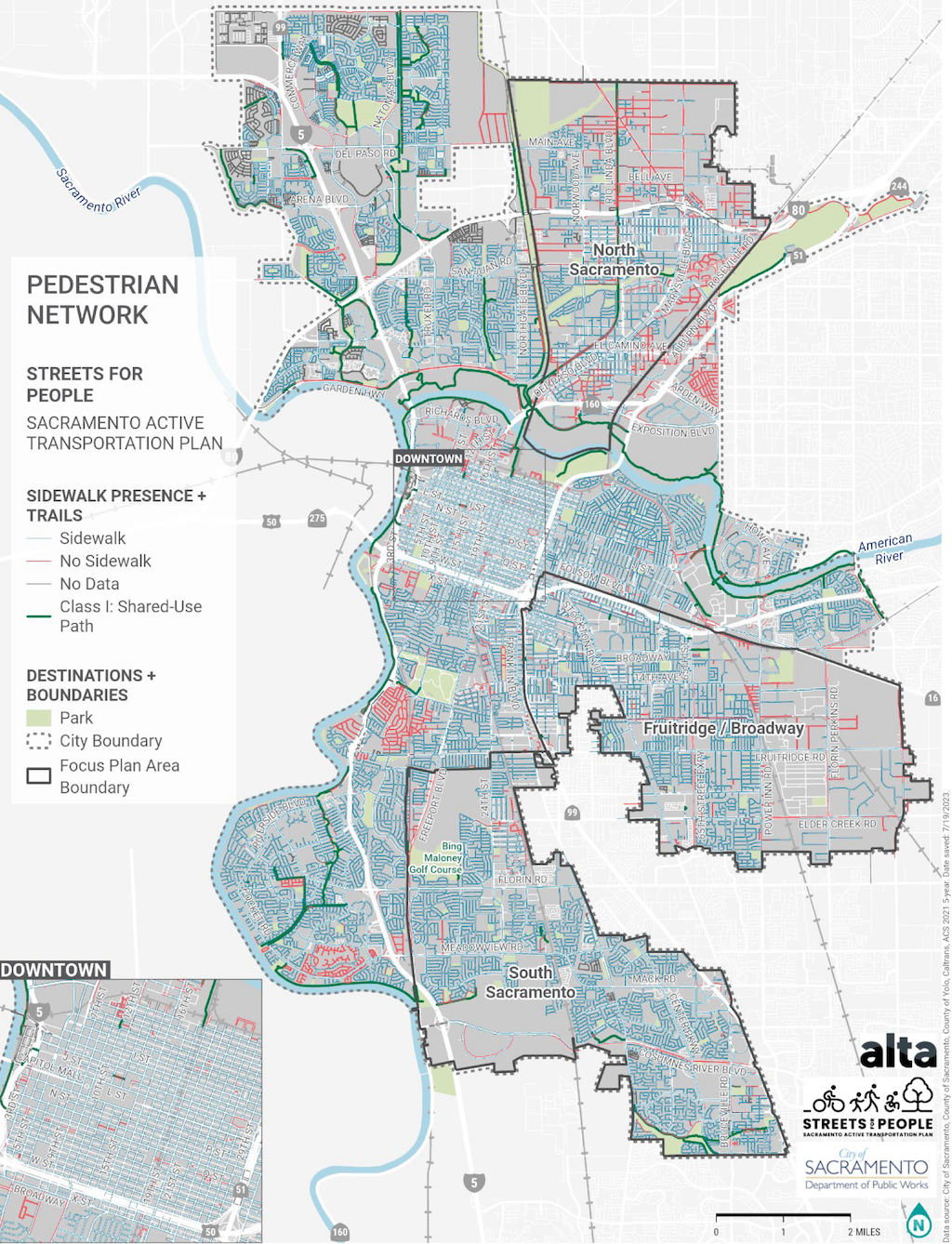
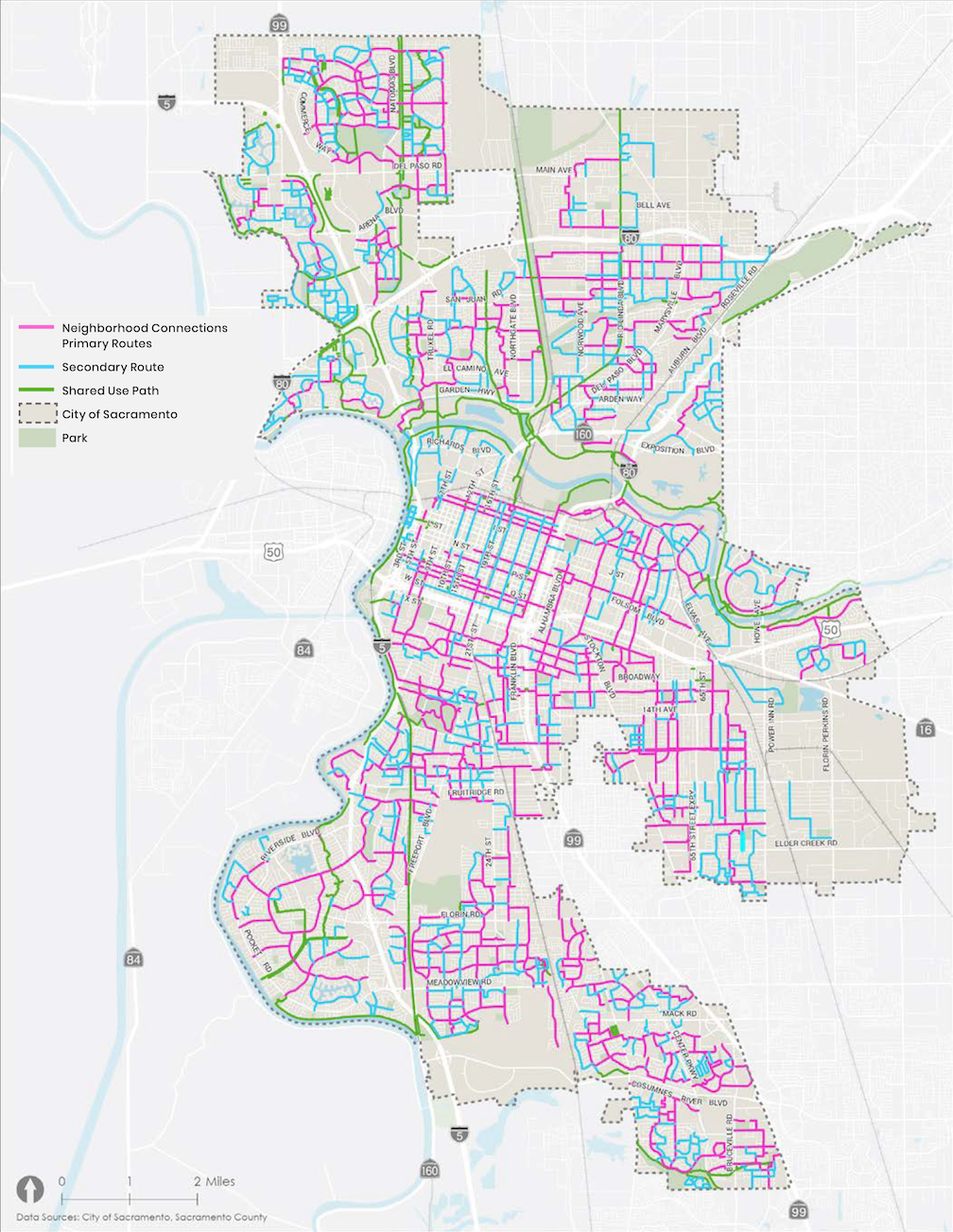
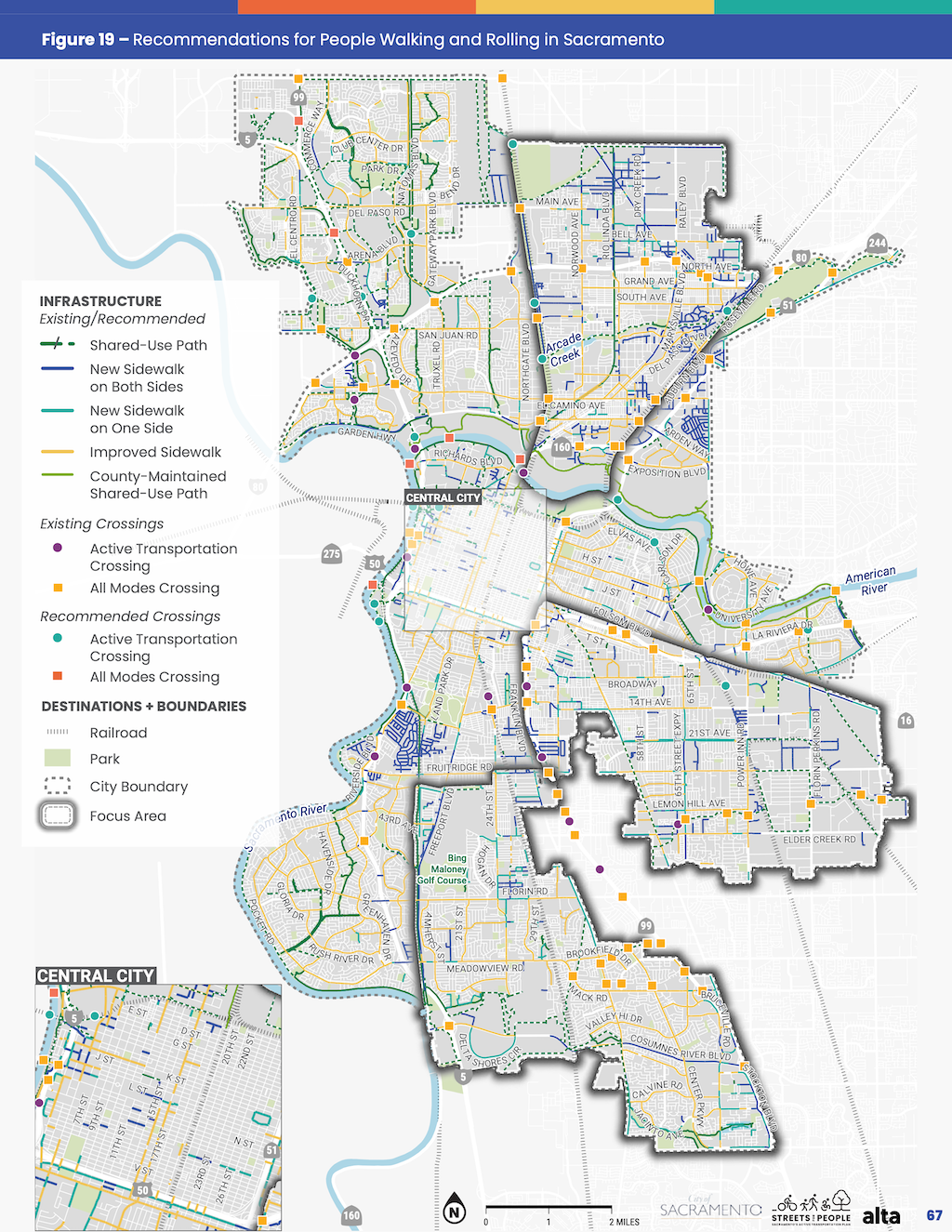
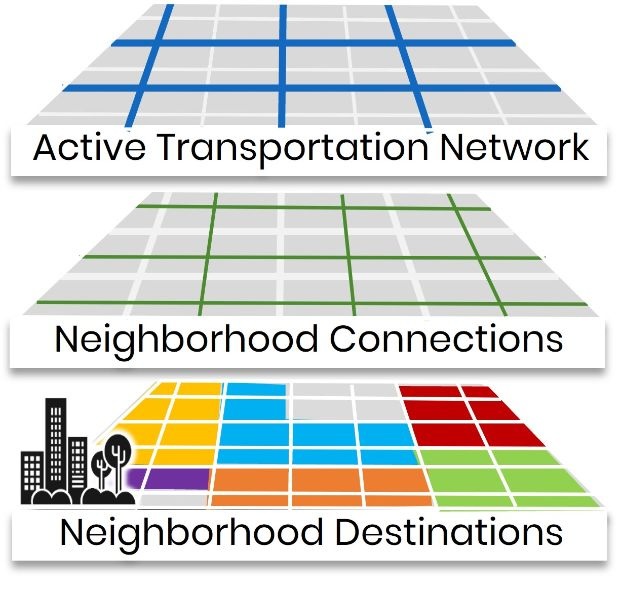
The City of Sacramento Streets for People draft plan has been released. The Streets for People / Active Transportation Plan webpage has more detail. The body of the plan is a little difficult to download there, so it is also available here (57MB pdf). The appendices and related documents are easy to download there (I don’t know why Appendix 5 is missing). A comment about terminology: ‘Streets for People’ refers both to the overall Active Transportation Plan, and to this specific section of the overall plan. The Streets for People: Sacramento’s Active Transportation Plan public draft 2025-03 is the section that covers arterial and major collector streets. Local streets are covered in the Neighborhood Connections Plan (2025-01), which has now be adopted by the city and will be incorporated into the overall plan later this year. The diagram below shows the relationship, with the green neighborhood connections, and the blue ‘active transportation network’ which is the topic of the draft plan.
I have only skimmed the plan, so don’t have comments yet, but since it is out there, I hope that many people will take a look and comment. To the city, mainly, but you can also comment on this blog post. Comments are accepted through April 6. Though the map for gathering geographically related comments is closed, it is still available for viewing. You can submit comments through a form, probably best for general comments that apply to the process or the overall document. You can email city staff directly at StreetsForPeople@cityofsacramento.org. The preferred method for comments is to make comments directly on the pdf, available at https://streetsforpeopledraftplan.altago.cloud/#/, probably best for specific comments on text or graphics. You can also sign up to receive email updates.
The Neighborhood Connections Plan is great and provides a solid basis for improving both safety comfort level for people walking and bicycling in their neighborhood. However, local streets are not where the majority of crashes occur, certainly not the fatality and severe injury crashes. These occur on arterial and major collector streets, the ones that were designed for motor vehicle movement and convenience. These roadways are too wide, and too fast. Yet many walking and particularly bicycling trips must cross or travel along these dangerous streets. Until these streets are redesigned to not only accommodate but encourage walking and bicycling, most people won’t leave their immediate neighborhood, and will continue to make most trips, even short trips, but motor vehicle. And that is the subject of this draft plan, and why it is so important.
Table of Contents
1 About This Plan
What Is Streets for People?
Need for a Focused Approach
What’s in the Plan?
Plan Goals
Recent Achievements
2 Walking, Biking, and Rolling in Sacramento Today
Building on the Past
What the Data Shows
Equity
Walking and Rolling
Biking
Safety
Comfort
Access
Sustainability
3 Community Engagement
Leading with Equity
Community Planning Team
Engagement Events
What We Heard
4 Recommendations 52
Network Recommendations
Intersection Recommendations
Recommended Policies and Programs
Maintenance Considerations
5 Implementation
Costs
Funding
Monitoring and Review
Next Steps
A Appendices (which are in separate documents, available on the webpage)
Note: Added letters of support from four organizations, below.
The Budget & Audit Committee of the Sacramento City Council meets tomorrow (!) Tuesday, February 25, 2025, 11:00 AM in city hall council chambers. The Budget & Audit Committee members are Roger Dickinson, Chair, District 2; Karina Talamantes, District 3; Caity Maple, District 5; and Eric Guerra, District 6.
On the agenda is item 10 SacATC 2024 Annual Report. The discussion, however, will include more than just the annual report. It will include the city’s proposed quick build program. Quick build, sometimes called tactical urbanism, is a concept related to Vision Zero, that rather than just accepting traffic violence, the city would take action to reduce or prevent future crashes at that location. What makes it unique, and different from the long term roadway redesign that the city undertakes when they can get grant funding, quick build analyzes the issue now, and takes action soon to correct it.
The city is calling this effort TAG Team (tactical action group), and it would be implemented from existing budget and staffing limits with six staff dedicated to the project.
If you can’t make daytime meetings, you can submit an eComment on the city meetings page. The earlier you submit eComments, the more likely committee members are to see them before the meeting.
Three examples of quick builds: the street closure and bikeway improvement at Broadway and 2nd Avenue and 34th Street, with yellow vertical delineators; the corner curb extensions that have been installed at some corners with paint and/or white vertical delineators, and lane channelization delineators on 15th and 16th Streets. Vertical delineators are much less expensive, and also somewhat less effective, than concrete curbs, but they do reduce the likelihood and/or severity of crashes.
SacATC (City of Sacramento Active Transportation Commission) met Thursday, January 16, 2025.
The agenda included:
3. Selection of Chair and Vice Chair for Calendar Year 2025: Arlete Hodel was re-elected as Chair, and Isaac Gonzalez was re-elected as Vice Chair. Juanluis Licea-Cruz joined the commission as seat K youth representative, a high school student at West Campus joined the comission. David Moore was appointed to the Seat J. Ali Doerr-Westbrook has completed her term on the commission.
4. Caltrans American River Bridge Rehabilitation Project: The presentation by Caltrans staff was frustrating. A number of questions about details of the bike path being added as part of the freeway rehabilitation (widening) project went unanswered. Commission concerns were that there are a limited number of connections from the new path to existing bikeways, and that Caltrans has demonstrated an inability to maintain bike paths by the horrible condition of the Causeway path. The Caltrans staff claimed that some other agency would be responsible for maintaining the path, but seemed unclear about what agency. Federal law requires that the host agency is responsible for maintenance of multi-use paths in perpetuity, but Caltrans has rarely complied with that requirement. Completion of the entire project is December 2026, but it is unknown whether the path will be available before then. I hadn’t realized, but this path was part of a lawsuit settlement over widening of the freeway; it was not a project initiated by or desired by Caltrans.
5. Alternative Recommendation: Truxel Bridge Concept and Feasibility Study: See the STAR blog post for this topic, which includes all the agenda document parts. The commission voted for recommendation 3, “reject the Truxel Bridge Concept and Feasibility Study and instead recommend that the City Council direct staff to evaluate and study a Truxel Bridge alternative without personal motor vehicles.’ It was clear from the large number of in-person comments and eComments, as well as commissioner comments, that the city commitment to a multi-modal bridge with private motor vehicles is unacceptable.
My comments added two details: 1) SacRT board has never approved the city concept, though discussions at the staff level indicate that it might. The approved SacRT project is a transit/walking/bicycling only bridge. 2) The light rail to the airport Green Line might never be completed due to very high cost and uncertain ridership. If bus rapid transit (BRT) is implemented instead, the benefits of a direct bridge route are not clear. The current bus Route 11 jogs to the freeway, and is not signficiantly delayed by that. This BRT is not part of the current regional plans because it was assumed that light rail would be implemented, but it is quite possible that it might be added to the high capacity bus network plans.
It is assumed that the city study will proceed until the city council makes a decision on the SacATC recommentation.
6. Streets for People: Neighborhood Connections Draft Final Plan: staff report and Neighborhood Connections Plan: There was strong community and commission support for the plan, and it will be forwarded to council, probably next month. The toolbox part of the plan is outstanding. Nearly all of the 13 treatments in toolbox can be implemented as quick-build projects with low-cost materials, and eventually replaced by hardened infrastructure. Community and commission comments addressed the lack of likely funding for implementation, but it is hoped that the city will allocate some funds to the project, particularly now that the primary resister Howard Chan is no longer city managert.
For ‘not on the agenda’, I commented on the much delayed maintenance (sweeping) of the separated bikeways in the central city. The bikeways became nearly impassible during leaf season, except where they were cleared by landscaping services supplied by adjacent property owners, which is not their responsibility, but is appreciated.
Commissioners requested an update on the staff effort to inform council about what quick-build means. and this topic may also come back to the commission.
Traffic Diverter / Street Closure page from Streets for People Neighborhood Connections
SacATC (City of Sacramento Active Transportation Commission) will meet this Thursday, starting 5:30 PM, in city council chambers at 915 I Street, Sacramento. Comments may be made in person or via eComment ahead of time. Note that there are two commission meetings scheduled at the same time, so it is possible that this meeting will be in another location in city hall.
The agenda includes:
3. Selection of Chair and Vice Chair for Calendar Year 2025
4. Caltrans American River Bridge Rehabilitation Project: This project includes the addition of a shared use path (walking and bicycling) to the State Route 51 (Capitol City Freeway) bridge over the American River.
5. Alternative Recommendation: Truxel Bridge Concept and Feasibility Study: See the STAR blog post for this topic, which includes all the agenda document parts.
The Neighborhood Connections Plan is largely unchanged from the 2024-10 draft. As such, I support it. It is important to remember that this plan only addresses residential and minor collector streets, which are important for encouraging walking and bicycling, but rarely are the location of fatalities and severe injuries. Those occur on major collector and arterial roadways, which are the subject of a separate Streets for People document, coming sometime later this year.
On page 19 the following info from the last round of public outreach is added:
PHASE THREE: PUBLIC DRAFT PLAN
Project Funding and Prioritization: How the plan will be moved forward into implementation, prioritization, and funding was a common theme. Community members requested clarification on the next steps for project implementation.
Speeding Implementation: Some workshop participants called for faster implementation of the recommended network via “quick build” projects.
Equity Considerations: Community members asked how equity would be considered for implementation, particularly where fewer active transportation facilities currently exists.
Youth Safety: School area improvements and other projects focused on addressing youth transportation needs was a theme in the virtual workshops.
The ‘Funding and Ways to Get the Network Built’ (page 123) is unfortunately unchanged. The city still does not identify even the possibility of using general funds for implementing this plan.
City of Sacramento held the second of two workshops on the Neighborhood Connections element of the Active Transportation Plan on Wednesday at noon. About 40 people participated, and there were many questions and comments. I was not able to participate in the first workshop a week ago, but I imagine the content and discussions were similar. The presentation given during the workshop is available.
You can comment in the body of these documents by using the Konveio tool (scroll down on the Streets for People Active Transportation Plan webpage to the box with a green bar at the top), or submitting by email to StreetsForPeople@cityofsacramento.org.
The City of Sacramento is holding two online workshops on the Neighborhood Connections portion of the Streets For All Active Transportation Plan, on Wednesday, November 13 at 6:00 PM, and Wednesday, November 20 at 12:00 noon. Registration is available on the Streets for People webpage. The Neighborhood Connections Public Draft Plan will be available on November 4 on the Streets for People webpage.
“The Neighborhood Connections Network is made up of residential streets and minor collectors that connect to neighborhood destinations, such as parks and retail. The network includes proposed traffic-calming treatments to reduce vehicle speeds and volumes to support people walking, biking, and rolling.”
Additional posts on Streets for People Active Transportation Plan are at category: Active Transportation Plan.
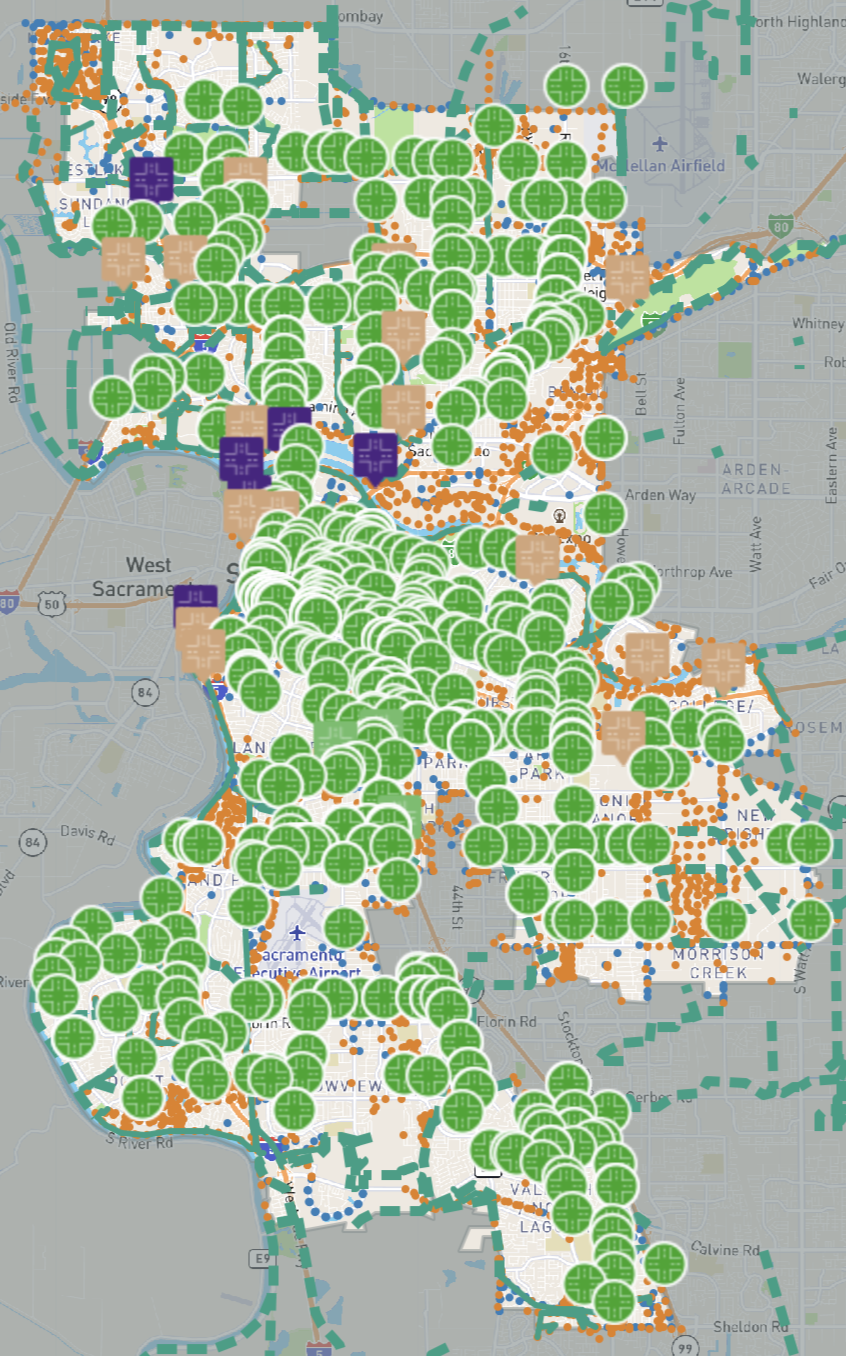
The interactive map developed for the Streets for People Active Transportation Plan is available for public input through August 11. The ‘add a route’ and ‘add a point’ options have a free-form entry box, so you can enter anything you would like, but using terms that the city uses, in the visual glossaries (below) or the traffic calming features (below) are more likely to be understood and accepted.
You can comment on the city’s recommendations: “Clicking on a draft network recommendation will launch a pop-up that will provide more information about the recommendation. You can leave a comment, like, or dislike on any recommendation.”
Or you can add your own: “Are there roads or intersections that don’t have a recommendation, but you think should? Use the “Add a route” and “Add a point” buttons below to mark these locations on the map.”
The interactive map offers visual glossaries for pedestrian infrastructure and classes of bikeways. Since you can’t have these glossaries open at the same time as the map, they are offered as blog posts and pdf documents by Getting Around Sacramento.
The crowd-sourced entries on the map are concentrated in the central city and north Land Park. We hope that people who walk and bicycle in other parts of the city, particularly the disinvested areas of South Sacramento and North Sacramento, will make suggestions on the map.
Neither the glossaries nor traffic calming features offer fully signalized intersections as a recommendation. Traffic signals regulate motor vehicle flow to some degree, but do not significantly slow traffic nor make streets safer for walkers and bicyclists. Safety is best achieved by slowing the motor vehicles through street redesign.
The ‘bicycle routes’ / sharrows option in the Visual Glossary of Classes of Bikeways has been misused by Sacramento and many other cities/counties/Caltrans by placing them on high volume and high speed roadways, in lieu of creating safer bicycle facilities. Their use should be strictly limited, and most existing locations should be converted to higher quality bicycle facilities.
Additional posts on Streets for People Active Transportation Plan are at category: Active Transportation Plan.
The City of Sacramento held the Streets for People Citywide Virtual Workshop #1 yesterday. Though the city may eventually post the slideshow, it is not on the program page Streets for People Active Transportation Plan yet, so I’m posting them here. These are low-ish resolution screen captures, so you won’t be able to see detail in them, but I hope they are still useful to you. I did not capture every single slide, but I hope the ones of interest are here. Of course the slides do not capture the presenter comments that went with each slide, which are important.
The next workshop, Streets for People Citywide Virtual Workshop #2, will be tomorrow, July 11. Please see the program web page for registration link. I assume the presentation will be the same.
The first workshop was poorly attended. I don’t know how many people, but the presenters mentioned several times how few people were on the webinar. My question/comment is that the Traffic Calming tab of the Neighborhood Connections storymap has the best examples of traffic calming measures, with many of the photos local, whereas the visual glossary pedestrian and visual gallery bikeways examples provided as part of the interactive map are of poorer quality, not local, and in a few cases should not be recommended at all. These two sources should use the same examples, where they overlap.
The second workshop will be followed by a series of focus groups for particular neighborhoods or areas of the city, and walk audits in those same areas. I hope that people will participate in one or more of them.
Streets for People Active Transportation Plan has posted an interactive map on which people may make comments on proposed projects, or add their own points or lines. There are visual galleries for pedestrian infrastructure and bicycle classes, but they overlay the map so can’t be viewed while viewing the map. The visual galleries have been captured and made available here. This post is the pedestrian infrastructure gallery, next will be the bicycle classes gallery.
These elements are not exhaustive. There are several elements in the Streets for People Neighborhood Connections storymap traffic calming tab which can be used on the interactive map as well. And you may add your own.
Note: Photos are not from Sacramento. These galleries and the elements they contain are re-used from projects in other cities.
Provide an area for people walking to travel separated from vehicle traffic. Typically constructed out of concrete and separated from the roadway by a curb or gutter and sometimes a landscaped buffer.