access to parks, and walking space

I have long been interested in access to parks, what the availability of parks is to people, and wanted to map this. It is just today that I was finally able to start doing this. I acknowledge the support of the Sacramento Area Council of Governments (SACOG) GIS staff, without which I could not have done this, as my ArcGIS skills are limited, though growing, and my access to the needed data is also limited.

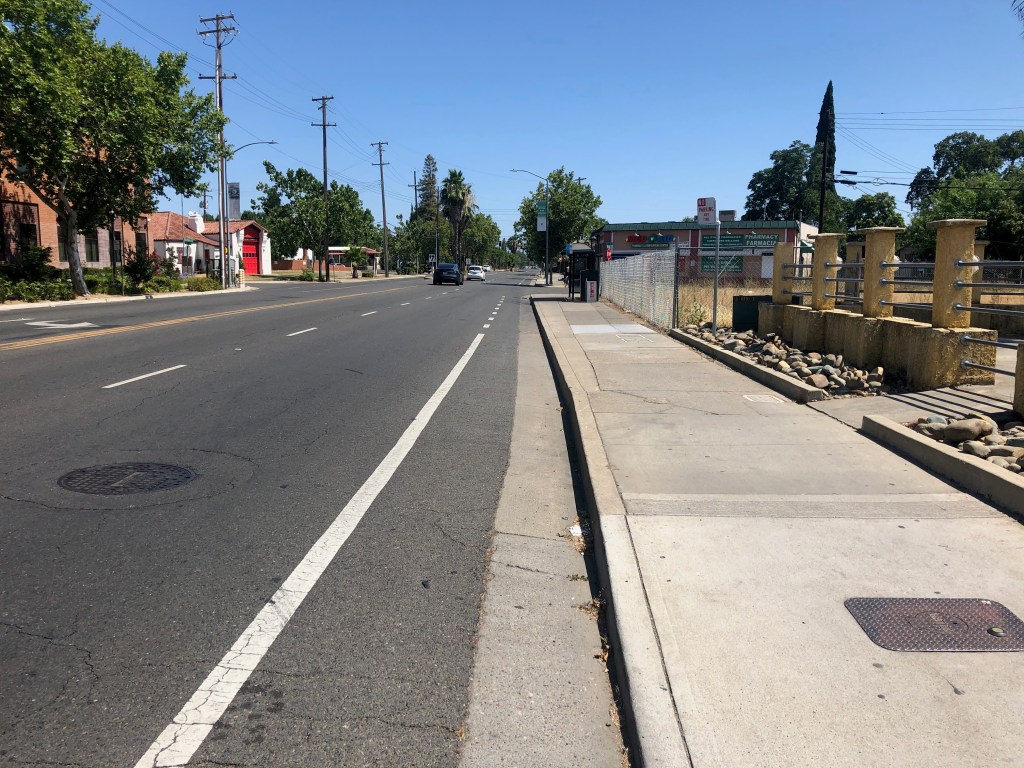
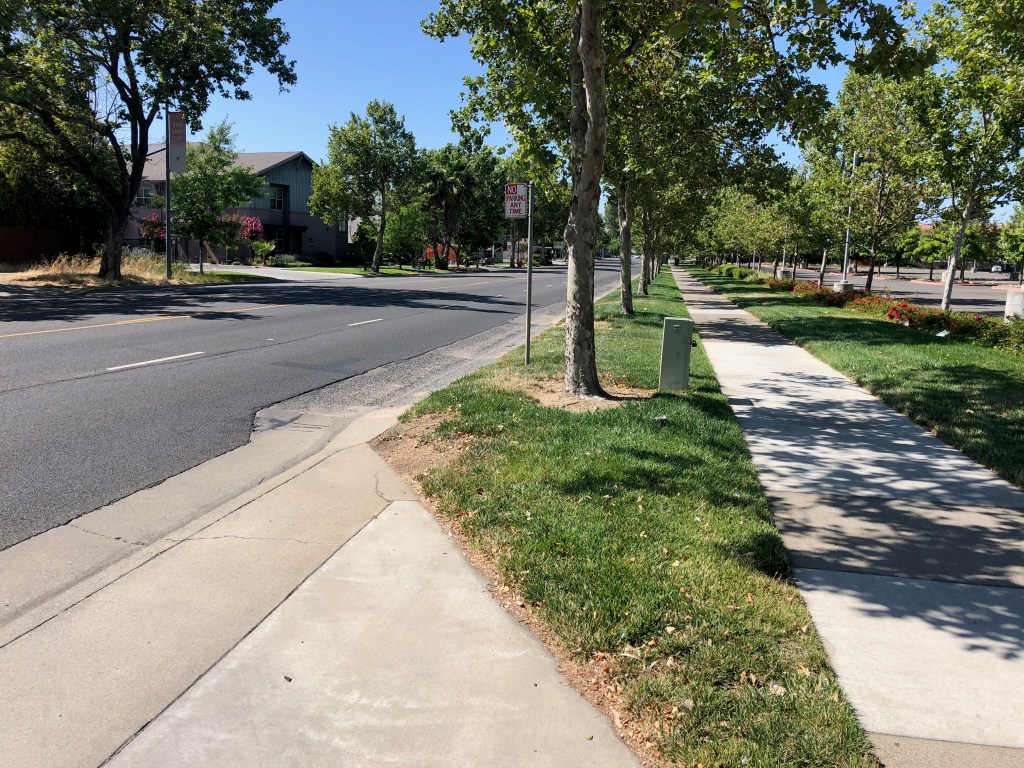
This issue of access to parks, always important, is suddenly critical under the pandemic, with people needing places to walk where they can achieve physical activity with appropriate physical distancing. With many neighborhoods in Sacramento not having sidewalks, or having narrow sidewalks (six feet at best, often five feet, sometimes four feet or three feet; yes, three feet!), and some of those who are still driving doing so very recklessly, sidewalks in and of themselves don’t make it for large areas of Sacramento.

Advocates all over the US, and the world for that matter, have asked that cities and counties open up streets for walking and bicycling, sometimes by prohibiting drivers and their motor vehicles, sometime allowing only local access. In the US, Oakland has become the leader in this (Oakland Slow Streets), though many other cities have implemented programs as well. The City of Sacramento is also considering this, with staff working on a proposal, though it is not known yet what it will look like, or if it will be adopted. A number of people have made suggestions for streets to ‘close’ (meaning open to walkers and bicyclists), but the nature of advocacy is that many of these suggestions have been for areas that have sidewalks, and that have parks, because these are the areas where many advocates live. I’m not saying they are wrong, but I want to do my part to see that open streets occur in the areas that most need them, which is almost always the low-income, disinvested areas of north Sacramento/Del Paso Heights and south Sacramento.

So, I picked two zip codes to map. One is 95814, the central city downtown, and the other is 95824, an area of south Sacramento (which includes both City of Sacramento and unincorporated Sacramento County).

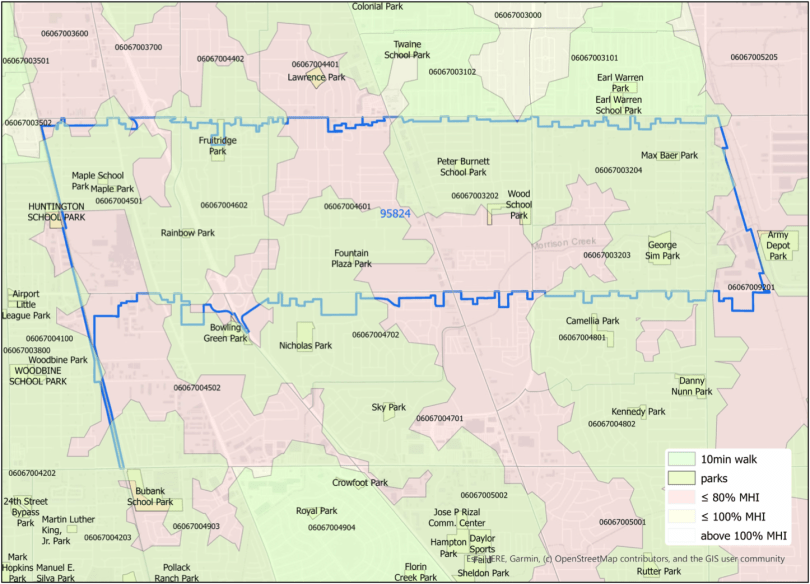
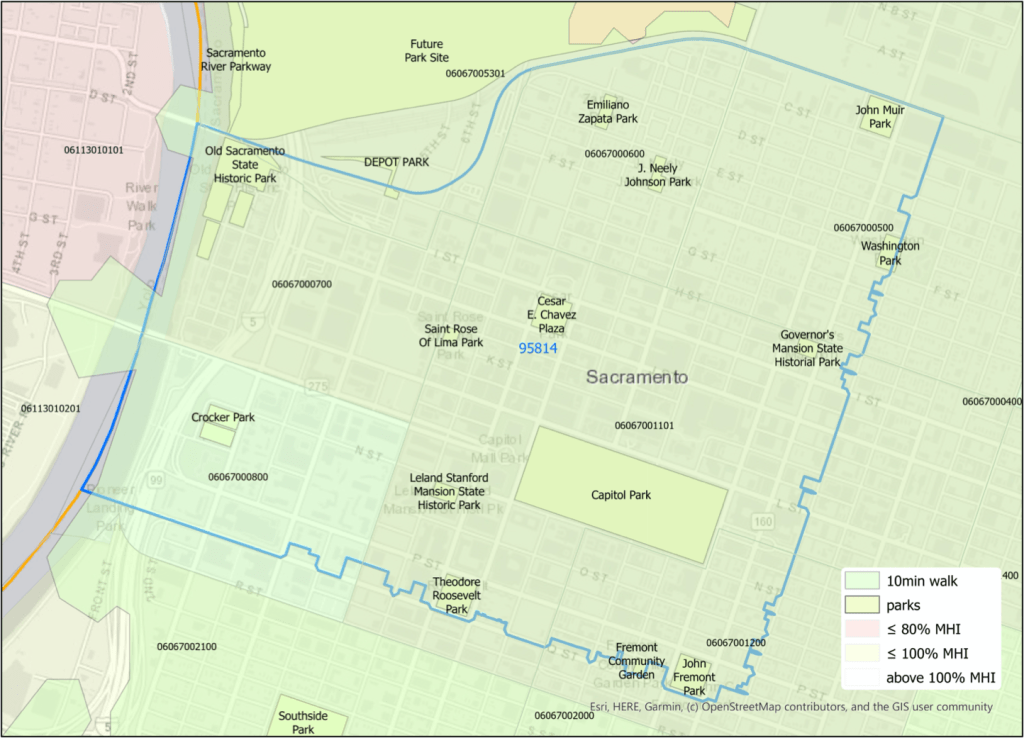
The maps shows the park locations (from the SACOG Regional Parks & Open Spaces 2018 data), and the 10-minute walking area around these parks. The reason I picked 10 minutes is the initiative by the National Parks and Recreation Association (NPRA) and partners: “We’re inspiring and enabling action to create a world in which 100% of people in U.S. cities—LARGE AND SMALL—have safe access to a quality park or green space within a 10-minute walk of home by 2050.” I’ve also included the Median Household Income for census tracts (ACS Median Household Income S1903 2013-2017). On the 95824 map, you can see that the entire zip code is less than 80% of California MHI ($67,169), a disadvantaged community. On the 95814 map, the 10-minute walking area covers up the MHI, but nearly the entire area is also below 80%.

Please note that there are many ways of mapping park access. In this case, I used park centroids (the geographic center of the park), which makes sense for smaller parks, but doesn’t work as well for large parks, and parks which are contiguous but named differently. There are also many ways of looking at disadvantaged community status, and at demographic characteristics. I chose ones that I had worked with before, and other criteria would yield different results. I’ve used zip codes here, though I think that if the cities and county actually analyze the data for need, census tracts are the better polygon size. Census tracts are less familiar to people than zip codes, but census tracts often more accurately represent what people think of as their neighborhood.

So, now with the maps. The first is 95814, downtown Sacramento, and the second 95824, south Sacramento. Clicking on the graphic map will bring up the option to download a pdf.

98814 zip code
95824 zip code

As you can see, the entire 95814 zip code has access to a park within a 10-minute walk. The 95824 zip code, however, only about half the area has access. Very different places! Therefore, I would recommend that the 95824 zip code, for example, needs open streets, now, and the 95814 zip code does not.

I welcome your feedback on these maps. What would you like to see? What data should I be considering? Do you see issues of access and space for social distancing in this way, or another way? What areas do you want to know about?

We can’t go back

sorry, could not find a photo for Sacramento,, but if someone provides it, I will replace this one of Los Angeles (via Business Insider)

We can’t go back to the way things were before! To the car-dominated world where walkers and bicyclists were considered second-class citizens, worthy of consideration only when it did not inconvenience the privileged drivers of cars. The streets are largely empty (except for some essential drivers and too many joy-riders). The air is clean. The city is quiet. It is (other than the above-mentioned joy riders) safe to cross the street, to bicycle on the street, even in some places, to walk in the street. I don’t intend to ever go back, and will work to make sure we do not go back.

Here is a list, with brief notes, of areas in which I think we should not and cannot go back. No priority order. I think that over time my ideas can be refined and added to. Let me acknowledge the many people on Twitter, my main social platform, for giving me a lot of good ideas and food for thought.

  • Right to Move: I believe that, as humans, we have a right to move, to freedom of movement (though I also believe that reduction or even suspension of this right for public health during a pandemic is acceptable, though traumatic). However, this right is expressed through walking (or mobility devices for those not able to walk). It is not expressed through bicycles, or scooters, or even transit, and it is absolutely not expressed through privately owned vehicles. I am not saying that bicycles and scooters and transit are not good methods of movement for transportation, but walking must always be the most important and the most guaranteed, our most basic right, with other modes coming later, if at all (in the case of cars). I am tired of myself and others being terrorized by private vehicle drivers, who are all too happy to inflict their traffic violence on innocent people. Walking FIRST!
  • Transportation
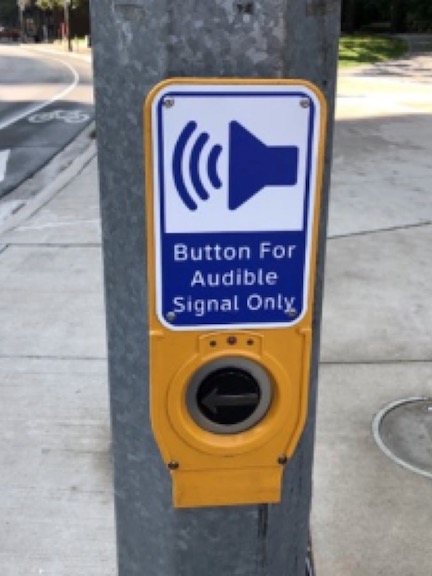
    • all pedestrian signals should be set on recall; they should be labeled with their function; and if there a locations where traffic engineers claim such a low rate of pedestrian use, I’d ask for an analysis of why is there no pedestrian use; if it is an urbanized area, why aren’t there pedestrians, and if it is a rural area, why is there a signal?
    • failure to yield to pedestrians (CA CVC 21950) should be considered a sociopathic offense, similar to drunk driving and smoking in buildings, and strictly enforced; I am not just concerned about the number of pedestrians who are killed and severely injured by drivers, but about all the people who could walk, but don’t, because they are rightfully afraid of car drivers; drivers who repeatedly violate this should have their driving privileges revoked (drivers license suspended and vehicle impounded), and those who still violate should be jailed
    • #NoNewLaneMiles (a more specific version of #NoNewRoads); we have all the roads we will ever need, we just need to use them more efficiently by increasing the density of homes, jobs, and services; because there are no new roads, there will be no greenfield developments, as we have plenty of infill/redevelopment land to work with, and we have an excess of single family homes
    • expenditures on roadways will only go to maintenance, and once a level of good repair is achieved, then to true complete streets projects which reallocate roadway space and increase safe crossings
    • all roadways that are more than two lanes per direction must be reduced to no more than two lanes. Drivers have proven themselves, again and again, incapable of responsibly using wide roadways, and so these wide roadways must end. Temporarily, we can put up barricades or delineators to reduce the lanes, and in the long run, determine and then implement ways of re-allocating this space to best serve the community; some land might be available for housing development
    • freeways will be designed and sized for freight movement, not for commuting; interstate commerce is the primary legally and morally justifiable use for our Interstate system; the idea of continuously expanding freeways so that a continuously expanding number of people can choose to commute continuously expanding distances is not socially or economically rational or feasible; where there are more than two lanes on a freeway, one or more of them should be designated (and enforced) as a freight-only lane so that freight is not slowed by commuting traffic
    • private and commercial fossil-fueled vehicles must be strictly controlled on all spare-the-air days; if the air quality particulates (winter) or ozone (summer) exceeds the ‘healthy’ level, then we start shutting down vehicles; this would be much easier to do if we implemented a pricing scheme (congestion management) all the time, but if we are still working on that, we can in the meanwhile reduce traffic; I’m thinking the easiest way to do that is to control on-ramps and off-ramps, since most long distance commuters, and much commercial traffic, is using the freeways; some on-ramps already meter vehicles, and we could just slow this down so fewer vehicles are allowed to enter; we would have to add off-ramp metering; there are a lot of ways of managing traffic, some of the best controlling the amount of underpriced or free parking, but this is definitely one to explore
    • vehicles must be speed limited, so that drivers cannot exceed safe speed limits; this is one of the easiest to accomplish because all modern vehicles could be speed limited with minor software modification, but I realize that it is politically the least feasible; nevertheless, we need to be talking about it and advocating for it
  • Work from home: I fully understand that not every job is amenable to working from home, and interestingly, it turns out that almost all of the truly essential jobs are not, but nevertheless, many jobs are; employers should be required to analyze each job position to determine whether a particular job could be done from home, either all the time, or some days of the week, and then to implement work from home policies that allow the least in-person work required
  • Schools: I am part of the educational system. I like the idea of school choice, and I think it has a number of benefits. However, I also see the cost of it. A huge amount of driving, taking students to and from school. The idling of cars outside the school has a measurable and negative impact on air quality in the classrooms. Much of this driving is unnecessary, and trips could be done walking or bicyclist, but is driven for the convenience of the parents (not the students). The greatest danger students walking and bicycling face is the drivers taking their own child to school, and in addition to the direct danger, there is the intimidation that makes people less willing to walk and bike. Students are getting significantly less physical activity. Students and families feel less connected to the neighborhood they live in, and the school feels less connected to its neighborhood as well. So:
    • for any school located on an arterial with more than two lanes of traffic in a direction, lanes will be immediately closed in order to increase the safety of students walking and bicycling, and to create a less polluted and hectic environment
    • private vehicles will be prohibited on campuses, except where the parent has submitted a statement to the school detailing why a particular student must be transported directly to the school (meaning, a disability of some sort), and received a pass; schools are there to educate students, not to accommodate drivers
    • for schools located on local streets, the block on which the school is located will be closed to through traffic for the duration of arrival and dismissal (or longer); of course this means that students and families using mobility devices must be guaranteed high quality sidewalks and crosswalks, with ADA ramps, at least 6 feet in width, and in good repair
    • school districts should have a conversation with families and the public about the ways in which a non-neighborhood school supports and does not support academic learning and the needs of its community
  • Housing: Part of the reason we have a housing crisis is that single family homeowners have been able to suppress the building of homes, for some types of people (read: minorities) and for some kinds of housing (read: multi-family), for a long period of our history. We all suffer from this: un-housed people, high rents, separation of jobs and housing, climate change, air pollution, most of our transportation dollars going to long distance commuters while we have potholes in our local streets, underinvestment in transit and rail, etc. The most egregious, though largely hidden from view, aspect of this is that single family housing has bankrupted our cities, and counties, and state. Single family housing can never generate enough sales tax or property tax or user fees to pay for the maintenance required to sustain all these spread out houses and roads and utilities and law enforcement, and fire, and, and and. I think it is becoming clearer by the day how financially on edge our governments were. They have huge bond debt, huge deferred maintenance and well as current maintenance obligations, and far too much reliance on new development just to keep the old going (which is called the development ponzi scheme – see Strong Towns). Sprawl is the primary though not the only driver (pun intended) of this. So:
    • immediately remove all residential zoning classifications, so that there is only one residential zone, and no limit on the types of housing that can be constructed on a piece of land; until such time as we can analyze what we need in terms of zoning and development standards, I’d leave the rest be, but this is a step we can and should take immediately
    • no developments (even infill) larger than a certain size should be allowed to deed road and utility improvements to cities and counties, unless they pay a fee to a maintenance endowment sufficient to maintain that infrastructure for all time; I am not talking about development fees, which of course are used to maintain past infrastructure and to keep the doors open, but never retained for the future, rather, these are banked funds to meet the needs of the future
    • recognize a right to housing for all people; this is obviously a huge undertaking, for which governments may not have the money (because of the sprawl subsidy and bankruptcy detailed above), though there is certainly a lot of shifting of resources that could get us a significant way there, but we need to start working toward that goal now, and with much of our societal focus on how to solve the issue as quickly and equitably as possible

Thank you if you stuck with this long list to the end. As I said, it is preliminary, and your constructive comments here or on Twitter are welcomed.

I admit that I thought we had a decent world, many issues to work on, but sort of OK. Probably some others felt this way. But the bottom has dropped out, for those in poor health (much of that poor health due to all the actions above that we did not take), people of color, low income people, un-housed people, people dependent on employer-provided health insurance, people in essential jobs. I am very lucky! (yes, the luck of privilege).

I hope that we reflect deeply on the clean air and streets available for people (outside cars) to live, and all join together to make sure we do not go back to the old, unenlightened times, but to work hard towards a better future.

I am quite aware that I have not mentioned, or have lightly touched on, a lot of other issues that are critical to so many people. Climate change is one of the biggies for me. Please don’t think that those other issues are unimportant to me, but transportation is my expertise and advocacy, and it needs strong voices, now and always.

beg button signs

The Manual for Uniform Traffic Control Devices (MUTCD), and the California equivalent, are standards for the design and placement of traffic control signs. They have the force of law for any federal or state funded roadways, but there is no enforcement mechanism, so signs that do not meet these standards can certainly be found, both in places that just decide they know better, and in places where the public right-of-way and use is evolving rapidly and the glacial pace approval of new signs is not keeping up.

The MUTCD has 14 signs related to the use of beg buttons to cross the street, in the R10-1 through R10-4 series. One of these is shown below, the most complicated one, R10-3e. Of the 14, none offer any information about whether the beg button is required or not. This is not an oversight; it is a direct expression of traffic engineer’s disdain for pedestrians. California could, of course, add other signs with better information, after approval by FHWA, but it has not seen fit to do so.

Noting the lack of good signs that actually address real-world situations, some entities have designed their own. One example is below, which came via Don Kostelec, of whom I’ll have more to say shortly. (original source not known)

Why is the distinction between these two types of signs important? Buttons can be used by limited vision or blind people to trigger the pedestrian signal, and the auditory and sometimes vibratory message that goes with it. When the conversation started about removing beg buttons, many disability advocates were up in arms, understandably. If there is no button, there is no message.

Except, of course, for automatic detection of pedestrians, and even pedestrians types, that many other countries and a very few places in the US are installing. Traffic engineers routinely resist automatic detection as “too expensive and not practical” despite spending much larger sums on vehicle detection. Which in the case of bicyclists, often doesn’t work anyway.

Traffic engineers also frequently place buttons in places where people with disabilities, as well as everyone, can’t find them and/or can’t reach them.

So, is there a way to preserve the function of buttons needed by disabled people, while not discriminating against all pedestrians? You bet. Just label the button for its function. And put it in an accessible location.

So, Don Kostelec. He is one of my heroes, as he has done a better job than anyone I know of documenting the failures of transportation agencies to install safe and usable pedestrian facilities. Sidewalks too narrow, or that end where you really need them; ADA ramps to nowhere; crosswalks that can’t be safely used; and on and on. I highly encourage you to check out his blog (http://www.kostelecplanning.com/blog/) and Twitter feed (@KostelecPlan). He does not hesitate to call out road and traffic engineers for their failure to think, and for their failure to follow their professional code of ethics. Though he didn’t originate it, I think he is responsible for popularizing the expression “Hold my beer!” in the transportation world, implying that only an engineer drinking beer, and momentarily designing a roadway or facility before going back to drinking, could have done something that stupid.

And on this topic of beg buttons, I particularly encourage you to read his recent post, Push buttons: The good, the beg, and the ugly.

There has also been a lot of discussion about whether it is hard to change the buttons from required to not required, which is called auto recall, or just recall. A number of cities have changed hundreds of buttons in very short order because they prioritized it. Newer signal control boxes allow changes to be made remotely, changing the function and timing of pedestrian signals. Older control boxes may require that someone go out and physically change them. The older boxes are sometimes derisively called squirrel cages because they had large physical clocks with rotating dial, with pegs to change the signal on or off, as it came around. They made noises like a squirrel or hamster cage. A few idiots have been saying that pedestrian signals should not be changed remotely because of security issues. That is the whole point of modern signal controllers, part of Integrated Traffic Systems (ITS), that they can be can sense and respond to actual traffic, and can be adjusted remotely to respond to changing conditions and for changing flow when crashes occur.

There is also the issue that many transportation agencies don’t know what is at the intersection. Does it have pedestrian signals or not? Does it have pedestrian countdown or not? What is the timing of the pedestrian phase, in terms of countdown? Is the beg button required or not? They simply don’t know. Locally, Sacramento County is the worst on this issue.

Previous post on beg buttons: Don’t touch that button! Then, there are locations where pedestrian crossing is simply prohibited, for reasons having everything to do with speeding traffic and nothing to do with pedestrian safety: and crossing prohibitions, and no-ped-crossing in the grid.

prudent vs. irresponsible drivers

The previous post was about prudent drivers. The table below shows how I think of prudent drivers, and irresponsible drivers. It is so hard to not be snarky about driver behavior, but I have toned it down quite a bit. If you think I am exaggerating, then you don’t spend much time on the roads walking and bicycling. I spend a lot of time doing both, probably averaging three hours per day, all of it closely observing driver behavior and the roadway built environment, because it is both my job and my advocacy. The irresponsible behavior is something I see every day, from a significant percentage of drivers. Notice that I did not use the term negligent driver, as is the legal term in my prior post on a prudent driver, because only some of this is negligent; much of it is just sociopathic.

Prudent Driver Irresponsible Driver
yields to pedestrians in crosswalks and waiting to cross never yields to pedestrians
takes turn at stop sign intersections goes out of turn at stop sign intersections
obeys speed limits, within 5 mph drives as fast as possible in all situations
on multi-lane roads, always slows or stops if a vehicle in another lane is stopped on multi-lane roads, pulls around other vehicles that are stopped, honks, and proceeds at full speed
rarely uses their car horn, and only to prevent a crash often uses their car horn to make those other idiots pay attention and get out of the way
is aware of what is going on around them is focused on other things than the road
doesn’t use their smart phone while driving, other than wayfinding holds ongoing conversation on smart phone; texts when they think they can get away with it
passes bicyclists with a safe distance, even when it means waiting yells at, honks at, and close-passes bicyclists, because they don’t belong on the road
believes all people have a right to share the public space on the roadway believes that right to the roadway is determined by the value of their vehicle and social status
will do anything to avoid a crash revels in crashes when they know they are right
knows the the cost of building and maintaining roads is subsidized by everyone is certain that gas tax monies are being illegally diverted to other uses
knows that parking is never ‘free’ and someone, or all of us, are paying believes that the right to free parking is guaranteed in the constitution, and that the parking space in front of their house belongs to them
could be a male or female (or non-binary) is almost always a male

a prudent driver

700. Basic Standard of Care: A person must use reasonable care in driving a vehicle. Drivers must keep a lookout for pedestrians, obstacles, and other vehicles. They must also control the speed and movement of their vehicles. The failure to use reasonable care in driving a vehicle is negligence.

Judicial Council of California Civil Jury Instructions, 2019

The term ‘prudent driver’ does not exist in law or case law for California, though it does for some other states. The concept is useful enough that I’d like to explore it here. The term is closely related to other concepts such as a ‘reasonable person’, ‘prudent man‘, ‘prudent person’, ‘duty of care’, and ‘standard of care’. The Judicial Council of California Civil Jury Instructions (CACI) document, excerpted above, is often referred to a ‘case law’, instructions for how to interpret legal codes, based on court findings. Many terms in California Vehicle Code are left intentionally fuzzy, but case law removes much of, but not all of, this fuzziness. In civil law, which is what this document covers, the three criteria for establishing liability are negligence, causation, and harm, meaning that the person acted in a negligent way, and harm was caused by the negligence.

Of the two issues most relevant to people walking, speeding and failure to yield are the most significant.

706. Basic Speed Law (Veh. Code, § 22350): A person must drive at a reasonable speed. Whether a particular speed is reasonable depends on the circumstances such as traffic, weather, visibility, and road conditions. Drivers must not drive so fast that they create a danger to people or property.

Judicial Council of California Civil Jury Instructions, 2019

Section 706: Basic Speed Law (and sections 707 and 708), presents the idea that violation of the speed limit is not, per se, evidence of negligence on the part of the driver, but that the test is whether the speed was reasonable. In most European countries, violation of speed limits is negligence, but unfortunately that is not the case in the US. But the document does lay out pretty clearly that the driver is responsible for controlling their vehicle and anticipating the presence of other users on the roadway.

710. Duties of Care for Pedestrians and Drivers in Crosswalk (Veh. Code, § 21950): A driver of a vehicle must yield the right-of-way to a pedestrian who is crossing the roadway within any marked crosswalk or within any unmarked crosswalk at an intersection. When approaching a pedestrian who is within any marked or unmarked crosswalk, a driver must use reasonable care and must reduce his or her speed or take any other action necessary to ensure the safety of the pedestrian.

A pedestrian must also use reasonable care for his or her own safety. A pedestrian may not suddenly leave a curb or other place of safety and walk or run into the path of a vehicle that is so close as to constitute an immediate hazard. A pedestrian also must not unnecessarily stop or delay traffic while in a marked or unmarked crosswalk.

The failure of a pedestrian to exercise reasonable care does not relieve a driver of a vehicle from the duty of exercising reasonable care for the safety of any pedestrian within any marked crosswalk or within any unmarked crosswalk at an intersection.

Judicial Council of California Civil Jury Instructions, 2019

Section 710 covers the failure to yield to pedestrians violation, CVC 21950. The case law does have some interesting quotes:

“While it is the duty of both the driver of a motor vehicle and a pedestrian, using a public roadway, to exercise ordinary care, that duty does not require necessarily the same amount of caution from each. The driver of a motor vehicle, when ordinarily careful, will be alertly conscious of the fact that he is in charge of a machine capable of projecting into serious consequences any negligence of his own. […]”

“It is undisputed that defendant did not yield the right of way to plaintiff. Such failure constitutes a violation of the statute and negligence as a matter of law in the absence of reasonable explanation for defendant’s conduct.”

To summarize, my interpretation of the judicial guidance is:

  1. Drivers must control the speed of their vehicle, no matter what the posted speed limit, in recognition that they must always be aware of other users of the roadway and take all reasonable precautions to ensure that crashes do not occur.
  2. Drivers must yield to pedestrians who are exercising reasonable care in crossing the street, and the pedestrian has a presumption of right-of-way in the absence of other evidence.

So, a prudent driver would not be negligent, and a negligent driver would not be prudent.

Next post, more about how a prudent driver behaves.

the city could do this now

Some things the City of Sacramento could do today, and this week, to improve transportation and safety now and in the future:

  • Paint red curb offsets for all marked and unmarked crosswalks. These are upstream offsets, which have a strong safety value of increasing the visibility of drivers and walkers to each other. Downstream offsets, beyond the crosswalk, are much less important. Paint is cheap! Yes, maintenance of paint is more expensive, but this is important enough to make the investment.
  • Set all pedestrian signals to auto-recall, city-wide. Later we can have a discussion about whether to leave them this way, and how this interacts with the audible signals for limited vision people. I’m NOT saying disconnect the buttons, they would work if you pressed them, rather, that you no longer need to press them.
  • Convert the southbound light rail lane on 12th Street from a shared general purpose travel lane to a transit lane, from C Street to K Street. Having drivers interfere with light rail should never be OK. Consider doing the same for the portions of 7th Street and 8th Street where there is excess vehicle capacity.
  • Enforce, with a vengeance, speeding and failure to yield to pedestrian laws. Impound the cars and revoke the licenses of anyone who has more than one of these violations in a week. Our streets have been taken over by lawless joy-riders, and we need to take them back, for the safety of walkers, bicyclists, and other people in vehicles, and yes, people in adjacent buildings. Yes, these situations will end up in court, about whether the city has the power to do this, but in the meanwhile, we get these people off the street. This is an emergency, after all, and this seems a reasonable use of police emergency powers.
  • Close at least one street of at least a eighth mile length in every census tract. Since census tracts vary by population size, in a very rough way, this distributes the closed streets in the fairest manner. It provides people safe walking space in their neighborhoods, to ensure physical distancing.
  • Close the extra lanes on any street that has more than two lanes per direction, and re-allocate that space to either pedestrians or bicyclists, as demand seems to indicate.

There is construction going on right now on N Street adjacent to Capitol Park. The street has been narrowed from three lanes to one lane, and it is working just fine. The prudent driver, the one following speed limits, or at least in the range, now sets the speed of the roadway, and the egregious violators have to live with it. Which is, I think, why I’m not seeing problems on N Street right now, and am still seeing it on other wide roadways.

What else would you recommend, actions that could take place almost immediately and would not cost much?

16th & E construction problems

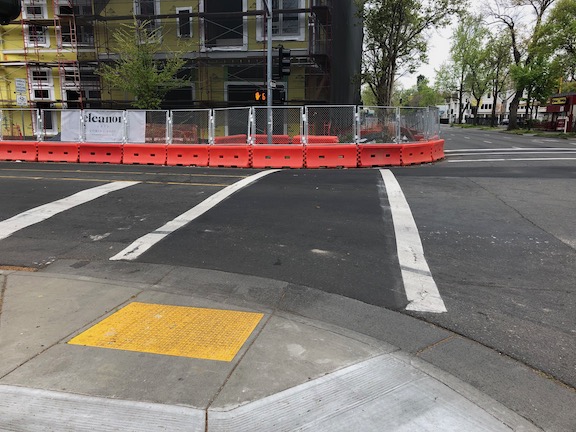
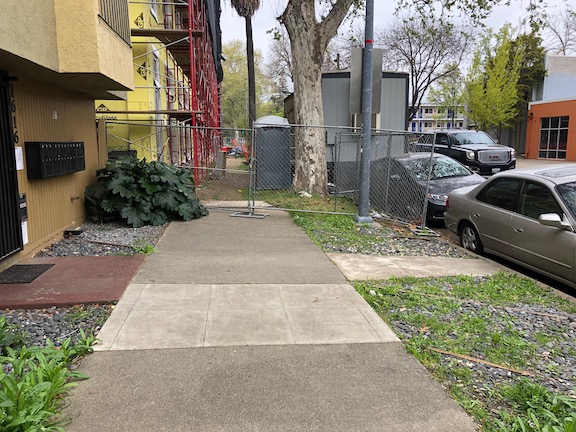
An new housing development at 16th Street and E Street (remember, I’m not against housing developments) has significant problems. At the southeast corner of 16th and E, the corner has been completely blocked by construction barriers and fencing, so there is no safe wait space for people using the crosswalk, and therefore both crosswalks should be closed. There should be a barrier and signing on the east side crosswalk over E Street, and there should be a barrier and signing for the south side crosswalk over 16th Street. Neither are there.

16th Street & E Street, no crosswalk barrier

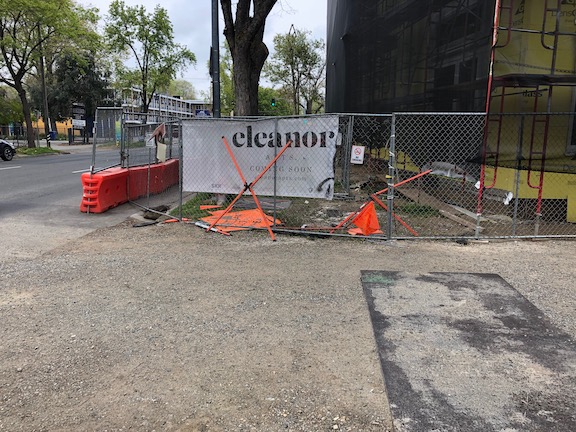
The project also has problems on 16th Street approaching from the south, where the sidewalk end, but a small sidewalk closed sign is not visible because it is on a canted fence, and there is no advance warning at F Street.

16th Street northbound, no visible signing

On E Street westbound, there is a construction fence with no sidewalk closed signing, nor is there any advanced signing at the last safe crossing at 17th Street.

E Street westbound, no signing

This property and development is apparently owned by SKK Development, Sotiris Kolokotronis, and is called Eleanor Apartments.

closed sidewalk & dead project at 700 16th

The apparently dead redevelopment project at 700 16th Street, the old Clarion Hotel, which occupies the block between 16th and 15th, and H Street and Government Alley, has closed sidewalks for a long period of time, even though nothing is happening there. The sidewalks closed are on H Street, the entire block, and 15th Street, the half block. As seen in the first photo below, there is enough pedestrian traffic on 15th Street to have worn a path in the sidewalk buffer. The solution here is to require the developer to remove this fence. If fencing is needed, which is doubtful on this side of the building, it should be on the property and not in the buffer. Re-opening this piece of sidewalk until such time as there is active development is the right thing to do.

15th Street use path, north of H Street, old Clarion Hotel

On the northwest corner of 15th Street and H Street, the corner could have been left open so that the two crosswalks could be safely used, but it was not. Instead, a sloppy fencing job leaves a sidewalk too narrow for ADA use.

15th Street & H Street, northeast corner, no ADA access for crosswalks

The sidewalk closure on H Street might need to remain because there is building access on this side, but it should be properly signed approaching from the east, which is is not.

H Street & 16th Street no signing

Lastly, on 15th Street southbound at Government Alley, there is a fence but no signing, and there is no advance warning at G Street that the sidewalk is closed ahead.

15th Street at Government Alley, no signing

This property is apparently owned by SKK Development, Sotiris Kolokotronis, and is called The Bernice. This failure to accommodate walkers is both the fault of the owner/developer, for the poor job of fencing and signing, and of the city for failing to monitor the situation (and perhaps for allowing it to exist in the first place). This also points out that there must be bonds for construction zone fencing and signing so that if a owner/developer fails to proceed with development, the city can go in and partially or fully restore access at the developer’s expense.

Sac permanently closes sidewalk

Note: updated 2020-03-28 to correct lane descriptions and add a photo of the lane shift.

On the south side of I Street, between 15th Street and 16th Street, the city has permanently closed the sidewalk. This was to construct a loading dock for Memorial Auditorium. I had noticed the construction going on there, the first phase of the city’s project for the convention center and community center theater, and just assumed things would be returned to normal when construction was complete. How wrong I was. I was flabbergasted when I saw this. The loading dock sticks quite a ways into what used to be the public right of way, erasing the sidewalk and two parking lanes (the general purpose lanes were shifted to the right). The loading dock is concrete, intended to be there forever. See the photos below.

If the loading area was really than important, and could not be provided anywhere else, the city could have set things up for easy temporary closure of some of the street so as to allow loading when needed. They did not, they made it permanent.

I have walked by here, on the sidewalk, when events were going on at the Memorial Auditorium and there were a lot of walkers using this sidewalk. I imagine for a lot of other uses as well.

Also note that the ‘ bike lane’ stripe does not meet standards for a bike lane because it is immediately adjacent to a hard barrier and fence, so requires shy distance not provided. So that means when there are eventually bike lanes on I Street, this will be a gap, permanently.

What the fuck were you thinking, City of Sacramento?

photo: I Street, south side, east of 15th Street
I Street, south side, east of 15th Street
photo: I Street, south side, east of 15th Street
I Street, south side, east of 15th Street
photo: I Street, south side, west of 16th Street
I Street, south side, west of 16th Street
photo: I Street, south side, west of 16th Street
I Street, south side, west of 16th Street
I Street westbound, lanes shifted right

10-minute walk to parks

There is a national movement, 10 Minute Walk, with a goal of every person in cities of all sizes is within a 10-minute walk to a park, by 2050.

In the Sacramento region, the City of Sacramento (Darrell Steinberg), the City of Elk Grove (Steve Ly), and the City of Citrus Heights (Jeannie Bruins) have signed on. None of the other cities have. Looking at the listing for the western United States, all are cities except for Los Angeles County. I am not sure if park districts can sign on, but that might make some sense for Sacramento County which has a large number of separate park districts as well at Sacramento Regional Parks.

Why is this important right now? Many neighborhoods do not have sidewalks, so people out for physical and mental health must walk in the street. Sometimes that is OK, on very low traffic and low speed streets, but as you may have noticed, some drivers are using the empty roads as an opportunity to speed and driver recklessly, unconstrained by congestion. Even on streets that have sidewalks, they are often much too narrow (4 feet, 5 feet, occasionally 6 feet, rarely more; I am talking about neighborhoods were most people live; central business districts often have wide sidewalks but few residents) to share with the 6-foot physical distancing requirement. Parks are a great alternative. I am not talking about gathering in parks, which has been prohibited or strongly discouraged in most places, but just a safe and pleasant place to walk. Though many of us will be working to prevent a return to previous traffic levels and speeds, the mostly empty streets we are seeing now have a limited shelf life, and the need for parks will be even greater.

Though I’ve been aware of this goal for a while, I have not looked into it or gotten involved yet. As I have the chance, I will post more, perhaps a map of the city or county showing ten minute walk buffers around parks, and information about whether this goal is in the existing and updated general plans for the counties and cities in the region.

In the meanwhile, you might want to look at the National Recreation and Parks Association (NRPA) web page on 10 Minute Walk for some background information.

Enjoy your walks!

10 Minute Walk logo