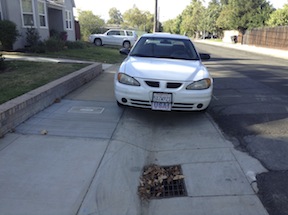
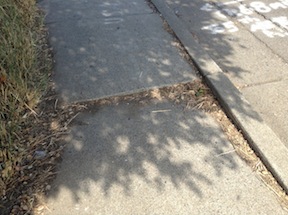
surprisingly good sidewalks

repaired sidewalk around tree, P Street at 16th Street

When working on my post about responsibility for sidewalks, I realized I did not have a good illustrating photo for the post, so I went off walking in my neighborhood (midtown) looking for examples of broken sidewalks. After walking a couple of miles, I’d found only a few, and they were not bad. I guess my view of the world has been jaundiced by the time I spend in the suburbs, where many of the sidewalks are broken and deteriorating. There, it would take me less than a block in most areas to find something wrong with the sidewalk, or to find no sidewalk at all.

In midtown, that is not so. I see a lot of places where the sidewalk has been replaced or repaired, often many times over the years, in a patchwork of concrete of varying ages. There are asphalt patches over uneven sections, which work as long as they are kept up to date, but must eventually be repaired by removal and replacement.

Read More »

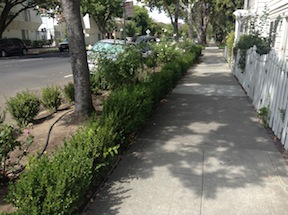
sidewalk buffers

garden sidewalk buffer on Q Street

The purpose of sidewalk buffers, also called planting strips, is to isolate pedestrians from moving motor vehicles, where parking does not provide a sufficient buffer. Sidewalks adjacent to the curb are called attached sidewalks, while sidewalks with a buffer are called detached sidewalks.

Traditionally all residential, collector, and arterial streets had buffers. Retail areas often did not, in order to make getting from the car to the sidewalk more convenient.

Modern suburbs, however, usually eliminated the buffer strip from all streets in order to maximize the area available for development and roadways. Pedestrians do not like to walk next to fast traffic. In part, the elimination of buffers is why there is much less walking in the suburbs. The lack of buffers also makes an area look harsh, with a bland expanse of pavement rather than the welcoming and beautiful strip of nature. The planting strips and their vegetation require maintenance, and responsibility for those areas is another question of responsibility.

Read More »

Choosing streets to walk

business on a two-way, two-lane street (Capitol at 18th)

I walk a lot in midtown, going to and from various destinations such as the train station, nonprofits and agencies I work with, grocery stores, theatres, farmers markets, breweries, etc. I was thinking last night as I walked to and from Capital Stage about what streets I choose to walk on.

Almost all the time I choose to walk on two-way, two-lane streets. I rarely choose to walk on the multi-lane streets and the one-way streets, except for short distances as I zigzag to my destination. The two-way, two-lane streets are usually quieter, less traffic and traffic moving more slowly. I can relax more with the quiet, and I can look around more, paying more attention to everything around me and not just traffic.

Why is this significant?

Read More »

Teaching children to cross

children crossing, Fauntleroy at Alaska, West Seattle (Seattle Bike Blog)

Streetsblog today posted an article “Our Streets Fail to Work for Children” which referred in turn to articles from Akron and Seattle. I commented on the Seattle Bike Blog post “We are failing our kids: A look at Seattle’s terrifyingly normal streets,” but I’d like to amplify my comments and specifically talk about pedestrian education.

Poor pedestrian infrastructure, as documented in these posts, is everywhere, more so in the suburbs and rural areas than in urban areas, but everywhere. The problems include:

Read More »

The I Street mess

Thank you, Elle, for reminding me in your “transportation ‘planning’ downtown” that I wanted to write about I Street. Note: If you are looking at Google Maps, it does not show the current lane configuration on I Street since the repaving and re-striping project of last fall, nor the realignment of tracks and work on extending 5th and 6th streets over the tracks.

I Street from the 4th Street crosswalk
I Street from the 4th Street crosswalk; I have the walk signal but this is still scary

I Street in Sacramento approaching the train station is a mess. Starting with the confusing floating bike lane between 7th and 6th streets (subject of a future post), the street becomes worse and worse: five lanes wide, high speed, and completely unfriendly to bicyclists and pedestrians. For pedestrians, the crossing on the east side of the I/5th intersection is uncomfortable because westbound traffic is already moving at high speed and often runs the red light, and right turning cars from I to 5th often do not yield to pedestrians in the crosswalk. The west side is so unsafe due to traffic turning left off 5th Street, it is signed against pedestrian crossing, even though this is a logical walking route from downtown to the train station. A crosswalk has been added on the east side of the I/4th intersection, but it has the same challenges that drivers are moving too fast and often run the run light. When I used this new crosswalk, I was very concerned, and I have a much higher tolerance for danger than most people do.

The right-most two travel lanes lead to the high-speed northbound I-5 freeway onramp, so drivers passing 6th Street are already accelerating to freeway speeds, many times going 55 mph as they cross through the I/5th intersection. The next two lanes lead to a medium speed onramp to the I Street bridge over the Sacramento river, and to the southbound I-5 onramp. For pedestrians, the only way to go westbound towards Old Sacramento is to go through the parking lot for the train station and under the onramps along an ugly, dark, poorly marked pedestrian way.

Read More »

Walkable City – live chat

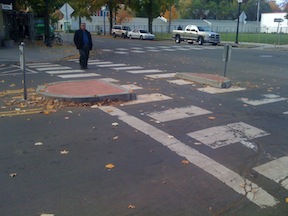
Pedestrian Refuge Median

I participated in the Walkable City live chat sponsored by Sacramento Press today, which featured Jeff Speck, author of Walkable City: How Downtown Can Save America, One Step at a Time, William Burg, and host Jared Goyette, which I advertised yesterday. I enjoyed hearing from both Speck and Burg. Burg is sort of the historian laureate of Sacramento, and his local perspective really added a lot.

You can review the recorded live chat by following the link from the live chat link above, and I highly recommend that you do. My take-aways from the conversation are:

  1. Jeff Speck reiterated his “General Theory of Walkability” which defines a favored walk as including the elements of useful, safe, comfortable and interesting.
  2. Speck said that in order to be walkable, a place must have “good bones”, short blocks in a grid pattern, with squares. Nearly always, these are pre-war neighborhoods. Burg pointed out that Sacramento downtown and midtown does have this, though our blocks are longer than many highly walkable cities, but our grid has been broken severely by the freeways and to some degree by the downtown mall and the convention center.
  3. Speck said that many cities that have a great reputation for walkability started with just one great street, or even one great block, such as LoDo (lower downtown) in Denver. The one great place increased the draw for young creatives, which led to more widespread changes.Read More »

Walkable City

Sacramento Press is sponsoring a live chat with Jeff Speck, the author of Walkable City: How Downtown Can Save America One Step At A Time. The live chat is tomorrow, January 3, at 12:30PM. The offline chat is already going on, if you want to check it out. I am currently reading the book, in the Kindle version, but am only part way through.

Many of the online comments so far have focused on creating a livable city, and it is wonderful to see so many positive ideas and accurate identification of challenges. Intelligent conversation like this is rare in the Sacramento news blogs. I’ll make some comments specifically on the walkability safety aspects. I’ve written about this before, but it is worth writing about again and again, because the problems still exist.

Traffic sewers: Multiple lane and one way streets are traffic sewers. This epithet is used to describe streets designed to flush traffic in and out of employment centers (and to homes in the suburbs) twice a day. They serve no other reasonable purpose, and they make a place very much less walkable. Three (or more) lane roadways are incompatible with walkability. They encourage high speed traffic, and provide too long a crossing distance to pedestrians to be comfortable with. They don’t meet the “8-80” criteria, of being safe and comfortable for people of all ages.Solutions:

  1. Therefore, I think that all three-lane roadways in Sacramento must be narrowed to two lanes. If a true refuge median is provided between two directions of travel, at least three feet wide, so that a person can cross each direction of traffic separately, then roadways with a total of four lanes are acceptable. If not, then only a total of two lanes. Six lane or more roadways, common in the northern and southern suburbs of the City of Sacramento, are not acceptable.
  2. One way streets also encourage high speed travel. I think that all of our one way streets should be converted to two way streets. This can be done over time as streets are repaved, it is not as high a priority as the narrowing of streets, above.

Read More »

Aggressive midtown drivers

I’ve only lived in midtown a while, but from the first it was clear to me that here was a walker and bicyclist paradise, at least in comparison to where I’d lived before, Carson City, and where I work, Citrus Heights. It still seems a bicyclist paradise to me, but I’m seeing the dark side for pedestrians. This may be a recent development, or perhaps I’ve just become more aware of the reality. Though I bike more than I walk, I’m certainly a pedestrian too, and there are a large number of pedestrians in midtown.

Many drivers in midtown are aggressive towards pedestrians. At times I think this is mostly commuters who live elsewhere and just work here, but at times I’m sure it includes the people who live here as well. Driver behavior I see on a daily basis:

  • Speeding: drivers exceed the posted speed limit, especially on the one-way streets
  • Failure to yield: drivers do not yield to pedestrians in marked and unmarked crosswalks; this is a violation of the law
  • Failure to stop: drivers do not stop in additional lanes when one driver has stopped; this is a violation of the law
  • Aggressiveness: drivers do not yield to pedestrians waiting to use marked and unmarked crosswalks; this is a violation of human decency

Read More »

Walk Score

Walk Score offers an assessment of the walkability of any location. It is available in any browser at http://walkscore.org/, and is also available as a free app for the iPhone and Android, and in any browser at https://www.walkscore.com. Walk Score is based on the distance to the places people want to go, such as grocery stores, restaurants, coffee shops, bars, movie theaters, schools, parks, libraries, bookstores, fitness locations, drug stores, hardware stores, and clothing & music.

I live at O St and 16 St in mid-town Sacramento P and 12th in downtown Sacramento, which has a WalkScore of 85, very walkable, shown at right. The R St and 16th St corridors, which have higher scores, are easy walking distance. The Neighborhood section of the app offers Walk Score, Transit Score, and Bike Score, but for the entire neighborhood of downtown, not for specific address.

The browser interface offers more information, for both specific addresses and general areas such as Sacramento. The graphic below is only part of the web page. Note that the results from the app and the web site are not the same, and I don’t know why, but they are similar enough that it should not make a big difference.

The exact algorithm that weights these amenities is not public, but you can get an idea by selecting the Street Smarts Walk Score option. Having six grocery stores within 0.6 miles, eight restaurants within 0.2 miles, and eight coffee shops within 0.3 miles supports my score. One critical item not on the list is farmers’ markets, which I would weight very highly, though the seasonal nature of most farmers’ markets might be a challenge. The closest one to me is two blocks away, but it only runs May through September. It is only 1.4 miles to the year-round farmers’ market at 8th St and W St. Some performance theatres show up in the movie theaters category, but some of them do not, so I’d make that a separate category since plays are such an important part of my life.

Read More »