The City of Sacramento and CADA held a community meeting on November 23 on the R Street Phase III Streetscape project, presenting design alternatives for the section of R Street between 13th and 16th streets. Phase I is the already completed portion between 10th and 13th, and Phase II is the upcoming portion between 16th and 18th. Three alternatives were presented for each of the three blocks, basically representing three different levels of traffic calming and devotion of right-of-way width to pedestrians rather than vehicles. Alternative three for each block includes curb extensions or bulb-outs at most corners. All the alternatives include wider sidewalks.
I am glad to see the city moving forward on these improvements, with the already completed Phase I making a huge difference to the usability and appearance of the street. Though the most economically vibrant portion of the street currently is this section from 13th to 16th, it will unfortunately be the last to be completed.
Rolled curbs slope up from the gutter pan to the sidewalk, whereas standard curbs have a more vertical face. Standard curbs are both old and modern, but there was a period of time in the 1950s through 1970s when rolled curbs were very popular, seen as a sign of the new suburbs. In the grid area of Sacramento, including the first ring suburbs, standard curbs are quite common. In the second ring suburbs and the sprawl suburbs, rolled curbs are quite common, not only being found in residential neighborhoods but even on arterial roads.
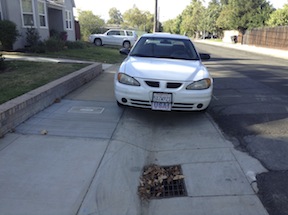
parking up on the sidewalk with rolled curb
So, what’s the problem with rolled curbs? Drivers use rolled curbs to drive up on the edge of the sidewalk, constraining the sidewalk width, reducing walkability, and not infrequently causing blockage of the sidewalk for people in wheelchairs. ADA regulations require at least 36 inches of clear width. Combine the narrow 4-foot sidewalks that were popular in the suburbs with this driver behavior, and the car-influence zone is expanded to the complete width of the right of way, leaving no place for pedestrians. [Note: This photo is for illustration purposes only, not to give this driver a hard time. This is common practice, and I’ve seen many instances where much more of the sidewalk was blocked.]
A side affect of parking up on sidewalks is that it leaves more of the street width for moving motor vehicles, which then increases the speed at which people drive. By trying to get their vehicles out of the way of the “speeding drivers,” they are actually making it easier for drivers to speed.
This week an article in the Sacramento Business Journal, “Rancho Cordova wants to make sidewalks problem of property owners,” talked about the city’s efforts to shift responsibility for sidewalks to the property owners, both residential and commercial. The city spokesperson, Davis Gassaway, attempts to gloss over the impact by saying that it should only cost $1000-1500 to repair a sidewalk, and that Sacramento, Roseville, and West Sacramento already have such ordinances. I think the costs quoted are on the low side. At about $4 per square foot (significantly more for curbs), $1000 would buy 50 linear feet of five foot wide sidewalk in a residential area, and 25 linear feet of ten foot wide sidewalk in a commercial/mixed use area. And just because another city is doing it doesn’t make it a good idea. So, what’s wrong with the idea?
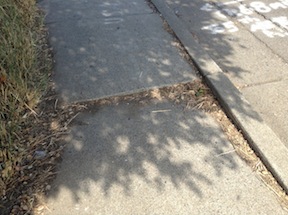
repaired sidewalk around tree, P Street at 16th Street
When working on my post about responsibility for sidewalks, I realized I did not have a good illustrating photo for the post, so I went off walking in my neighborhood (midtown) looking for examples of broken sidewalks. After walking a couple of miles, I’d found only a few, and they were not bad. I guess my view of the world has been jaundiced by the time I spend in the suburbs, where many of the sidewalks are broken and deteriorating. There, it would take me less than a block in most areas to find something wrong with the sidewalk, or to find no sidewalk at all.
In midtown, that is not so. I see a lot of places where the sidewalk has been replaced or repaired, often many times over the years, in a patchwork of concrete of varying ages. There are asphalt patches over uneven sections, which work as long as they are kept up to date, but must eventually be repaired by removal and replacement.
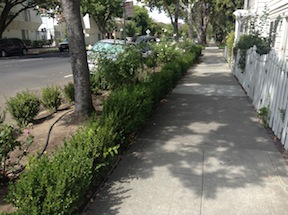
The purpose of sidewalk buffers, also called planting strips, is to isolate pedestrians from moving motor vehicles, where parking does not provide a sufficient buffer. Sidewalks adjacent to the curb are called attached sidewalks, while sidewalks with a buffer are called detached sidewalks.
Traditionally all residential, collector, and arterial streets had buffers. Retail areas often did not, in order to make getting from the car to the sidewalk more convenient.
Modern suburbs, however, usually eliminated the buffer strip from all streets in order to maximize the area available for development and roadways. Pedestrians do not like to walk next to fast traffic. In part, the elimination of buffers is why there is much less walking in the suburbs. The lack of buffers also makes an area look harsh, with a bland expanse of pavement rather than the welcoming and beautiful strip of nature. The planting strips and their vegetation require maintenance, and responsibility for those areas is another question of responsibility.
A “green wave” is a traffic signal sequence set so that vehicles will encounter green lights for some distance, so long as they are traveling at the selected speed. A green wave can also be set for bicycle speeds, though it very rarely has been, and never in Sacramento.
To some degree, all signals are set this way, though the degree and distance of sequencing varies widely. Many of the east-west streets in the Sacramento grid have signals set for motor vehicles, and when traffic is not congested, it may be possible to go all the way across downtown and midtown on green lights, for example on J Street. Very few north-south streets are set this way, I can think of only the 15th & 16th couplet, and the 9th & 10th couplet. At intersections with the east-west couplets, these north-south couplets seem to have their green wave broken. Only if the grid spacing and the selected speed calculate out is it possible to have a green wave in all directions. Sadly, many signal sequences in the Sacramento region are set above the posted speed limit, encouraging drivers to speed so that they make all lights.
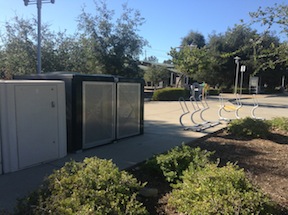
bike lockers at SacRT light rail Glenn station in Folsom (SacRT rental, BikeLink, bike racks)
If you are a light rail user, you may have noticed bike storage lockers at some of the stations. Two types of lockers exist:
rental lockers at 19 SacRT light rail stations, which are listed on the SacRT “Biking with RT” webpage
on-demand lockers at 3 SacRT light rail stations in Folsom, plus the Folsom Pedal Stop bike station
The rental lockers work well for people who routinely commute the same route to and from work, and are leased for 6 months or 13 months at pretty reasonable rates. The downside to rental lockers is that they can be used by only one person, and are empty when not in use by that person. Mike Mattos, SacRT Chief of Facilities & Business Support Services Division, said that these lockers were mostly purchased at the time of rail extensions, and they are repaired and replaced from operating funds. They move lockers from one station to others as demand changes. They have explored on-demand systems, but have not installed any because they don’t feel that any vendors so far meet their criteria. He pointed out that the downside of on-demand systems for typical commuters is that they don’t then have a guaranteed space at their station.
M Street bike routeAs I said yesterday, I choose primarily two-way, two-lane streets to walk on, because they offer a quieter and calmer place to enjoy walking, looking around, and finding businesses to frequent. When bicycling, I’m more likely to be going someplace specific, and more likely to be in more of a hurry. If given the time, I’d almost always rather walk than bike, but bicycling certainly saves a lot of time, and so I bicycle more than walk.
The first criteria for choosing streets to bike on is traffic speed. In the grid, nearly all of the streets are posted 25 mph, but traffic speeds vary widely from 20 to 40 mph. When a street is designed for 40 and then posted for 25, motor vehicle drivers respond by going 40. Again, this is a street design issue. I am not afraid of 40 mph traffic, and I am OK mixing in with it – I’m a vehicular bicyclist, but why, when I don’t need to? So I pick other streets.
First preference is quiet streets with a design or signing welcoming to bicyclists. Best example is M Street in East Sacramento, my usual route to and from Trader Joes, and also when I jump off the parkway at Sac State and continue into downtown/midtown. Streets like M are the closest Sacramento has to bike boulevards or neighborhood greenways.
Second preference is narrow streets without bike lanes. Why? Because the traffic moves slowly on these streets, sometimes below the posted speed. Since I’m now treating stop signs as yield signs, the more frequent stop signs on these streets don’t slow me down very much, there are few vehicles to take turns with except at two brief times of day. Parking along these streets helps a lot, particularly when it is diagonal, because parked cars create friction that slows drivers.
Third preference is streets with bike lanes. But often these are higher volume, higher speed streets. If I’m really in a hurry, these are the streets I use. Fewer stop signs and fewer signals make for a faster trip. In that sense I’m making the same decision as car drivers.
business on a two-way, two-lane street (Capitol at 18th)
I walk a lot in midtown, going to and from various destinations such as the train station, nonprofits and agencies I work with, grocery stores, theatres, farmers markets, breweries, etc. I was thinking last night as I walked to and from Capital Stage about what streets I choose to walk on.
Almost all the time I choose to walk on two-way, two-lane streets. I rarely choose to walk on the multi-lane streets and the one-way streets, except for short distances as I zigzag to my destination. The two-way, two-lane streets are usually quieter, less traffic and traffic moving more slowly. I can relax more with the quiet, and I can look around more, paying more attention to everything around me and not just traffic.
Poor pedestrian infrastructure, as documented in these posts, is everywhere, more so in the suburbs and rural areas than in urban areas, but everywhere. The problems include:






 Getting Around Sacramento