The City of Sacramento’s Farm to Fork Al Fresco program, which has provided space for outdoor dining during the pandemic by using sidewalk, sidewalk buffer, parking lane, and/or street areas, has been in my opinion a great success. Though I’m COVID cautious and not partaking, I know that this program has been critical to keeping many restaurants in business. I hope that the program continues, to some degree, even after the pandemic. Even when dining inside is permitted again, I think these outdoor spaces are a strong addition to the livability of Sacramento, and in almost all cases is a better use of street space than parking. I strongly support the permanent closure of some street segments, particularly R Street between 14th and 15th, and 20th Street between J and K. I also support widening of sidewalks or buffer space so that more restaurants can permanently offer outside dining space.
In the initial rollout, there were a number of problems. Some of the sidewalk diversions were not posted properly, and the ramps provided did not meet ADA. In a few cases sidewalks were completely blocked, without providing an alternate route. But these problems seemed to be quickly resolved, through the work of the city, business owners, and business associations. I talked with a number of restaurant owners and managers, making suggestions of improvements, and they almost always made them. Though I recognize some people don’t think there should be dining or drinking outside at all during the pandemic, this program really has a good vibe, in my mind. The businesses have been positive, the people have been positive.
Except El Santo. El Santo, a restaurant/night club at K Street and 10th Street, put up a barrier and shelter that completely blocks the sidewalk on the south side of K. For a while, the sidewalk to the east was blocked by an active utility construction zone, but that construction is long since over. People walking or rolling (wheelchair) are forced out onto the detectable warning stripe (very uncomfortable to travel along) or the light rail tracks (dangerous). See the photo below.
El Santo, K St & 10th St, blocking sidewalk
I reported this issue to the city on September 23, 2020. I don’t know when the blockage was installed, since this was my backpacking season and I may well have missed it. It is not clear to me whether the city gave issued a faulty encroachment permit or whether the business violated the permit, but the effect is the same, a sidewalk that can’t be used. I followed up with a phone call January 6, 2021. Nothing has been done to correct the issue. The business does not care, the city does not care. It is problems like this one, allowed to fester, that will darken public perception of the Al Fresco program.
Thank you, Ali Doerr Westbrook, for flagging the latest violation of walker and bicyclist accommodation on a construction project in Sacramento.
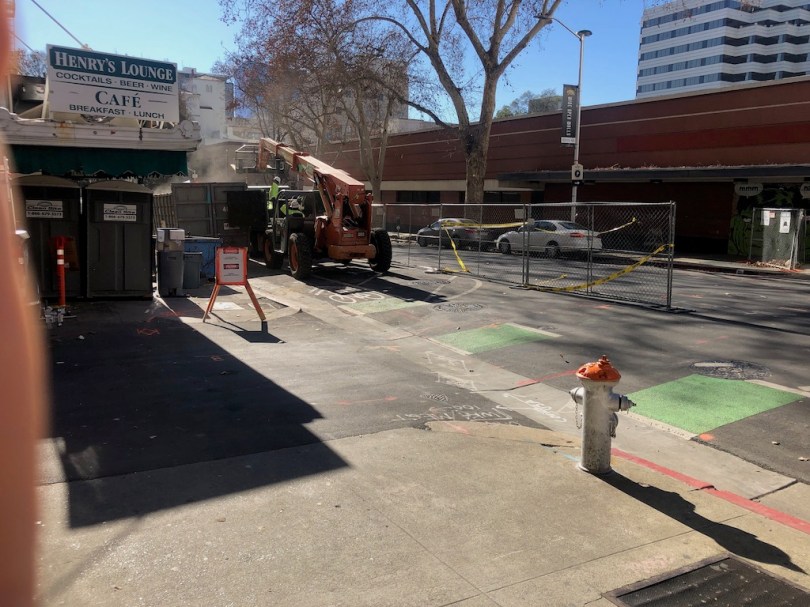
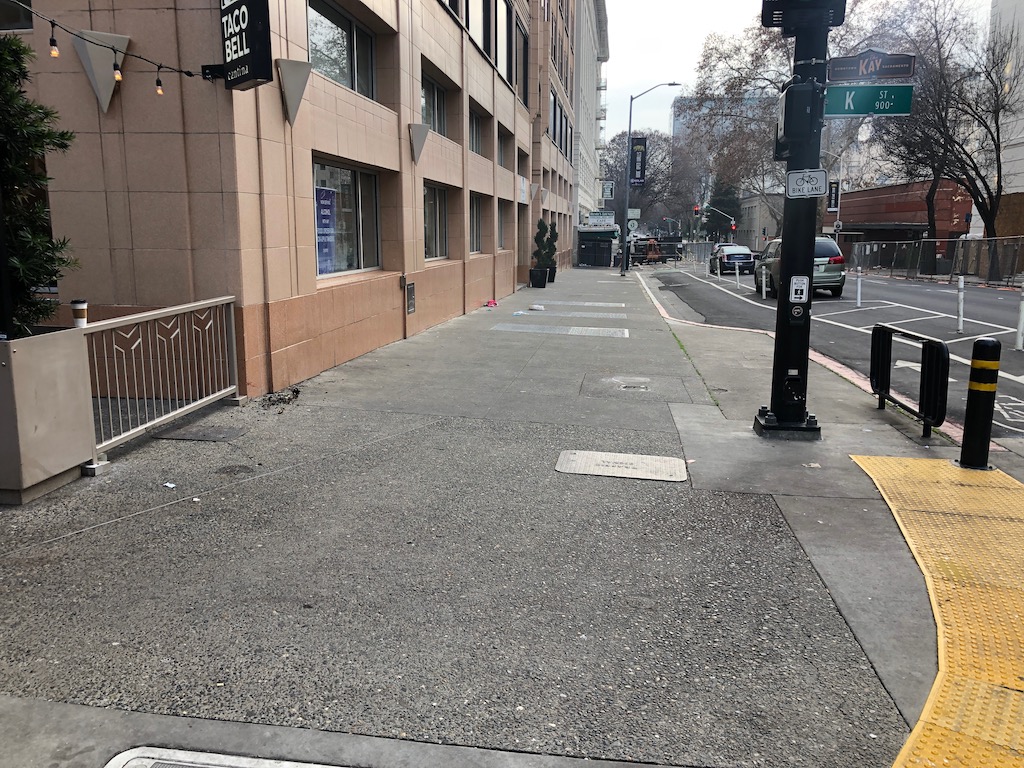
The east side of 9th St between L St and the alley is blocked by a construction project. Both the sidewalk and bike lane are blocked. There is no advance signing at 9th and K for southbound walkers and bicyclists, as required by ADA. There is no signing on the construction fencing, as required by ADA. Construction fencing is not an acceptable detectable warning, as required by ADA. Note that this construction project, the conversion of Capitol Park Hotel into supportive housing, is a city project, so not only is the city responsible for a traffic plan that accommodates walkers and bicyclists, but field checking that the plan is being followed, and enforcing it when it is not.
9th St at K St, no advance warning of closure ahead for walkers or bicyclists
This blockage would in itself be bad, but it is made worse by the blockage of the sidewalk on the west side of 9th St, between K and the alley. This private project is also not properly signed and barricaded. Between these two projects, there is NO walker access on 9th St between K St and L St. None. None. None. Of course one could cross at the alley between one side and the other, but then the city conveniently has a walker-hostile code that crossing streets at alleys is illegal. Got the bases covered, Sacramento!
Though the most egregious, this incident is just the latest in a series of offences in the central city. I have posted on some of these here (tag: construction zone), and on Twitter. I’ve also reported a large number of them to the city’s 311 app. Of these 311 reports, about half are closed without anything being done. Making the same report multiple times increases the likelihood, but doesn’t guarantee it.
The worst of the violations are on city projects. The renewal of Memorial Auditorium had issues. Though now finished, it resulted in the permanent closure of the sidewalk on the south side of I Street. The next worse offense is the ongoing city project called 3C, the convention center and community auditorium construction project. Though some of the issues have been resolved here, several remain, particularly on the 15th St side. And this Capitol Park Hotel project is also a city project. There have been other city project problems, but I don’t have time today to go back through my records and photos to identify all of them.
In response to the concerns from myself and many others, the city had said that it would come up with a construction accommodation policy. After a year, nothing has happened. The city, at least the part of the city responsible for construction zone traffic plans, just does not care. Walkers and bicyclists are routinely ignored or actively discriminated against, in favor of motor vehicle drivers. The city is in violation of its ADA consent decree in allowing these issues to occur and to continue.
Following the online virtual open house, I realized I could not picture the situation on some segments of Stockton. Though I’ve traveled Stockton many times, I had not in a while, so I went back. I had commented during the open house, as well as after, that I didn’t think the cross-sections presented gave enough information on or weight to trees, so that was part of my agenda, to see the tree situation better. The day I went, last Sunday, was one of the cooler days in a while, high of 80 degrees Fahrenheit, but on the street the lack of shade and heat was noticeable. Add 20 degrees, and it would be intolerable for walking and unpleasant for bicycling.
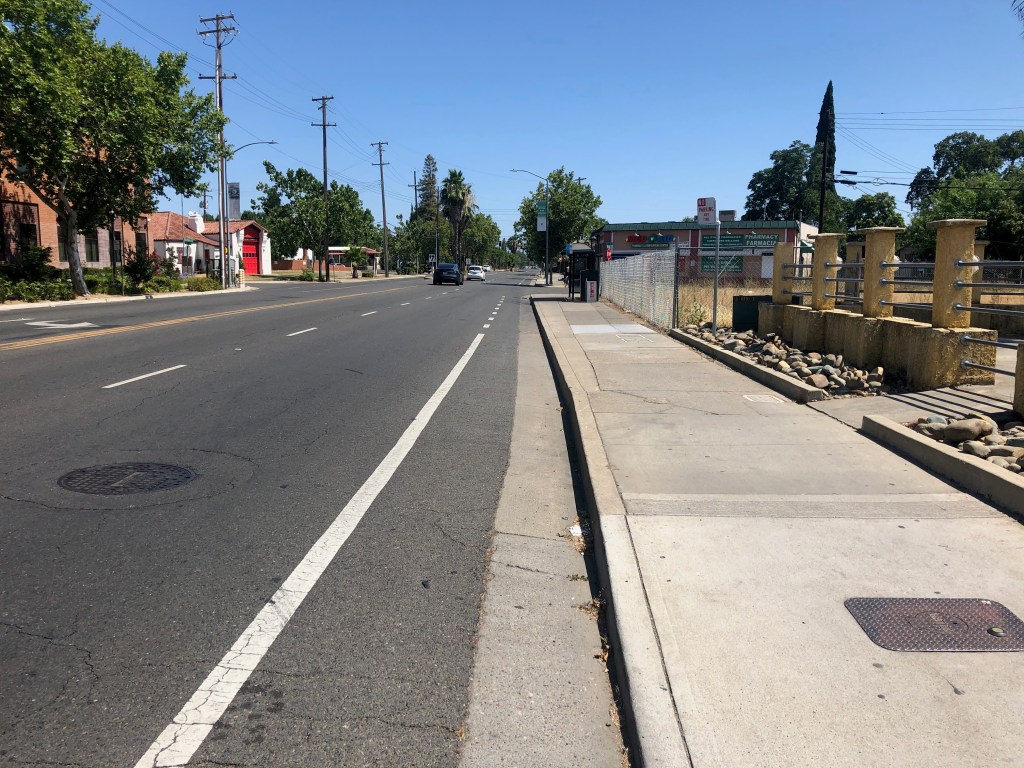
The tree situation is not good. There are some sections with healthy trees, and some places where trees on commercial properties are healthy and shade the sidewalks, but on the whole, trees are lacking. The first photo below, taken looking south, to the south of Broadway, shows a long section with no trees at all, no buffer, no shade. The sidewalk is wide enough, but who would want to walk here?
Stockton Blvd south of Broadway
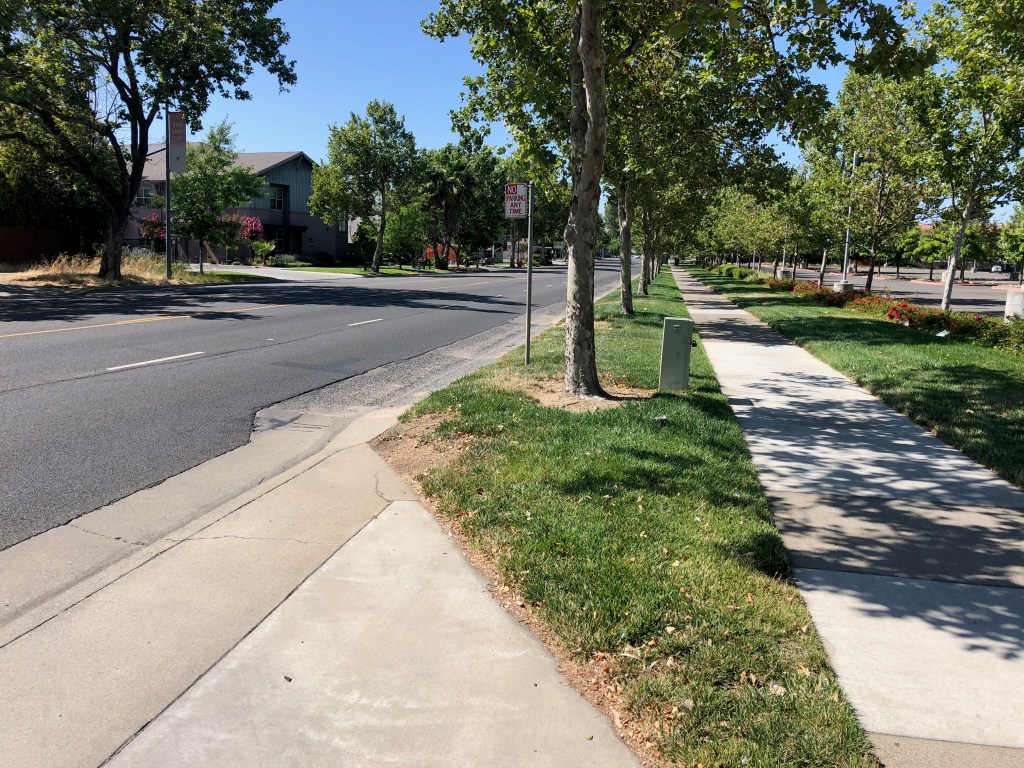
The next photo is of the section adjacent to UC Davis Medical Center where trees are present in a slightly too narrow buffer. The trees are relatively young, but when mature, will provide necessary shade and probably also crowd the buffer.
Stockton Blvd near UC Davis Medical Center
The next photo is of a very narrow strip where trees were present but were all cut down, and the following photo, a Google streetview capture of the trees. The trees were obviously planted in a strip far too narrow for them, and some of them were unhealthy as a result, so I’m not presenting this as a model, but as a warning that commercial properties cannot be relied upon to provide trees. Even the small trees in this narrow strip provided some shade and feeling of place to the street. In addition to this instance, there are many commercial properties and some residential properties along Stockton where the trees are dying, dead, or have been removed. And conversely, some where the trees on commercial properties are in good condition, so thank you to these properties. Trees, if they are to serve as a long-term amenity, as I believe they should, must be provided in the public right of way and maintained by the city.
Stockton Blvd, removed trees, near JansenStockton Blvd, trees before removal, near Jansen
A small archive of photos from Stockton Blvd are available in the Flickr album at the end of this post, and those who live along or do business along can provide more detail.
So what is the solution? The first part of the solution is that the city must modify its cross-section renderings and pages so that it highlights the tree situation. Will there be a sidewalk buffer? How wide? What numbers and kinds of trees? To what degree will the project rely on trees on private property, versus trees in the public right-of-way? I find the options presented as unacceptable because they don’t really address this issue. On a few of the pages, trees are mentioned, but never in enough detail.
I would propose for community along Stockton Blvd that there should be continuous sidewalk buffers planted with trees, all the way from Alhambra to 47th Ave/Elder Creek Rd. Where buffers are present with trees, great, make sure they are preserved and cared for. Where buffers are present but the trees are absent or unhealthy, plant new trees and care for them. Where there are no buffers, create them, and plant trees and care for them. Where there is a healthy tree line on private property, this can serve for now, but the buffer should still be provided for the protection of walkers and as a bulwark against possible abandonment of the private trees. I envision Stockton Blvd being a tree-lined community asset, where walking is a pleasure and traffic speeds and volumes are low.
For new buffers, the minimum width of the buffer should be eight feet, as anything narrower does not allow for full development of the trees, and leads to excessive root heaving of the sidewalk. The heaving is to some degree an inevitable consequence of having trees, but wider buffers and correct watering regimes reduce the problem considerably. Where the existing buffers are at least six feet and the trees are healthy, the buffer can be widened or left as is, depending on the situation. Where the buffer is narrower than six feet, the buffer must be expanded.
Where commercial businesses are present and buildings meet the sidewalk, the trees should still be present, but the spacing and species can be adjusted in consultation with the property or business owners so that they don’t block off visibility of local businesses. In most cases the buffer would be paved, with tree wells for the trees, and street furniture or other amenities in the buffer, but the buffer would still be a minimum of eight feet.
Intersections
Another issues that the city diagrams and information do not address is intersections and crossings. The existing conditions report acknowledges that there are long distances between safe crossings on the south end, but doesn’t provide much detail about intersections.
The intersections as they exist actively discourage pedestrian activity. The midblock crossings, of which there are a few, do not have any additional protection. At a minimum, these locations need user-activated RRFBs (Rectangular Rapid Flashing Beacons). At many of the signalized intersections with minor streets, there is a pedestrian prohibition on either the north or south leg. These prohibitions exist solely to speed the signal cycle and encourage traffic flow; they do not exist for safety reasons. They must be removed. The photos below shows just one of the many such prohibitions. A person walking on the south side of Jansen, wanting to go south on Stockton, would have to use two crosswalks, waiting for the signal, and then walk through an overly wide commercial driveway. There is no reason for this.
Stockton Blvd at Jansen Dr, pedestrian prohibition
At the major intersections, where crosswalks are present on all legs, the crossing distances are long. Though not as bad as many other locations in Sacramento, intersections are often flared out to add turn lanes, both left and, often, right turn lanes. This increases crossing distance. This issue can be solved in two ways: removing the unnecessary turn lanes, or adding pedestrian refuge islands in the middle, so that slower walkers can make the crossing in two stages. The medians must be six feet wide, to meet standards, and must have a pedestrian button so that people don’t become stranded. (Note: I’m not in favor of pedestrian buttons at all, except when they: 1) trigger audible information, or 2) lengthen the crossing time; however, this is one situation in which they make sense)
The project information does not really address intersections at all. City staff said that these details would be worked out later, but I find this unacceptable. Intersection design must be part of the options presented. Intersections are where most conflicts occur between pedestrians and vehicle drivers, and bicyclists and drivers as well, so they are a critical element of any effort to improve Stockton.
Driveways
Some of the sections of Stockton are littered with driveways. Each commercial property has one to several. Part of improving Stockton must be to reduce the number of driveways. Each commercial property should have one driveway, or less. One of (the only) advantages of the parking moats that front the street (what I mean by parking moat is that the commercial buildings are set back away from the street, and parking lots face the street; these parking moats contribute significantly to the feeling of Stockton Blvd being a car-dominated place). In several cases, these parking moats can be combined for several properties in order to reduce the frequency of driveways. The issue with driveways is that they not only make a place feel busy and unwelcoming to walkers and bicyclists, but they are safety hazards for walkers and bicyclists very nearly as bad as the hazard of an intersection.
Stockton Blvd, north of Elder Creek, excessive driveways
Built Form
There is a section of ‘old’ Stockton Blvd where the buildings come to the sidewalk, and parking, if any is to the side or back. This traditional pattern (traditional before suburban sprawl) is the best built environment, the one that feels most welcoming to people outside cars. It increases customers, it makes the street feel smaller and the sidewalk feel larger.
The ‘new’ sections of Stockton Blvd where buildings are set back behind a moat of parking have exactly the opposite effect, producing an environment that feels unwelcoming to walkers, makes the sidewalk feel like a part of the street rather than a part of the neighborhood. This built form is a widely recognized mistake, but the correction will take many, many years as these commercial properties evolve. But what can happen, now, is that all new commercial buildings can be required to front the sidewalk. There are a lot of empty or abandoned parcels on Stockton, which everyone hopes will see new development. That development should be the traditional pattern that gives the street a neighborhood feel rather than a traffic sewer feel.
Stockton Blvd, buildings fronting the sidewalk
Speed Limits
Another issue that the study pays scant attention to is speed limits. Whether or not the street design option work depends on design speed and posted speed. The default assumption in transportation planning is that speed limits cannot be lowered, due to California ‘law’. First, it is not a law, it is case law, established by judges, not the legislature, that says traffic tickets won’t be enforced unless speed limits are set to the level at which only 15% of drivers exceed. This will of course be changed, but the process is long, with powerful opponents, most specifically CHP whose lip service to safety is legend. But more important to this study is that streets that are reconfigured, with a change to lane width or number of lanes or mix of modes, can be set to any speed limit the city wishes. The road is new, and the past speed limit doesn’t apply.
So, in accordance with my desire to see a tree-lined neighborhood boulevard, I think that the speed limit for this entire length should be 30 mph. And of course the street must be designed to enforce that posted speed limit.
Highway 50 Interchange
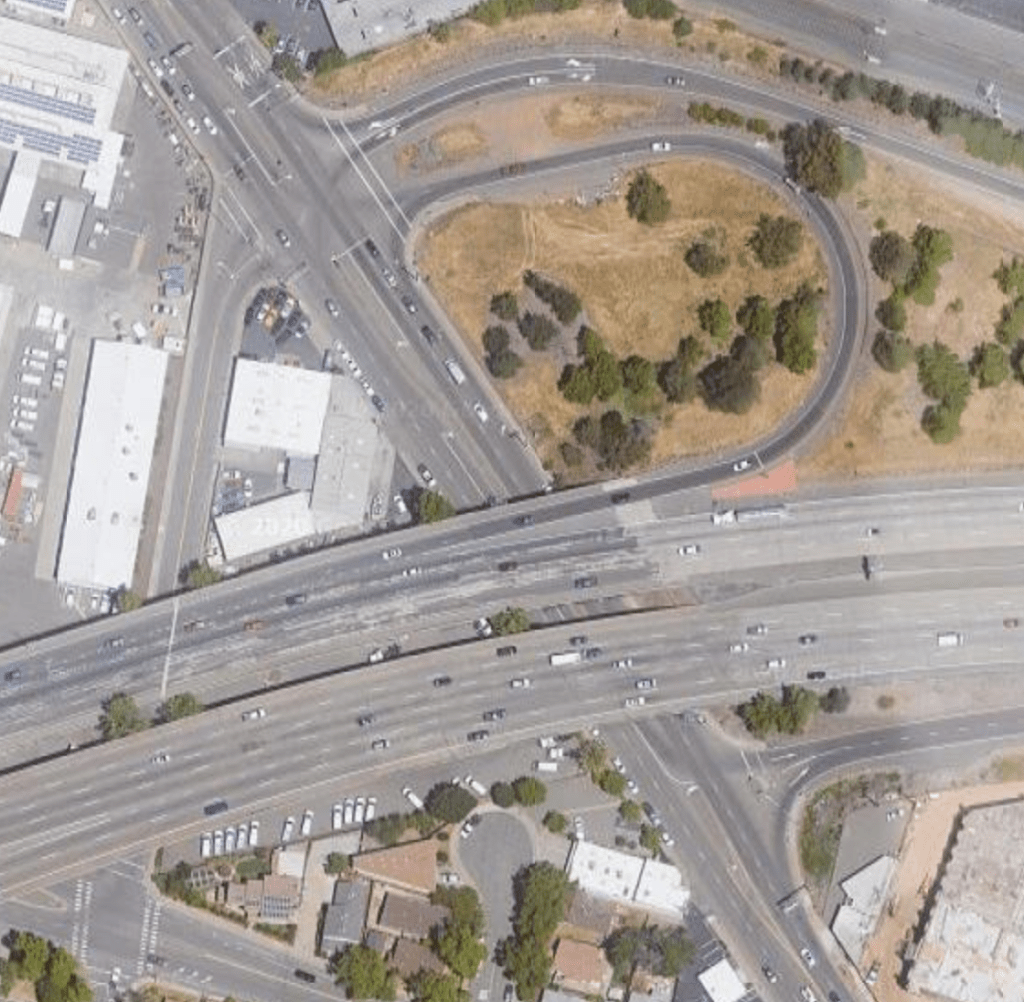
The Hwy 50 and Stockton Blvd interchange is problematic for both walkers and bicyclists. There are no bike lanes through this section, at all, and walkers on the east side of Stockton face long crossing distances in a design that strongly favors high speed motor vehicle drivers. In the photo below, look at the long crossing distance on the north side of the freeway, of the exit and entrance ramps. It’s about 120 feet, with no protection from drivers, at all. I have both used and observed this crosswalk, and can confirm that very few drivers yield to walkers in the crosswalk. It is a guaranteed death trap for walkers.
The roadway striping does not delineate areas for motor vehicles and bicyclists, nor does it indicate where riders or drivers should be merging to reach their destination. It is just a wide-open area, and as with all wide-open areas, drivers will assume they have complete right-of-way. You can see by the tire tracks that the turns on and off the freeways are being taken at high speed.
Stockton Blvd – Hwy 50 interchange
This interchange must be completely reconfigured for the safety of walkers and bicyclists, and drivers for that matter. The entry and exit ramps must connect with the street at 90 degree angles, requiring drivers to make low speed turns. Bicycle lanes with green conflict markings must be installed throughout the interchange. Sidewalks must be improved and crossing distances shortened to no more than 22 feet.
It is disappointing that such a critical safety hazard was not addressed in the study.
Mode Share
The study, online survey, and open house never address the key issue for the entire corridor, which is: what should be the priority of travel modes in design of the street? Some of the options imply a higher priority for some modes than others, but the critical question is never asked of the public. I had said in my previous post that my priorities would be transit first, then walking, then bicycling, then private motor vehicle travel. However, having spent more time looking at and thinking about the corridor, I’m going to change that. The priorities should be walking first, strongly supported by the tree-lined boulevard configuration I’ve outlined and justified, then transit, then bicycling, then private motor vehicles.
What is is important here, though, it not my preference, but that the public, and in particular the residents and customers along the corridor were never asked this question.
What Now?
I’ve laid out what I consider some major flaws in the study. I am not against the particular options that were presented, and from that limited perspective, the study has done a good job. But the number of things NOT considered is glaring. I know the city hopes to address these issues later, but I don’t find later to be acceptable. The public needs a full set in information now, so that it can comment on the study from a perspective of understanding how the street will feel after the changes, not just design diagrams, but how each traveler will get along and across the corridor, and whether it supports their desires for mobility and livability.
I think the city should pause the study process and add in the elements not addressed, then go back out to key stakeholders, and re-do the engagement process including the survey and open house.
JUMP unceremoniously pulled out of Sacramento (the Sacramento region program that included West Sacramento and Davis) in the very early days of the pandemic. The bike and scooters disappeared, except for those few that are still out there, abandoned and never picked up. Though the company claimed that the devices weren’t being used, that is not true. Despite people not commuting to work (the stay at home was not yet clearly defined), they were still getting used, at perhaps half the rate as before. I’ve suspected that Uber/JUMP was already planning a pull-out, and saw the pandemic as a convenient excuse. Sacramento had been the most successful JUMP system in the US, in terms of rides per bike per day. Some argue that means they would not have pulled out unless they had to. But I see exactly the opposite reason, that they pulled the bikes and scooters because they were so successfully competing with what Uber considers (and has now demonstrated) to be its core business, ride hailing.
Lime also had scooters here for a while, but they disappeared as well. Spin had a program based on the campus of Sacramento State, and I saw a few of the scooters off campus, but they were never widespread. I’ve heard rumors of other scooter companies, but never saw any of the scooters. There were also some short-lived or planned but not implemented bike and scooter share programs in other cities around the region.
JUMP is now out of the bike and scooter business altogether. They sold the business, and apparently some of the bikes, to Lime. There are stories on the Internet from locations all around the US about Uber recycling the batteries and scrapping the bikes, so this is apparently widespread, and either already has or will shortly erase most of the bike fleet from existence.
Lime had an electric bike share bike for a while, though never in Sacramento. I saw them but never rode one, as the places they were available had alternative vendors that I was already using. The reviews I read said they were much better than the pedal bikes Lime was famous/infamous for, but nowhere near as good as JUMP bikes.
So, what does this have to do with re-opening from the pandemic? I have not heard anything from any of the agencies involved in the bike share program about how bike share can be brought back. SACOG (Sacramento Area Council of Governments), the original sponsor of the Tower Bridge pilot program (remember the white SoBi bikes?), SMAQMD (Sacramento Metropolitan Air Quality Management District), which provided some of the start-up funds, the City of Sacramento, the City of West Sacramento, and the City of Davis. Not a peep. There may be discussions going on, just not public, or there may not be.
This region, not just the area covered by the JUMP program, must have a bike share program. I am less certain that scooters must be part of the program, but I’m sure many feel they should. As people who were using transit but are not willing to right now, for an unknown but hopefully not too long period of time, search for alternatives, the choice to drive, and often to purchase a vehicle in order to drive, would be disastrous for the region. Our air quality has been wonderful for three months, but has already returned to the ‘unhealthy for sensitive individuals’ level even with only a fraction of the pre-pandemic traffic levels. If 80% of those who were using transit now drive, air quality will likely be in the ‘unhealthy’ for all category for much of the summer, and jump into the ‘very unhealthy’ category from time to time. We can’t let this happen. We must provide alternatives for people who cannot and will not drive, and that must include bike share. Of course the impact of motor vehicles, more than 40% of carbon emissions in the state, go far beyond current air quality to civilization-changing climate change, but my biggest concern right now is the short term impact on air quality.
Beyond air quality and climate, there are equity concerns about how we re-open. Yes, I know the JUMP system was not perfect. Even after expansion, it covered only part of the low income communities in Sacramento. JUMP had a low income uer discount program, but it was almost a state secret, and they never solved the issue for unbanked people.
We know that most transit users right now are essential workers and people who have no other way of getting to essential destinations. Those who can have been driving, but many can’t. They are not of a driving age (too old or too young), the have valid reasons they are unable to drive, and they simply do not want to be a part of the planet-destroying car obsession. What are we doing to do for these people? Are we going to put all our transportation eggs (funding and projects) into the cars-first basket, as we have done for too long, or are we going to change our futile ways and provide real alternatives? Are we going to commit low income people to a descending spiral of debt as they try to keep old cars running, or buy cars that barely run, just so they can get where they need to go?
The solution is bike share. Here is what I think needs to happen:
Equity concerns must be predominant in rolling out the new bike share system. Who really needs this option? How can we make sure it works for them? As one of my favorite people, Tamika Butler (and many others) has said, we don’t want to return to normal, because normal was never acceptable. High income state office workers are not the people the new system should be designed for, though certainly it should work for them too.
We must discard the idea that a privately owned and operated system can work to meet the transportation needs of the region. It could be a public system, or it could be a public/private system, but it cannot ever again be solely private.
Bike share is identified as a critical transportation service, and as a logical part of the transit system. This does not mean that it is operated by transit agencies, though it could be, but that transit agencies are a core partner in the program.
Major traffic attractors will not reopen until a bike share system is in place to handle the additional car traffic that might otherwise be generated. This most definitely includes shopping malls, and probably includes government offices in downtown Sacramento. Universities and colleges are not an issue, for now, as they will be online and not the trip generators they usually are.
Funding for bike share infrastructure (bikes and bike racks) will be diverted from road building projects. If the emergency powers of the state and county have any meaning at all, this is well within their power to do. When transportation agencies talk about the ‘color of money’, what they generally mean is that they don’t want to make the effort to justify different uses, and they are happy with the current mode share. Time to end that malfeasance.
The City of Sacramento is not taking the failures of its construction zone signing and maintenance seriously. I have forwarded a number of issues to the city, both via email and via the 311 service. Nothing seems to have come of any of this. I have not seen a single location corrected. The 311 requests are being closed without being corrected. It is not clear to me whether the city staff are incompetent, or simply don’t care, but I’m going to list some resources I’ve found useful. These may be useful to readers, so that you can recognize failures and report them as well.
The Manual of Uniform Traffic Control Devices (MUTCD) addresses construction zones in Part 6: Temporary Traffic Control Devices. California has its own version, similar but not identical, the CA-MUTCD Part 6. Don’t misunderstand me, the MUTCD/CA-MUTCD is very weak on pedestrian and bicyclist accommodation. If you randomly threw a dart at the manual, 999 times out of 1000, you would see text or signs or diagrams that assume that pedestrians and bicyclists don’t exist. Nevertheless, the manual has the force of law, for any agency that uses federal funding, and it is what most agencies use as the gospel.
pedestrian barricade, with detectable edge (National Work Zone Safety Info Clearinghouse)
Note that the MUTCD prohibits the use of tape, rope, or plastic chain strung between devices because they are not detectable and do not comply with the design standards in the ADAAG; therefore, they may not be used as a control for pedestrian movements (MUTCD 6D.01).
National Work Zone Safety Information Clearinghouse
The 2017 video, Why We Cycle, was offered for free streaming for one day, yesterday. Though the freebie is over, I highly recommend you watch the video; at $4.99 it is still a great deal. This video has brought joy to me in ways that I haven’t felt in a while, and I think it will do the same for you.
So if you can push the car out of the city grid, leave it at the edges, and go walking further, it’s an enormous advantage for health, for clear air, for interaction.
Sjoerd Soeters
Though the bicycling infrastructure in the Netherlands has received the greatest notice in the US, this video is only secondarily about the infrastructure, instead focusing on cultural capital and transformation.
My own commute is cycling, that’s because I live cycling distance from work, but that is not a coincidence, that is why I live there.
Erik Verhoef
The video demonstrates the long list of benefits to a cycling culture (note that the video unapologetically uses the term cycling, without the cultural baggage of spandex and Strava and high priced bikes that the term carries in the US):
convenience: the bike is often the quickest way to get somewhere
economics: the bike is far less expensive than private motor vehicles, and even than transit
health: an active life brings measurable and significant benefits to the individual and to society in health care costs
cognitive: because bicycling requires people to be aware and interact with a large amount of information, there are clear benefits to cognitive development and maintenance
creativity: bicycling increase creativity, while on the bike and in life
reduced absenteeism: work absenteeism is lower for people who bicycle, and presumably for school as well
freedom to move: people are much freer to go where they want to go, when they want to go, on a bike
diversity: bicycling exposes people to diversity that they would not be if driving, to meet the ‘other’, to actively negotiate the flow with others
It’s the story of living in a city that is human scaled, that allows me to engage with the social/spatial environment… the intangible effects…
Marco te Brommelstroet
Data on bicycling trips clearly pointed to the conclusion that choices were often governed much more by the senses than the coldly logical plans of traffic designers, even causing people to leave the safe but sometimes boring cycle-ways for more interesting routes.
I noticed in the video, and it was commented on by one interviewee, that some signals have all ways for bicyclists at the same time, a bicycle scramble, so to speak. Because bicyclists have so much experience with negotiating with each other, it just works!
… it relates to the culture of mutual shared respect, but also the culture of trust; instead of infrastructure, by the users of infrastructure
Fariya Sharmeen
The adolescent social area can be the whole city, not a limited area close to the home. It’s about fun, being together. The video highlighted schools where nearly every student walks or bicycles, such a huge contrast to the US.
Dutch children are the happiest children in the world, just because they can go farther and farther from their homes…
Cycling is a good metaphor for a good education.
… to put the priority in relationships between people, then we support the cycling, we support freedom for children. Priorities for children and for bikes are good priorities for a happy politics.
Leo Bormans
A better world is possible, and we can achieve it if we work together and insist that each decision we makes moves us towards that end, and away from the car supremacy under which we have suffered, and died.
I have long been interested in access to parks, what the availability of parks is to people, and wanted to map this. It is just today that I was finally able to start doing this. I acknowledge the support of the Sacramento Area Council of Governments (SACOG) GIS staff, without which I could not have done this, as my ArcGIS skills are limited, though growing, and my access to the needed data is also limited.
This issue of access to parks, always important, is suddenly critical under the pandemic, with people needing places to walk where they can achieve physical activity with appropriate physical distancing. With many neighborhoods in Sacramento not having sidewalks, or having narrow sidewalks (six feet at best, often five feet, sometimes four feet or three feet; yes, three feet!), and some of those who are still driving doing so very recklessly, sidewalks in and of themselves don’t make it for large areas of Sacramento.
Advocates all over the US, and the world for that matter, have asked that cities and counties open up streets for walking and bicycling, sometimes by prohibiting drivers and their motor vehicles, sometime allowing only local access. In the US, Oakland has become the leader in this (Oakland Slow Streets), though many other cities have implemented programs as well. The City of Sacramento is also considering this, with staff working on a proposal, though it is not known yet what it will look like, or if it will be adopted. A number of people have made suggestions for streets to ‘close’ (meaning open to walkers and bicyclists), but the nature of advocacy is that many of these suggestions have been for areas that have sidewalks, and that have parks, because these are the areas where many advocates live. I’m not saying they are wrong, but I want to do my part to see that open streets occur in the areas that most need them, which is almost always the low-income, disinvested areas of north Sacramento/Del Paso Heights and south Sacramento.
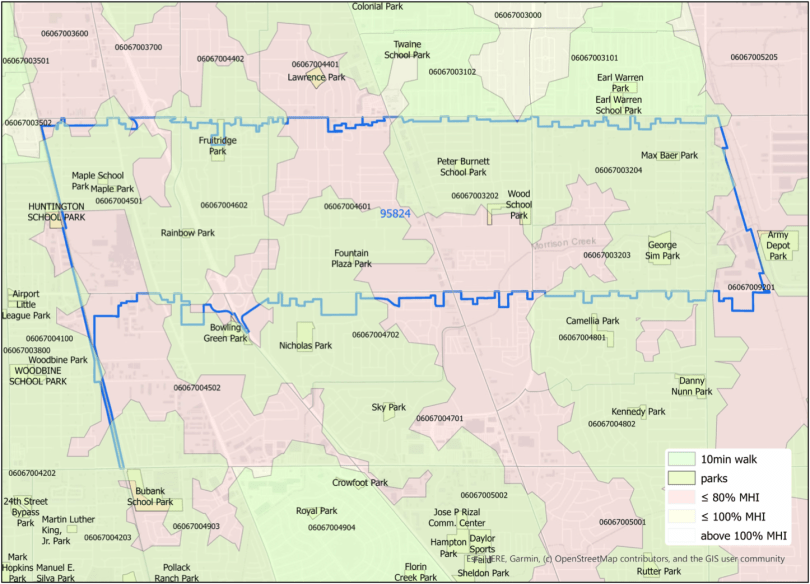
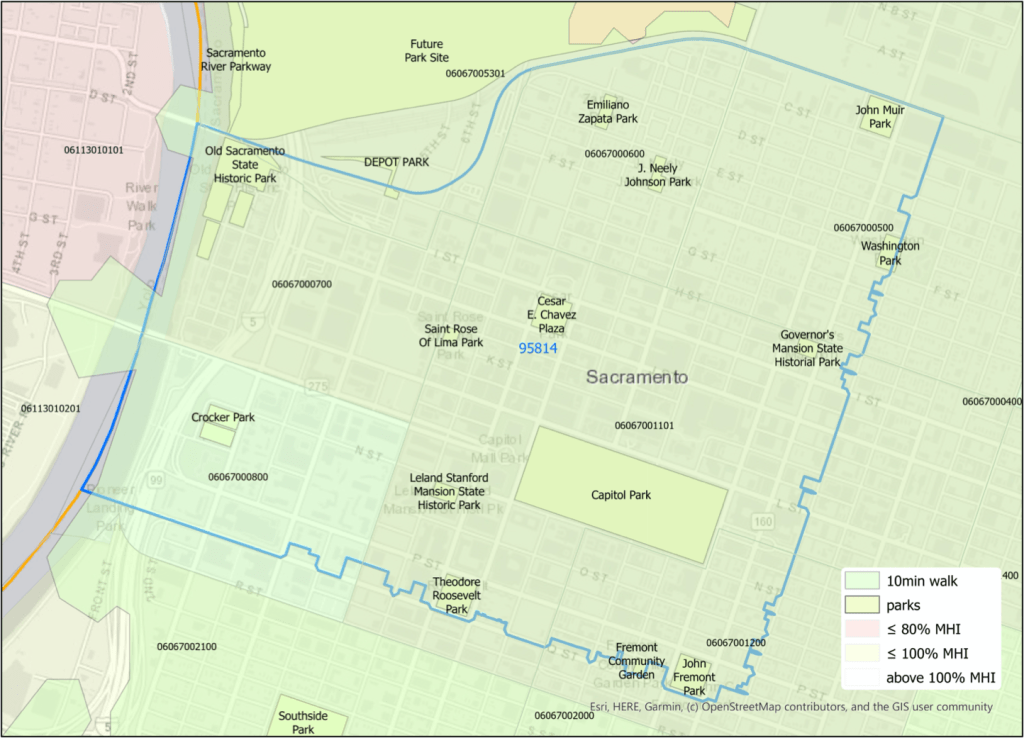
So, I picked two zip codes to map. One is 95814, the central city downtown, and the other is 95824, an area of south Sacramento (which includes both City of Sacramento and unincorporated Sacramento County).
The maps shows the park locations (from the SACOG Regional Parks & Open Spaces 2018 data), and the 10-minute walking area around these parks. The reason I picked 10 minutes is the initiative by the National Parks and Recreation Association (NPRA) and partners: “We’re inspiring and enabling action to create a world in which 100% of people in U.S. cities—LARGE AND SMALL—have safe access to a quality park or green space within a 10-minute walk of home by 2050.” I’ve also included the Median Household Income for census tracts (ACS Median Household Income S1903 2013-2017). On the 95824 map, you can see that the entire zip code is less than 80% of California MHI ($67,169), a disadvantaged community. On the 95814 map, the 10-minute walking area covers up the MHI, but nearly the entire area is also below 80%.
Please note that there are many ways of mapping park access. In this case, I used park centroids (the geographic center of the park), which makes sense for smaller parks, but doesn’t work as well for large parks, and parks which are contiguous but named differently. There are also many ways of looking at disadvantaged community status, and at demographic characteristics. I chose ones that I had worked with before, and other criteria would yield different results. I’ve used zip codes here, though I think that if the cities and county actually analyze the data for need, census tracts are the better polygon size. Census tracts are less familiar to people than zip codes, but census tracts often more accurately represent what people think of as their neighborhood.
So, now with the maps. The first is 95814, downtown Sacramento, and the second 95824, south Sacramento. Clicking on the graphic map will bring up the option to download a pdf.
98814 zip code95824 zip code
As you can see, the entire 95814 zip code has access to a park within a 10-minute walk. The 95824 zip code, however, only about half the area has access. Very different places! Therefore, I would recommend that the 95824 zip code, for example, needs open streets, now, and the 95814 zip code does not.
I welcome your feedback on these maps. What would you like to see? What data should I be considering? Do you see issues of access and space for social distancing in this way, or another way? What areas do you want to know about?
sorry, could not find a photo for Sacramento,, but if someone provides it, I will replace this one of Los Angeles (via Business Insider)
We can’t go back to the way things were before! To the car-dominated world where walkers and bicyclists were considered second-class citizens, worthy of consideration only when it did not inconvenience the privileged drivers of cars. The streets are largely empty (except for some essential drivers and too many joy-riders). The air is clean. The city is quiet. It is (other than the above-mentioned joy riders) safe to cross the street, to bicycle on the street, even in some places, to walk in the street. I don’t intend to ever go back, and will work to make sure we do not go back.
Here is a list, with brief notes, of areas in which I think we should not and cannot go back. No priority order. I think that over time my ideas can be refined and added to. Let me acknowledge the many people on Twitter, my main social platform, for giving me a lot of good ideas and food for thought.
Right to Move: I believe that, as humans, we have a right to move, to freedom of movement (though I also believe that reduction or even suspension of this right for public health during a pandemic is acceptable, though traumatic). However, this right is expressed through walking (or mobility devices for those not able to walk). It is not expressed through bicycles, or scooters, or even transit, and it is absolutely not expressed through privately owned vehicles. I am not saying that bicycles and scooters and transit are not good methods of movement for transportation, but walking must always be the most important and the most guaranteed, our most basic right, with other modes coming later, if at all (in the case of cars). I am tired of myself and others being terrorized by private vehicle drivers, who are all too happy to inflict their traffic violence on innocent people. Walking FIRST!
Transportation
all pedestrian signals should be set on recall; they should be labeled with their function; and if there a locations where traffic engineers claim such a low rate of pedestrian use, I’d ask for an analysis of why is there no pedestrian use; if it is an urbanized area, why aren’t there pedestrians, and if it is a rural area, why is there a signal?
failure to yield to pedestrians (CA CVC 21950) should be considered a sociopathic offense, similar to drunk driving and smoking in buildings, and strictly enforced; I am not just concerned about the number of pedestrians who are killed and severely injured by drivers, but about all the people who could walk, but don’t, because they are rightfully afraid of car drivers; drivers who repeatedly violate this should have their driving privileges revoked (drivers license suspended and vehicle impounded), and those who still violate should be jailed
#NoNewLaneMiles (a more specific version of #NoNewRoads); we have all the roads we will ever need, we just need to use them more efficiently by increasing the density of homes, jobs, and services; because there are no new roads, there will be no greenfield developments, as we have plenty of infill/redevelopment land to work with, and we have an excess of single family homes
expenditures on roadways will only go to maintenance, and once a level of good repair is achieved, then to true complete streets projects which reallocate roadway space and increase safe crossings
all roadways that are more than two lanes per direction must be reduced to no more than two lanes. Drivers have proven themselves, again and again, incapable of responsibly using wide roadways, and so these wide roadways must end. Temporarily, we can put up barricades or delineators to reduce the lanes, and in the long run, determine and then implement ways of re-allocating this space to best serve the community; some land might be available for housing development
freeways will be designed and sized for freight movement, not for commuting; interstate commerce is the primary legally and morally justifiable use for our Interstate system; the idea of continuously expanding freeways so that a continuously expanding number of people can choose to commute continuously expanding distances is not socially or economically rational or feasible; where there are more than two lanes on a freeway, one or more of them should be designated (and enforced) as a freight-only lane so that freight is not slowed by commuting traffic
private and commercial fossil-fueled vehicles must be strictly controlled on all spare-the-air days; if the air quality particulates (winter) or ozone (summer) exceeds the ‘healthy’ level, then we start shutting down vehicles; this would be much easier to do if we implemented a pricing scheme (congestion management) all the time, but if we are still working on that, we can in the meanwhile reduce traffic; I’m thinking the easiest way to do that is to control on-ramps and off-ramps, since most long distance commuters, and much commercial traffic, is using the freeways; some on-ramps already meter vehicles, and we could just slow this down so fewer vehicles are allowed to enter; we would have to add off-ramp metering; there are a lot of ways of managing traffic, some of the best controlling the amount of underpriced or free parking, but this is definitely one to explore
vehicles must be speed limited, so that drivers cannot exceed safe speed limits; this is one of the easiest to accomplish because all modern vehicles could be speed limited with minor software modification, but I realize that it is politically the least feasible; nevertheless, we need to be talking about it and advocating for it
Work from home: I fully understand that not every job is amenable to working from home, and interestingly, it turns out that almost all of the truly essential jobs are not, but nevertheless, many jobs are; employers should be required to analyze each job position to determine whether a particular job could be done from home, either all the time, or some days of the week, and then to implement work from home policies that allow the least in-person work required
Schools: I am part of the educational system. I like the idea of school choice, and I think it has a number of benefits. However, I also see the cost of it. A huge amount of driving, taking students to and from school. The idling of cars outside the school has a measurable and negative impact on air quality in the classrooms. Much of this driving is unnecessary, and trips could be done walking or bicyclist, but is driven for the convenience of the parents (not the students). The greatest danger students walking and bicycling face is the drivers taking their own child to school, and in addition to the direct danger, there is the intimidation that makes people less willing to walk and bike. Students are getting significantly less physical activity. Students and families feel less connected to the neighborhood they live in, and the school feels less connected to its neighborhood as well. So:
for any school located on an arterial with more than two lanes of traffic in a direction, lanes will be immediately closed in order to increase the safety of students walking and bicycling, and to create a less polluted and hectic environment
private vehicles will be prohibited on campuses, except where the parent has submitted a statement to the school detailing why a particular student must be transported directly to the school (meaning, a disability of some sort), and received a pass; schools are there to educate students, not to accommodate drivers
for schools located on local streets, the block on which the school is located will be closed to through traffic for the duration of arrival and dismissal (or longer); of course this means that students and families using mobility devices must be guaranteed high quality sidewalks and crosswalks, with ADA ramps, at least 6 feet in width, and in good repair
school districts should have a conversation with families and the public about the ways in which a non-neighborhood school supports and does not support academic learning and the needs of its community
Housing: Part of the reason we have a housing crisis is that single family homeowners have been able to suppress the building of homes, for some types of people (read: minorities) and for some kinds of housing (read: multi-family), for a long period of our history. We all suffer from this: un-housed people, high rents, separation of jobs and housing, climate change, air pollution, most of our transportation dollars going to long distance commuters while we have potholes in our local streets, underinvestment in transit and rail, etc. The most egregious, though largely hidden from view, aspect of this is that single family housing has bankrupted our cities, and counties, and state. Single family housing can never generate enough sales tax or property tax or user fees to pay for the maintenance required to sustain all these spread out houses and roads and utilities and law enforcement, and fire, and, and and. I think it is becoming clearer by the day how financially on edge our governments were. They have huge bond debt, huge deferred maintenance and well as current maintenance obligations, and far too much reliance on new development just to keep the old going (which is called the development ponzi scheme – see Strong Towns). Sprawl is the primary though not the only driver (pun intended) of this. So:
immediately remove all residential zoning classifications, so that there is only one residential zone, and no limit on the types of housing that can be constructed on a piece of land; until such time as we can analyze what we need in terms of zoning and development standards, I’d leave the rest be, but this is a step we can and should take immediately
no developments (even infill) larger than a certain size should be allowed to deed road and utility improvements to cities and counties, unless they pay a fee to a maintenance endowment sufficient to maintain that infrastructure for all time; I am not talking about development fees, which of course are used to maintain past infrastructure and to keep the doors open, but never retained for the future, rather, these are banked funds to meet the needs of the future
recognize a right to housing for all people; this is obviously a huge undertaking, for which governments may not have the money (because of the sprawl subsidy and bankruptcy detailed above), though there is certainly a lot of shifting of resources that could get us a significant way there, but we need to start working toward that goal now, and with much of our societal focus on how to solve the issue as quickly and equitably as possible
Thank you if you stuck with this long list to the end. As I said, it is preliminary, and your constructive comments here or on Twitter are welcomed.
I admit that I thought we had a decent world, many issues to work on, but sort of OK. Probably some others felt this way. But the bottom has dropped out, for those in poor health (much of that poor health due to all the actions above that we did not take), people of color, low income people, un-housed people, people dependent on employer-provided health insurance, people in essential jobs. I am very lucky! (yes, the luck of privilege).
I hope that we reflect deeply on the clean air and streets available for people (outside cars) to live, and all join together to make sure we do not go back to the old, unenlightened times, but to work hard towards a better future.
I am quite aware that I have not mentioned, or have lightly touched on, a lot of other issues that are critical to so many people. Climate change is one of the biggies for me. Please don’t think that those other issues are unimportant to me, but transportation is my expertise and advocacy, and it needs strong voices, now and always.
The Manual for Uniform Traffic Control Devices (MUTCD), and the California equivalent, are standards for the design and placement of traffic control signs. They have the force of law for any federal or state funded roadways, but there is no enforcement mechanism, so signs that do not meet these standards can certainly be found, both in places that just decide they know better, and in places where the public right-of-way and use is evolving rapidly and the glacial pace approval of new signs is not keeping up.
The MUTCD has 14 signs related to the use of beg buttons to cross the street, in the R10-1 through R10-4 series. One of these is shown below, the most complicated one, R10-3e. Of the 14, none offer any information about whether the beg button is required or not. This is not an oversight; it is a direct expression of traffic engineer’s disdain for pedestrians. California could, of course, add other signs with better information, after approval by FHWA, but it has not seen fit to do so.
Noting the lack of good signs that actually address real-world situations, some entities have designed their own. One example is below, which came via Don Kostelec, of whom I’ll have more to say shortly. (original source not known)
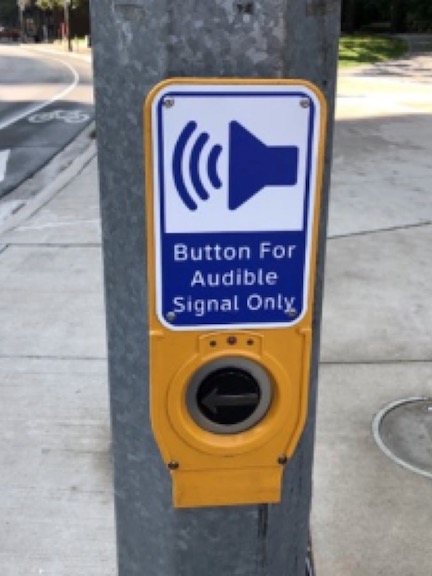
Why is the distinction between these two types of signs important? Buttons can be used by limited vision or blind people to trigger the pedestrian signal, and the auditory and sometimes vibratory message that goes with it. When the conversation started about removing beg buttons, many disability advocates were up in arms, understandably. If there is no button, there is no message.
Except, of course, for automatic detection of pedestrians, and even pedestrians types, that many other countries and a very few places in the US are installing. Traffic engineers routinely resist automatic detection as “too expensive and not practical” despite spending much larger sums on vehicle detection. Which in the case of bicyclists, often doesn’t work anyway.
Traffic engineers also frequently place buttons in places where people with disabilities, as well as everyone, can’t find them and/or can’t reach them.
So, is there a way to preserve the function of buttons needed by disabled people, while not discriminating against all pedestrians? You bet. Just label the button for its function. And put it in an accessible location.
So, Don Kostelec. He is one of my heroes, as he has done a better job than anyone I know of documenting the failures of transportation agencies to install safe and usable pedestrian facilities. Sidewalks too narrow, or that end where you really need them; ADA ramps to nowhere; crosswalks that can’t be safely used; and on and on. I highly encourage you to check out his blog (http://www.kostelecplanning.com/blog/) and Twitter feed (@KostelecPlan). He does not hesitate to call out road and traffic engineers for their failure to think, and for their failure to follow their professional code of ethics. Though he didn’t originate it, I think he is responsible for popularizing the expression “Hold my beer!” in the transportation world, implying that only an engineer drinking beer, and momentarily designing a roadway or facility before going back to drinking, could have done something that stupid.
There has also been a lot of discussion about whether it is hard to change the buttons from required to not required, which is called auto recall, or just recall. A number of cities have changed hundreds of buttons in very short order because they prioritized it. Newer signal control boxes allow changes to be made remotely, changing the function and timing of pedestrian signals. Older control boxes may require that someone go out and physically change them. The older boxes are sometimes derisively called squirrel cages because they had large physical clocks with rotating dial, with pegs to change the signal on or off, as it came around. They made noises like a squirrel or hamster cage. A few idiots have been saying that pedestrian signals should not be changed remotely because of security issues. That is the whole point of modern signal controllers, part of Integrated Traffic Systems (ITS), that they can be can sense and respond to actual traffic, and can be adjusted remotely to respond to changing conditions and for changing flow when crashes occur.
There is also the issue that many transportation agencies don’t know what is at the intersection. Does it have pedestrian signals or not? Does it have pedestrian countdown or not? What is the timing of the pedestrian phase, in terms of countdown? Is the beg button required or not? They simply don’t know. Locally, Sacramento County is the worst on this issue.
The previous post was about prudent drivers. The table below shows how I think of prudent drivers, and irresponsible drivers. It is so hard to not be snarky about driver behavior, but I have toned it down quite a bit. If you think I am exaggerating, then you don’t spend much time on the roads walking and bicycling. I spend a lot of time doing both, probably averaging three hours per day, all of it closely observing driver behavior and the roadway built environment, because it is both my job and my advocacy. The irresponsible behavior is something I see every day, from a significant percentage of drivers. Notice that I did not use the term negligent driver, as is the legal term in my prior post on a prudent driver, because only some of this is negligent; much of it is just sociopathic.
Prudent Driver
Irresponsible Driver
yields to pedestrians in crosswalks and waiting to cross
never yields to pedestrians
takes turn at stop sign intersections
goes out of turn at stop sign intersections
obeys speed limits, within 5 mph
drives as fast as possible in all situations
on multi-lane roads, always slows or stops if a vehicle in another lane is stopped
on multi-lane roads, pulls around other vehicles that are stopped, honks, and proceeds at full speed
rarely uses their car horn, and only to prevent a crash
often uses their car horn to make those other idiots pay attention and get out of the way
is aware of what is going on around them
is focused on other things than the road
doesn’t use their smart phone while driving, other than wayfinding
holds ongoing conversation on smart phone; texts when they think they can get away with it
passes bicyclists with a safe distance, even when it means waiting
yells at, honks at, and close-passes bicyclists, because they don’t belong on the road
believes all people have a right to share the public space on the roadway
believes that right to the roadway is determined by the value of their vehicle and social status
will do anything to avoid a crash
revels in crashes when they know they are right
knows the the cost of building and maintaining roads is subsidized by everyone
is certain that gas tax monies are being illegally diverted to other uses
knows that parking is never ‘free’ and someone, or all of us, are paying
believes that the right to free parking is guaranteed in the constitution, and that the parking space in front of their house belongs to them