H Street is commonly used by bicyclists leaving Sacramento Valley Station, and others as well. It has decent bicycle facilities except for some gaps.
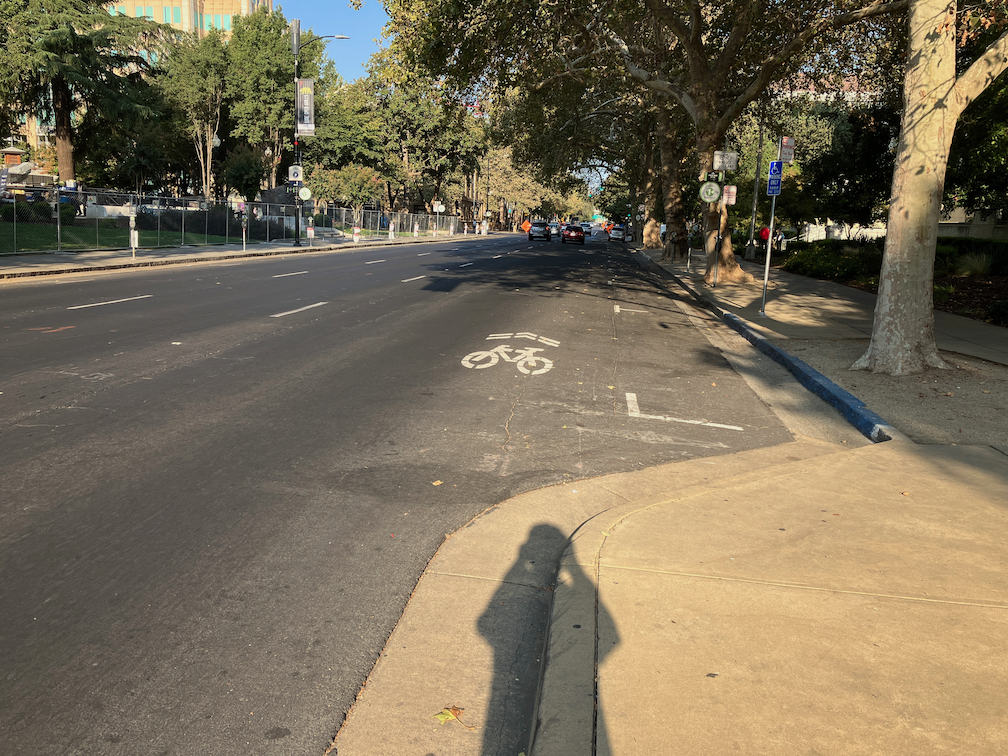
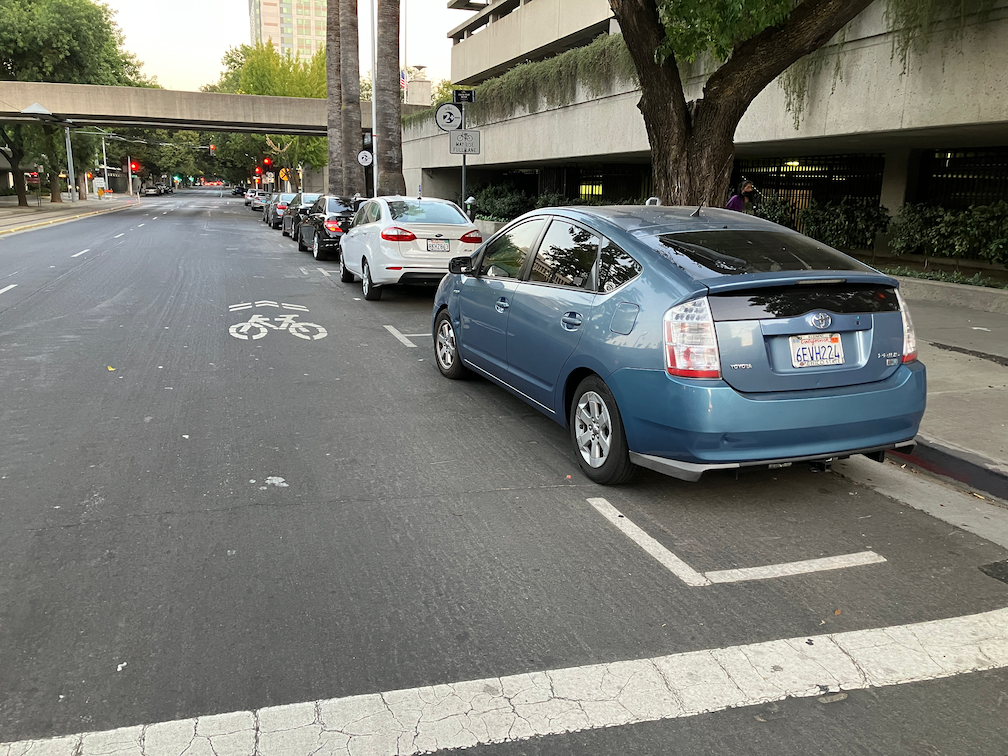
H Street has a bike lane on the south side from 5th Street to 16th St, except one block, 7th Street to 8th Street. There is absolutely no reason for this gap. This is the section between the Sacramento County Administration Building on the south and a decked parking garage on the north. The parking seems to be there for the convenience of people working in the building, as there does not seem to be turnover of the parking spots. There is ample parking in the garage. This parking should be removed and a bike lane painted IMMEDIATELY. No excuses. A common quote in the bicyclist community is “sharrows are bullshit”, and this is the case here, where the city has preferenced motor vehicle drivers over bicyclist safety.
H St parking and sharrows from 7th St to 8th St
There is a bike lane on the north side between 7th Street and 13th Street. Bike lanes on the left side of one-way streets are much less used than right side bike lanes, but are useful.
I have long been planning to write about the extremely poor bicyclist facilities from M Street to Hornet Tunnel, which is a major access point for Sac State.
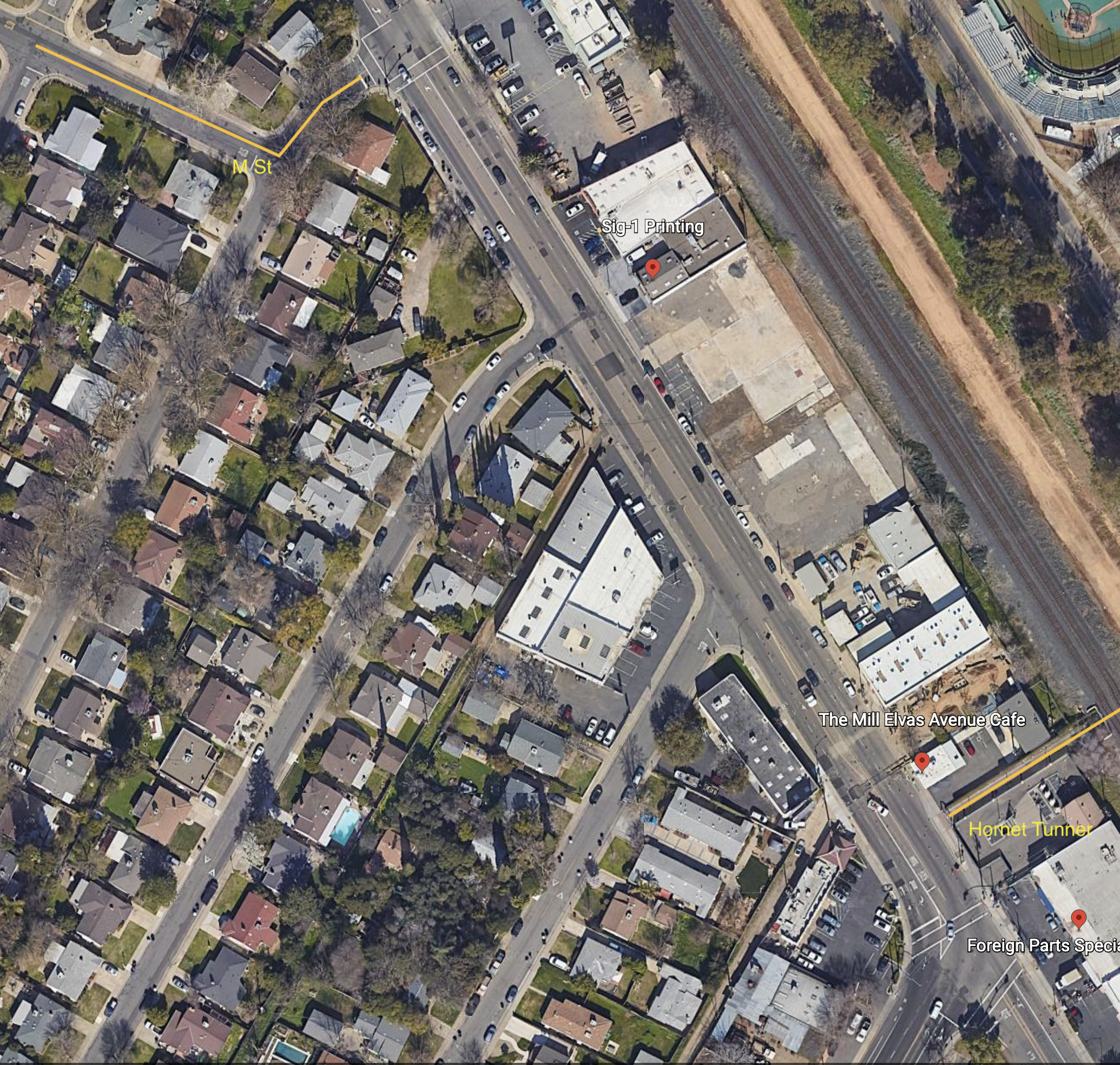
M Street is a major east-west bicycle route, with some but not all of it marked as a bicycle route. If the city used the bicycle boulevard designation, it would be designated a bicycle boulevard. M Street forms an uncontrolled T-intersection with 62nd Street, which leads a short way left to a signalized T-intersection with Elvas Ave.
Hornet Tunnel is a major access point to Sac State campus, probably second only to the Guy West bridge access on the north side.
The map below shows M Street, 62nd Street, Elvas Ave, and Hornet Tunnel, as it exists.
The route from M Street to Hornet Tunnel is heavily used by bicyclists, both students and people passing through to the American River Parkway paths. It would be much more heavily used if it were safe, but it is not.
Eastbound to campus, one must cross over four lanes somewhere between 62nd Street and the median along Elvas Ave, and then ride on the wrong side of the street to reach Hornet Tunnel. Westbound, it is not bad, only having to merge over the northbound lanes to a dedicated left turn lane to 62nd Street. The signal here is surprisingly responsive to bicyclists, so the wait is usually short.
At the 62nd Street & Elvas Ave intersection, Elvas is 62 feet wide, 70 feet with sidewalks. There are shoulder stripes setting off unofficial parking, one southbound lane, one center turn lane, and two northbound lanes. At 64th Ave, Elvas is 68 feet wide, 76 feet with sideewalks. At Hornet Tunnel, Elvas is 63 feet wide, 77 feet with sidewalks, with two northbound lanes and three southbound lanes, two of which are dedicated right turn lanes to 65th Street. Elvas was formerly wider at Hornet Tunnel, but some sidewalk was added there to ease crowding at the tunnel entrance/exit. Given the city-preferred, though unnecessarily wide 11 foot travel lanes, there is room for six lanes of traffic here! That means there is ample room for bicycle facilities. But there are none present.
Some bicyclists take the striped shoulders to be bike lanes, but they are not. The city’s 2018 Bikeway Master Plan shows this section of Elvas between 65th Street and Hornet Tunnel as a Class 2 (on-street) bike lane, but this is false. It is not indicated as such with either pavement markings or signage. Though the shoulder stripe southbound has the dashed marking often used to indicate a bike lane approaching an intersection, this is a fake. It is NOT a bike lane. People park along this stretch, so even if it were a bike lane, it would not be safe nor meet minimal standards for a bike lane.
Solutions
What street redesign and reallocation would make is safer for bicyclists?
First, for northbound bicyclists, there should be a separated bikeway on the right side of the street. Along this section, there are four driveways and a stretch of street-oriented perpendicular parking (where vehicles enter directly into parking spaces from the street). There is a section of 270 feet with no existing buildings. Though there could be parking protected bikeway along here, I don’t think the parking is even needed. Instead, this is probably a good location for a curb separated bikeway, with hard curb to prevent encroachment on bicyclists. The curb would be cut only for driveways which are currently in use. The existing parking along this stretch is used mostly by students to avoid paying on-campus parking fees. All the businesses have onsite parking. The one business that might reasonably need short-term parking on Elvas is The Mill coffee shop. Separated bikeways work best with long stretches without driveways, but one here is workable.
Southbound is more complicated. If there were a bike lane or separated bikeway on the southbound side of Elvas, bicyclists would still need to cross to Hornet Tunnel, at a location where there is currently no way to do so. I see three options:
First, have bicyclists ride south to the existing 65th Street & Elvas Ave intersection, and use the crosswalk on the north side to cross over and then go north to the tunnel. This is very awkward, out of the way, and encourages bicyclists to use a crosswalk, which is not illegal but poor practice.
Second is to create a two-way separated bikeway (often called a cycletrack) on the east side of Elvas, from 62nd Street to the tunnel. A separate bicyclist signal phase would need to be created for northbound bicyclists to cross to 62nd Street, and southbound bicyclists to cross to the east side of Elvas Ave. An advantage to this solution is that parking on the west side of Elvas does not need to be changed, though it can be reasonably argued that there should be at least a regular bike lane here for bicyclists who are not going to the tunnel, but continuing south on Elvas or south on 65th Street.
Third, have bicyclists continue southbound on Elvas, but create a clear zone for crossing to the tunnel by signalization. Northbound motor vehicles would be held by the existing signal at the intersection of 65th Street and Elvas Ave, while southbound motor vehicles would be held at a stop line just north of the tunnel by new signal heads. Bicyclists would cross to the tunnel during the red phase. There would need to be queuing area for southbound bicyclists, since they would exceed the stacking capacity of the bike lane during busy times. This option probably slows motor vehicle throughput more than the other options.
No matter which solution, the sidewalks along Elvas Ave should be repaired and widened, and street trees should be planted. And of course the street needs to be repaved.
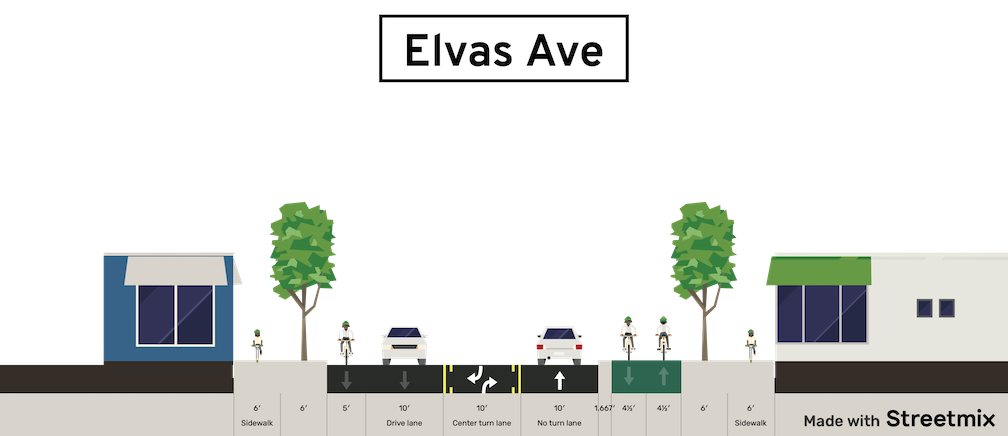
Below is a Streetsmix diagram showing one possible configuration (looking north) with a two-way separated bikeway (cycletrack) on the east side, along with wider sidewalks and trees in a planing strip, and a southbound regular bike lane. And yes, all this fits in the existing over-wide Elvas Ave right-of-way!
Note: Added information on proposed streetcar alignment below.
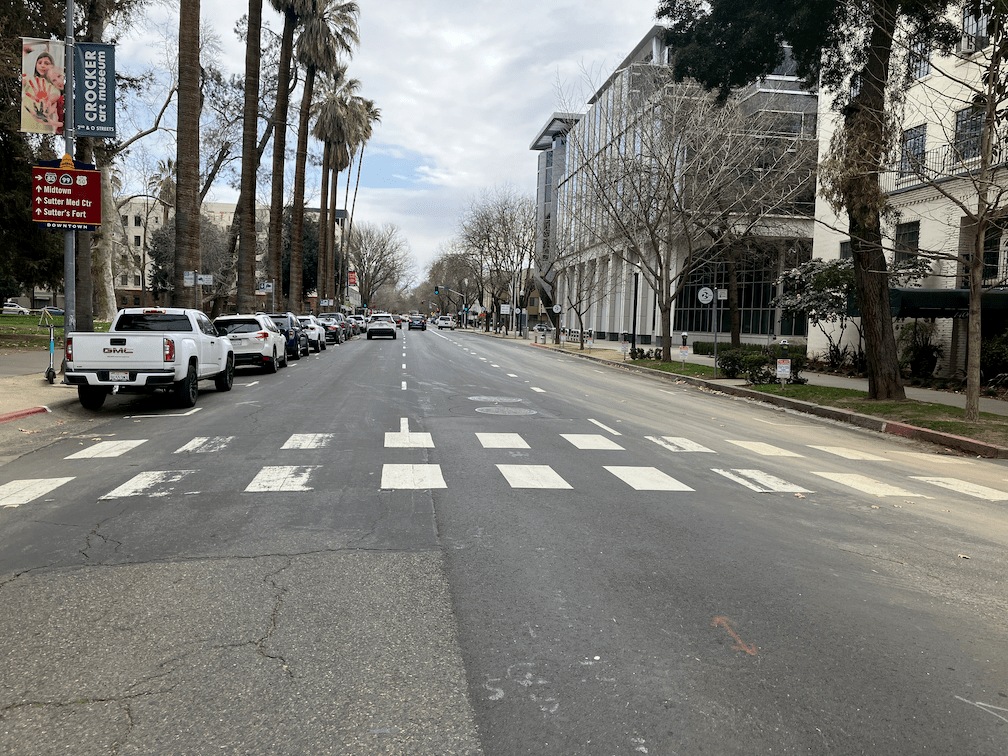
N Street in downtown Sacramento, from 3rd Street to 15th Street, is a three lane street with parking on both sides. There are no bicycle facilities. For part of the stretch, from 8th Street to 15th St, the sidewalk on the north side is a designated bike route, and is signed as such. Currently, this route alongside Capitol Park is closed due to annex construction, and not alternative has been provided. The city has made the choice to offer nearly unlimited capacity for motor vehicle drivers, but to dump walkers and bicyclists onto the same sidewalk. Some of the time this sharing works, but not when it is at all busy with either walkers or bicyclists.
N Street does not need, and has never needed, three motor vehicle lanes. Since the pandemic, the street is empty most of the day, with very short periods of heavier traffic, but it is never congested. Even before the pandemic, there was only about 20 minutes a weekday when the street could have, perhaps, be considered congested. Frequent construction projects, both before and during the pandemic, have narrowed N Street from three lanes to two, and even to one for shorter periods of time. When there was one lane, traffic was slow (a good thing!) but never really backed up.
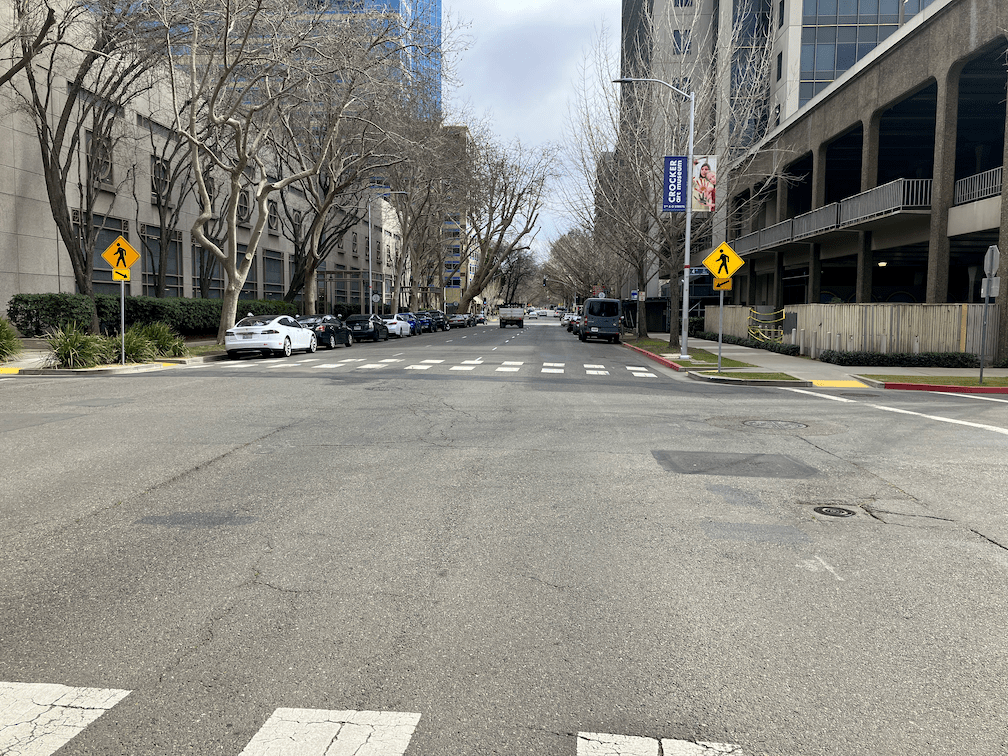
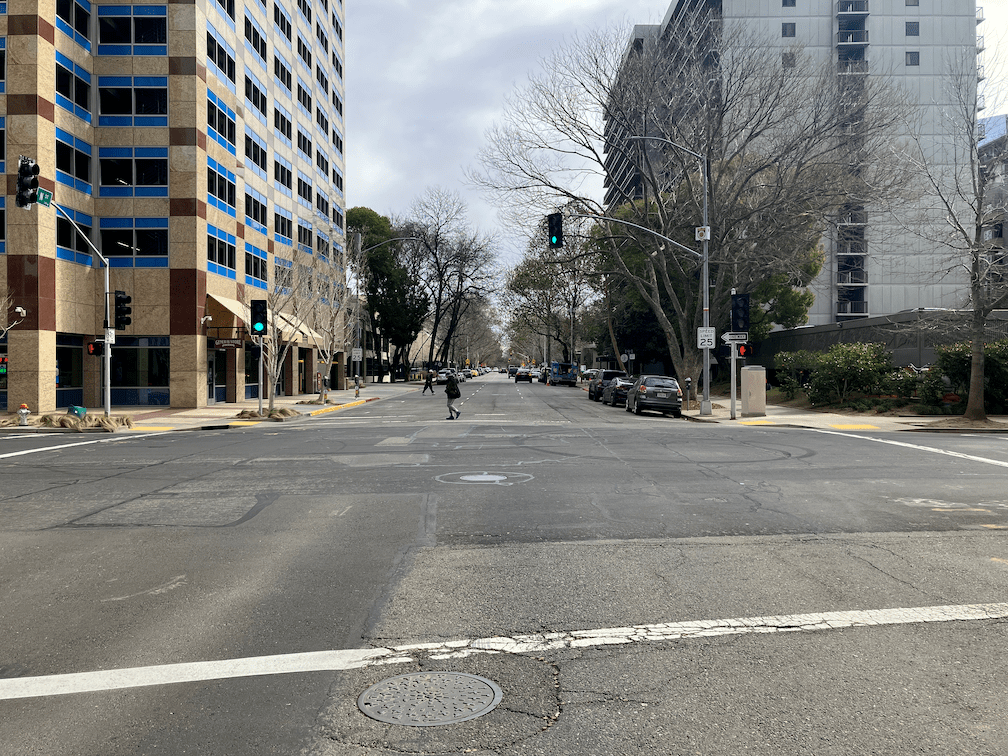
The gallery of photos below was taken today, admittedly mid-day when there is almost no traffic at all, but ‘rush hour’ would not look much different. Motor vehicle traffic has come back to pre-pandemic levels on some city streets, but has not on N Street, and it is very unlikely that it ever will.
How should N Street right-of-way be reallocated? By installation of a parking protected separated bikeway on the north (left) side of the street, from 3rd Street to 15th Street. Separated bikeway is the official term, though protected bike lane or cycletrack are common alternative terms. Though in general left side or right side each have advantages and disadvantages, in this case left side (north side) works best because the of long stretch free of driveways on the Capitol Park side, from 10th Street to 15th Street.
Sacramento already has parking protected separated bikeways on P Street, Q Street, 10th Street, and J Street, though J Street in particular is a weak implementation. The NACTO diagram shows a high quality parking protected separated bikeway with a concrete curb, which retains all the benefits and safety even when there are no parked cars. For sections with driveways, protection with vertical delineators may be appropriate.
NACTO diagram one-way cycletrack with curb
The number of driveways in each block between intersections is:
3rd-4th: one, parking garage
4th-5th: zero
5th-7th: two, parking garage, gated driveway
7th-8th: zero
8th-9th: one
9th-10th: two, rarely used
10th-15th: none
The advantages of this reallocation:
greatly reduces conflict between walkers and bicyclists on the north sidewalk between 8th St and 15th St
provides a safe east-west bicycle route
reallocates unneeded roadway width from motor vehicles to bicyclists
The city’s Central City Mobility Project will add 62 blocks of separated bikeways to the downtown area. All of these projects are great. But N Street is not among them. The lane reduction on I St, shown in purple, is particularly great. N Street would benefit from the same. Lane reductions not only slow motor vehicle traffic, but can shorten crossing distances for people walking. Three (or more) lanes in a direction are never safe, and never appropriate in an urban area. All of the three lane roadways in the city should be reallocated to other uses, and reduced to two lanes.
These type of projects are often called road diets, but I don’t like that term. The road is not on a diet, it is just being reallocated from unnecessary or unwanted motor vehicle capacity to more useful purposes such as walking, bicycling, or dining.
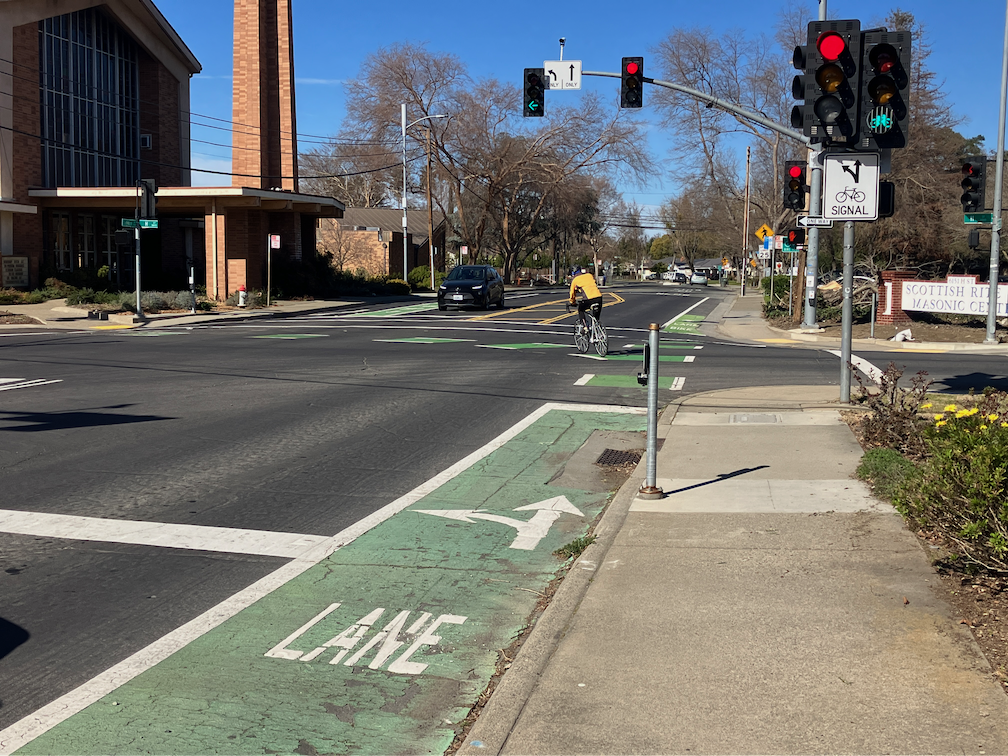
I was at a meeting last evening with transportation advocates when the subject of the turn left from Carlson Drive to H Street came up. Most people expressed discomfort about this turn, and most of the people were also experienced and skilled bicyclists. They felt that left turning motor vehicles, which go at the same time as left turning bicyclists, would encroach on the dashed green lane and hit bicyclists. They were also uncomfortable turning across the straight through lane, as they had seen people run this red light. This is a critical intersection and area for bicyclists, as it is one of four main routes onto and off the Sacramento State campus for bicyclists.
So far as I know, this was the first use of green paint, and the first use of a bicycle signal head in the city. The installation was intended to be innovative, and it was, for its time, in Sacramento, but it hasn’t stood up to the test of time.
Here is what it looks like from above. As you can see, it is a complicated intersection with several features intended to ease and speed motor vehicles. The city attempted to make the intersection safer without really changing it at all, beyond the green paint. Green paint helps communicate, but it does not protect in any way, and it has no legal meaning under California Vehicle Code or city code.
Carlson Dr – H St intersection aerial
The two photos below show the setting of the left turn. The bicycle lane on the right side of the street leads to a dashed (skip) green lane turning through the intersection. The bike lane stop line is somewhat in front of the motor vehicle stop line, and there is a button to trigger the bicycle signal. The bicycle signal face is mounted to the right of the motor vehicle signal face, and there are two, before the intersection and on the far side.
bicyclist pressing the button to trigger the bicycle signalbicyclist turning left from Carlson to H St; bicycle signal face green
I was there at a low traffic (motor vehicles and bicyclists) time of day and was unable to capture a bicyclist and motor vehicle adjacent to each other on the turn.
I have to say that I was not uncomfortable with the left hand turn. I’m a strong bicyclist and good at anticipating and mitigating for driver misbehavior. But I’m not the person bicycle facilities should be designed and built for. They need to be comfortable and legible (understandable) for any bicyclist, of any age and skill level, including Sac State students who seem to be the majority of the bicyclists here. This left turn is not.
There has been only one reported bicyclist injury crashes at this intersection since the green paint was put in (as of December 2020), and one in the 6-1/2 years before, so it is not a high injury intersection. But intersections like this discourage bicyclists, and so fewer people are willing to bicycle here. The poor quality of most of the access points to the Sac State campus probably in large part explains why the school has a much lower bicycling rate than most universities.
I don’t have a ready solution for fixing this intersection so that it is safe and comfortable (low stress) for bicyclists. But I do believe it is the city’s responsibility to study it, design a safe and welcoming intersection, and install it.
The City of Sacramento, that bastion of doing the least amount possible, has failed to notice that progressive cities in the US and worldwide are making changes to their environment to make is safer for people who walk and bicycle, and more efficient and welcoming for people outside of cars.
What the city is NOT doing, that it could:
Accept responsibility for maintaining sidewalks, as an integral part of the transportation network. The city continues to shirk its responsibility, spending funds on motor vehicle infrastructure instead of maintaining walker infrastructure.
Installing leading pedestrian intervals (LPIs) at every traffic signal in the city. The same eleven have been in place for years; none have been added. The recent legislation, AB 2264, only applies to state highways; it is up to cities and counties to implement on other roadways.
Daylighting intersections. This means removing parking from within 15-20 feet of the crosswalk or stop bar, either by painting and enforcing red curbs, or building curb extensions (bulb-outs) at every intersection. Upstream, approaching the intersection, is the big safety feature, downstream, leaving the intersection is much less important. There are interim solutions here, such as painting curb extensions and using soft-hit posts (vertical delineators).
Implementing construction zone requirements that accommodate walkers and bicyclists. The current city policy is to provide safe bypasses only if it does not in any way inconvenience drivers. The public has asked that a policy be developed along the lines of the Oakland construction policy, but the city has stonewalled against that.
Making transportation improvements that benefit walkers and bicyclists, except with county, state or federal grants. The city simply will not spend any of its general funds on improving transportation safety.
Waiting until a roadway is completely repaved to reallocate roadway width to bicycle lanes or separated bikeways, or transit. Compounding this issue is that the city doesn’t share with the public the repaving projects that it intends to do, so the public has no chance to comment beforehand.
Lowering speed limits citywide. While it is true that spot reductions have little effect on travel speeds, there are a growing number of cities that have lowered speed limits citywide, with a significant reduction in speed.
Enforce traffic laws. The Sacramento Police Department has essentially stopped enforcing laws related to the safety of walkers and bicyclists. This of course is also true in many other places. Police don’t see traffic safety as an issue worthy of concern. Of course so much of law enforcement is used as pretext to oppress, and I’m not in favor of any of that, but if the police won’t even enforce failure to yield to people in the crosswalk, what use are they? We would all be much safer if traffic law enforcement were removed from the police, largely automated, and the money saved diverted to real community needs. Yes, defund the police.
Painting marked crosswalks at every intersection. Yes, I know that unmarked crosswalks are legal crossings, but most drivers either don’t know or don’t care, so marking crosswalks is critical.
Remove beg buttons. These buttons, which sometimes a walker must press to get a walk sign, and sometimes don’t need to press (this is called auto-recall) are a direct attempt to discriminate against people walking. The city, after much pressure from the public at the beginning of the pandemic, set five crossings to auto-recall, out of the thousands. Of course they didn’t change the signing, so people walking don’t know this. The city it being intentionally obstinate in its defense of this outmoded requirement.
Remove pedestrian prohibition signs unless that is a demonstrable safety reason for the prohibition. There are numerous signs all over the city that were placed solely to preference motor vehicle drivers over people walking. The default should be that every one is removed unless the city wishes to do a traffic study to justify them.
Install traffic diverters (mode filters) all over the city. These diverters, which allow bicyclists free travel but turn motor vehicle drivers aside, are the single most effective safety measure that city could implement. But the city has decided to take these off the menu of solutions, for no reason that it has ever been made public. The few that exist are in the central city, almost none in other neighborhoods. Another example of privileging the already privileged over lower income neighborhoods.
Charge for parking, eveCavrywhere. Residential neighborhoods, where there is usually open parking space, would be charged through permits for the cost of maintaining that portion of the street. Any place where parking is in short supply, market rates for parking should be charged. Giving away free parking is subsidizing drivers and throwing your tax money in the trash.
I could go on with this list for pages. In fact, I have: walking policies for SacCity, and many related posts. But the city is still not taking meaningful action on any of these items, so I will keep reposting. For as long as it takes. And it will probably take quite some while before the city gets over its culture of doing the least amount possible.
Caveat: The city has disinvested in lower income and high minority neighborhoods, probably for its entire history. The first steps should be taken in these neighborhoods, with input from the residents, of course, and not in higher income and non-minority neighborhoods which have always gotten more than their share.
My last three posts have been about locations where sharrows replace bike lanes for one-block sections in the Sacramento central city: Sacramento’s worst possible place for sharrows; Sac kill those sharrows on I St; Sac kill those sharrows on H St. There may well be other such locations that did not come to mind. If so, please let me know so I can document and post on them. I’m not asking about locations that should have bike lanes, or where bike lanes should be upgraded to separated (protected) bikeways. There are simply too many of those locations for me to deal with.
So, why are bike lane gaps so important? Bike lanes are basically a promise to bicyclists that the city is providing a safe place to ride your bike. Yes, I know traditional bike lanes have serious safety issues (they are called door zone bike lanes, or DZBLs), but for the average rider, they are safer than no bike lane. But this promise is broken when there is a gap. For these gap sections, bicyclists who felt comfortable riding in a bike lane are suddenly left to deal with motor vehicle traffic in a location where neither the bicyclist nor drivers are sure how to behave. What does the average bicyclist then do? Decide never to ride on that street again. And if they have a scary experience, they may even decide not to ride again at all.
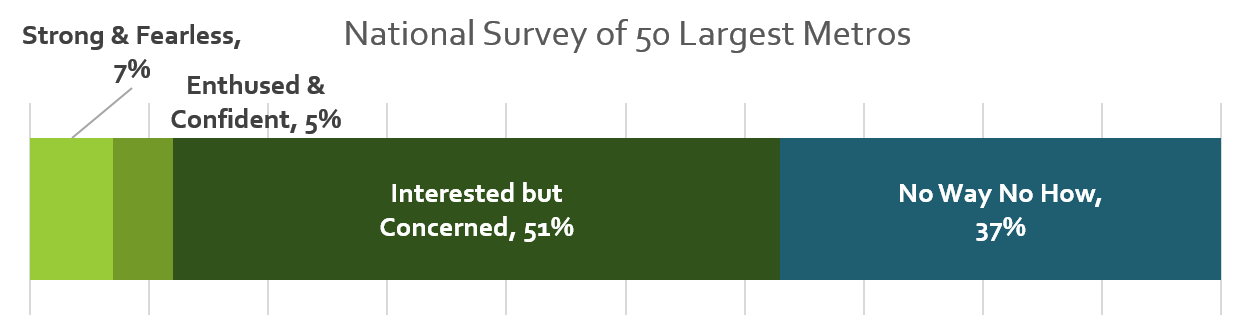
I’m a bicyclist with strong vehicular bicycling skills. I know where the safest place to ride is on every street, and I ride there no matter what motor vehicle drivers or law enforcement happens to think about it. But I am far, far from a typical Sacramento bicyclist. I am ‘strong and fearless’, though as I get older, I’m tending towards ‘enthused and confident’. The four types of bicyclists, or levels of comfort, developed in Portland but applicable to Sacramento, are shown in the graphic:
The city should be designing bicycle facilities that work for all three categories of people who will bicycle. When there is a gap in a bike lane, the city has designed bicycle facilities that serve the ‘strong and fearless’, only 7% of potential bike riders. This is discriminatory. It is wrong. I suspect that with the resurgence of bicycling and the availability of e-bikes, the ‘no way, no how’ category has shrunk a bit.
The city must close bike lane gaps. Not off in the future when the street is repaved, or when a grant is obtained, but NOW. To do otherwise is to intentionally discourage bicycling and to risk people’s lives.
The third place where sharrows need to be eliminated in the central city Sacramento is I Street at the county jail. In the phot below, the right hand lane is a parking lane most of the time, except for commute rush hour, 4:00-6:00PM on weekdays (note the time sign in the ‘bikes may use full lane’ photo following), when it is a general purpose lane. When it is a parking lane, there are sharrows nearly covered up by parking, as you can see in the second photo. This is not a bike lane in any sense of the word, but drivers assume that it is and close pass anyone using that area to ride in. When it is a general purpose lane, there is high speed traffic approaching the Interstate 5 onramps, absolutely not an appropriate location for sharrows. The current trend in use of sharrows is 1) don’t use them at all; 2) if they are used, they should absolutely never be used over 35 mph, and rarely used over 25 mph. Though the posted speed limit of I Street is 25 mph (though it isn’t really posted anywhere), regular traffic speeds are over 35 mph, and during commute hours is over 45 mph except when congestion prevents that. So this is not any appropriate location for sharrows.
Of all the places where bicyclists are at risk of getting doored, this is the place. Everyone parking here has a family member or friend who is in jail. They are upset, they are depressed, they are often angry, they are not thinking about bicyclists and looking before they open their door. There is also a lot of turn-over here, so a lot of door opening. When I ride this area, I ride in the exact middle of the next lane over, taking the lane. But that is something that the average bicyclist will not do. So the sharrows leave them vulnerable to both close passing and dooring.
The city has placed a ‘bikes may use full lane’ sign (MUTCD R4-11), but is is up high against the background of a tree, where it would not likely be noticed by drivers or bicyclists. Of course bicyclists may use the full lane, with or without the sign, but again, most bicyclists will not do that. If signing is to have any meaning at all, the sign must be much bigger than it is, closer to 7th Street, and the message should also be marked on the pavement.
I St west of 7th St, part-time parking and general purpose lane with sharrows, SacramentoI St west of 7th St, sharrows and parking in a part-time general purpose lane, SacramentoI St west of 7th St, bikes may use full lane sign
I am not sure what the best solution is here. It is not to get rid of the parking; this is one location where on-street parking is justified. The right hand lane should be a parking only lane, however. There is no justification of traffic volume requiring another general purpose lane during commute times. That just encourages more driving and higher speeds, as drivers race each other for the on-ramps.
This is also a location where bicyclists separate into two destinations. Riders heading towards Sacramento Valley Station stay on the right so they can turn on 5th Street toward the station. Riders heading to Old Sacramento must move to the left hand side to avoid the high speed on-ramps. The left side bike lane, however, doesn’t even start until just before 5th Street, leaving no refuge for bicyclists trying to merge across traffic to the left side between 7th Street and 5th Street. I think there needs to be an intentional location for bicyclist to shift, at 7th Street or 6th Street or 5th Street. There would be a green bicycle box for waiting, and a signal with exclusive bicycle phase for bicyclists to safety transition from the right side to the left side. A bike lane would be present from that crossing point on I Street, without gaps.
Of course I Street needs to be reallocated so that it serves all users, and is not just a traffic sewer for drivers going to the freeway. It should be no more than two lanes at any location. Fewer lanes would slow traffic, as the prudent driver sets the speed rather than the egregious speeder. There should be a separated (protected) bikeway on either the left or right side, with a safe transition from one side to the other at some point.
Caveat: I post about issues in the central city because I live here, and see the problems every time I am out walking or bicycling. However, I strongly believe that the city should be focused on solving issues in lower income, disinvested neighborhoods, of which there are ample throughout the city. The central city has received more than its share of bike facilities.
Next sharrows location to address is I Street between 10th Street and 9th Street. The bike lane present to the east disappears in this block, with Cesar Chavez Plaza on the south and Old City Hall on the north, before picking up again west of 9th Street. Not having my tape measure out (and I’d have to measure late night when there is no traffic), it isn’t clear why this one block does not have a bike lane. It may be that the curb extension is too wide, or it may be that the general purpose (car) lanes are not configured correctly. If lanes, then it is an easy problem to fix, just re-stripe the lanes and add a bike lane. If the curb extension, then that would require a bit of infrastructure work. I fully support curb extensions, nearly all intersections should have them, but in some places the city has installed them incorrectly and caused issues for bicycle facilities. This is not, as many places are, a case for removing parking, but for designing the street correctly. Of course ultimately there should be no three-lane one-way traffic sewers in the city, and right of way should be reallocated to a separated (protected) bikeway and wider sidewalks.
I St westbound at 10th St, Sacramento
Caveat: I post about issues in the central city because I live here, and see the problems every time I am out walking or bicycling. However, I strongly believe that the city should be focused on solving issues in lower income, disinvested neighborhoods, of which there are ample throughout the city. The central city has received more than its share of bike facilities.
The block of H Street between 7th Street and 8th Street in downtown Sacramento has shadows instead of a bike lane. There is a bike lane in the preceding block, and in the block past, but not this block. Why? Because on-street parking has been preserved on this block in preference to bicycle facilities. The right lane lane is marked with a sharrow. Not a properly placed sharrow, but one in the door zone of the parking lane. When shadows are used, they should be placed in the center of the travel lane. But rare is the situation in which they should be used at all. Research indicates that sharrows are less safe than no markings are all, less safe than marked bike lanes.
So why is this parking here at all? No reason whatsoever. On the north side of this block is a County of Sacramento parking garage. There is even a pedestrian bridge between the parking garage and the Sacramento County administrative building on the south side of H Street, as seen in the photo.
I am certain that all of these cars belong to county employees or contractors. They should be parking in the garage, and this parking should be removed so that at least a marked bike lane can be placed in this block. Of course H Street should have a separated bikeway from 6th Street, Sacramento Valley Station, to 16th Street, where it becomes two-way. But a Continous painted bike lane is at least a first step.
There are a number of locations in the central city where bike lanes are dropped for a block in favor of parking and travel lanes. Every single one of these should be fixed either by the removal of parking or a general purpose lane.
Caveat: I post about issues in the central city because I live here, and see the problems every time I am out walking or bicycling. However, I strongly believe that the city should be focused on solving issues in lower income, disinvested neighborhoods, of which there are ample throughout the city. The central city has received more than its share of bike facilities.
Note: As is not unusual, I had forgotten that I’d written about N St before: N Street bike route to cycle track, 2015. Seven years have passed, the city has taken no action.
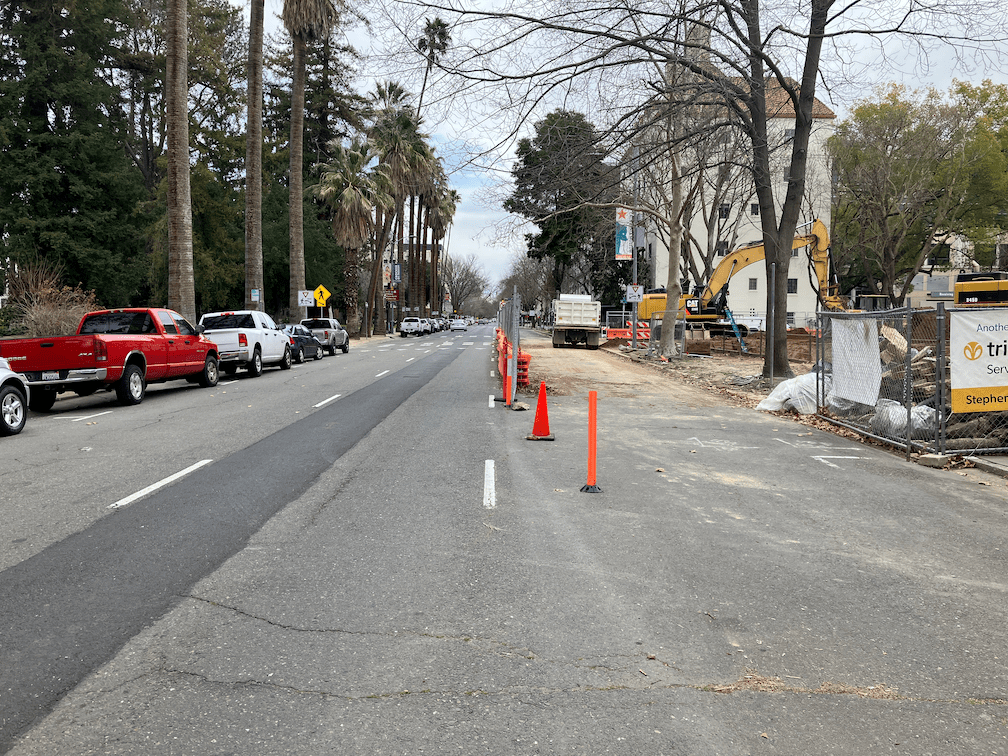
The construction for the Capitol annex project has narrowed N St to two lanes eastbound, from 10th St to 14th St, and parking has been removed from the south side to shift the lanes over. Now is the time for the City of Sacramento to implement its long-delayed (if not deep-sixed) plans for re-allocating space on N St. There have been ongoing utility projects over the last few years that have narrowed N St to two or even just one lane. At no time did that create significant congestion, during the pandemic or before the pandemic. I live two blocks from N St, and both travel along it and cross it frequently. I’ve never seen more than momentary congestion, in 11 years. What that means is that N St, in its three-lane configuration, has grossly excess capacity for motor vehicles.
While the street has been narrowed is the time to redesign the street so that it has no more than two general purpose lanes, and has a curb-protected or parking-protected bikeway. Probably on the left. This is in fact the perfect setting for a separated bikeway, five blocks from 10th St to 15th St with no intersecting streets from the north side, which is Capitol Park.
It is true that the sidewalk on the north side of N St is a designated bikeway, so bicyclists may use the sidewalk to avoid riding in the street. But bicyclists on the sidewalk are often in conflict with people walking on the sidewalk. The sidewalk has pretty continuous use by walkers, particularly during the lunch time – walk time for state workers, but a lot of people also include a circuit of the Capitol Park on their runs and walks. This conflict is easy to solve: create a safe, welcoming, protected (separated) bikeway on the street. And do it now!
On N St eastbound, the leftmost lane is a designated left turn lane at 10th St, which is what makes possible the two-lane configuration beyond 10th St. As a temporary measure, this works well, and forcing turns off three lane streets is a good solution for so many overbuilt arterials roads in Sacramento, but here it is only temporary, and would be obviated by the conversion of all of N St from 3rd St to 15th St. N St becomes a two-lane street at 15th St, and then becomes a two-way street at 21st St. N St from 15th St to 21 St would probably be a good candidate for a separated bikeway as well, but with paint bike lanes existing, would be a lower priority.
Below is a StreetMix sketch of what N St might look like. Note that the width of the street and the elements are estimated, not measured. I don’t believe parking is needed on both sides, but the diagram shows it for people who think it is necessary. Left side is north, Capitol Park in this case, and right side is south, mostly state buildings.
N St Sacramento between 3rd St and 15th St
As a reminder, I feel strongly, and it is backed up by evidence:
Three-lane streets are significantly less safe than two-lane streets, primarily for the muli-lane threat (one vehicle stops for walkers and the others do not). They are also a clear sign of poor land use planning, which puts residents and the things they need to reach (jobs, stores, recreation and entertainment, medical, etc.) far away. Narrowing all such roadways in the city from three to two, or less, would increase safety, increase livability, and encourage people to make different choices about where they live and visit. Maps of collisions (vehicle vs. vehicle, vehicle vs. walker, vehicle vs. bicyclist) align almost perfectly with overbuilt arterials.
One-way streets are significantly less safe than two-way streets, for the same multi-lane threat, and because there isn’t any friction to slow drivers. However, I think that the only valid argument for one-way streets is to accommodate separated bikeways, bus lanes, or rail transit. That may be true of N St.
And, sorry, can’t resist, get rid of the worthless palm trees while they are at it. We need shade trees, not poles.










 Getting Around Sacramento