small business, not homeownership

Many organizations and governments are again touting homeownership as the path to economic security and wealth creation. I have my doubts. The wealth generated for people who own homes is not wealth out of thin air, nor is it wealth out of moral superiority. It is wealth out of exclusion and externalized costs. Every day, the gap among homeowners, and renters, and unhoused people grows, and the structure of wealth accumulation depends upon this gap.

As we, as a society, come to realize that we cannot continue to subsidize single family homes and their development pattern that requires large amounts of infrastructure, huge amounts of driving, and an impoverishment of cities, the single family home will lose value. This is hard to believe, given the exponential increase in home prices, but it will happen. As has been said by many others, the suburbs will largely collapse of their own weight, of their permanent debt burden. See growth ponzi scheme. Some will survive by changing their form and becoming small towns within the bigger city, but most will not. Detroit is the fate of most suburbs.

So, when the reckoning comes, and the American dream of homeownership comes to an ignominious end, what then is the alternative?

I’d like to propose small business ownership as a better model. No, I have no illusions that small business ownership is easy, or that it is any quick path to wealth. The business owners I talk to would find this laughable. But the wealth that is gradually accumulated is real wealth for the owner and real wealth for the community. It does not need subsidized infrastructure. It does not need an expensive transportation system and associated harms. It may need a small boost from the government, at times, but largely it survives and thrives by being part of an ecosystem of a healthy (and wealthy) community.

Some people claim that homeownership is the way to erase the disparity in wealth between white people and people of color. I’ll let the people of color speak for themselves, but for me, nothing about the current system or the proposed system of widespread homeownership looks likely to erase the gap. In fact, though it may bring a few people from the renter category into the homeowner category, it will very likely cast the rest downward into struggling renters and unhoused. If the government spends money to increase homeownership, as seems the politically preferable action these days, what then of the unhoused? What then of renters? What then of people who live in substandard and deteriorating housing, whether they own it or rent it?

I believe that government should stop subsidizing, and stop promoting large developments and large businesses. Large developments and large businesses seek government support in order to make what they do more profitable, but it is at the expense of the rest of us. This is nowhere more clear than in our transportation system, which was designed, and continues to be designed, to support large corporations and large shopping areas (malls), to make possible long distance commuting which is necessary when we separate single homes from work, shopping and recreation, and which destroys both the general environment on which we depend and the local communities that suffer from this system.

All efforts should instead be focused on small businesses. What do they need to succeed? What small government actions would support them? In this, I am completely aligned with the Strong Towns message:

Strong Towns Chuck Marohn in Citrus Heights on Thursday

Chuck Marohn, President of the Strong Towns organization, will be in the Sacramento area this Thursday (June 16). He is speaking in Citrus Heights, 6:00PM to 7:30PM, and it appears he is also presenting to the SACOG Board at a workshop, item 14 (immediately following consideration of the proposed transportation sales tax measure side agreement).

This conjunction seems appropriate, since Strong Towns has just released its five campaigns that are the core of its new strategic plan:

  1. We’re Advocating for Safe and Productive Streets
  2. America *Must* End Highway Expansions
  3. Your City’s Accounting Is Unnecessarily Obscure. It’s Time To Pull Back the Veil
  4. Legalizing Incremental Change—Everywhere—To Meet America’s Housing Needs
  5. End the Parking Mandates and Subsidies That Are Hurting Our Cities

So, how does the transportation sales tax measure measure up?

  1. It does almost nothing for safe and productive streets. It at least give lip service to complete streets, but since it does not define what that means, the transportation agencies will create arterials that look a little nicer, but do little to slow traffic or increase the number of safe crossings. In fact, it is the unwritten policy of each of the agencies that speed limits will NOT be reduced when a roadway is reconstructed.
  2. It is all about highway expansions. More freeways, more interchanges! More construction jobs dedicated to making our cities worse rather than better.
  3. Accounting. The Existing Measure A has an Independent Taxpayer Oversight Committee (ITOC), which ensures that no one is absconding with funds, but does not address whether the projects actually contribute to economic stability, nor whether bonding almost all projects was a good idea. Measure A income is going largely to pay off bond debt, which is why SacTA and other advocates are so wanting to pass another measure, so Measure A can be bailed out.
  4. The measure says nothing about the connection between land use and transportation. It just makes the assumption that more transportation infrastructure is good, and more sprawl (technically, low density exurban development) is also good.
  5. Parking is hardly mentioned. Yes, this is primarily the purview of local agencies (cities and the county), but it is interesting that none of the projects in the Transportation Expenditure Plan address management of parking. Isleton wants to rehabilitate a parking lot, and the City of Sacramento wants parking facilities (not defined).

I am a founding member of Strong Towns, and the organization has influenced my thinking about transportation and housing more than any other source. I don’t agree with everything, but I do agree with most, and it is these goals that I work to implement in the city, county, and region.

So – go see Chuck!

backroom deals on sales tax

Imagine, if you will, a backroom filled with cigar smoke, burley guys with prominent gun bulges around the edges, the sounds of illegal gambling games coming from the adjacent room, and the clink of bootleg whiskey bottles. Around the table sit power players, working out deals. Someone asks about the public, and one of the burley guys says “We took care of them”.

This is the picture I have of the just-released proposed agreement on the transportation sales tax measure being developed. Read the agreement: Mitigation Agreement, and the SACOG 2022-06-16 Agenda Item 13 Staff Report that introduces it. It is important to realize that this agreement was developed by Sacramento Mayor Darrell Steinberg, SACOG Executive Director James Corless, and the proponents of the measure (called ‘The Campaign’ in the agreement). The proponents are named A Committee for a Better Sacramento, but their website tell the story: two mega-developers of greenfield (agricultural) lands, Cordova Hills Development Corporation and Angelo T. Tsakopoulos and Affiliated Entities, and the California Alliance for Jobs, an organization that supports large infrastructure projects on behalf of construction contractors (it is the contractors, not the workers who are represented). The proponents want the taxpayers to build them a freeway and interchanges to increase the value of their greenfield developments. The public was not involved. Actually, the SACOG Board of Directors was not really involved.

Before going into what is wrong with the agreement, a review of what happened at the last SACOG Board Meeting on May 19. Almost every representative from Sacramento county and cities badmouthed the SACOG study that revealed that the Capital Southeast Connector would likely cause the region to not meet its 19% greenhouse gas (GHG) reduction target, and therefore likely lose a significant amount of state and federal funding for transportation and housing. Several of them even questioned the honesty of the staff that wrote the study. It was a pretty horrible display of politicians saying they know more than professional staff. On the other hand, almost every representative of counties and cities in the region that are not in Sacramento County expressed concern about losing transportation and housing funding if the measure passes. James Corless listened to this, and decided an agreement that helps some select developers and some select projects, while harming the region, is the way to go.

So, the agreement. What is wrong with it?

  1. The agreement accepts that project proponents (cities and the counties, not measure proponents) can make a determination about whether their project meets air quality requirements. It encourages both projects and the overall program to meet SACOG requirements and inclusion in the MTP/SCS, but accepts that they may not. This will establish a precedent that will be used by project hosts and tax measure proponents from now on, to claim they don’t need to follow SACOG.
  2. The agreement proposes that SACOG undertake a study of the proposed measure to determine GHG/VMT impacts. This will be expensive, and the funds will come out of the Sacramento Transportation Authority (SacTA) Measure A funds, meaning less money for other projects. This study would probably be a good idea, but it should have been done before the measure was written, not after. If this measure fails, as it should, advocates should demand that climate impact studies be done before the Transportation Expenditure Plan is completed, not after.
  3. The agreement also proposes a third party study, because, basically, the measure proponents don’t trust SACOG to kowtow to the party line. Who will this third party be? The agreement doesn’t say. Handpicked by the proponents? Handpicked by SacTA (current SacTA Executive Director Kevin Bewsey was formerly the Principal Civil Engineer for Sacramento County, hardly an unbiased role)? The agreement says, if the two studies don’t agree, we’ll talk about it. Hmm. More smokey back rooms.
  4. The agreement depends upon an ‘extra’ $510M in additional sales tax revenue for mitigation. What if sales tax remains flat, or decreases? What if construction and management cost go up at the same rate as the sales tax receipts, thereby eating up the excess? No mitigation, then? That is the implication.
  5. The agreement relies on the good will of the transportation agencies in the county (pretty please) to spend their extra sales tax revenue on mitigation: “…recipient agencies can pledge that the use of these additional funds be used first for GHG Mitigation.” Notice it doesn’t say must or will, just can. Citrus Heights, for example, which is much more likely to propose multi-modal transportation projects than other entities, will be asked to sacrifice sales tax revenue to mitigate the Connector and other capacity expansion projects, even though they won’t benefit from those. The same for the City of Sacramento, which makes it doubly disappointing to me that Mayor Steinberg is a party to this agreement.
  6. The agreement implies that the GHG/VMT generating projects can be mitigated sometime later: “Therein, there should be no net increase to regional GHG emissions after mitigation measures are complete.” It doesn’t say the mitigation needs to happen first, or at the same time as the project, just sometime within the 40 years. Ouch!
  7. An MOU is just a statement of intent, laying out what each party intends to do. It is not a contract, and is not legally binding. If one of the parties is unhappy with what the other parties have done, or not done, they can bring a civil suit, but they may not allege breach of contract, because it is not a contract.
  8. The agenda staff report says it is likely that the SACOG Blueprint will have to be delayed in order for staff to be shifted to the study. This is SACOG’s flagship product. Why in the world would it be delayed just to meet the needs of the transportation sales tax measure proponents? This is crazy.
  9. $100M out of City of Sacramento’s share of sales tax revenues would be added for the Mobility Center. Why? What does this have to do with the Capital Southeast Connector and other roadway capacity expansion projects? Are we going to mitigate all the bad things in the measure with a small investment in electric vehicles?

    The measure proponents are bullying SACOG. This was their intention, else why would they have removed the GHG/VMT climate protection language that was in the deferred 2020 measure? It is as though the school bully said “hand over your lunch money” and the victim counter-proposes an agreement to only give half of the lunch money, and agrees not to report the bully to the Principal (the Principal, in this case, being the public).

Please take a look at the SACOG Board page to see who your representatives are, and contact them about this agreement.

The SACOG Board Meeting is this Thursday, June 16, starting at 9:30AM, and this is agenda item 13. You can view the meeting at https://us06web.zoom.us/j/82132538239. You can comment via Zoom, or by email or online or phone, or even in person. This is apparently the first in-person meeting of the board. See the agenda for details.

For more on the measure, see Measure 2022 posts. The use of this category is not meant to confuse. A lot of people are referring to this as Measure A, but the measure letters are assigned by county elections after they have qualified, so this is in no sense Measure A at this time.

CARB 2022 Scoping Plan

CARB has released for public review the Draft 2022 Scoping Plan Update. The June 23/25 CARB Board Meeting will have public comment (and board decision?) on this document. The document is 255 pages, not even including many appendices. I have only just begun to review the document, but what I see so far is pretty disappointing. For a brief introduction, see the four page Executive Summary. Also see Air Board Seeks Comments on Climate Scoping Plan; Shoup Urges a Look at Parking.

From the Executive Summary: “… rapidly moving to zero-emission transportation, electrifying the cars, buses, trains, and trucks that now constitute California’s single largest source of planet-warming pollution”. Notice that bicycles are not mentioned. Even more worrisome is that one third of the carbon reduction is from actions that capture carbon, including natural environments and as-yet unavailable carbon capture technology.

From the Ensure Equity and Affordability section: “… effective actions to move with all possible speed to clean energy, zero-emission cars and trucks, energy efficient homes, sustainable agriculture, and resilient forests…”. No mention of electric bikes or transit. Unless CARB intends to buy every low income person in the state an electric car, its plan will not meet with needs of low income and disinvested communities. What would meet those needs is a transit-first policy and funding, with significant state investment in making walking and bicycling more welcoming and safer.

In the entire document, there are two instances of ‘bike’ and three of ‘bicycling’ (and none of bicycle or e-bike or electric bicycle). There is one instance of ‘transit’. Six instances of ‘walking’. Ten instances of ‘active transportation’, but 163 instances of ‘transportation’, many of them referring to other documents and programs. In contrast, 157 instances of ‘vehicle’. Not hard to see where the focus is.

Here is a wordcloud of just the Executive Summary section. See if it speaks to your concerns. A wordcloud of the entire document would show vehicle prominently.

CARB seems incapable of imagining a future that is not dominated by cars. They simply intend to replace existing cars with electric cars. Put simply, this is climate arson, by the very agency that is supposed to be working on climate change in a serious way.

Sadly, many of the climate change and environmental organizations seem aligned with this focus on vehicle electrification.

I’ve said it before and will repeat (again and again): electric cars, or any electric vehicles other than bikes, are only a partial solution to the climate crisis. Serious solutions will include and prioritize walking, bicycling and transit. If you are an electric car booster and not working to reduce the dominance of motor vehicles in our cities and lives, you are not serious about climate change. And you are certainly not serious about livable cities.

Lime fails on bike share

Below is a photo of a Lime/JUMP bike that has been abandoned for three weeks now, parked on my street, P Street, between 13th St and 12th St. It has been reported to the city, twice, and to Lime, three times. And it is still there. Of course the battery has depleted so that GPS no longer works. But Lime knows the last reported location of the bike, before it died.

Let me be clear and blunt. Lime does not give a shit.

This kind of neglect will continue until: 1) the city (and SACOG) holds Lime accountable for managing the bike share fleet, 2) the city or the region gets a real bike share operator, or 3) the city or the region changes to a publicly owned system. The third option is probably the best, because then the city and/or region can manage the bike share system as part of the transportation network, and SacRT can take on some responsibility for the bike share system as a first mile/last mile solution with transit.

SACOG Board on sales tax analysis

The SACOG Board met today, and agenda item 12 was on the SACOG Review & Analysis of Proposed Citizens’ Transportation Tax Initiative in Sacramento County. This was an information item, for discussion, not for action. This post is a brief summary of the discussion, to follow on to the earlier post on the analysis: SACOG analysis of Measure 2022. The analysis identifies 26 (or more) capacity expansion projects proposed in the measure’s Transportation Expenditure Plan, all of which would increase GHG/VMT, and most of which would also increase sprawl.

Nearly every representative of the cities and counties in Sacramento County rejected the analysis as being flawed, some even said it was unprofessional. They claimed that the analysis made so many assumptions that it could not be trusted, and that SACOG should not be in the business of producing documents like this. Despite that fact that planning for transportation and land use is specifically the purview of the MPOs, and that they instead support a measure that speculates about transportation needs for 40 years into the future. If you don’t like the message, blame the messenger.

I can’t resist pointing out that this has become a pattern for supporters of more of the same (more capacity expansion, more sprawl, more GHG/VMT):

Supporters of sprawl and the measure proponents: Show us the data!

SACOG: Here is the data.

Supporters of sprawl and the measure proponents: No, not that data. We don’t believe you.

On the other hand, every representative from the other five counties in the SACOG region expressed great concern that allowing the measure to go through would threaten their own transportation projects and funding due to the region not meeting GHG reduction goal of 19%. Don Saylor of Yolo County was the most succinct, saying that SACOG must consider the impact on the region as a whole, and that it is time to move past the limited vision of the past.

The out-of-left-field part of the discussion was that Darrell Steinberg talked about an ongoing negotiation with the measure proponents that would mitigate for the worst aspects of the measure. This apparently has been going on for six weeks, and is the reason the release of the analysis was delayed, even though it was completed a month ago.

Darrell talked about five elements of the negotiation (this is captured from his verbal report, and may not be accurate, no printed information was offered):

  • $300M in the measure for the connector would be contingent upon SACOG defining mitigation measures, and that the Capital Southeast Connector JPA accepted the mitigation.
  • SACOG would develop a scenario in the currently developing MTP/SCS that includes the connector.
  • SACOG would commit to putting the connector in the MTP if these other conditions where met.
  • An additional $300M would be provided for connector mitigation in the measure.
  • $100M will be added to the California Mobility Center, diverted from other projects.

It looks as though Steinberg is putting the onus on SACOG, not on the proponents. It is true that none of the government entities have any control over the measure, but if negotiations are going on, it should be from a position of strength, not weakness. If the City of Sacramento opposed the measure, it is very unlikely that it would pass.

The proponents intended to bully the agencies into supporting it, and to make sure that they got their message across, removed the climate protection language from the measure. They want the agencies to make their own decisions about whether and how to mitigate climate impacts, regardless of regional interests or the intent of the state legislature, or even the interests of the counties that would be impacted.

To my knowledge, no opponents of the measure, of which there are many, the majority of the transit, transportation, and environmental advocacy organizations, were asked to participate in the negotiations. Yet another example of excluding public engagement, just as the people who wrote the measure excluded public engagement.

SACOG said that the analysis would be presented to the various SACOG committees, and would come back to the board in June. It isn’t clear to me what, if anything will happen at that point. I assume the negotiations will have completed by then, successfully or unsuccessfully. It isn’t clear what kind of agreement could be reached that would actually be binding on Sacramento Transportation Authority and the other governments, since a measure, if passed and not found unconstitutional, has the force of law. Maybe there is a way.

For more on the measure, see Measure 2022 posts. The use of this category is not meant to confuse. A lot of people are referring to this as Measure A, but the measure letters are assigned by county elections after they have qualified, so this is in no sense Measure A at this time.

SACOG analysis of Measure 2022

SACOG has released a blockbuster analysis on the effects of the proposed transportation sales tax measure that may be on the ballot in November 2022. The report is extensive, 88 pages. The SACOG Board agenda for 2022-05-19, item 12: SACOG Review & Analysis of Proposed Citizens’ Transportation Tax Initiative in Sacramento County is available here; the entire agenda packet is available on the SACOG website, but is quite large. I will be creating a number of posts on this analysis, but to start, here are two key quotes:

SACOG’s analysis of the proposed transportation tax initiative in Sacramento County projects the region would likely fall short of meeting its state-mandated 19 percent per capita greenhouse gas reduction target by nearly 2 percent. This would jeopardize the region’s ability to compete for state transportation and housing funding programs. The analysis shows that the potential impacts from this revised 2022 initiative are indeed significant enough that the region and decisionmakers should take the time to understand and weigh the potential benefits of the transportation investments against the risks of failing to meet the region’s GHG target.

SACOG Review, page 7

* The 26 known capacity expanding projects in the measure would substantially increase per capita GHG emissions, threatening the region’s ability to meet its 2035 GHG target. This conclusion results from the impact of the transportation facilities themselves, and from the impact additional transportation capacity would have on the location of new housing and employment development, substantially altering the region’s land use forecast and travel patterns and increasing per capita VMT.

* As a result, while the region’s 2020 MTP/SCS succeeded in meeting the per capita GHG emissions reduction target—19% from 2005 to 2035—the analysis shows that the initiative’s capacity projects would erode the region’s performance by nearly 2%; adding the capacity projects to the 2020 MTP/SCS would achieve an overall reduction of per capita GHG of less than 17% by the target year.

* The transit expansion projects in the initiative did not offset the impact of the initiative’s roadway capacity expanding projects enough to help the region meet its GHG emissions reduction target.

SACOG Review, page 5

For more on the measure, see Measure 2022 posts. The use of this category is not meant to confuse. A lot of people are referring to this as Measure A, but the measure letters are assigned by county elections after they have qualified, so this is in no sense Measure A at this time.

Grids are Good

This post was inspired by one on Strong Towns: Grids are Good. I’ve written about grids before (re-gridding Sacramento, trenching and decking Interstate 5, Sacramento Riverfront Reconnection, Phase 1) but it is a topic worth repeating.

The Sacramento central city is a complete grid, and so are some areas to the east and south of the central city, but the grid is broken by Hwy 50 to the south and Business 80 (Capitol City Freeway) to the east. The further from the central city one gets, the less likely there is to be a grid. Often major arterials still are on a grid, but not always, even some of them are broken. All of the freeways limit crossings. Local streets that used to go through do not. In general, the lower the income of the neighborhood, the fewer streets are carried through by underpasses or overpasses. This was an intentional design by Caltrans, intended to break up lower income neighborhoods and to isolate them from higher income neighborhoods. The principles of redlining were not just about home loans.

In a region with two major rivers, the American and Sacramento, the grid will of course be limited. However, I will point out that the Sacramento region has three bridges across the Sacramento and nine bridges across the American. Portland, a city of similar population but a bit less sprawling, has 12 bridges over just one river, the Willamette.

I worked for several years in the City of Citrus Heights. The saying was ‘it doesn’t go through’. Very few streets are through streets, and there is really nothing resembling a grid at all. This is not an accident, it was an intentional design decision by the county and developers to create street system that didn’t connect, because it was thought to provide a feeling of ruralness, of a peaceful suburb. Of course to get anywhere, everyone has to drive everywhere, so every street has too much traffic, and the major roads are congested much of the time. Ironically, the one remaining historically rural/agricultural part of the county, Orangevale, has a better street grid that any other suburb in the county.

Railroads also break up the grid. In many cases, though, the railroad alignments predate most of the development.

The lack of a grid is why our transportation system does not work well, why our transit system does not work well. Though there are opportunities here and there to reconnect or create a grid, the lack of a grid is something we will have to live with, forever, or at least until the ungridded suburbs die of their own weight (meaning not enough tax income to sustain them).

This is a superficial analysis. I would like like to get more specific about locations where the roadways network was intentionally broken or designed to be broken, and where the grid could be healed.

Freeport Boulevard Transportation Plan Emerging Design Concepts

City of Sacramento staff (Drew Hart) presented to the Sacramento Active Transportation Commission last Thursday on the Freeport Boulevard Emerging Design Concepts. The presentation slides are here. The city’s Freeport webpage has a lot of background material. A link to the virtual open house on April 28 (tomorrow!) is available. This project and the Northgate project are being supported by the same consultant, so you will notice similarities in the process and graphics.

The northern section, between Sutterville Road to the east and Sutterville Road to the west, should look exactly like the traffic-calmed, complete street to the north. This project on Freeport was successful. There is no reason for five lanes in this section. One lane northbound, one lane southbound, and one left turn lane southbound is all it needs. If traffic backs up at the Freeport and Sutterville Road to the east intersection, then shorten the signal cycle.

The emerging design document skips over the issue of whether four general purpose lanes are even needed. A concept should be presented that reduces general purpose lanes to two, and reallocates roadway width to other modes.

Dedicated right hand turn lanes should be removed everywhere. Dedicated left hand turn lanes should be provided only where traffic studies have shown a clear need, and should never reduce the roadway width for other uses.

Green lanes are shown behind protection for separated bikeways. Since the protection does or should prevent vehicle incursion, the paint is not needed.

Dedicated transit lanes should be considered. Though SacRT has not identified this as a high frequency route in the High Capacity Bus Service Study (Route 62 is 30-minute frequency), reconstruction of the roadway must consider the possibility of dedicated transit lanes and transit supporting infrastructure. Appendix A, available on the project webpage, provides a lot of detail about existing transit stops, which are mostly quite poor.

Some businesses along Freeport have multiple driveways, more than are justified by the amount of vehicle traffic access. Closure and narrowing of driveways should be considered. Since almost every business has parking fronting the street, no on-street parking is needed anywhere. This is poor urban design, but it is the nature of the corridor and could not be corrected without wholesale reconstruction of the corridor.

While separated bikeways are often a good solution, the frequency of driveways might make for poor quality infrastructure. Unless driveways can be closed or reconfigured, separated bikeways may not be the best solution.

Posted speed AND design speed should be considered for reduction. Posted speed is 30 mph from Sutterville Rd (to the east) to Arica Way, 35 mph from Arica Way to Fruitridge Rd, and 40 mph from Fruitridge Rd to Blair Ave. The section from Sutterville Rd (to the east) to Fruitridge Rd should be posted and designed for 25 mph, in recognition of the density of businesses and driveways. The section from Fruitridge to Blair Ave should be posted and designed for 30 mph, as it has a lower density of businesses and driveways, and is adjacent to the airport for a significant distance.

Prioritization of the modes for Sutterville (to the east) and Fruitridge Rd should be:

  • walking
  • bicycling
  • transit
  • motor vehicle

Prioritization of the modes for Fruitridge Rd to Blair Ave should be:

  • bicycling
  • transit
  • walking
  • motor vehicle

Crash/collision map of the Northgate Blvd corridor for pedestrians (walkers) and bicyclists. Data is from SWITRS for the years 2015-2019. (pdf)

map of Freeport Blvd Emphasis with pedestrian and bicyclist crashes

Land Park open (car free) roads?

With the exciting news that the closure of a part of JFK Drive in Golden Gate Park will remain permanently closed to private vehicles. This closure was made to provide safe open space during the pandemic, and is only a small portion of the roads in the park. Most of the people who live in San Francisco support this closure to cars (opening to walkers and bicyclists), and most of the people who visit the park from elsewhere (which includes me) also support.

People have started talking about Land Park in Sacramento. I was certainly not the first. This has been an ongoing conversation among advocates for walking and bicycling for years, but it never turned into a movement. Maybe today is the day.

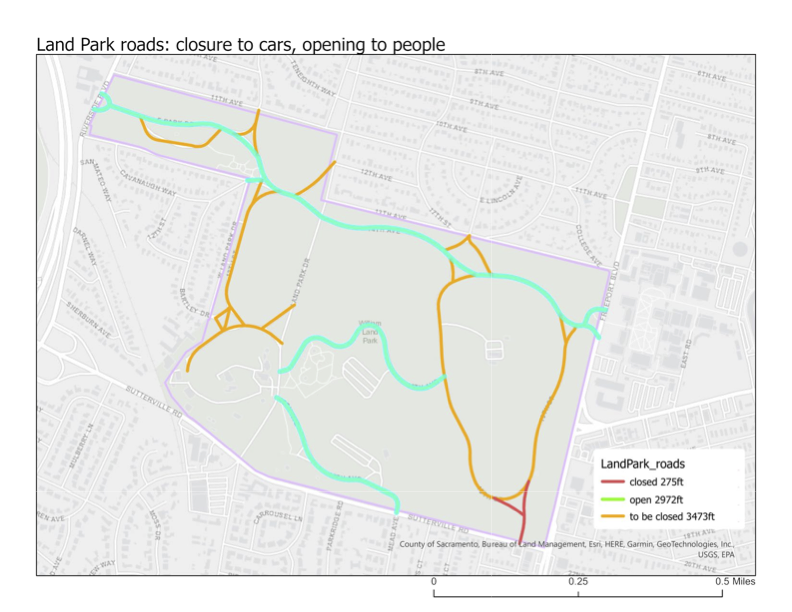
Below is my (modest) proposal for closing some of the roads in Land Park to private vehicles (pdf). There is a small existing closure, of the roadway in from the southeast corner of the park. It has gates that are permeable to bicyclists.

My proposal closes about 53% of the roads in the park, but leaves open roads that access important points such as Fairytale Town and the golf course (if that is important). It also leaves open an east-west route through the park, with ample parking along the roadside, for those who need vehicle access. People who drive are most likely to access the park from Riverside Drive, Land Park Drive, and Freeport Blvd; all those access points remain open.

Of course the use of the term ‘closed to cars’ is really an inversion. Roads that are closed to private vehicles are by nature open to walkers and bicyclists, and so are really ‘open’ to people.

So, what do you think? Constructive comments are always welcome.