this week 2024-08-19

A slower week, so far as I know. SacMoves Coalition hosts an event calendar at https://sacmoves.org/events/.

Tuesday 20

Wednesday 21

Friday 23

Sunday 25

  • Sunday Streets SF: Mission Ciclovia, 11:00AM to 4:00PM (no, not Sacramento region, but if you’ve never experienced the joy of an open streets event, highly recommended; entirely accessible by train and transit; bring your bike!)

report on SacATC 2024-08-15

Several transportation advocates attended the SacATC meeting in person, several people made eComments online, and hopefully others watched via Zoom.

3. Two Rivers Trail Phase III

This project is in the selection of alternatives and preliminary design phase. It will connect the existing trail segments of the Two Rivers Trail (the one on the south side of the American River, matching the American River Parkway Trail on the north side), except for crossings of the two UPRR (Union Pacific Railroad) tracks across the river, which are under discussion but without resolution. An additional crossing is Hwy 160, with uncertainty due to there being no active project design to replace one or both sides of the bridge, which are substandard, and will need to be replaced. Commission members asked a number of questions about the alternative alignments, particularly around the old city landfill. The project will report back when alternatives are selected.

4. Street Design Standards Amendment

This was just an update on the project, which is in early stage with some meetings held but several others yet to go (stakeholders, technical advisory, and public). Actual designs were not discussed, though public comment requested that the designs be innovative and cutting edge, and that outmoded or unsafe designs in the 2009 version be eliminated completely from the amendment.

5. Active Transportation Commission 2024 Annual Report

The presentation was on the 2023 report, with some questions about formatting, but the major questions having to do with whether to carry the 2023 recommendations, which sadly have not been acted on by city council or staff, into the 2024 report, or to modify them. The consensus seems to be there there should be a list of recommendations focused on safety issues, with safety for walkers and bicyclists being a higher priority than promotion of walking and bicycling (or course, they can’t really be separated). Recommendations that do not end up on the safety list might be on a separate list, not as prominent, but not lost. There was also discussion about organizing things by short-term and longer-term, but no consensus.

Recommendation 1: Increase Funding for Active Transportation Infrastructure Projects was agreed as the top priority on any list. Recommendation 6: Create a Sacramento Quick-Build Bikeways Program, also received a lot of support, however, not universal agreement.

Discussions will continue at the September and October, and perhaps November, SacATC meetings. A number of members of the SacATC were absent, quorum just barely made, but there seemed to be agreement that the conversation would continue from this point and not go back to the beginning, and the returning members would catch up on their own.

Of course the elephant in the room is that the city council accepted the report and recommendations, but has made no policy or funding decisions to implement the recommendations. The request to add funding to the 2024-2025 city budget for any of the recommendations was rejected by the city manager. Staff has moved forward in minor ways on some of the recommendations, using existing funding and staffing.

My favorite, Recommendation 9: Finalize the Construction Detour Policy, is stalled out in Public Works, and it is not clear when or if it will ever see the light of day. Adherence to best practices for ADA accommodation and meeting PROWAG guidelines is not popular in the regressive Public Works Department.

SacATC 2024-08-15 (Active Transportation Commission)

The Sacramento Active Transportation Commission (SacATC) meets today, August 15, 2024 at 5:30 PM. in city council chambers, 915 I St. It can be viewed online by going to the city meetings page, selecting SacATC livestream. Comments are only available in-person, via the meetings page eComment, or ahead of time to the city clerk, if eComment is not working. In-person comments are the most effective.

The agenda includes three main items:

  1. Two Rivers Trail Phase III (T15225400)
  2. Street Design Standards Amendment
  3. Active Transportation Commission 2024 Annual Report

I encourage everyone to attend in person, or watch online, and to submit comments. Recently, public participation has increased, but far too few citizens are engaged. Though the commission is not powerful, it is one of the few ways the public has of engaging the city on the public health crisis that is the epidemic of traffic violence in the city.

SacCity fails to act on traffic violence

At the June 11 city council meeting at which the 2024-2025 budget was adopted, seven of the council members spoke strongly about the need to address safety on the city’s streets, acknowledging that the city leads California as the most deadly for roadway users. But no modification was made to the budget to reflect that priority, and the city manager refused to make any changes to the budget to fund street safety.

In the two months since that council meeting, nothing has shown up on the council agenda to move forward on street safety, nothing has shown up to allocate funds, except some minor grant applications.

The city has long had a policy that it does not fund street safety projects, except for the required grant matches. Other than grant matches, no city general funds are expended to make our streets safer. The city certainly has been successful in getting some grants, but also has not been competitive on many others.

The Sacramento Active Transportation Commission (SacATC) made a recommendation in their annual report to allocate $10M to safety projects. Council members spoke in support of the idea, but no action was taken to fund those ideas.

We have an epidemic of traffic violence in the city. Yet the city is doing almost nothing to address that. Walkers, bicyclists, drivers and passengers are all dying in horrible numbers. What is the city doing in response? Submitting grant applications and hoping for the best. This is unacceptable.

The council must take this public health crisis seriously, and allocate funds to start solving it. It must also stand up to the city manager, who does not believe in spending money on street safety. The city manager runs the city according to his own whims, and rarely follows the direction of council on anything. The council must either stand up to, or fire, the city manager. So long as he is in the position, the city will not move forward on saving the lives of vulnerable roadway users.

again, from the outside in

I’ve written before that streets should be planned from the outside in. Nearly every street I travel and nearly every plan I see for changing street width allocation clearly shows that the reverse is what was built, and what is planned.

There are a number of streets where center turn lanes are provided in blocks where there are few to no driveways. S Street near where I live is just one example. Many blocks have few to no driveways, yet the center turn lane exists all the way from 3rd Street to Alhambra Blvd. Could the street width be better used? You bet.

The most egregious example, however, is the Broadway Complete Streets project. I’ve written quite a number of posts, about the ways in which the project is successful, and the ways in which is it not. The project is such a disappointment to all the transportation advocates I talk to. Why?

Broadway was planned from the inside out. A center turn lane, all the way, whether needed or not. I’ll point out the expression, “A foolish consistency is the hobgoblin of little minds”, Ralph Waldo Emerson, from the essay Self-Reliance“. Next, two motor vehicle lanes, one each way (which is an improvement over two each way before the project). The lanes are overly wide, 11 feet when they could have been 10 feet (not less than 10, because it is a bus route). Next, traditional bike lanes, mostly five feet wide but sometimes six, sometimes with a painted buffer (no vertical delineators), sometimes without. The bike lanes could have been parking protected, but they were not. They could have been wider, so that two bicyclists could safely pass each other, and accommodate cargo bikes and three-wheeled bikes. They were not. There is a short one block section between 15th Street and 16th Street where these a curb-protected bikeway. But nowhere else.

Then comes the sidewalks. The city apparently had a design policy to not touch the sidewalks, which then engenders ADA requirements, which are somewhat expensive to meet (though a small fraction of the entire project). But they did touch the sidewalks in places, and in each of these places, the sidewalks are narrower than they were before the project. In several locations, the sidewalks do not even meet ADA or PROWAG guidelines. The city has claimed that since PROWAG has not been adopted by FHWA, the requirements don’t apply to the city. In other words, go ahead and sue us, but we aren’t going to do the right thing. That is what city staff said when challenged about this.

Has the city learned its lesson? No. The two additional segments of Broadway to the east have exactly the same design.

The city’s stated objective for this project was to slow and reduce motor vehicle traffic so that people would stop for businesses along the street, increasing economic vitality. Broadway has real problems currently, as you can see by traveling along the corridor. A lot of empty buildings, a lot of parking lots, a lot of low value fast food joints. But is also has a number of great locally owned businesses, many of which were beginning to fail due to the street design and the pandemic. I admire the city’s intent, but mourn their failure to create a street than will accomplish that.

SacBee: quit parroting CHP misinformation

An article in the SacBee today reports that a bicyclist died when he/she swerved into the path of a motor vehicle. The article parrots the CHP spokesman, that the bicyclist swerved. No doubt the uninjured driver would say that. The bicyclist is dead and has nothing to say, so the CHP takes the word of the driver.

Note that no crash investigation has been conducted by CHP. Crash investigations take weeks, and require gathering of detailed information about the point of collision, and the direction of movement of the bicyclist and driver at the time of collision, and more information about the victim and perpetrator. But without the results of an investigation, the CHP just assumes that the bicyclist is at fault and the driver is innocent. This is victim blaming of the first order. Of course this is standard procedure for CHP, where almost every officer thinks that every bicyclist crash is the fault of the bicyclist, without evidence to support that assumption. CHP is not a safety-oriented agency, they are a victim-blaming agency. No surprise.

What is a surprise is that the SacBee would parrot the CHP’s misinformation about the crash. News media does not exist to reprint agency press releases. It should exist to question what agencies say, particularly when the agency expresses certainty about a crash that has not received an incident investigation. Please do better, SacBee. Report the facts that are known, not CHP speculation.

this week 2024-08-12

Note: Don’t expect this to be a regular feature. I’ll do it when I can. SacMoves Coalition hosts an event calendar at https://sacmoves.org/events/. Added note about consent calendars, below.

Monday 12

  • SacRT Board Meeting – canceled (no surprise)

Tuesday 13

Wednesday 14

Thursday 15

Friday 16

Consent Calendar items

All of the agency agendas have items on a consent calendar or consent agenda, items which are routine continuations of decisions already made, or which are not expected to generate any controversy or public discussion. Any council/board/commission member may request that an agenda item be pulled from the consent calendar for discussion. Sometimes this is just so that they can make a statement of support, and sometimes it is because they wish the governing body to really discuss the item. It is not unusual for an item that really deserves discussion to be snuck by on the consent agenda, but at the same time, discussion of every single item would lead to interminable meetings. The consent calendar does serve a useful purpose.

The public may comment on any item on the consent calendar. However, unless the item has been pulled for discussion, comment is unlikely to change the outcome. The consent calendar is passed en-masse, not item by item. It is often not known until the consent calendar comes up whether or not a particular item may be pulled, so if you do wish to comment, you must submit a speaker card for that item ahead of time (if in person) or a comment beforehand on whatever schedule and mechanism the entity requires.

street design and land use

Street design and land use are intimately connected. Street design should support surrounding land use (not land use somewhere else), and land use should take advantage of the best characteristics of streets. But in most of Sacramento, street design and land use do not support each other.

At the regional level, SACOG (Sacramento Area Council of Governments) has transportation authority but does not have land use authority. They must rely on encouragement of local governments to implement better land use, and is able to use transportation investments to a small degree to support better land use. But the City of Sacramento does have both transportation and land use authority, and could and should be planning the two in unison to accomplish a more sustainable and livable built environment.

Many of our streets are designed to allow people to pass through at high speed, not to stop for living. In some cases, this is an historical artifact because some of our major streets were at one time state highways. But other streets were designed in the same way in more recent times. The city has allowed and encouraged business development along these former highways, with more driveways, more parking, more intersections, more congestion that reduces transit effectiveness, and fewer safe crossings. At the same time, the city has widened roads and widened lanes, creating or maintaining high speed limits which are completely incompatible with the function of streets as places, or as Strong Towns puts it, places for building wealth.

The roadways which try to combine the functions of high speed and throughput with local productivity are called ‘stroads’, a street/road combination. These roadways fail at both. They must be healed by conversion to either streets or roads.

Stroad to Road

In order to bring street design and land use into alignment, the city must either redesign these stroads (a street/road hybrid) toward road function by:

  • Greatly reduce driveways and eliminate on-roadway parking
  • Eliminate signals that serve shopping centers, and replace major signalized intersections with roundabouts
  • Provide on-demand safe crossing at moderately frequent intervals for walkers and bicyclists
  • Discourage homes and businesses along these roadways

Stroad to Street

Or, redesign these stroads toward street function by:

  • Change roadway design to enforce motor vehicle speeds of 20 mph or less
  • Encourage homes and small businesses along streets
  • Create space for living in the public right-of-way by temporary or permanent closure of some streets, and street or sidewalk dining areas (with ADA-compliant routes).

In most cases it is more cost effective to change a stroad to a street, but both transformations are possible and necessary. We need fewer roads and more streets in our transportation system.

Land Use

An effective land use pattern offers the opportunities of daily life (jobs, businesses, dining, entertainment, groceries and shopping) within walking or bicycling distance of home. In Sacramento, the midtown section of the central city already offers this type of land use, because it was developed before the primitive concept of zoning pushed all uses further away. A few other places in Sacramento offer widely scattered examples of such land use.

Relatively few trips outside the neighborhood would be necessary if we had this type of mixed use and diverse land use. Though both land use and streets in midtown could be even better, it is an example which other neighborhoods could emulate. Of course streets must support this land use, with slow speeds which do not endanger people walking and bicycling, and where parking is sufficient but not in excess.

The city should support small businesses in every reasonable way. It need not prohibit larger businesses, but let them succeed or not on their own, without promotion or subsidy from the city.

Small parcels, often called fine-grained development, best support a diversity of housing types and businesses. The city should preserve small parcels, prohibiting consolidation except under compelling public interest, and where large parcels exist, consider purchase, division into small parcels, and sale to small scale infill developers.

Street and Land Use Supporting Each Other

Below is a photo of K Street in midtown Sacramento. The street design, one lane each way, low volume and low speed, temporary curb extensions to calm traffic, painted crosswalks, some on-street parking but reduced to increase walker safety. Of course it could be even better. The land use, a mix of storefront retail and housing, in turn supports good road design. This is a street. This is a place where people want to spend time, and spend money, and feel welcome.

photo of street design and land use that support each other, K St, midtown Sacramento
street design and land use that support each other, K St, midtown Sacramento

Street and Land Use Working Against Each Other

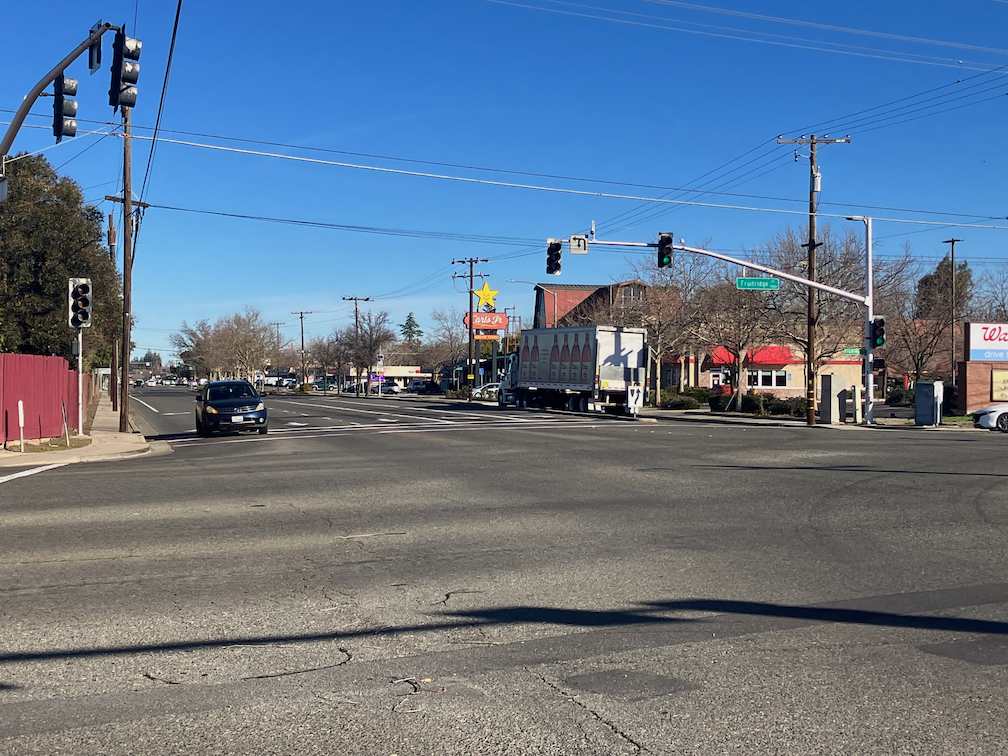
Below is a photo of Freeport Blvd at the intersection with Fruitridge Rd in south Sacramento. The street is designed for high speed travel, accommodating high volumes of motor vehicles. Bike lanes are present in some places, but dropped when necessary to promote motor vehicle flow. Dual left turn lanes endanger everyone on the road, and right turn lanes present a hazard to bicyclists. The crosswalk has faded to near invisibility. And the land use reflects those problems. Fast food businesses oriented to drivers and excluding walkers and bicyclists. A blank fence to try to isolate residences from the roadway, but of course it does not reduce exposure to noise and air pollution. Parking lots facing the street rather than storefronts. This is not a place where people feel welcome.

Freeport is NOT the worst stroad in town, by any means, but it is typical. Does the roadway encourage poor land use? Yes. Does the land use encourage the poorly designed roadway? Yes.

Intersection Control

Intersection control means the devices used at intersections to control the actions and behavior of motor vehicle drivers and others including walkers. The types of controls are:

  • none
  • 2-way yield
  • 2-way stop (or minor approach stop, MAS)
  • 4-way stop (or all-way stop, AWS)
  • roundabouts without signals
  • partial traffic control signals, such as flashing red or flashing yellow, and HAWK or RRFB
  • complete traffic control signals, with a cycle of green-yellow-red

It is often assumed, by traffic engineers and by the public, that safety increases moving down the list of intersection controls. However, there is research both supporting and contradicting this assumption.

Intersections may have features designed for people crossing, such as pedestrian crossing signals, with or without a countdown, and accessible pedestrian signals, compliant with PROWAG (Public Right-of-Way Accessibility Guidelines). Pedestrian signals may require user activation (the beg button) or may use automated pedestrian detection. Exclusive pedestrian phases allow people to cross when no motor vehicles are moving, thereby reducing the chance for crashes to near zero.

Other features may increase or decrease safety. Examples that may increase safety if properly designed and implemented, are curb extensions, refuge islands, automated red light cameras, near-side traffic signal placement, raised crosswalks or raised intersections, and roadway design that slows vehicles approaching the intersection. Examples that may decrease safety, particularly for walkers and bicyclists, are dedicated turn lanes, faded or non-existent crosswalks, pedestrian crossing prohibitions, and roadway designs that encourage speeding approaching the intersection.

Traffic Signals

Traffic engineers often try to solve known safety issues by adding new traffic signals. Little attention is paid to alternative solutions such as adding traffic calming features, or removing hazardous features. New or enhanced traffic signals are VERY expensive, ranging up to $1,000,000 per intersection. The addition of new signals ensures that money will not be available for traffic calming solutions that would be less expensive and more effective.

Traffic signals do not decrease the speed of motor vehicles in between intersections. Drivers immediately accelerate to the speed they had before stopping at the signal (if in fact they do stop). But signals do delay drivers, leading to frustration and increased violation of motor vehicle codes, particularly in yielding to walkers in the crosswalk. Red light running has become epidemic in the Sacramento region, perhaps worse than other regions, so it is not safe for anyone to proceed on a green signal or a pedestrian walk signal. This indicates a failure of traffic signals to control driver behavior, and that they may no longer be effective for safety.

The fact is, traffic signals are largely intended to smooth and ease traffic flow, and are often not safety features at all. Safety is used to justify new or upgraded signals, often without evidence.

Traffic signals are a classic example of ‘orderly but dumb’. Intersections should be ‘chaotic but smart’. (Strong Towns concept and Carlson’s Law)

Traffic engineers often claim that existing traffic signals were installed based on meeting warrants defined in the Manual for Uniform Traffic Control Devices (MUTCD, and the California version CA-MUTCD), but generally can’t produce those warrant documents. Many signals were installed based on politician requests and were not and are not justified by intersection characteristics. The warrant process emphasizes traffic flow and de-emphasizes safety for walkers and bicyclists.

All existing traffic signal locations should be analyzed every ten years, and signals which did not meet, or no longer meet, warrants, shall be removed. As roadways are modified or rebuilt with traffic calming features, far fewer traffic signals will be necessary.

When are traffic signals justified?

  1. At the intersection of two major roadways.
  2. Where the flow of traffic on one roadway does not provide gaps in traffic for crossing that roadway.
  3. At offset or skewed intersections where visibility or understanding may be difficult.

Most existing and proposed traffic signals do not meet any of these criteria. Major roadways, almost always designed as stroads, which are roadways designed for higher speed but with land use or design features that require slower speed, including driveways and turning movements, should be uncommon in urban areas.

Signals should never be installed to serve driveways, including shopping centers.

For any new traffic signal installed, it must include:

  • Signal cycles no longer than 90 seconds. Longer cycles are biased against walkers, and encourage walkers to cross against the signal.
  • Leading pedestrian interval (LPI) which provides the walk sign three or more seconds before the green light for drivers. Leading pedestrian interval (LPI) should be installed at ALL traffic signals in the city within five years. Bicyclists may proceed on the walk signal.
  • Elimination of slip lanes, dedicated right-hand turn lanes, and dedicated left-hand turn lanes more than one. Turning movements constitute the greatest danger to all roadway users.
  • No right (or left, for one-way roads) turn on red. No right on red should be installed at ALL traffic signals in the city within ten years.
  • Automated pedestrian detection to eliminate the need for beg buttons while achieving compliance with PROWAG. No person walking or rolling shall be required to manually actuate a pedestrian signal.
  • Implementation of exclusive pedestrian phases at any intersection with significant pedestrian flow. This phase may be achieved with turn prohibitions during pedestrian movement, or by all-way pedestrian crossing, called pedestrian scrambles.
  • Demand-responsive operation so that the signal cycle responds to demand by drivers, walkers and bicyclists, rather than set to an unchanging cycle.

Existing signals should meet the same criteria when upgraded.

HAWK and RRFB signals

HAWK (High intensity Activated crossWalK) and RRFB (Rectangular Rapid Flashing Beacon) are partial signals installed to allow walkers to cross roadways which would be difficult or unsafe to cross. However, HAWK signals are violated by some drivers, and RRFB signals are violated by many drivers. These signals are often justified by traffic engineers as ‘safer than nothing’, but it only takes one violating driver to kill a walker. RRFBs should not be used on roadways with a posted speed limit over 30 mph, and HAWKs over 35 mph.

Other Intersection Control

Intersections without signals can have stop signs, yield signs, or no signs at all.

The intersection of two low-speed (20 mph or less), low volume streets do not need any sign. They can be left uncontrolled, with drivers and bicyclists negotiating right of way at intersections, based on the universal first-come/first-served principal.

Intersections of moderate-speed (up to 30 mph), moderate volume streets may justify some signing. In order of increasing regulation, these are:

  • Two-way yield
  • Two-way stop
  • Four-way stop

The lowest level of signing that can provide safety for the intersection is the right level of signing. Stop signs should not be installed based on neighborhood or politician request, but rather based on observation of user behavior and the intersection, and crash history. The objective should not be to eliminate all possibility of crashes but to eliminate any possibility of fatal crashes.

With roadways designed for safety and placemaking rather than motor vehicle speed and throughput, intersection control can be the minimum necessary rather than the maximum control and expense.

Roundabouts

A roundabout is a circulatory intersection in which motor vehicles and bicyclists yield to others already in the roundabout, but otherwise do not need to stop. By eliminating traffic signals and stop signs, they ease traffic flow (and therefore driver frustration) and reduce crashes, particularly fatal and severe injury crashes. Other than low speed, low volume local streets that require no traffic control but do require user negotiation, roundabouts are the safest sort of intersection. Multi-lane roundabouts should really not be called roundabouts at all, and are generally no safer than signalized intersections.

References

Previous Getting Around Sacramento posts