confronting the stop sign myth

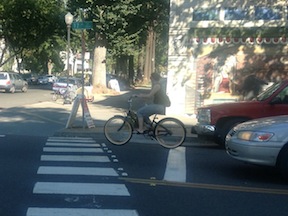
this bicyclist rode through a stop sign, past a right-turning car, rude and dangerous
this bicyclist rode past a right-turning car on the right side, without letting the car driver go first

I often see or hear the statement “bicyclists run stop signs all the time.” The person making the statement is not just making an observation, but trying to justify some attitude or action on their part, such as “bicyclists shouldn’t be on the road,” “bicyclists should be on the sidewalk,” “bicyclists should be thrown in jail,” “it is OK to intimidate or run over bicyclists,” or “we should not be spending any of our transportation money on bicycle facilities.”

I think that it is time for all of us to confront that statement and end its use. Yes, it is true that some to many bicyclists run stop signs. It is also true some to many motor vehicle drivers run stop signs. To refer back to my earlier posts on stop signs, stop signs are installed largely to reduce vehicle speeds and to get drivers to take turns at intersections. Bicyclists are rarely exceeding the speed limit, so that function is not served by the stop sign, nor by a bicyclist stopping. In the case of taking turns, the issue is taking turns, not the act of stopping. If a bicyclist does not stop at a stop sign, but no other vehicles are present which should go first, then the function of the stop sign to get people to take turns is intact, it has not been violated.
Read More »

News summary August 11

Carnage

Other

News summary August 4

Caltrans surveys Sacramento sites for new railyard (SacBee 2013-08-04)

Back-seat Driver: Guy West Bridge to get a face-lift (SacBee 2013-08-02)

Interchange work points to growth hot spots (Sacramento Business Journal 2013-08-02 paywall)

Elkhorn interchange to get widening, stoplight (Sacramento Business Journal 2013-08-01)

Despite changes, labor and neighborhood groups remain opposed to big-box ordinance (Sacramento Press 2013-07-29); for any of you wondering why this is a transportation issue, it is because big box stores generate considerably more motor vehicle trips than do small, locally owned businesses, and they are part of the sprawl development patterns that many places are striving to eliminate

In Sacramento, bicycling buds part of a growing trend (SacBee 2013-07-29)

Bike rack artist Gina Ross fuses functionality with creativity (Sacramento Press 2013-07-9)

News summary July 28

Carnage

Other

Sacramento’s Transportation Report Card

The lead article this week in the Sacramento News & Review is Sacramento’s report card. I can’t resist getting in on the fun.

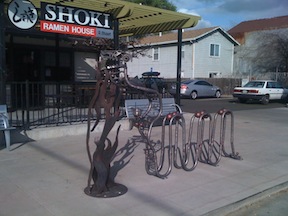
R-St_Dragon-bike-rackThe article covers bicycle transportation in the “On two wheels” paragraph, and does it pretty well, giving a C grade. I’d add that art bike racks can be fun if they are also functional. The dragon at Shoki Ramen House and the bottle openers at New Helvetia Brewing are good examples. I think bicycling really works pretty well in the central city and some of east Sacramento, with people getting along in sharing the road most of the time. The further out you go, though, the worse things are, with belligerent drivers traveling at high speeds. I’d give central city a B and the far suburbs an D-. Does this average to a C?

Read More »

News summary July 21

Carnage

Other

News summary July 14

Carnage

Other

freeway teardown

Synchronously today, Terry Preston (WALKSacramento) and SABA (Jim Brown) posted to Facebook with a link to an article “Is it time to start dismantling downtown freeways?” I encourage you to follow and join in those discussions: Sacramento Area Bicycle Advocates and Terry Preston. I am glad to see this being discussed. I posted on this blog about the same topic, “and the freeways” back in March.

SF-FerryBuilding_Embarcadero
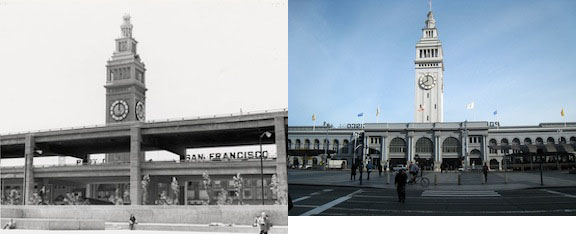
San Francisco Ferry Building, with and without the Embarcadero Freeway

Read More »

clarifying my doubts

M62Just before posting “doubting protected bikeways” yesterday, I’d been reading Momentum Magazine, one of my favorites. After posting, I turned the page, and there was a 14 page article entitled “The Rise of the North American Protected Bike Lane” by Angie Schmitt (not yet posted to their website, so you’ll have to read the paper or digital copy). The article is a classic defense of protected bikeways, with the standard criticism of vehicular cycling.

The heart of the article is the “by the numbers” graphic which shows the increase in bicycling in seven different cities that occurred after installation of protected lanes. The increases are impressive. The text talks about Portland research on types of bicyclists, positing that such facilities are necessary to get the “interested and concerned” 60% onto bicycles. Though safety is mentioned several times, it is clear the greatest benefit proposed is an increase in bicycling mode share. I’m not in disagreement with any of this. What I am in disagreement with is the focus on increasing bicycle share as the most important goal of changes we make to our streets.

Bicycling mode share in the U.S. ranges from below 1% in some places to as high as 6% in a few cities. Andy Clarke of The League of American Bicyclists is quoted as saying we could increase this to 10% or even 15% with the use of protected facilities. Sounds great. The problem is that it leaves a whole lot of motor vehicles on the road, making our cities unlivable and threatening the lives of pedestrians.

Read More »

doubting protected bikeways

Protected bikeways, also called separated bike lanes or cycle tracks, are all the rage these days. The NACTO Urban Bikeway Design Guide codified cycle tracks, but they were already showing up in several cities, and are now being implementing in a great number more. I’ve ridden on cycle tracks in Long Beach, San Francisco (just yesterday, in fact) and other cities, and yes, they are a pleasure to ride on compared to riding in traffic or traditional bike lanes. Many people have declared the era of vehicular cycling dead, and the era of protected bikeways upon us.

So why am I doubting?

Read More »