The City of Sacramento established a Tactical Action Group (TAG) otherwise known as Transportation Safety Team, in March 2025. Unfortunately, very slow progress has been made on this. The program lead is in place, Philip Vulliet, and an administrative assistant, but the other five positions have not. The city has a difficult time filling positions, particularly engineering position, as the pay level is low compared to other entities and private industry. A webpage for the program has not been established.
So far as I know, the only information on the program is a presentation given by Mr. Vulliet to Strong SacTown in June 2026. I think there was a presentation to SacATC, but I’ve been unable to find it. The slides are below, but they are not very specific. The Strong SacTown meeting notes have more detail, and follow the slides. Thank you, Strong SacTown.
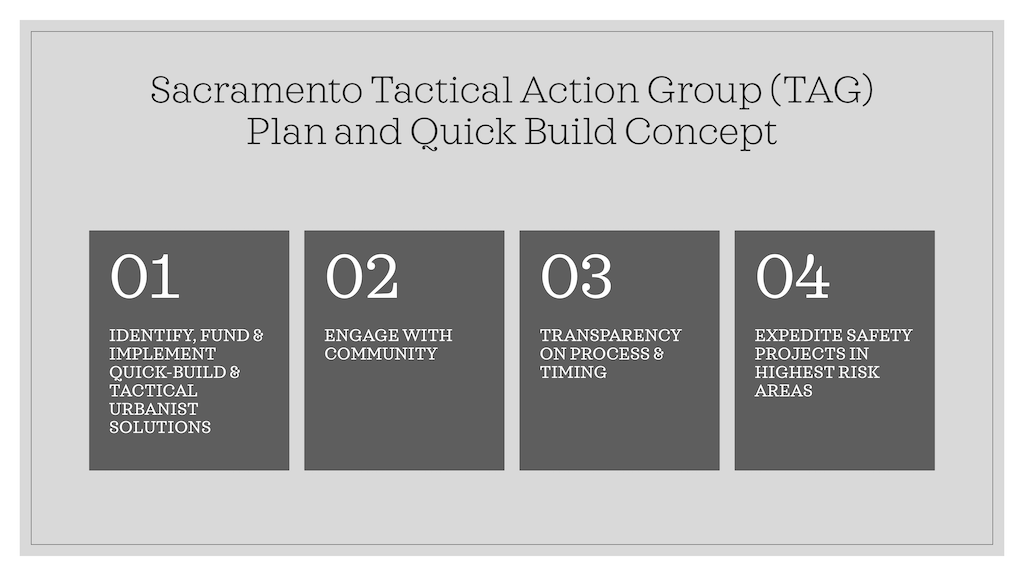
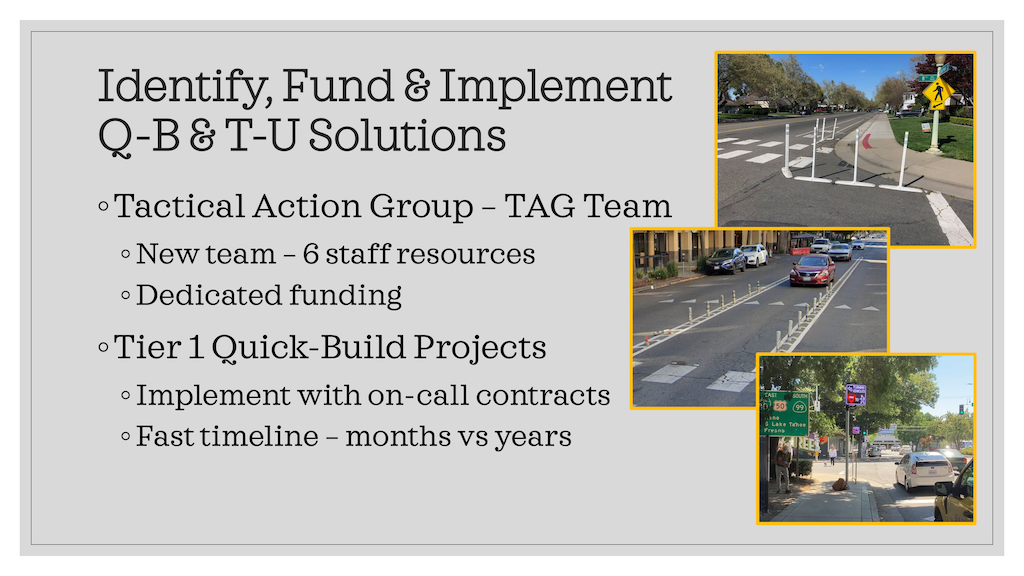
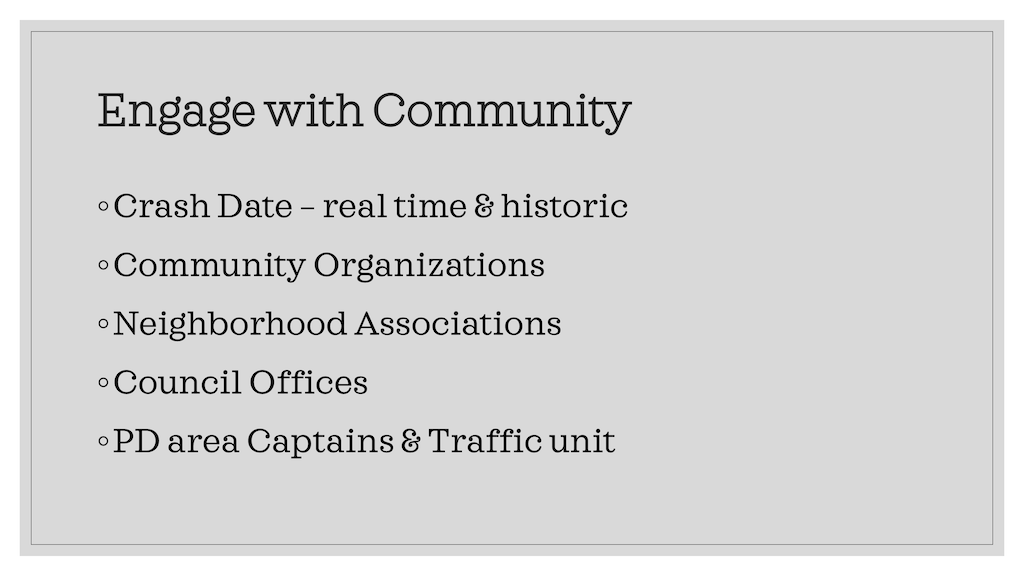
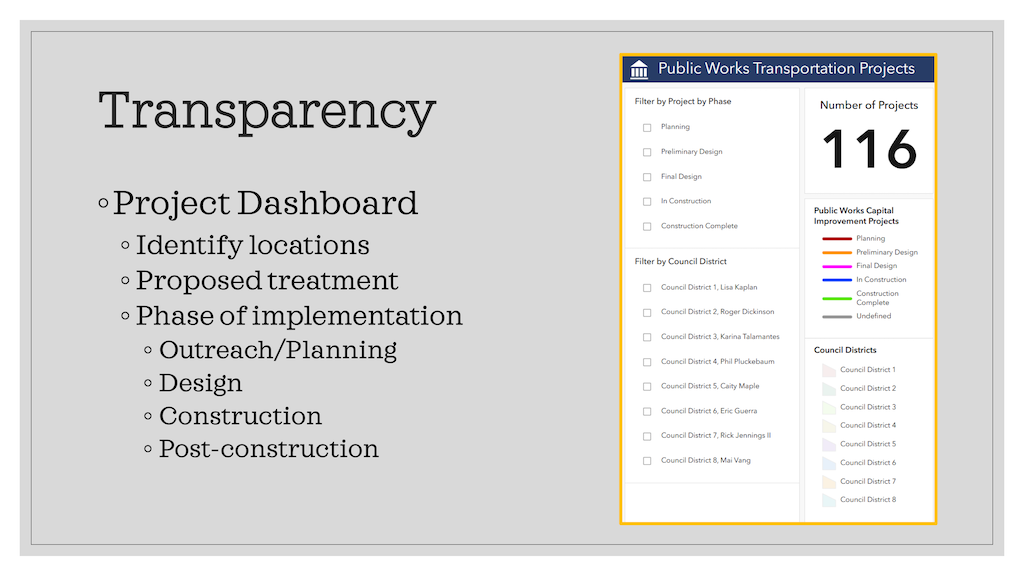
- Presentation: Quick Builds & Transportation Safety Initiative
Phil Vulliet (VOO-lee-ay) is the new lead for the city’s Safety Response Team where he will help Sacramento respond faster to urgent safety needs and continue advancing the City’s goal of eliminating fatal and severe injury crashes.
- About Phil: 20+ years of experience. Project manager for capital improvement projects (aka big road projects) for last 11 years. Managed Broadway Complete Streets, Downtown Mobility Project, and others. Prior to that, did consulting.
- 2018 City passed Vision Zero Action Plan. Based on 10 years previous accident data. Established list of high-injury network – responsible for >70% of serious injuries in cities. Looked at root causes of vehicular violence and impact on pedestrians and cyclists. Looked at impact on bicycles and pedestrians – 40% fatal collisions. We need to protect them.
- Planning efforts came from the research – top 5 corridor study, 6-10 corridor study is now in planning and quick builds will be prioritized as well.
- Parking protected bike lanes were created and then the central city mobility project was completed in 2024 as well as broadway complete streets, Franklin complete streets wrapping up and northward school access was completed.
- Funds are being used to match grants.
- 13,000 crashes still (all mode crashes)
- Transportation safety initiative was passed in 2025 – responsibility to track now.
- Transportation Safety Team (TST) – established jobs for 6 FTE’s
- Quick builds – rapid implementation limitations (no land acquisitions), limited electrical work, excavation only by city crews (try not to dig), Council action needed – assigned project in tiers
- Tier 1 – quickest of quick builds – surface treatments (Paint and Plastic), includes alterations in traffic circulation. Community informed
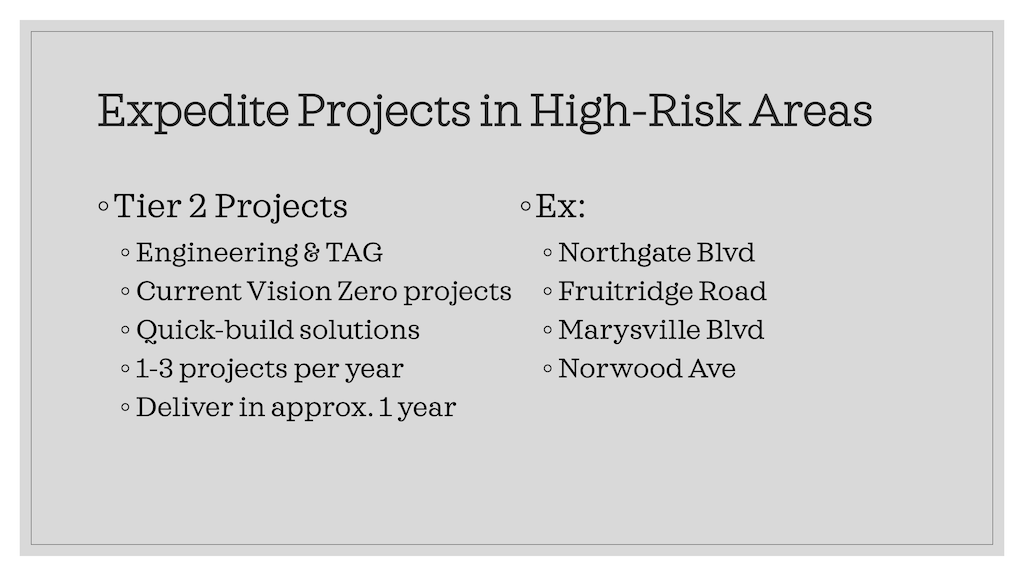
- Tier 2 – outside of the TST team – require full plans and bidding. Pilot projects. It takes about a year.
- Quickbuilds are faster than CIP
- CIP – Safety program, quick build CIP – sales tax generates the funds for the safety programs
- TST – They require contracting readiness, design delivery capacity, need new processes and new tech as well as outreach, follow-up and reporting needed.
- They were given an exception by the city council that they are allowed to go to contract vs. go to bid
- Software platforms can share real-time speeds and volumes without having to do a traffic study (speeds up the process of evaluation)
- Outreach is beyond critical – it’s about equity, some cities are more organized than others. TST only has so much staffing to support and cannot watch every intersection.
- Feedback needed when the quick build has been built and if it’s not working, that’s the beauty of it, they can fix it quickly.
- The public facing GIS dashboard is up and is working to create a map to show where in the city there have been quick builds implemented.
Q&A Notes
- Q: Gets through
- A: Budget will help, it will increase funding, but that is not the limiting factor
- Q: Process to determine an LPI (Leading Pedestrian Interval)
- A: Megan Carter – give pedestrians a few extra seconds of time to provide more time. LPIs will be implemented everywhere, unless we can justify not doing it. There are some lawsuits if you don’t implement LPS ( not being equitable if it does not include LPS). ATC will go with a plan next year.
- Q: What are issues you face when you change the fabric of the street
- A: Daylighting and recommended clearance and it was 25% parking loss. New state law that doesn’t require any parking to be provided. Willing to accept delays for cars.
- Q: Streets are designed like roads and are in urban areas. When you add parking it does slow people down.
- A: They do try to account for that. Ideally if he had a magic wand he would make the traffic slower.
- Q: is that a tier 1 or a tier 2
- A: We can look at curb usage and how we monetize it and manage uber’s, lyft’s and waymo.

