This afternoon (2023-09-14, 1:30PM), the Sacramento Transportation Authority (SacTA) will hear from consultants about a survey of likely voters and attitudes toward a transportation sales tax measure. Agenda item 13 is available (the entire agenda packet is so long that it is hard to find this item; this is a low resolution version).
The survey indicates that only 54% would vote yes, which is less than the 67% required for passage, assuming that the measure is sponsored by SacTA, and not a citizen initiative.
There are a lot of interesting bar charts, in the presentation. Below is just one, showing the level of support in various surveys and actual elections over time. I recommend you take a look at the whole document to see what jumps out for you.
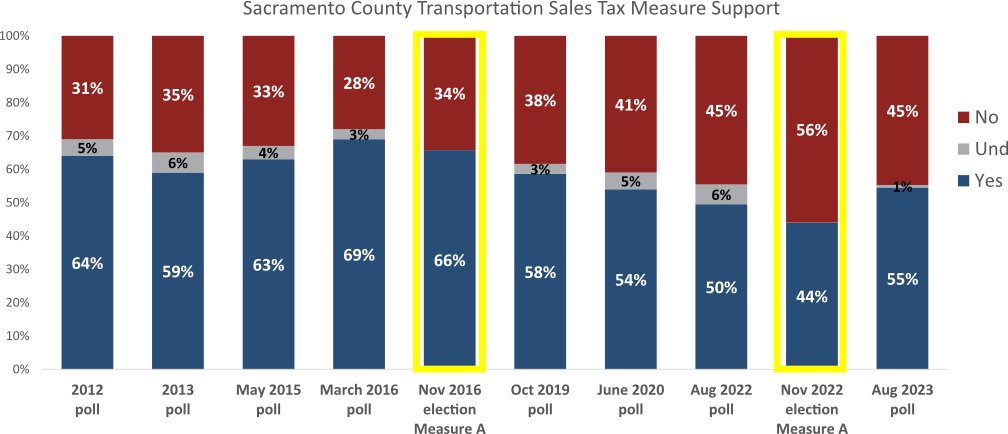
The presentation does not really address what I think is a key factor, which is the cynicism developed by voters over time when the same failed policies get presented again and again. The 2016 Measure A, the withdrawn 2020 Measure A, and the landslide failure of 2022 Measure A presented transportation investments that are more of the same: more highways, more interchanges, more roadway capacity, more air pollution, more greenhouse gas emissions. The voters have never been offered an alternative that does not represent the interests of traffic engineers who always want more: more cars, more concrete, more ribbon cuttings, more money. Particularly after the 2022 developer-sponsored ‘citizen initiative’, voters don’t trust that sales taxes will be spent on what they actually need for livability and economic vibrancy. 2022 Measure A was just more money in the pockets of greenfield developers and highway builders. Money out of the voters pockets.
But there is now an alternative, Mayor Darrell Steinberg’s proposal. I wonder if that were presented to the public, what the level of support would be. More about that in the next post.


[…] on the voter survey presentation. The presentation was a brief version of the whole document (see SacTA hears voter survey), highlighting the most critical parts. The jist of the presentation is that a measure on the 2024 […]
LikeLike