Note: Please see post on City of Sacramento Street Design Standards. It turns out that there are at least two different sets of design standards.
The City of Sacramento has Standard Specifications and Drawings that require certain designs for the public right-of-way. There were last revised April 2020, and are available on the Utilities: Development Standards page. It is not clear why these are part of Utilities rather than Public Works or Community Development, but they are. Though I haven’t done an element by element comparison, they seem to be a considerable improvement over the previous standards, which seem to be June 2009.
There are designs which are not being followed, and others that should be eliminated. Today, I’ll address sidewalks crossing alleys. Alleys are only common in the central city, but they do exist other places throughout the city.
The city design standard is below (pdf of entire page). The detail is hard to see, but the alleyway, sidewalk, and alley driveway are all concrete, none are asphalt. The T-11 Standard Alley Entrance Detail page says “Portland Cement Concrete (PCC) is the city standard pavement for alleys.”

Of course there are many alleyways that are asphalt, and some that are unpaved gravel. I don’t know when the city standards changed to require pavement, or when to require concrete, but those are the current standards. That means that if an alley, or a sidewalk, or the alley driveway is changed, it must meet current standards. Below is a photo of Neighbors Alley at 17th Street, which was just redone within the last two months. It clearly does not meet city standards. Both the driveway and the sidewalk are asphalt, not concrete. Though I noticed this work being done, I failed to notice who was doing it. City? Private? Private utility? Not sure.
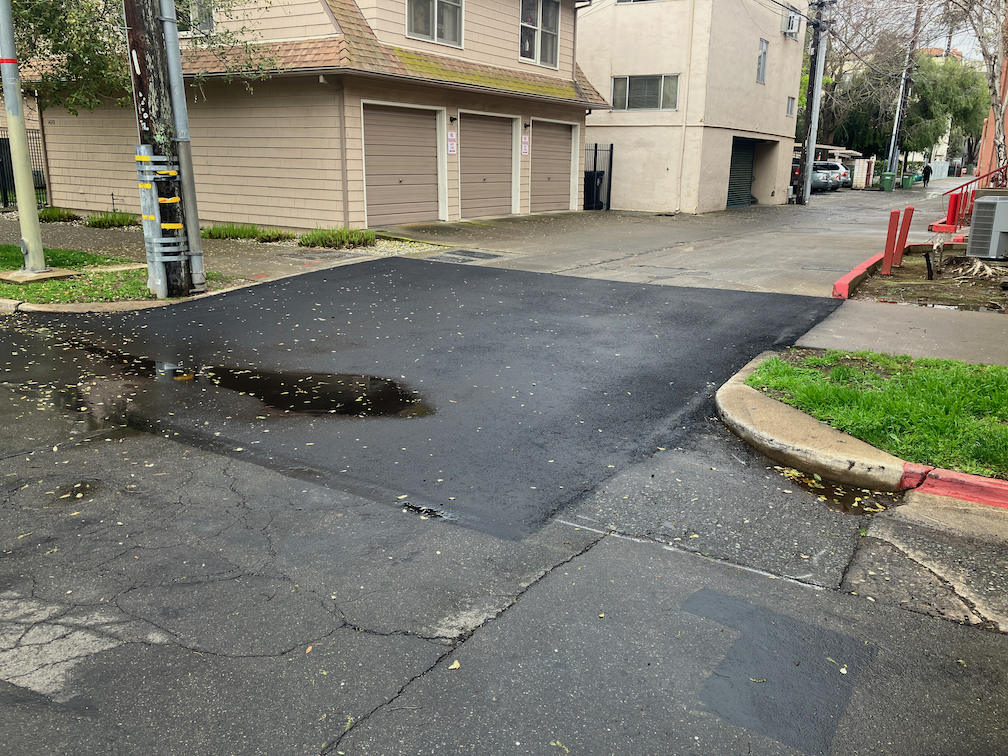
Why is this a big deal?
- Concrete sidewalks are a visual reminder for drivers that they are crossing a place where walkers have the right of way. Not that many drivers pay any attention to this, but for those who do, it makes a difference. We have all experienced drivers pulling out of an alley across the sidewalk, and not slowing or looking until they reach the street edge. Though there is of course less traffic in an alley than on a street, the danger presented by each driver is much higher for an alley. By poor design, we have trained drivers to ignore the presence or possibility of people walking.
- The sidewalk area and the alley driveway are favorite areas for the placement of utility access covers. When done right, this is not an issue, but something about an alley seems to cause the city and utilities to not do it right. There are a lot of utility patches and utility covers that are trip hazards, or worse for people using mobility devices.
- Asphalt deteriorates much more quickly than concrete, so asphalt sidewalks will develop rough edges and potholes long before a concrete sidewalk would.
Some additional photos of sidewalks and alleys, all in my neighborhood, are below. The first is Quill Alley adjacent to the light rail tracks. Though the alley is unpaved, the sidewalk and the alley driveway are concrete, as they should be.

The second is Powerhouse Alley at 14th St. This is an alley, sidewalk, and alley driveway done right. The sidewalk is continuous, as it should be, and is concrete, as it should be.
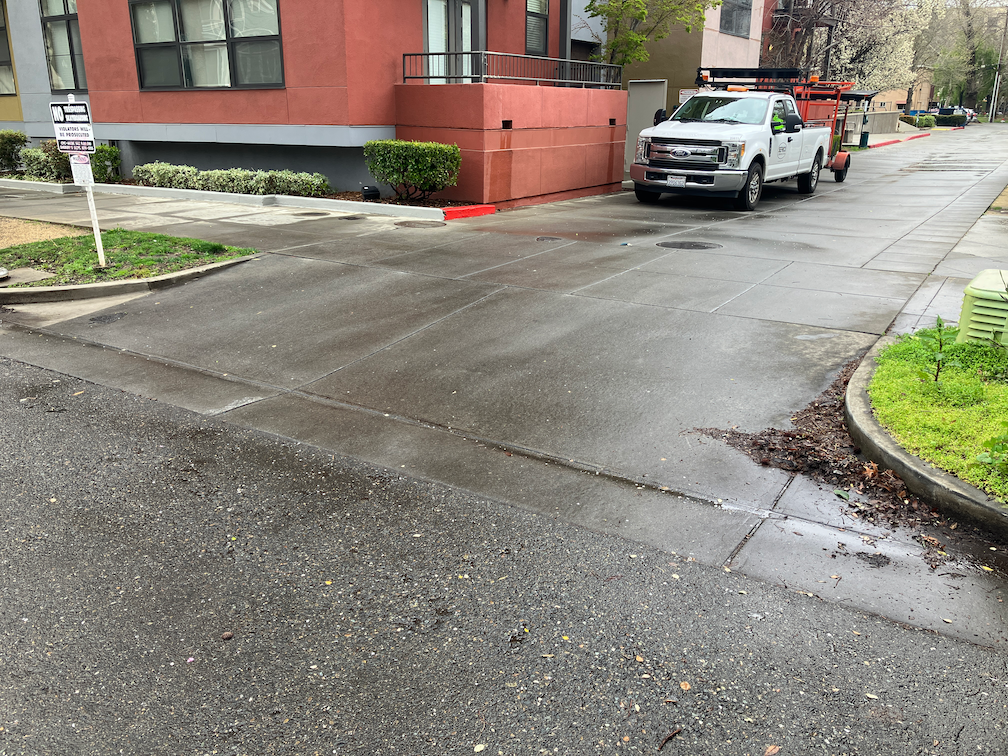
The third is Neighbors Alley at 17th Street, on the east side of 17th Street, opposite the lead photo. The alley is asphalt, the sidewalk is asphalt, and the driveway is asphalt. Utility covers intrude into the sidewalk area, but at a slope. The asphalt edge has deteriorated, making a rough surface for walking or rolling. Think for a moment the thought process of a driver exiting the alley. Where do they stop? On top of the person walking.

Of all the problems with walkability (and roll-ability) in the city, these alley entrances don’t rank high on the list. But they are an example of how city design standards, and lack of enforcement of those standards, makes walking more dangerous and less pleasant, and reinforces the motor vehicle dominance of our public space. These spaces should be walkers first, drivers last, but they are the reverse.
 Getting Around Sacramento
[…] had recently posted on the design for alley sidewalk crossings, based on a document from the City of Sacramento website. I shortly thereafter discovered that […]
LikeLike
Oh my, we see this so often when working. If the driveways were done right that would be awesome.
LikeLike
Hi Dan: My husband and I moved to Sac part time in July. We have lived in Midtown since November so that he can catch light rail to his job in the eastern part of the City.
I have a call in to the City regarding getting our new street Democracy Alley in the Marshall School area paved. It is semi-improved gravel right now. I see at the bottom of the City’s webpage on alley maintenance, https://www.cityofsacramento.org/Public-Works/Maintenance-Services/Street-Maintenance/Alley-Information, that it says “Average cost for a PCC (Portland Concrete Cement) alley in midtown over $150,000 and requires buy-in of adjacent property owners that adjoin the alley.”
Does that mean that the property owners are responsible for picking up that cost. Thanks if you can help with this answer while I await their call back.
LikeLike
In most cases, the alleys in the central city are owned by the adjacent property owners, not the city. The city has an easement for the alley, but doesn’t own it. So the implication that the property owners must pay for alley improvements seems to be correct. However, I know that the city has improved a number of alleys without that contribution. Probably one of your steps is to talk to your city council member about it.
LikeLike