Community meeting on crosswalks – 2

Part one, Community meeting on crosswalks, prior posts:  removal of crosswalksDon’t use the ‘A’ word. Next related post will be about Zegeer.

Question and answer session of the meeting:

  • The city is doing a speed study on Freeport from Sutterville Rd to Meadowview Rd, and will include part of Sutterville (not clear what part)
  • There are no red light cameras on Freeport; the city piggybacks on country red light program
  • There are no lead pedestrian interval signals on Freeport, or even is south Sacramento (all are in the central city); Ryan Moore said these should not be used in low pedestrian areas (which is false)
  • Resident commented on Fruitridge Rd, 24th to Freeport, a lot of red light running and few safe crossings
  • Resident who lives on Oregon suggested changing the speed limit on Freeport
  • Steve Hansen says that the city would like to change Freeport, but to do so, the community (residents, businesses, neighborhood associations) will need to come together to decide how; people will have to give up some time for better safety; he also mentioned narrow sidewalks with obstructions
  • Several people asked about or commented on specific sections and intersections; Matt mentioned catching egregious speeders
  • South Land Park Neighborhood Association (Ryan?) asked what public notice there was before crosswalk removal and said they were not notified; not clear if the other two were notified
  • Ryan Moore said that each removal was analyzed, he says they followed the law of CA MUTCD; said most of the removals were result of complaints; said neighborhood input makes no difference; mentioned FHWA info on crosswalks, referring to Zegeer report though not by name (more info about Zegeer in a future post)
  • Neighbor said that any process that removes crosswalks is flawed; mentioned no still phase on signals (time between red one direction and green the other); going out of the way is not reasonable to ask; can’t have data on people walking because people are scared to walk
  • Steve Hansen and Jay Schenirer want to review pedestrian guidelines, not sure what document this is; said we need to talk about equity because the top corridors of Vision Zero concern are not necessarily located in disadvantaged communities
  • Neighbor said speed display signs don’t seem to have any effect on behavior; asks for immediate action and not years out
  • Ryan Moore continually says “we’d like to but we can’t” but offers no proof; continues to say that crosswalks at this volume and speed are not safe
  • Neighbor said there are bus stops close to Oregon which is true and which might make removal a violation of Title 6
  • Issue of sidewalk maintenance responsibility has come up several times; city continues to insist that it is the responsibility of the property owner (even though most sidewalks are part of the public right-of-way and all are part of the transportation network)
  • Many people pointed out that improvements could have been made at the Freeport-Oregon intesection, such as bulb-outs, refuge median, lighting; there is a median already but it is too narrow to provide refuge
  • Participant asked for a pedestrian commission, Jennifer Donlon Wyant said the the city Active Transportation Commission would be seated in April or May
  • Jay Schenirer wrapped, mentioned that McClatchy students drove the changes to Freeport north of Sutterville Rd

My overall take on the community meeting is that the city council members and the public, both residents of the neighborhood and others, want proactive changes to increase pedestrian safety and walkability. They don’t want excuses. Ryan Moore, the Interim City Traffic Engineer, seem prepared only to offer excuses.

Of all the people on stage, Ryan Moore seemed the least sympathetic to the person killed, or the issues that it raises. He said much the same thing he’d said to the SacBee: “Instead, traffic engineers hope that by removing some crosswalks, pedestrians will instinctively choose to cross at a safer, nearby intersection,” Moore said. He kept referring to federal and state standards that were being followed, though a number of people in the audience who know a great deal about traffic engineering noticed that he was mis-stating and mis-using standards and research to defend his actions and opinions.

Community meeting on crosswalks

I had promised I’d report on the community meeting to address the crosswalk removal over Freeport at Oregon and related issues, but it has taken me a while. Previous posts: removal of crosswalksDon’t use the ‘A’ word. For background, see the SacBee article: Why Sacramento erased 23 crosswalks, including one where a grandmother died after removal.

The meeting was hosted by City of Sacramento council members Jay Schenirer and Steve Hansen, and school board president Jessie Ryan, and held March 8 at Hollywood Park Elementary which is east of the intersection where the fatality occurred.

Steve talked about the concept of a stroad, a street/road hybrid that doesn’t do either well, though he did not use the term. Freeport is a stroad. He introduced vision zero, talked about changing both infrastructure and behavior, mentioned that the traffic motor officers are gradually being built up but are far below what they should be, and said “we should enjoy the public space and not be afraid.”

Ryan Moore, Interim Traffic Safety Engineer, and the person responsible for the removal of crosswalks, repeatedly mentioned a ‘Systematic Safety Analysis Report’ but is was not clear what this is, and the city website has no mention of it. He also said that he was following all the federal and state rules, as well as research, by removing the crosswalks.

Jennifer Donlon-Wyant, the Active Transportation Specialist, gave a Vision Zero presentation similar to what many people have seen before, but highlights are that Sacramento is the second worst in the state for pedestrian fatalities per capita. She went over the ten profiles that are the core of the draft Vision Zero Action Plan, of which three are related to speed, and one related to transit stops, which all play a role in this incident. One that does NOT apply is ‘Pedestrian Crossing Outside of an Intersection or Crosswalk.’ Though the city had erased the marked crosswalk, it was and is still a valid legal crosswalk. Freeport Blvd is not one of the top five fatality and injury corridors in the city.

Matt Armstrong, Sergeant of the Motor Team (officers on motorcycles) said he has 7 officers on at a time, maximum, for the entire city. They respond to complaints, but otherwise focus on schools and high volume corridors. He said top concerns are red light running, distracted driving, and speed. He mentioned something I had not heard before, that this was a multi-lane threat crash. A multi-lane threat crash occurs on streets with more than one lane in the same direction (Freeport has two lanes in each direction), when one driver stops for a pedestrian and other drivers does not. This is a violation of CVC 21951 “Whenever any vehicle has stopped at a marked crosswalk or at any unmarked crosswalk at an intersection to permit a pedestrian to cross the roadway the driver of any other vehicle approaching from the rear shall not overtake and pass the stopped vehicle.”

Jessie Ryan said the district recognized that their policies were insufficient and were going to adopt the California School Boards Assocation Safe Routes to School policy (which is very weak), that they were creating heat maps to prioritize unsafe routes, is committed to using and reviewing data, and welcomes public input. The district, prior to this, has shown little interest in Safe Routes to School and has implemented only some minor projects.

Kirin Kumar of WALKSacramento and Jim Brown of Sacramento Area Bicycle Advocates (SABA) spoke briefly about the need for culture change in the community and in the city bureaucracy.

Next post I’ll discuss some of the public comments and questions, and the answers provided.

Don’t use the ‘A’ word

I attended the community meeting hosted last evening by Jay Schenirer, Steve Hansen, and the school district, called as the result of the recent fatality and severe life-threatening injury on Freeport Blvd. I’ll write more soon about the meeting itself, but for today, a comment about use of the ‘A’ word, accident. Every public official that evening, with the exception of Jennifer Donlon Wyant, used the word accident. Some of them repeatedly, with Ryan Moore, the Interim City Traffic Engineer, being the worst offender. Many of these uses were made while standing in front of the Vision Zero slide that states “Vision Zero ~ a traffic safety philosophy that rejects the notion that traffic crashes are simply “accidents,” but are preventable incidents that can and must be systematically addressed.” Oh, the irony.
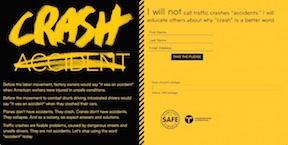
Not the time to go into a detailed explanation of the harm that using this word causes, but you can check out http://droptheaword.blogspot.com, or #CrashNotAccident on Twitter. Basically, the common understanding of the word in traffic violence conversations is to excuse motor vehicle drivers (and engineers) of responsibility for their actions, implying that nothing could have been done, when in fact many things could have been done.

So, a modest proposal. Every time a public official uses the ‘A’ word, they make a contribution of $20 to a local transportation advocacy organization. Eventually, people will cure themselves of using the word, but in the meanwhile it will be an important source of income for nonprofits working to overcome the bias inherent in use of the word, and the underlying windshield perspective that accepts traffic violence as inevitable.

Vision Zero comments

Here are my comments on the draft Vision Zero Action Plan for Sacramento. Most of these were posted on the boards at the 2018-01-31 meeting, and in email to the city.

  • Sacramento essentially has no traffic enforcement currently. More about this tomorrow.
  • I was concerned by the prominence of the bicyclist fatalities increasing 150% without any contextual information. As with any data point with small numbers, as bicyclist KSI (killed and severely injured) is with respect to pedestrian and vehicular KSI, noise can lead to apparently huge changes that may not indicate a pattern. It would be sad if that one statistic were used to argue that changes to protect bicyclists should be prioritized, when it is clear from all the other data in the plan that pedestrians are at the greatest risk.
  • If 78% of KSI occurred at intersections, issues can be addressed more quickly and cheaply by focusing on intersections rather than corridors.

Profiles

All profiles should have the DAC/CES overlay, not just profile 3.

  • Profile 1: unsafe speed and profile 3: 35+ streets: Street Narrowing should say Street Narrowing and Speed Limit Reduction
  • Profile 4: 30+ streets should include lane narrowing
  • Profile 5: broadside: is there evidence that adding signals reduces crashes, anecdotal evidence would argue that it increases crashes
  • What does no bullets for efficacy mean, that there is no benefit, or that there is insufficient research?

I asked about why there was a 30+ and a 35+ profile. The answer is that collision characteristics change considerably between 25 and 35, with 30+ being an issue for bicyclists, and 35+ being an issue for all modes.

Vision Zero Actions (p. 45-50)

  • 1.5 Launch online, interactive crash data map and website. > short-term
  • 2.2 Install 10 low-cost safety improvements, including new road markings, signs, and minor signal modifications per year. > 10 locations
  • 2.3 Develop prioritized list and deliver half of engineering safety projects on the HIN in Disadvantaged Communities (commensurate with share of fatal collisions). > separate so that list is short-term, deliver is long-term
  • 4.4 Install school zones at all schools. > what about reductions at qualified locations?
  • 5.4 Update City signal timing policy to improve safety for all modes (e.g. all red time, pedestrian crossing times). > should include specific mention of LPI at high-pedestrian or high-collision intersections

crash not accident

CrashNotAccidentCourtesy of Families for Safe Streets, Transportation Alternatives and the Vision Zero movement in New York City, there is a new effort and pledge to stop using the incorrect word “accident” for crashes involving vehicles, at Crash Not Accident. Though this is an effort that has been going on locally and nationally for some while (see We Save Live’s Drop the “A” Word). In the Sacramento region, the two most egregious users of the incorrect term are @SacRegion511 and law enforcement officers.

I ask all of you to join this effort. Every time you hear the word accident used when people are talking about vehicle crashes, correct them. Every time you see something on the Internet that uses the wrong word, comment. Yes, those people who prefer to absolve motor vehicle drivers of fault and consequence will not be happy. They may unfriend or unfollow you, and they will reply with angry requests to consider the poor “victim,” the motor vehicle driver, who will be scarred for life. In my opinion, scarring for life is a tiny price to pay for taking someone else’s life with irresponsible use of a motor vehicle. Am I angry? You bet I’m angry!

South Sacramento Vision Zero

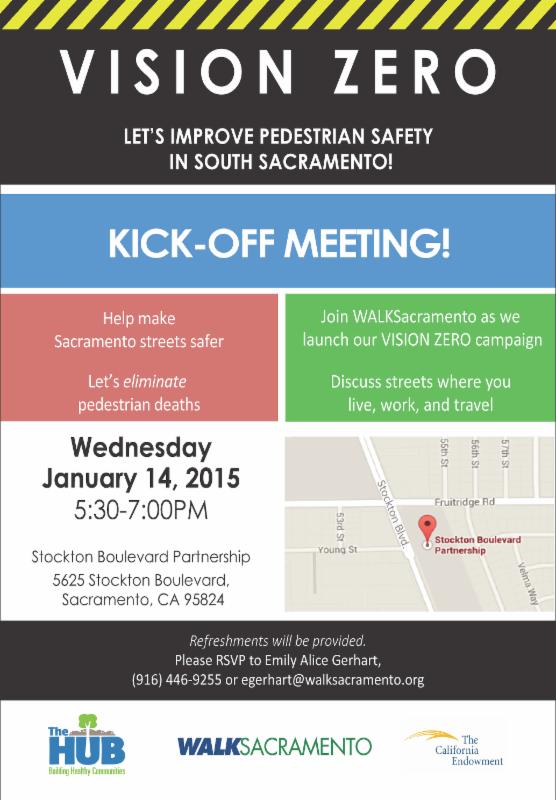
Vision Zero Kick-Off MeetingWALKSacramento and other partners are hosting a Vision Zero Kick-Off Meeting on Wednesday, January 14 in south Sacramento, part of the ongoing Building Healthy Communities project. This is the first event in Sacramento, and I encourage you to participate, even if you don’t reside or work in south Sacramento. A city, county and region can be judged by how it treats its most vulnerable citizens, and there is no doubt that walking (and bicycling) safely is a major justice challenge for south Sacramento. Click on the thumbnail at right to view the flier.

From WALKSacramento’s email:

You are invited to join WALKSacramento on January 14, 2015 as we launch “Vision Zero” in South Sacramento.
Vision Zero aims to reduce pedestrian and bicycle fatalities to ZERO by improving infrastructure, education, and enforcement.  We’re starting a Vision Zero project in South Sacramento because we know that it is within our power to prevent these tragedies on our streets.
We need better street design, better regulations, and better enforcement.
Let’s start talking about what we can do to help make Sacramento streets safer.
For more information and to RSVP, please contact Emily Alice Gerhart, egerhart@walksacramento.org

Vision Zero, which started in Sweden, is now a wordwide effort to eliminate pedestrian, bicyclist and motor vehicle fatalities. In the United States, New York and San Francisco are leaders, but the idea is now being talked about nearly everywhere, including Sacramento.

A Vision Zero for Cities Symposium was held in November in New York City, with attendance by a few people from the Sacramento region. Transportation Alternatives has posted the Collectively Drafted Statement of Principles from that symposium, and Streetsblog USA has a good summary of the event at What Would a National Vision Zero Movement Look Like?