SacATC meeting 2025-01-16 report

SacATC (City of Sacramento Active Transportation Commission) met Thursday, January 16, 2025.

The agenda included:

3. Selection of Chair and Vice Chair for Calendar Year 2025: Arlete Hodel was re-elected as Chair, and Isaac Gonzalez was re-elected as Vice Chair. Juanluis Licea-Cruz joined the commission as seat K youth representative, a high school student at West Campus joined the comission. David Moore was appointed to the Seat J. Ali Doerr-Westbrook has completed her term on the commission.

4. Caltrans American River Bridge Rehabilitation Project: The presentation by Caltrans staff was frustrating. A number of questions about details of the bike path being added as part of the freeway rehabilitation (widening) project went unanswered. Commission concerns were that there are a limited number of connections from the new path to existing bikeways, and that Caltrans has demonstrated an inability to maintain bike paths by the horrible condition of the Causeway path. The Caltrans staff claimed that some other agency would be responsible for maintaining the path, but seemed unclear about what agency. Federal law requires that the host agency is responsible for maintenance of multi-use paths in perpetuity, but Caltrans has rarely complied with that requirement. Completion of the entire project is December 2026, but it is unknown whether the path will be available before then. I hadn’t realized, but this path was part of a lawsuit settlement over widening of the freeway; it was not a project initiated by or desired by Caltrans.

5. Alternative Recommendation: Truxel Bridge Concept and Feasibility Study: See the STAR blog post for this topic, which includes all the agenda document parts. The commission voted for recommendation 3, “reject the Truxel Bridge Concept and Feasibility Study and instead recommend that the City Council direct staff to evaluate and study a Truxel Bridge alternative without personal motor vehicles.’ It was clear from the large number of in-person comments and eComments, as well as commissioner comments, that the city commitment to a multi-modal bridge with private motor vehicles is unacceptable.

My comments added two details: 1) SacRT board has never approved the city concept, though discussions at the staff level indicate that it might. The approved SacRT project is a transit/walking/bicycling only bridge. 2) The light rail to the airport Green Line might never be completed due to very high cost and uncertain ridership. If bus rapid transit (BRT) is implemented instead, the benefits of a direct bridge route are not clear. The current bus Route 11 jogs to the freeway, and is not signficiantly delayed by that. This BRT is not part of the current regional plans because it was assumed that light rail would be implemented, but it is quite possible that it might be added to the high capacity bus network plans.

It is assumed that the city study will proceed until the city council makes a decision on the SacATC recommentation.

6. Streets for People: Neighborhood Connections Draft Final Plan: staff report and Neighborhood Connections Plan: There was strong community and commission support for the plan, and it will be forwarded to council, probably next month. The toolbox part of the plan is outstanding. Nearly all of the 13 treatments in toolbox can be implemented as quick-build projects with low-cost materials, and eventually replaced by hardened infrastructure. Community and commission comments addressed the lack of likely funding for implementation, but it is hoped that the city will allocate some funds to the project, particularly now that the primary resister Howard Chan is no longer city managert.

For ‘not on the agenda’, I commented on the much delayed maintenance (sweeping) of the separated bikeways in the central city. The bikeways became nearly impassible during leaf season, except where they were cleared by landscaping services supplied by adjacent property owners, which is not their responsibility, but is appreciated.

Commissioners requested an update on the staff effort to inform council about what quick-build means. and this topic may also come back to the commission.


Traffic Diverter / Street Closure page from Streets for People Neighborhood Connections

SacATC meeting 2025-01-16

SacATC (City of Sacramento Active Transportation Commission) will meet this Thursday, starting 5:30 PM, in city council chambers at 915 I Street, Sacramento. Comments may be made in person or via eComment ahead of time. Note that there are two commission meetings scheduled at the same time, so it is possible that this meeting will be in another location in city hall.

The agenda includes:

3. Selection of Chair and Vice Chair for Calendar Year 2025

4. Caltrans American River Bridge Rehabilitation Project: This project includes the addition of a shared use path (walking and bicycling) to the State Route 51 (Capitol City Freeway) bridge over the American River.

5. Alternative Recommendation: Truxel Bridge Concept and Feasibility Study: See the STAR blog post for this topic, which includes all the agenda document parts.

6. Streets for People: Neighborhood Connections Draft Final Plan: staff report and Neighborhood Connections Plan

The Neighborhood Connections Plan is largely unchanged from the 2024-10 draft. As such, I support it. It is important to remember that this plan only addresses residential and minor collector streets, which are important for encouraging walking and bicycling, but rarely are the location of fatalities and severe injuries. Those occur on major collector and arterial roadways, which are the subject of a separate Streets for People document, coming sometime later this year.

On page 19 the following info from the last round of public outreach is added:


PHASE THREE: PUBLIC DRAFT PLAN

  • Project Funding and Prioritization: How the plan will be moved forward into implementation, prioritization, and funding was a common theme. Community members requested clarification on the next steps for project implementation.
  • Speeding Implementation: Some workshop participants called for faster implementation of the recommended network via “quick build” projects.
  • Equity Considerations: Community members asked how equity would be considered for implementation, particularly where fewer active transportation facilities currently exists.
  • Youth Safety: School area improvements and other projects focused on addressing youth transportation needs was a theme in the virtual workshops.

The ‘Funding and Ways to Get the Network Built’ (page 123) is unfortunately unchanged. The city still does not identify even the possibility of using general funds for implementing this plan.

SacCity mayoral candidates on transportation

I don’t know anyone who hasn’t already voted, but information about the City of Sacramento mayoral candidates, Flo Cofer and Kevin McCarty, will be valuable beyond the election. SABA (Sacramento Area Bicycle Advocates) sent in a Gear’d Up email a compilation of candidate positions and perspective on transportation, which I’ve copied below.

Sacramento Mayoral Candidates on Transportation and the Environment
SABA is taking a look at the stances of the two Sacramento mayoral candidates – Dr. Flojaune Cofer and Assemblyman Kevin McCarty – related to environmental issues. While we understand that there are many important issues facing Sacramento, especially with regard to the unhoused population, our focus here is on issues related to transportation and the climate crisis. 
The views presented here are taken from forums conducted by the League of Women Voters, the Sacramento Bee, and KCRA 3.
Flo Cofer - a Black woman wearing a purple jacket and yellow blouse.Dr. Flojuane Cofer is an epidemiologist, policy director, and advocate for change. She worked at the California Department of Public Health and then as a Senior Policy Director at Public Health Advocate. Cofer served on Sacramento’s Active Transportation Commission, Mayor’s Commission on Climate Change, Sacramento County Sheriff’s Outreach Community Advisory Board, and the Measure U Community Advisory Commission. 
Kevin McCarty - a man with light brown skin wears a gray jacket and blue shirt.Since 2014, Kevin McCarty has served as Sacramento’s Assembly member – representing the 6th Assembly District. McCarty serves as Chair of the Assembly Public Safety Committee. From 2014 to 2023, he served as the Chair of the Assembly Budget Subcommittee on Education Finance. A lifelong Sacramentan, McCarty began his career as a Housing and Redevelopment Commissioner, and then served on the Sacramento City Council for a decade.
SABA does not endorse either candidate. (Disclosure: Cofer is a member of SABA and McCarty has lent financial support to a project that will launch in 2025.)
Here’s where they stand on the issues:
Climate Action & Adaptation Plan, which includes a greenhouse gas reduction target for 2030 and a carbon neutrality goal for 2045.
Cofer: As a commissioner on the Mayor’s Climate Commission, Cofer helped develop Sacramento’s Climate Action Plan and would like to move the dates up to accomplish carbon neutrality sooner. As mayor she would commit to setting priorities for the city council and plan how the city can take on more to achieve climate goals sooner.
McCarty: He would like to achieve the goals that were set out in the plan and figure out how to pull down resources from the state and federal governments. When the city was in a budget crisis, he found resources to support city services like the firefighters and would do the same for the Climate Action Plan.

Funding for the Climate Action & Adaptation Plan Including Proposed 2026 Sales Tax (the Plan is budgeted at over $3 billion)
Cofer: She believes we need to look at the Plan and figure out how to implement it; set a goal and figure out where to start; and decide on the major investments we need to make now to save money down the line and yield us dividends. Cofer says we should look at matching funds from the state and federal government, as well as local partnerships. She believes neighborhood associations, unions, nonprofits and businesses will step up and that we should see them as partners rather than adversaries. The public was frustrated that the sales tax from 2019 was not spent on homelessness, affordable housing and the arts, and Cofer says we need to build trust with the voters by righting things before going and asking for more money; and we also shouldn’t impose a tax on people with lower incomes.
McCarty: He wants to look at opportunities to leverage funding for state efforts. McCarty says the State of California is our largest employer and landowner and we need them to step up to help us achieve our climate goals. Voters are very frustrated that things aren’t getting done and McCarty believes we have to restore confidence in city leadership to pass traditional revenue. He says the sales tax is regressive and that people of lower income are disproportionately impacted by climate and should not bear disproportionate burden.

Commitments to Climate Initiatives
Cofer: She believes we need new leadership. Cofer has built coalitions and served on five different boards, committees, and coalitions. In the first 100 days, she commits to 1) set priorities for the city of Sacramento that include our climate goals and take action every year. 2) Make sure we have a standing committee on climate where we have community members helping us to figure out new innovative solutions.
McCarty: His top two initiatives are to promote active transportation and build more infill housing.

Public Transit & Active Transportation
Cofer: She supported a resolution to expand transit and make it free for kids K-12. She believes the best way to expand transit is to provide it at low or no cost and wants to get young people to ride so they become lifelong transit riders. Cofer wants to expand free rides to college students and to make public transit accessible for disabled and older people. She would like to see it kept running for major events – make it convenient and useful for everyone, not just low-income people.Cofer served on the Active Transportation Commission because she is an avid bike rider and has been hit by a car. She wants to implement design features to make it safer for people to bike and walk. When there is new construction, Cofer wants to make bikes and pedestrians a priority to signal that safety is paramount.
McCarty: When he lived in Boston, McCarty took public transportation everywhere, but Sacramento’s transit system isn’t as comprehensive. McCarty believes we need more routes and frequency, and to look at land use so people can live closer to the things they need and won’t always need to drive. He believes our transportation infrastructure prioritizes cars. As a medical consultant for a school district, McCarty tried to get kids to walk more. He says there’s a need to make walking safer by not having people camping on sidewalks and by addressing other public safety issues.  

Cycling and Pedestrian Safety
Cofer: She acknowledges that traffic is the number one cause of fatalities and serious injuries. Cofer wants to invest money to draw matches at the state and federal level. She says traffic safety should be proactive.
McCarty: He believes that roads should be fixed to proactively eliminate deaths. He would like to improve bike and pedestrian infrastructure across Sacramento, not just midtown. McCarty acknowledges that there is an equity issue – some people ride by choice; some don’t have another option.

Sprawl and Urban Development & Downtown Revitalization
Cofer: One of the things in the CAAP is prioritizing infill development. Cofer wants to develop housing and build near existing infrastructure to not increase emissions. As someone who served on the Climate commission, she doesn’t want to start building in places where we already have trouble with transit. She believes we need to start building in places where we already have rail and bus lines and not create another car-centric community. Cofer doesn’t want to offer downtown properties to developers “for free.” She would like to use adaptive re-use for example, bringing Sacramento State downtown. Cofer says downtown needs to be an entertainment hub. She believes that bringing state workers back to the office is not the way – it goes against our climate goals.
McCarty: He says we have a housing shortage and we have people coming to Sacramento. McCarty believes we’re not going to end sprawl by simply limiting construction within the city; we can’t control what happens across another border. He says we need to facilitate infill development and that telework is here to stay. 45% of downtown property is state or federally owned and they pay zero property tax. McCarty would like to instead, put that property in private hands such as housing, entertainment, restaurants. He wants to work with Sacramento State to bring student housing downtown.

Meetings week of May 15

Note: This will not be a regular feature, but occasional, to share meetings you might be interested in. Some are organizations, some are agencies.

Monday

  • SACOG Bikeshare Policy Committee: 2:00PM, in person (1301 L St) or Zoom; the agenda is Overview of the Regional Bike Share Program (Nicole Zhi Ling Porter) and Update on Bike Share Technical Expert Agreement (Nicole Zhi Ling Porter). The presentations are not available ahead of time.

Wednesday

  • Walkable City Book Club: an informal group meets to discuss Walkable City, by Jeff Speck, on occasion of the 10th Anniversary Edition; this week the group is discussing Part 3: Getting the Parking Right (page 117). The group meets 6:00PM at Lefty’s Taproom, 5610 Elvas Ave, Sacramento, CA 95819. Usually second Wednesday, but for May third Wednesday. If you want to be added to the email list, please email me (allisondan52@gmail.com) and I’l get you added.
  • Sacramento Climate Coalition: meets 6:30PM once a month via Zoom to discuss climate action at the regional and state level; email info@sacclimate.org to get added to the email announcement list

Thursday

  • ECOS Climate Committee: meets 6:00PM once a month via Zoom to discuss local climate concerns and actions; this month the topic is the recently released City of Sacramento Climate Action and Adaptation Plan.
  • City of Sacramento Active Transportation Commission (SacATC): meets 6:00PM monthly in person (city council chambers) or via Zoom; agenda on the Upcoming Meetings page; this month the main agenda items are 21st Ave Beautification Project, Pocket Greenhaven Neighborhood Transportation Plan Final Draft, and Streets For People: Sacramento Active Transportation Plan Phase I Outreach.

Friday

  • SacMoves Coalition: meets 10:00AM on third Fridays via Zoom; the coalition is primarily a gathering of organizations working in transportation, environment, and housing, but individuals may participate in meetings; to get added to the announcement list, please email Mia Machado, MMachado@sacbreathe.org.

Sacramento Transit Advocates and Riders (STAR) maintains a calendar of transit and transportation meetings on groups.io. You may subscribe to that calendar at https://groups.io/ics/1509831/783555437945795328/feed.ics. The calendar is not intended to be exhaustive, but is useful.

Sac CAAP: council update

The City of Sacramento preliminary draft Climate Action and Adaptation Plan (CAAP) was on the agenda of the 2022-08-16 city council agenda, with a workshop on carbon neutrality. The council had asked staff for a status report, and to bring ideas for accelerating reaching carbon neutrality sooner than the original target date of 2045.

The staff presentation presented a few things that had happened before completion of the plan. Staff focused, as does the plan, on buildings and EVs. Ryan Moore of Public Works talked about transportation projects, but did not mention policy. Jennifer Venema presented several acceleration ideas, but they were vague. One was the build-out of the bicycle master plan, as though it was that, or everything else. The slides used by the staff presentation have not been made available to the public.

Almost everyone who spoke on the agenda items, on Zoom and in person (this was the first in-the-room council meeting), spoke in support of achieving neutrality sooner, and taking serious actions rather than the mild actions suggested by the plan. I am really proud of the citizens and organizations that took the time to formulate thoughtful statements and to wait for their turn.

Some of the council members spoke. Katie Valenzuela was the only one with a substatiative idea (see below), the others just offered platitudes. Darrell Steinberg unfortunately went off on a long rant in support of the transportation sales tax measures, including the lie that it had been amended. The side agreement between SACOG and SacTA has not been approved, and the language of the ballot measure has not changed at all – it is still bad news for the climate.

Katie Valenzuela’s slide

I made the following statement:


“Transportation is 57% of carbon emissions in Sacramento. Equitable transportation is what we should be talking about.

Transportation priorities, carried over from Mayors Commission on Climate Change:

  1. Active transportation
  2. Transit
  3. Electrification of remaining motor vehicles

The CAAP seems to invert that priority, and is strongly focused on EVs, which would retain the motor vehicle dominance of our transportation system.

Active transportation should be first and foremost in the CAAP.

Why is active transportation so important to transit? Because that is how people get to and from transit. Both are important to an effective response.

$510M for a full buildout of the bicycle master plan is a fraction of what is already being spent on motor vehicle capacity expansion. For example, the Fix 50 projects is estimated at $433M, but will probably come in much higher.

Deb Banks mentioned that the bicycle master plan needs an update. The pedestrian plan, however, dates from 2006, and is completely out of date. Yet the CAAP does not even mention updating those documents nor combining them into an active transportation plan.”

Read More »

Sac CAAP: more carbon-intense transportation and land use

The City of Sacramento (and the county, and the region, and the state) have created a very carbon-intensive transportation system, focusing on moving motor vehicles (more and faster) over all other uses of the public right-of-way. It has also created a carbon-intensive land use pattern, by allowing and encouraging sprawling development that places everything further away, and makes motor vehicle travel the only reasonable option for many people to get from one place to another. Sprawl not only makes transportation less efficient, but uses more water and more electricity, reduces agricultural lands, and isolates people. Freeways and the arterial street network that supports them are far more expensive than other roadways, so most of our transportation budget goes to those two types. There is little left over for streets, and little left over for maintenance. But you know all that.

If the city is serious about reducing greenhouse gas emissions (GHGs), it would focus most of the Climate Action and Adaptation Plan on these issues. Transportation and land use, and housing in particular, cannot be separated from each other. They should not be separated in the plan. If we change our transportation system without changing land use and housing, we fail. If we change land use and housing without changing the transportation system, we fail. They must both be changed, healed from the harms of past city action or neglect, together. What the draft plan proposes to do is make minor changes to housing and minor changes to transportation, but sets low goals for both. And it uses enough vague language that it is not even clear that those low goals will be achieved. Most importantly, it does not commit the city to spending any money to fix problems and do better. What it is basically doing is kicking the can down the road, in case future versions of the city government happen to be more committed to change and innovation.

I encourage you to take a look at the plan (yes, it is long and hard to read), and then contact your city council member to express your concerns. I’ll likely be gone by 2045, so won’t see the outcome, but for many of you and your children, the meek action and underfunding that the plan proposes will make your world unlivable. Time for leadership is now!

Sac CAAP: what to focus on

The City of Sacramento’s Climate Action and Adaptation Plan (CAAP), preliminary draft, includes the graphic below, showing emissions by sector for the city.

Transportation is 57% of emissions (2016), and is likely higher now because other sectors are being reduced but transportation is expanding. One might assume that 57% of the document would be devoted to this primary source. But Chapter 6, GHG-Reduction Measures and Actions, devotes 15 pages to built environment, 14 pages to transportation, and 13 pages to other sectors (waste, water and wastewater, carbon sequestration). Transportation is the second sector to be addressed, after built environment, which I think represents that the city sees transportation as less important than built environment.

what Sacramento did wrong

I’m reviewing the City of Sacramento’s Climate Action and Adaptation Plan (CAAP), preliminary draft. I’ll have several more posts on this, but what immediately comes through to me is that the plan doesn’t acknowledge what the city did wrong in the past to create such a carbon-intensive city.

So, let me help with that:

Transportation

  • focusing the transportation network on continuously expanding capacity for motor vehicles, ignoring and more frequently being hostile to other modes; this has changed slightly, but is still the dominant approach
  • spending almost all funds on roadway capacity expansion (more lanes and interchanges) instead of maintaining what we have; every pothole is a policy failure
  • refusing to accept responsibility for sidewalks, which are a critical and core component of the transportation network
  • refusing to spend any general funds on transportation improvements, other than required matches, depending instead almost entirely on grant funding from the state and federal levels
  • providing free and below market rate parking throughout the city, which not only subsidizes but increases motor vehicle use
  • going all-in on motor vehicle electrification, while nearly ignoring electric bikes; there are no electric bike incentives, and no electric bike charging facilities
  • failing to update the outmoded 2006 pedestrian plan, and/or to combine it with the bicycle plan into an integrated active transportation plan
  • refusing to develop policy around transportation solutions, as though every project were unique and had nothing to do with other projects or with the overall pattern; the bicycle and pedestrian master plans are examples, laying out individual routes but not creating policy that determines what kind of facilities are appropriate for what kinds of streets and intersections
  • refusing to innovate and pilot new ideas, as every peer city has been doing; despite accepting the progressive NACTO guidelines, the city has actually not implemented anything that does not comply to the letter with the regressive MUTCD guidelines

Housing and Land Use

  • zoning which prevented multi-family and mixed use throughout most of the city; this has changed a little, and will change more with the 2040 General Plan, but the legacy of this will be with us for generations, and yes, the intent was largely racist; zoning of this sort makes everything further away, requiring more driving
  • setting development standards which make inefficient use of land, with setbacks and height limits, which again, spreads everything out
  • eliminating inclusionary zoning without creating a viable method of funding affordable housing through development impact fees or other mechanisms; for example, the city only contributed pittance $2.8M of the $40 or so that the newly opened Lavender Courtyard cost
  • supporting and celebrating large residential greenfield developments while ignoring infill development, and placing requirements on development that are easy for large developers and onerous for small developers; this has changed a bit, but not much
  • bending over backwards to promote and subsidize very large projects, such as the arena and Delta Shores, while paying no attention to small businesses; every empty storefront is as much a failure of the city as it is of that business

None of this is to say that the city is not doing some good things, or that it is not light years ahead of the county, and ahead of most of the cities in the region. But overcoming carbon addiction requires admitting that you have a problem, and largely created the problem, and can’t overcome the problem until you stop doing the wrong things.

I think it is important that the CAAP not only state what the city will do, but also what it will STOP doing.

Sac Transportation & Climate Workshop

The first City of Sacramento Transportation & Climate Workshop was held last night as part of the regular city council meeting. The first news, which was not at all clear before, is that this is the first of several workshops, which will develop the plan further. The next workshop has not been scheduled, but may be in March.

screen capture from city presentation

Some highlights:

  • No one spoke against the seven big idea projects.
  • People liked the enhanced bus lane on Stockton for SacRT route 51, but it didn’t receive much notice in the discussion.
  • Nailah Pope-Harden of Climate Plan and a local activist, said bold is the minimum, and said all projects should be about reconnecting communities. Many other speakers referred back to Nailah’s challenge.
  • The opening slide of the city presentation showed SacRT bus route 30 on J Street, pulled out of traffic and blocking the bike lane. Irony probably unintentional, but it does illustrate one of the ways in which the city does not support transit or bicycling. The bus should not be pulling out of traffic, but stopping at a bus boarding island with the separated bikeway running behind it.
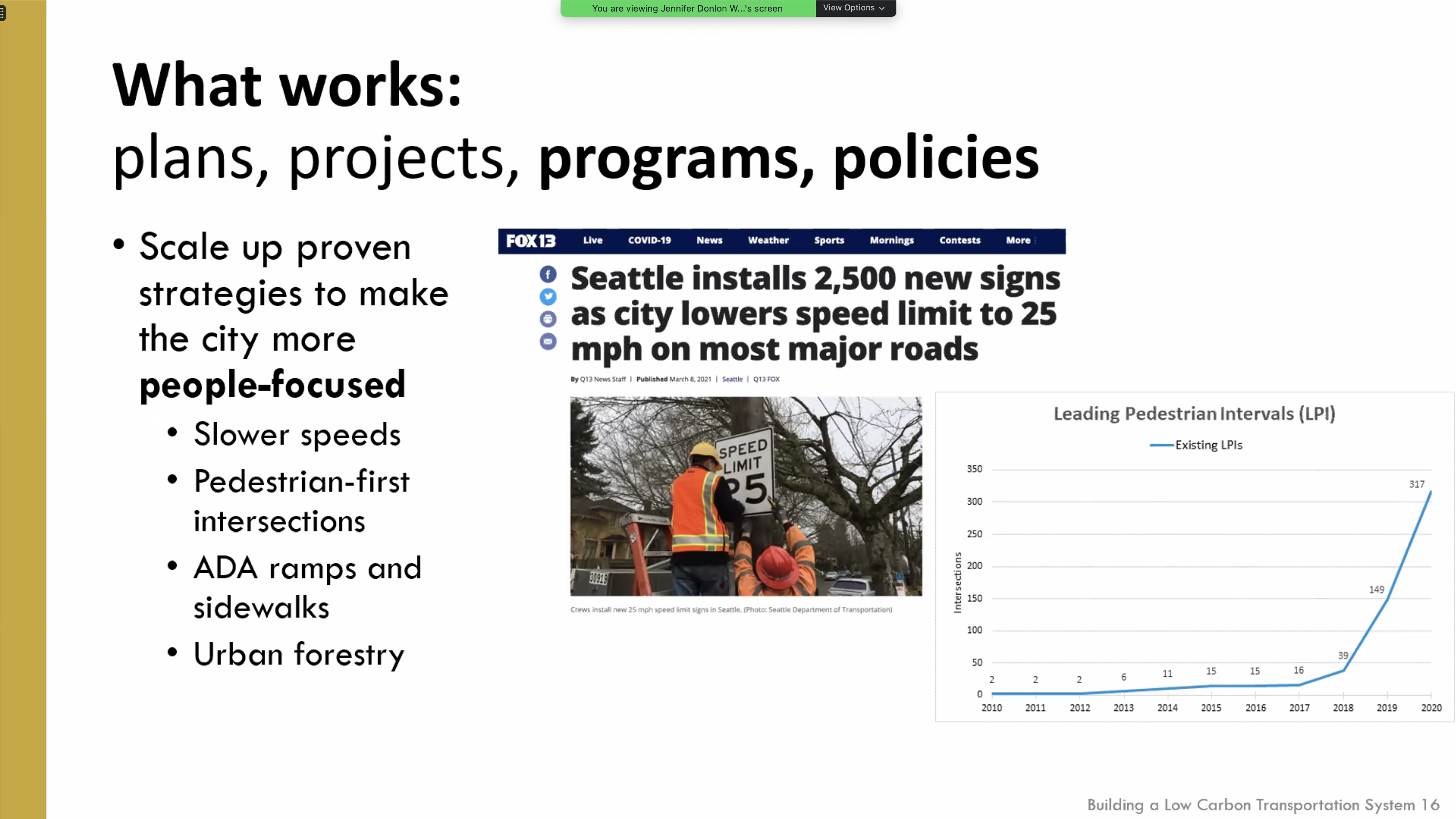
  • Sam Zimbabwe of Seattle DOT presented on the ways in which the city has shifted mode share to transit with projects and priorities. One of his slides showed the huge increase in the number of intersections at which they have programmed leading pedestrian intervals (LPIs) to enhance pedestrian safety.
  • Jeff Tumlin of San Francisco MTA said they have realized that waiting for a few big projects is an ineffective approach, and are now doing many small projects, often with temporary measures that can be improved when made permanent. He said that sales taxes don’t have to be regressive, if the benefits are directed to the right places and projects, and that well-designed congestion pricing is not regressive. He also suggested that city staff should be challenged to a higher level of productivity and innovation, and let go if they choose not to meet that. He also spoke about SFMTA’s approach, with partners, of working on transportation and housing as a unified goal, not siloed.
  • Darrell Steinberg mentioned several times the idea of the city doing a transportation ballot measure so that it could set its own priorities for investment rather than compromising with the county (SacTA) over projects which don’t meet the needs of the city.
  • City staff said transportation is now 56% of carbon emissions in the city, which is higher than numbers reported before.
  • Ryan Moore poo-poo’d the idea of lowering speed limits, saying the MUTCD prevents that, without mentioning the state law which allows reductions in specific circumstances. Others pushed back on this.
  • Rick Jennings spoke enthusiastically about getting more kids on bikes and his own experience of bicycling with kids.
  • Jeff Harris spoke about EVs, despite the setup of the workshop being about other transportation ideas, not EVs.
  • Mai Vang pointed out that the ideas are too District 4 (central city) focused, believes that there should be more focus on low-income and outlying areas. She said we need better access to light rail stations, not just bicycling access to downtown.
  • Civic Thread spoke (all their employees!) about the need for a city-wide Safe Routes to School program to address the recent parent death at school dismissal at Hearst Elementary, as well as safety needs at every school. They also highlighted equity and community access.
  • Henry Li and Jeff Harris pointed to micro-transit (SmaRT Ride) as being a great success, but SacRT has still not provided information to the community to judge that.
  • Henry Li spoke mostly about funding, and did not address the Stockton/Route 51 project. He again highlighted light rail to the airport, despite the transit advocacy community’s request that all light rail extensions including ARC/Citrus Heights/Roseville considered before selecting the next project.

The message from the invited speakers and the community was clear: we need to make big changes in a hurry, and city funding and commitment will be necessary for that to happen. How will the city respond?

What are your highlights from the workshop?

screen capture of Seattle DOT slide on speed limits and LPIs