Arena for revitalization and transit?

Richard Layman, author of the Rebuilding Place in the Urban Space blog, posted yesterday on “An arena subsidy project I’d probably favor: Sacramento.”

After an extensive review of the benefits and pitfalls of arenas and stadiums, and subsidies of them, he goes on to look at the Sacramento subsidy for the Kings arena (the Entertainment and Sports Complex). He gives it a tentative up vote, based on the effects of moving investment from the suburbs to the center city, and utilizing the existing transit system.

Take a read and see what you think.

transit vs parking parity?

There is a bill before Congress to restore the parity between parking tax breaks and transit tax breaks. Most of the media, unions and environmental organizations are arguing to achieve parity in the tax subsidy, by raising the transit benefit to that of the parking benefit. Some have questioned whether it might not be better to reduce the parking benefit to that of the transit benefit (Level the Commuter Playing Field By Reducing the Tax Break for Parking, Streetsblog DC 2014-01-02). I’ll argue that there should be no tax benefit whatsoever for parking. As Shoup says, there is no such thing as free parking. Any parking subsidy at all encourages drivers to make poor economic choices, which means in this case that they are more likely to drive to work than they otherwise would be. Ultimately, there shouldn’t be any direct tax benefit for any modes of transportation, not even bicycles. We can better express societal priorities by rational expenditure decisions than by subsidies. In the short term, however, it might make sense to continue transit (and bicycling) subsidies in order to make up for the past perturbations that we forced into the system with parking subsidies.

We should be arguing for the complete elimination of the parking tax benefit. Period.

When people, and their employers, come closer to paying the real costs of parking, we will have less parking and fewer people commuting by motor vehicle. That is a benefit that doesn’t require a tax subsidy.

Sacramento’s Transportation Report Card

The lead article this week in the Sacramento News & Review is Sacramento’s report card. I can’t resist getting in on the fun.

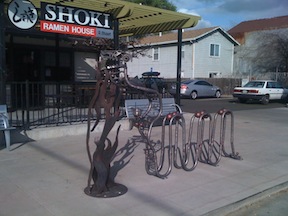
R-St_Dragon-bike-rackThe article covers bicycle transportation in the “On two wheels” paragraph, and does it pretty well, giving a C grade. I’d add that art bike racks can be fun if they are also functional. The dragon at Shoki Ramen House and the bottle openers at New Helvetia Brewing are good examples. I think bicycling really works pretty well in the central city and some of east Sacramento, with people getting along in sharing the road most of the time. The further out you go, though, the worse things are, with belligerent drivers traveling at high speeds. I’d give central city a B and the far suburbs an D-. Does this average to a C?

Read More »

Bike Score

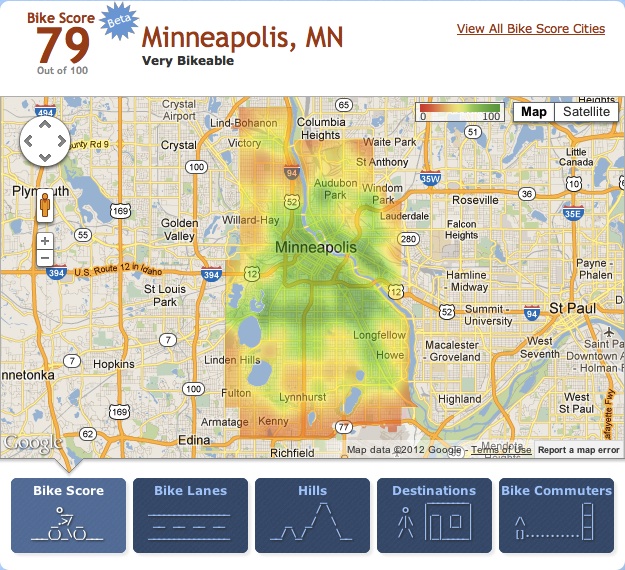
Bike Score for Minneapolis, with “heat map”

The next stage from the folks at Walk Score, Bike Score, is now available, for a select 10 cities. There aren’t any big surprises, Minneapolis, San Francisco, and Madison are at the top.

Sacramento is not on the list of 10. If you’d like to see it there, you can go to the Bike Score page and tweet a vote for it. Please do!

Walk Score also recently released Transit Score, where Sacramento is listed, as 22 out of the 25 largest cities with accessible transit data, at a score of 32. Both the Bike Score and Transit Score are created at a city-wide level, unlike the address-specific Walk Score. So these rankings are just first steps, but nevertheless interesting and useful.

You may have seen articles in the media recently about the high correlation between walkability and housing prices, with walkable communities in high demand and unworkable suburbs in the doldrums. This is good news for all of us. Walk Score was in fact designed as a tool for helping people find real estate and apartments in places that fit their desired lifestyle. As the correlation between walkable, bikeable, transit-dense communities and livability becomes more clear, resources (societal and personal) will be shifted away from the suburbs to urban areas.

Transit Score

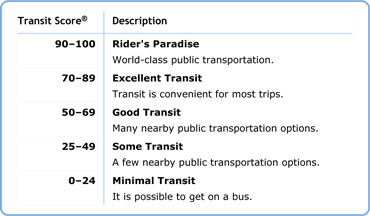
I previously wrote about Walk Score and its use in Sacramento, and now the Walk Score company has released Transit Score. Sacramento ranks 22 out of 25 cities, with a Transit Score of 32 (of 100), in the category of “some transit.” The categories are rider’s paradise, excellent transit, good transit, some transit, and minimal transit. It is worth noting that if all the major cities had provided their transit information, Sacramento would probably have not been on the list at all, because with a population of just under a half million, it is not in the usual top 25 but would show up in a top 50.

Walk Score notes “The Transit Score algorithm calculates a score for a specific point by summing the relative ‘usefulness’ of nearby routes. We define usefulness as the distance to the nearest stop on the route, the frequency of the route, and type of route.” As pointed out in the recent Streetsblog post, it does not including information about where you can go once you’ve gotten onto the transit, which also of course affects the usefulness of the transit.Read More »

Portland

I have been in Oregon City, Oregon, for the last few days visiting my friend Tim, as well as Patti who came over to join us from Idaho. We worked together in the Superstition Wilderness in Arizona many years ago. Monday I spent in Portland while Tim was working. Since I don’t have my bike […]

Getting started

As I ride my bike and use transit, and even to some degree as I walk, I think about our transportation system. In part this is my job, as a Safe Routes to School Coordinator, to observe, document, and reflect on the patterns of traffic and human behavior. But is is also just part of how I relate to the world. I believe that the two most important activities we do in our lives, for their impact on the earth, are eating and getting around. Eating is something I very much enjoy, but don’t spend a lot of time thinking about. Getting around is.

I’ve been living in Sacramento since April 2011, but there was a long period of transition as I left Carson City. There was also a long period of transition in becoming car-free. I’ll have more to say about being car-free in the future, but it has already faded into the background for me. I spend much more time thinking about how I get around than on the fact that I have no car and rarely drive.

This blog will collect my thoughts about how our transportation system works in Sacramento, both for me and for other people. Just so you know, I don’t think the system works very well. A system designed to give priority to the personal motor vehicle doesn’t work. It doesn’t work for us personally, it doesn’t work for us as a society, and it most certainly does not work for our relationship with the earth. We are killing the earth for our own convenience, and I feel strongly that we must stop.

I have a personal blog (link at right) on which I’ve posted a bit about transportation issues, and I’ll link back to those posts here and sometimes cross-post, but most of what will show up here is transportation ideas I’ve had rattling around for some time, and reactions to the day-to-day joy and challenge of getting around.