a safe and effective transportation system

Many organizations and individuals are deciding to oppose the transportation sales tax measure being proposed for the November 2022 ballot in Sacramento County. The reasons for opposition are many, but previous posts here (Measure 2022) cover significant ones. If the measure does not qualify for the ballot, or does qualify and fails, what then are we to do for transportation? Below are some ideas for a safe and effective transportation system. They are not yet well organized or prioritized.

I acknowledge the contribution of Walkable City Rules by Jeff Speck to this list. If you haven’t read it, please do. I don’t agree with everything he says, but it is the best prescription for correcting our transportation system and healing our cities that I know of. See also Measure 2022: the path not taken.

The realities of climate change and social justice demand a radical redesign of our existing transportation system and radical shift in transportation policies and investments. More of the same, with slight improvements, as the sales tax measure suggests, will not serve our needs now or in the future. See also our racist and classist transportation system.

General

  • all projects must contribute to or be neutral in reaching regional (SACOG) and state goals for reducing VMT and GHG (vehicle miles traveled, greenhouse gas emissions)
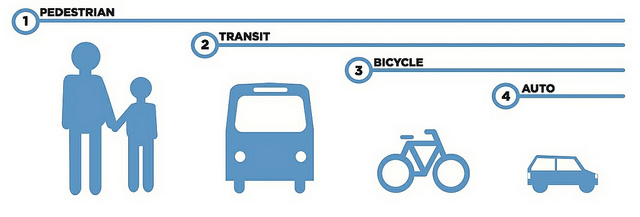
  • travel modes will be prioritized as: 1) active transportation (walking and bicycling), 2) transit, and 3) motor vehicles

Equity

  • sales taxes are regressive, and will not be the default mechanism for funding transportation projects
  • travel needs of people who don’t or can’t drive (children, elderly, disabled, choice) will receive at least the same concern and investment as those who do drive
  • at least 60% of transportation investments must serve formerly underinvested communities
  • transportation projects will be selected and designed to meet community needs previously expressed through community engagement; projects will not be selected by transportation agencies or employees
  • anti-displacement measures will be included in all transportation projects
  • no investments will be made in transitioning motor vehicles from fossil fuels to electric or hydrogen, except where formerly underinvested communities need supporting infrastructure; transitioning vehicles away from fossil fuels merely maintains motor vehicle dominance of our transportation system
  • all projects over $10M will require a health impact analysis
  • agencies will educate the public about H+T (housing and transportation) costs as a measure of housing affordability

Policies

  • roadways will be maintained in a state of good repair to serve all travel modes
  • transportation planning will be integrated with land use planning
  • only agencies that acknowledge and plan around induced travel demand will receive transportation funding
  • all transportation agencies must implement a robust complete streets policy which includes frequent, safe crossings of roadways and speed reductions
  • congestion pricing will be considered as a solution in all dense urban areas, to reduce motor vehicle travel and to fund transportation projects; pricing will be based at least in part on vehicle weight, value or emissions
  • cities and counties will not accept responsibility for maintaining local roadways in new developments; therefore, new development must establish reserve accounts to cover ongoing maintenance

Vision Zero

  • all transportation agencies must establish and implement Vision Zero policies in which redesign of roadways is a preferred action
  • at least 25% of transportation funds must be spent on Vision Zero projects
  • all roadway fatalities will be analyzed using a safe systems approach, with required change to the roadway design or use to prevent future fatalities

Roadway Design

  • implement 10-foot or less travel lanes whenever a roadway is repaved; remove striping from local streets
  • all new developments will require a grid street system of one-eighth mile so that the need for arterials and collectors is reduced
  • consider all right-turn-only and left-turn-only lanes for elimination
  • eliminate slip lanes everywhere
  • require signal cycles to be 90 seconds or less
  • eliminate level-of-service (LOS) in transportation planning
  • conversions of one-way streets to two-way streets will be funded; one-way one-lane streets will be considered an acceptable design for local streets and central cities
  • overly wide roadways will be reduced, with unneeded right-of-way returned to adjacent property owners or sold for infill housing
  • rougher pavements such as brick will be considered whenever slower traffic speeds are desired (but crosswalks will be smoother than the pavement)

Traffic Enforcement

  • wherever possible, automated enforcement will be used to enforce vehicle code that protects vulnerable users, rather than direct enforcement by law enforcement officers
  • violations which to do not threaten the safety of other roadway users will be de-prioritized or removed, with reduced fees if maintained
  • temporary or permanent vehicle confiscation will be used for egregious violators of vehicle codes
  • cities and county shall have the authority to do city-wide and county-wide reductions of posted speed limits, with or without corresponding changes to roadway design; redesign is of course preferred

Parking

  • all on-street motor vehicle parking in urban areas will be charged, either through curb metering or though flat fees
  • parking fees will be used to:
    • cover the cost of providing on-street parking construction and maintenance, and parking enforcement
    • improve transportation and economic vitality within the neighborhood that generates them, and therefore will not go into the general fund
  • parking minimums will be eliminated
  • de-couple parking from rent so that car-free renters are not subsidizing renters with cars
  • parking will be managed to maintain a level of availability on every block (similar to the Shoup 85% rule)
  • removal of on-street parking for higher uses such as active transportation, dining, and community spaces will be supported; however, removal of a travel lane rather than removal of parking is preferred
  • remove parking upstream of intersection corners to ensure visibility (daylighting); not needed when curb extensions provide the visibility
  • parking lanes/areas will be maintained to a reduced and less expensive level than roadways

Freeways

  • freeway removal, reduction, or decking will be considered for all freeways
  • new interchanges must be 100% paid for by private development
  • in urban areas, reconnect street networks over or under freeways at no less than one-half mile intervals, and provide pedestrian and bicyclist connections at no less than one-quarter mile intervals
  • managed lanes must be converted from general purpose lanes, not created through capacity expansion

Transit

  • transit performance measures will be developed, with a tentative goal that 80% of the population is served by 15 minute or better frequency bus or rail service, within one-half mile, for at least 15 hours per day on weekdays and 12 hours per day on weekends
  • transit will not be used as a mitigation for roadway expansion or induced motor vehicle travel; transit is a desirable mode in and of itself
  • transit will be funded to at least the equivalent of one-half cent of sales tax
  • dedicated bus lanes or bus rapid transit (BRT) design will be implemented on all high ridership bus routes
  • transit agencies will have flexibility to allocate funds between capital, maintenance, and operations, based on established criteria
  • metered freeway on-ramps serving four or more regular (non-commute) buses per hour will have bus bypass lanes

Sidewalks and Crosswalks

  • sidewalks will be considered an integral part of the transportation network, and therefore maintained by transportation agencies rather than property owners, except where trees or work on private property impacts the sidewalk; buffer strips in which trees are planted will be considered public responsibility
  • sidewalk infill will be considered a primary use of transportation funds, with at least 60% going to formerly underinvested neighborhoods
  • sidewalks with driveway ramps that slope the sidewalk crosswise will be replaced with continuous flat sidewalks, or the driveway eliminated
  • all traffic signals that have a pedestrian signal head will be programmed with a leading pedestrian interval (LPI) of at least 3 seconds
  • required pedestrian-activation will be eliminated (buttons to trigger audible information are acceptable); pedestrian auto-detection will be considered
  • raised crosswalks or raised intersections will be the default design for all reconstructed intersections
  • all crosswalks will be marked, with the possible exception of purely residential areas
  • pedestrian crossing prohibitions will be analyzed and eliminated where not strictly necessary for safety
  • curb extensions, the width of parking lanes and designed to not interfere with bicycling, will be installed whenever intersections are modified or reconstructed

Bicycle Facilities

  • bike facilities on any roadway with a posted speed limit over 30mph must be separated (protected) bikeways
  • bike facilities on any roadway with a posted speed limit over 40 mph must be separated from the roadway
  • roadway design will be used to make bicycle facilities unnecessary on low speed streets
  • design and implement low-stress bicycle networks
  • prioritize filling gaps in the bicycle network
  • re-stripe or re-design roadways so that bike lanes or separated bikeways are not dropped at intersections
  • bike share, and possibly scooter share, will be supported with transportation funds
  • secure, on-demand bicycle parking will be provided at common destinations; bicycle racks will be provided at common destinations and on every block in urbanized areas

Schools

  • school districts will have the authority to close roadways fronting the main entrance to a school, during arrival and dismissal times, in order to increase student safety and protection from air pollutants
  • Safe Routes to School programs or similar will be supported by transportation funds at the local level
  • school districts will be prohibited from building new schools at locations which are not easily accessible via active transportation or transit
  • school districts will prioritize neighborhood schools over magnet schools, in order to reduce travel
  • school districts will develop policies that allow neighborhood schools to remain open under declining enrollment
  • school districts will be responsible for the same transportation demand management requirements placed on any other entity

Thank you if you read all the way through. I realize some of these are radical ideas, but radical ideas make space for more reasonable ideas provided by others. That is part of the purpose of this blog.

Measure 2022: transit congestion improvement???


A group calling themselves A Committee for a Better Sacramento is sponsoring a citizen-initiated ballot measure for the November election, titled “Sacramento County Transportation Maintenance, Safety, and Congestion Relief Act of 2022—Retail Transactions and Use Tax”. (Note: Some people are referring to this as Measure A, but measure letters are assigned by county elections, not by the sponsors. I’ll continue to refer to it as Measure 2022, for now.)

One of the categories in the Exhibit A: Transportation Expenditure Plan is Congestion Relief Improvements (page A-16), and the subcategory Transit and Rail Congestion Relief Improvement Projects, which is allocated 10.85% of the measure, or about $890M over the 40 years. Projects listed are (they are not numbered in the document, but are here for reference):

  1. LRT peak service trains
  2. LRT extensions, Green Line to the airport, Blue Line to Elk Grove and Citrus Heights, Gold Line to Folsom
  3. High capacity bus corridor network throughout Sacramento County, including but not limited to Stockton Blvd, Watt Ave, Sunrise Blvd, Florin Rd, and Arden Way
  4. BRT to Citrus Heights, Stockton Blvd, and Sunrise in Rancho Cordova
  5. In coordination with the Capital Southeast Connector Joint Powers Authority, design, plan and construct a transit component, such as a bus rapid transit service, along the Capital Southeast Connector corridor to mitigate greenhouse gas (GHG) emissions and meet air quality targets. SacRT will match $40 million in revenues generated by this Measure with $80 million in state and federal funds for a total of $120 million in resources toward this goal. The project would consist of providing signaling and a bypass at critical connector sections to improve service, lower travel time, and reduce GHG impacts

The document does say that funding is ‘intended to be flexible’, which is good since the types of projects that might be constructed over 40 years will likely have little to do with this list. None of this funding is available for operations, which is in a different category, Sacramento Regional Transit District (SacRT) Maintenance, Operations, and Transformative System Improvements. More about that soon.

Light rail extensions and improvements for more frequent peak service (not for operating more frequent peak service, just for the infrastructure) sound appealing (items 1 and 2). Currently SacRT has unofficially prioritized Green Line to the airport, even though that would do almost nothing to reduce congestion. Infrastructure for Gold Line to Folsom is already funded, so it is strange to see it here. On the other hand, Blue Line to Citrus Heights is here, even though SacRT has removed it from consideration for the foreseeable future.

The terms ‘high capacity bus corridor network’ and ‘BRT’ (items 3 and 4) are not defined in the document, so the public really has little idea what is intended. SacRT has not been very clear about this either. Projects in other places have revealed that the quality of the improvements to a corridor, and the restraints placed on private vehicle travel, make all the difference in whether bus corridor enhancements are valuable or pointless.

The $40M for the Capital Southeast Connector (item 5) is small in comparison to the size of the allocation, but it points out how poorly thought out the entire measure is. Who would even use transit on this corridor? The connector is designed to serve commercial traffic between Folsom (really El Dorado County) and Elk Grove, and to promote greenfield development along the connector. Greenfield developments are not designed to appeal low income workers, they are designed to appeal to high income white collar workers, who might be commuting to Folsom, Rancho Cordova, and Elk Grove. But those are not the sort of people who use transit unless it is clearly superior to drive-alone, and transit on this soon-to-be-congested corridor will not make the grade.

All of these projects are premised on the idea that the other projects in the measure will maintain or increase congestion, so it is necessary to improve transit to mitigate for that other congestion. Sadly, the SACOG MTP/SCS makes the same assumption, that transit projects will counteract the increased VMT and GHG emissions from other projects and poor land use.

Transit should not be a mitigation; it should have standing in its own right as a superior mode of travel. It should not be an attempt to make up for bad decisions made elsewhere. The question should be: what can we do to better serve existing riders, and what can we do to induce new riders?

This section of the Transportation Expenditure Plan is so-so. Not bad, not good, but mostly not well thought out and not clear what the benefits and trade-offs will be.

Search for category Measure 2022 to see posts as they are added.

Sac Transportation & Climate Workshop

The first City of Sacramento Transportation & Climate Workshop was held last night as part of the regular city council meeting. The first news, which was not at all clear before, is that this is the first of several workshops, which will develop the plan further. The next workshop has not been scheduled, but may be in March.

screen capture from city presentation

Some highlights:

  • No one spoke against the seven big idea projects.
  • People liked the enhanced bus lane on Stockton for SacRT route 51, but it didn’t receive much notice in the discussion.
  • Nailah Pope-Harden of Climate Plan and a local activist, said bold is the minimum, and said all projects should be about reconnecting communities. Many other speakers referred back to Nailah’s challenge.
  • The opening slide of the city presentation showed SacRT bus route 30 on J Street, pulled out of traffic and blocking the bike lane. Irony probably unintentional, but it does illustrate one of the ways in which the city does not support transit or bicycling. The bus should not be pulling out of traffic, but stopping at a bus boarding island with the separated bikeway running behind it.
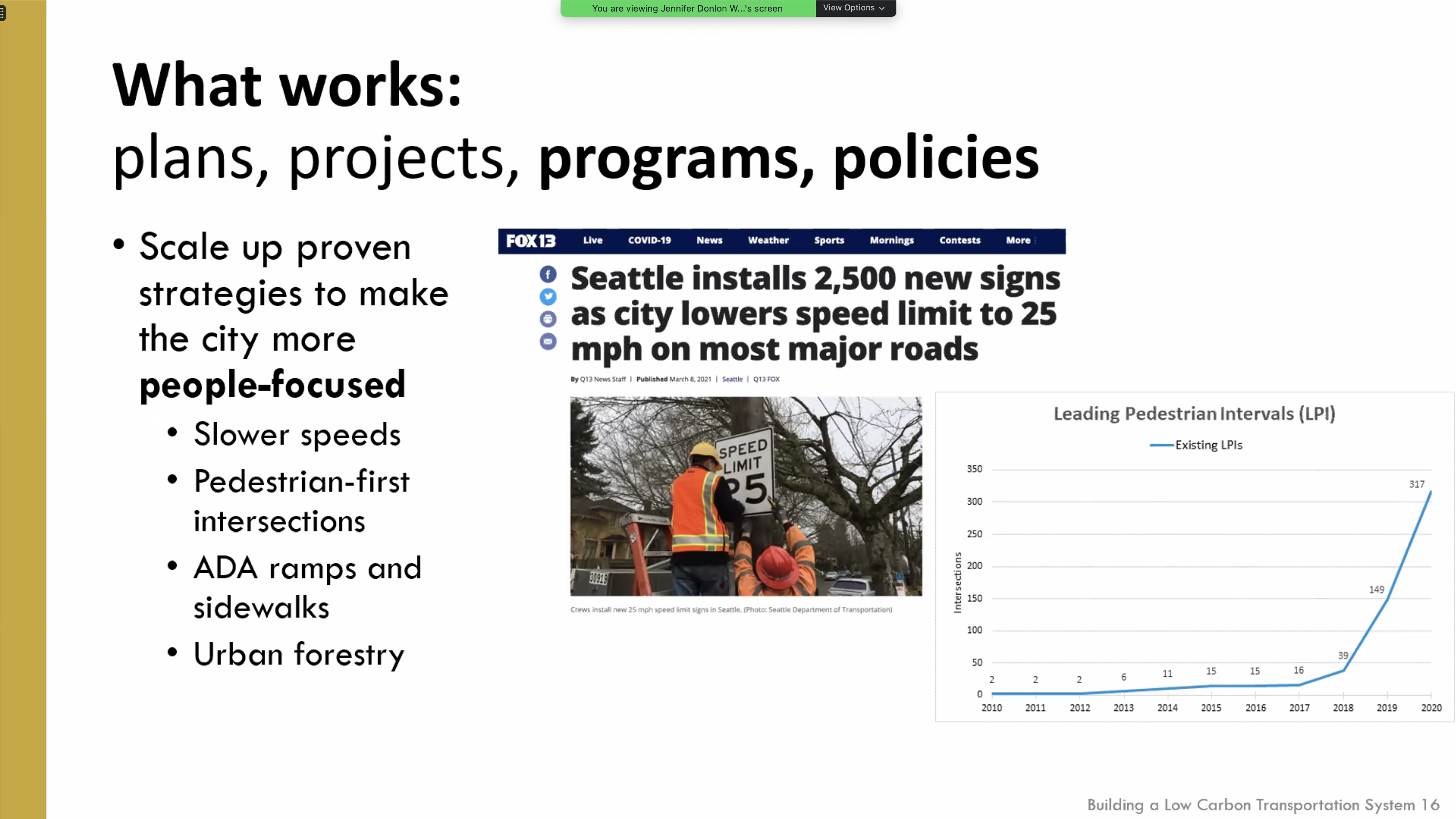
  • Sam Zimbabwe of Seattle DOT presented on the ways in which the city has shifted mode share to transit with projects and priorities. One of his slides showed the huge increase in the number of intersections at which they have programmed leading pedestrian intervals (LPIs) to enhance pedestrian safety.
  • Jeff Tumlin of San Francisco MTA said they have realized that waiting for a few big projects is an ineffective approach, and are now doing many small projects, often with temporary measures that can be improved when made permanent. He said that sales taxes don’t have to be regressive, if the benefits are directed to the right places and projects, and that well-designed congestion pricing is not regressive. He also suggested that city staff should be challenged to a higher level of productivity and innovation, and let go if they choose not to meet that. He also spoke about SFMTA’s approach, with partners, of working on transportation and housing as a unified goal, not siloed.
  • Darrell Steinberg mentioned several times the idea of the city doing a transportation ballot measure so that it could set its own priorities for investment rather than compromising with the county (SacTA) over projects which don’t meet the needs of the city.
  • City staff said transportation is now 56% of carbon emissions in the city, which is higher than numbers reported before.
  • Ryan Moore poo-poo’d the idea of lowering speed limits, saying the MUTCD prevents that, without mentioning the state law which allows reductions in specific circumstances. Others pushed back on this.
  • Rick Jennings spoke enthusiastically about getting more kids on bikes and his own experience of bicycling with kids.
  • Jeff Harris spoke about EVs, despite the setup of the workshop being about other transportation ideas, not EVs.
  • Mai Vang pointed out that the ideas are too District 4 (central city) focused, believes that there should be more focus on low-income and outlying areas. She said we need better access to light rail stations, not just bicycling access to downtown.
  • Civic Thread spoke (all their employees!) about the need for a city-wide Safe Routes to School program to address the recent parent death at school dismissal at Hearst Elementary, as well as safety needs at every school. They also highlighted equity and community access.
  • Henry Li and Jeff Harris pointed to micro-transit (SmaRT Ride) as being a great success, but SacRT has still not provided information to the community to judge that.
  • Henry Li spoke mostly about funding, and did not address the Stockton/Route 51 project. He again highlighted light rail to the airport, despite the transit advocacy community’s request that all light rail extensions including ARC/Citrus Heights/Roseville considered before selecting the next project.

The message from the invited speakers and the community was clear: we need to make big changes in a hurry, and city funding and commitment will be necessary for that to happen. How will the city respond?

What are your highlights from the workshop?

screen capture of Seattle DOT slide on speed limits and LPIs

J St bus stops & bikeway

I recently attended a meeting of SacTRU (Sacramento Transit Riders Union) and heard complaints about the bus stops along J Street between 19th Street and 29th Street, in the section where a separated bikeway (cycletrack, protected bike lane) was installed. I have heard these concerns before, so let me talk about them. Two SacRT routes run along this section of J Street, Bus 30 and Bus 38.

The concerns are two:

  1. The bus stops are too widely spaced.
  2. The bus stops are very difficult for disabled people (and bus operators) to use because the bus no longer stops at the curb, but rather in the street.

Actually, there are TOO MANY bus stops in this section of 10-1/2 blocks, from 19th Street to nearly 29th Street where the separated bikeway ends. Five bus stops, two of them only one block apart. In a central city setting like midtown, bus stops should be no closer than three blocks apart (about 1/4 mile), and preferably more, like four to six blocks. Why? Because every stop slows the bus significantly, not only the deceleration to the stop and acceleration from the stop, but dwell time. Buses in some areas like this actually spend more time stopped than moving, and as a result, the speed of the route is often below 10 mph. The following five photos show the five bus stops. It is significant that there are too many stops, because solutions to issue 2 are not inexpensive.

J St near 19th St
J St near 22nd St
J St near 25th St
J St near 27th St
J St near 28th St

The second issue is real. Bus operators can have a hard time deploying ramps to the street, particularly when the street is strongly crowned as parts or J Street are. A disabled passenger needing the bus ramp, which might be a wheelchair user or someone with a disability making stepping up to and down from the bus difficult, have to wait in the bikeway to board, not appreciated by the rider or by bicyclists. After debarking, the person must travel along the bikeway to the nearest driveway or corner curb ramp, again, not appreciated by the rider or bicyclists.

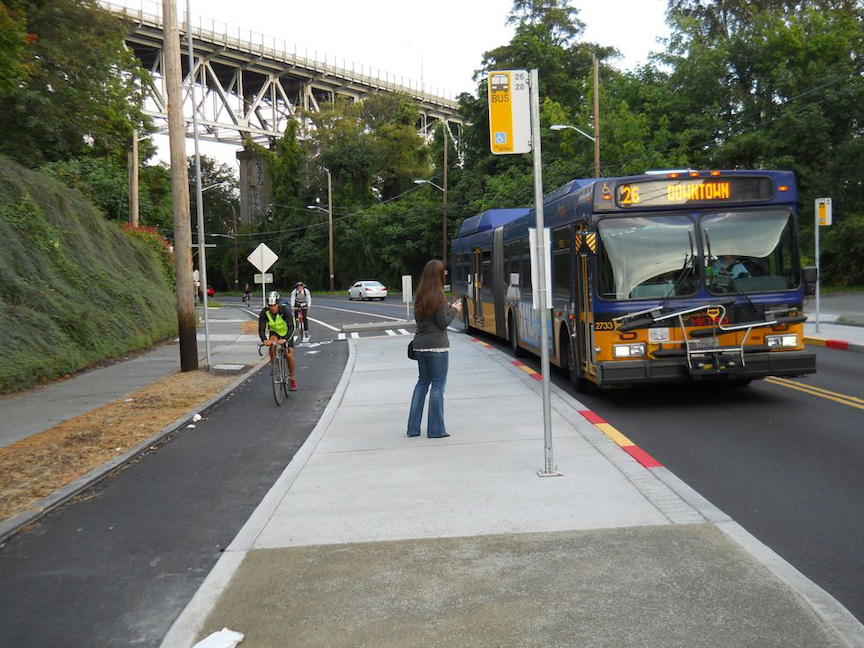
So, what is the solution? Bus boarding islands, which have been implemented in many cities. The first photo below is from Seattle. Riders have an large area to wait for the bus, the bus ramp is easy to deploy, and there is a safe crossing to the sidewalk at the end of the island. A slight disadvantage for the rider is that they must ramp down off the island and then back up to the sidewalk.

Seattle bus boarding island (from NACTO)

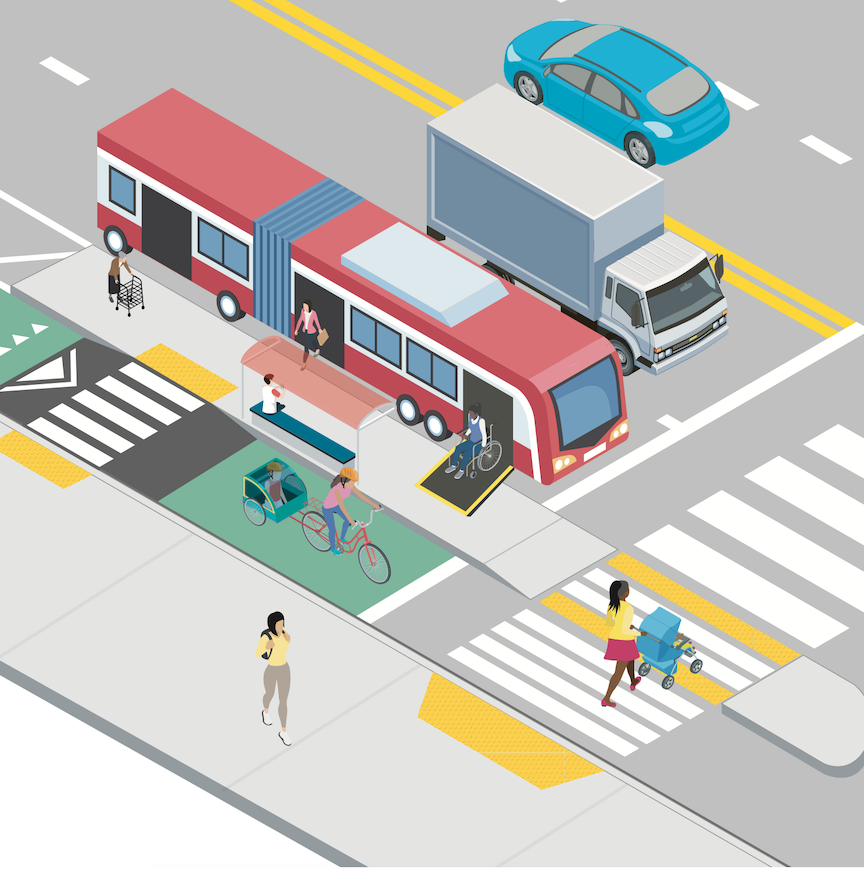
The diagram shows an alternative configuration, where the bikeway humps up over the crosswalk, but the route from platform to sidewalk for bus riders is level. This is probably safer for both riders and bicyclists.

diagram of bus boarding island with level crosswalk (from Vision Zero Network)

There are two significant challenges for these bus boarding islands. First is that installing them may require addressing drainage, which can greatly increase the cost of the installation. If three of the five bus stop photos, you can see drainage inlets, so this would be an issue on J Street.

The second is that by placing the bus boarding island where the bus stop now is, buses then stop in the travel lane rather than pulling out into the bus stop. The positive of this is that they don’t then have to negotiate their way back into traffic, which can be challenging and lead to significant delays to the bus schedule. The negative is that private vehicle drivers will complain about the slight delay to their drive from having to wait behind the bus. The convenience and safety for the many people on the bus outweighs the slight inconvenience for private vehicle drivers, but there will be complaints. Timed points on the route, where the bus would stop to wait if it is ahead of schedule, should not be in the travel lane, but that is not true for any of these stops.

To solve the boarding issue on J Street would take a cooperative project with SacRT and the city, and funding from both sides. The number of bus stops should be reduced, probably to three, so that fewer bus boarding islands are needed. This should be carefully planned so that they don’t need to be changed. It is possible to install temporary bus islands, as Oakland and other cities have done in a few places, so if the stop doesn’t turn out to be the best location, it can be moved without great expense.

Roseville is a car-centric hell

Due to a miscommunication with a person who gave me a ride from the end of my backpack trip in Foresthill, I ended up in the Galleria part of Roseville yesterday instead of old downtown, which was what I intended. What a hellscape!

Roseville Transit does not run on Sunday, or course not, why would a transit system serve people on Sunday? So there is no way to get from the Galleria area to any place else in Roseville, or to any place else in the world.

Being stubborn, I decided I needed to walk to the closest transit, which is the Louis/Orlando Transit Center just off Auburn Blvd/Riverside Drive in Citrus Heights. On my three mile walk between the Galleria area and old downtown Roseville, I saw two bicyclists and one walker. And thousands of cars, most of them high end SUVs (pedestrian killers). Galleria Blvd has sidewalks in some places, but rarely on both sides, so you have to cross back and forth. No warning ahead, no crosswalks, just cross when you come to the end.

If you wonder what people were doing on the Memorial Day weekend, they were shopping. And shopping. And shopping. Though there is a Roseville Transit line that serves the main mall area, Monday-Saturday, it is almost not possible to walk to or from there. Sidewalks come and go, and with all the freeway onramps and off-ramps surrounding, it does not feel safe to walk. Once on the mall property, there are no sidewalks, just the ones around the buildings.

If you want to see how bad the Galleria part of Roseville is, take a look at Google: https://goo.gl/maps/jGX7BrAJFyDUrwja9/. Follow a piece of sidewalk to see how far it goes, whether it actually connects to anything. Remember that the mall area itself is much more pedestrian friendly that any of the surrounding shopping areas.

I thought, well at least things will be better when I get to old downtown Roseville. In some ways, yes. It is not a place designed for the exclusive needs of cars. There are actual locally owned businesses instead of national chains. There are places to eat, drink, shop. But… it was late Sunday afternoon and the sidewalks had been rolled up. It is hard for local business to compete with the huge subsidies that the national chains and malls get. All that car infrastructure that supports the mall, the six to ten lane roadways, the freeways and interchanges, that all was paid for by you, not by the developers, and that is money out of not just your pocket, but the the pockets of local business owners trying to compete.

On to the transit center, at least some of the walk through quiet OLD residential neighborhoods, the original part of Roseville. Thankfully, SacRT saved the day, bus and then light rail, to home. Of course service is less frequent on Sunday, and other than light rail, it doesn’t run late, but it runs! It is a lifeline for people who can’t drive, who don’t want to drive, who don’t want to be a part of car-centric hell places like Roseville.

I was walking, not bicycling, but of course was also looking at bicycle facilities. There are bike lanes on most of the stroads in Roseville. And what welcoming bike lanes they are! The photo below is of the dashed bike lane on Galleria Blvd northbound, approaching Hwy 65. It runs for 900 feet! Between high speed traffic on the left and high speed traffic on the right (40 mph posted means the minimum speed, not the maximum, most drivers are going about 55). The right hand lane is the freeway access lane, so drivers are accelerating towards the entry, hoping to catch a green light and squeal tires onto the onramp. Yes, this is the behavior I observed. Roseville seems to be of the impression that painting lines on the roadway for bicyclists is all it takes, that and nothing more.

Galleria Blvd bike lane, northbound to Hwy 65

The one good thing about being in Roseville is that it reminds me of how lucky, and how privileged, I am to live in Sacramento central city.

Stockton Blvd Corridor Plan review

I have finally gotten to reviewing the Stockton Blvd Corridor Plan, following my post noticing the draft plan: Stockton Blvd draft available.

Overall, the plan is great, and when someday implemented, will result in a much safer and livable Stockton Blvd. The plan addresses major concerns raised by the community, including safer and more frequent crossings, better lighting, more trees, more effective transit service, and others. However…

  • The plan is still too oriented to the throughput of motor vehicle traffic. Better, but not as good as it could be. Maintaining the five lane configuration for significant parts of the corridor is unnecessary.
  • The plan does not even mention speed limits. When any street is reconfigured/reallocated, it removes any obligation to the unsafe and outmoded 85% rule, so the city should have considered speed limit changes for the corridor.
  • The plan recommends two-way cycle tracks in some locations. These are great for traveling along, but the problem comes in transitioning into and out of them at the beginning and end. Unless very clear guidance and priority is provided, these transitions can be very unsafe, particularly for less experienced bicyclists. In most cases, a bicycle signal head with exclusive bicyclist phase is required at beginning and end.
  • The plan acknowledges the challenging intersection of Stockton Blvd/34th Street/R Street as a “unique challenge” (page 13), but doesn’t even suggest solutions. I believe that the only way to make this intersection safe is to either restrict R Street or 34th Street, or to construct a flyover for light rail, similar to that for 19th Street, Watt Ave, and Sunrise Blvd. Yes, the expense of any of these might be beyond the scope of this plan, but eliminating this issue from the plan makes it difficult to compare the relative cost and benefit of other solutions.
  • On page 36, a diagram shows a bike lane eastbound on T Street to the right of a dedicated right hand turn lane. Bike lanes should never be to the right of dedicated turn lanes unless there is a bicycle signal head to create an exclusive bicyclist phase, which the plan does not propose. This must be fixed.
  • Shared bus and bike lanes will be a new concept for the city, and region. I support the implementation of these, and have used them in several other cities where transit frequency is not high. But they should be considered a pilot. If they don’t work out for bicyclists, and bus drivers, in this region, how do we fix it?
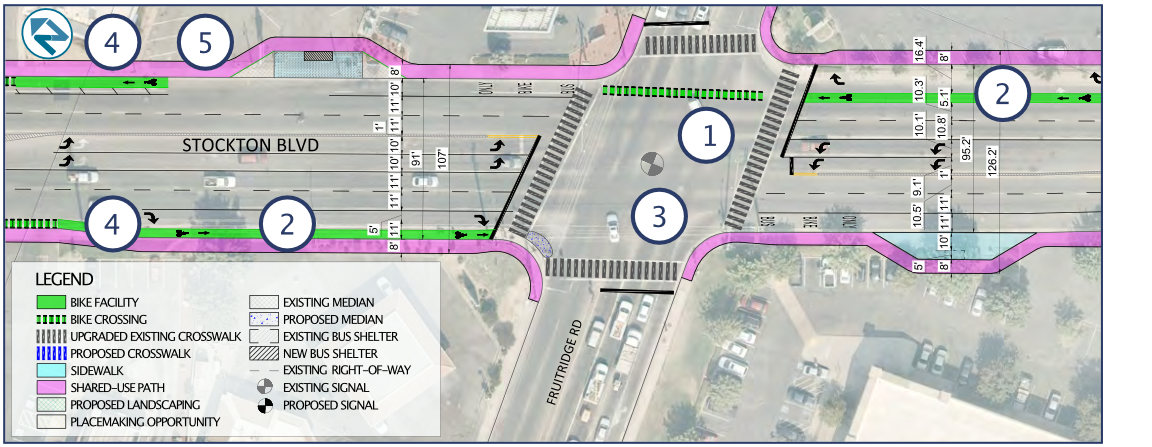
  • The flared intersection at Stockton Blvd and Fruitridge Road is preserved in the plan, but this is completely inappropriate. Flared intersections are always more dangerous for people crossing the street. The roadway width at the intersection, shown on page 41, is 90 feet. Crossings of this length cannot be safe, no matter what the length of the pedestrian cycle, without a pedestrian refuge median (with push buttons unless the pedestrian crossing is already on auto-recall). Double left hand turn lanes are dangerous for drivers and everyone else, as driver attention is focused on the vehicle beside, and not the roadway ahead, so these should be reduced to single left turn lanes. The right hand turns lanes should probably be eliminated, unless a traffic study shows conclusively that traffic would not clear during a signal cycle without them. The upshot is that this intersection should be completely reconfigured, not just tinkered with.
  • The plan does not indicate which intersection signals and signalized pedestrian crossings will be on auto-recall, or not. There is probably no justification for pedestrians activation buttons at any location on the corridor (pedestrian crossings should have auto-detection), but if there is, these should be called out clearly in the plan.
  • The plan shows most intersections as having skipped (dotted) green bike lanes striped through the intersection, but a few do not. They should be used everywhere. For the protected legs of partially protected intersections, the striping should be continuous rather than skipped (dotted). MUTCD frowns on this, but it has been installed many places with positive safety outcomes.
  • Added item: No right turn on red prohibitions should never be used without leading pedestrian intervals (LPI). Otherwise, drivers turning will immediately come into conflict with walkers in the crosswalk. I don’t think this is being proposed in this plan, but just want to make sure.

The City of Sacramento Active Transportation Commission will consider the plan this evening (2021-03-18). I apologize for not posting this in time for you to consider my suggestions, and relay them to the commission, if you agree.

Stockton Blvd & Fruitridge Road intersection

Added info: There was a discussion about the prioritization of different travel modes during the SacATC meeting this evening. It reminded me of one of my favorite graphics about transportation modes, from Chicago Department of Transportation. I think this is the right answer for Stockton Blvd, and for nearly every other roadway.

Stockton Blvd draft available

The Stockton Blvd Corridor Study draft is now available for review. It and some display boards reflecting the report can be downloaded at https://www.cityofsacramento.org/Public-Works/Transportation/Planning-Projects/Stockton-Blvd-Corridor-Study. The city is asking for feedback through email rather than another round of workshops.

I have not reviewed the report, but if I have comments to share, I’ll post them on the blog. My take on the earlier ideas are here: Stockton Blvd Corridor Study and Stockton Blvd needs trees.

Stockton Blvd needs trees

This is a follow-on the the Stockton Blvd Corridor Study post.

Trees

Following the online virtual open house, I realized I could not picture the situation on some segments of Stockton. Though I’ve traveled Stockton many times, I had not in a while, so I went back. I had commented during the open house, as well as after, that I didn’t think the cross-sections presented gave enough information on or weight to trees, so that was part of my agenda, to see the tree situation better. The day I went, last Sunday, was one of the cooler days in a while, high of 80 degrees Fahrenheit, but on the street the lack of shade and heat was noticeable. Add 20 degrees, and it would be intolerable for walking and unpleasant for bicycling.

The tree situation is not good. There are some sections with healthy trees, and some places where trees on commercial properties are healthy and shade the sidewalks, but on the whole, trees are lacking. The first photo below, taken looking south, to the south of Broadway, shows a long section with no trees at all, no buffer, no shade. The sidewalk is wide enough, but who would want to walk here?

Stockton Blvd south of Broadway

The next photo is of the section adjacent to UC Davis Medical Center where trees are present in a slightly too narrow buffer. The trees are relatively young, but when mature, will provide necessary shade and probably also crowd the buffer.

Stockton Blvd near UC Davis Medical Center

The next photo is of a very narrow strip where trees were present but were all cut down, and the following photo, a Google streetview capture of the trees. The trees were obviously planted in a strip far too narrow for them, and some of them were unhealthy as a result, so I’m not presenting this as a model, but as a warning that commercial properties cannot be relied upon to provide trees. Even the small trees in this narrow strip provided some shade and feeling of place to the street. In addition to this instance, there are many commercial properties and some residential properties along Stockton where the trees are dying, dead, or have been removed. And conversely, some where the trees on commercial properties are in good condition, so thank you to these properties. Trees, if they are to serve as a long-term amenity, as I believe they should, must be provided in the public right of way and maintained by the city.

Stockton Blvd, removed trees, near Jansen
Stockton Blvd, trees before removal, near Jansen

A small archive of photos from Stockton Blvd are available in the Flickr album at the end of this post, and those who live along or do business along can provide more detail.

So what is the solution? The first part of the solution is that the city must modify its cross-section renderings and pages so that it highlights the tree situation. Will there be a sidewalk buffer? How wide? What numbers and kinds of trees? To what degree will the project rely on trees on private property, versus trees in the public right-of-way? I find the options presented as unacceptable because they don’t really address this issue. On a few of the pages, trees are mentioned, but never in enough detail.

I would propose for community along Stockton Blvd that there should be continuous sidewalk buffers planted with trees, all the way from Alhambra to 47th Ave/Elder Creek Rd. Where buffers are present with trees, great, make sure they are preserved and cared for. Where buffers are present but the trees are absent or unhealthy, plant new trees and care for them. Where there are no buffers, create them, and plant trees and care for them. Where there is a healthy tree line on private property, this can serve for now, but the buffer should still be provided for the protection of walkers and as a bulwark against possible abandonment of the private trees. I envision Stockton Blvd being a tree-lined community asset, where walking is a pleasure and traffic speeds and volumes are low.

For new buffers, the minimum width of the buffer should be eight feet, as anything narrower does not allow for full development of the trees, and leads to excessive root heaving of the sidewalk. The heaving is to some degree an inevitable consequence of having trees, but wider buffers and correct watering regimes reduce the problem considerably. Where the existing buffers are at least six feet and the trees are healthy, the buffer can be widened or left as is, depending on the situation. Where the buffer is narrower than six feet, the buffer must be expanded.

Where commercial businesses are present and buildings meet the sidewalk, the trees should still be present, but the spacing and species can be adjusted in consultation with the property or business owners so that they don’t block off visibility of local businesses. In most cases the buffer would be paved, with tree wells for the trees, and street furniture or other amenities in the buffer, but the buffer would still be a minimum of eight feet.

Intersections

Another issues that the city diagrams and information do not address is intersections and crossings. The existing conditions report acknowledges that there are long distances between safe crossings on the south end, but doesn’t provide much detail about intersections.

The intersections as they exist actively discourage pedestrian activity. The midblock crossings, of which there are a few, do not have any additional protection. At a minimum, these locations need user-activated RRFBs (Rectangular Rapid Flashing Beacons). At many of the signalized intersections with minor streets, there is a pedestrian prohibition on either the north or south leg. These prohibitions exist solely to speed the signal cycle and encourage traffic flow; they do not exist for safety reasons. They must be removed. The photos below shows just one of the many such prohibitions. A person walking on the south side of Jansen, wanting to go south on Stockton, would have to use two crosswalks, waiting for the signal, and then walk through an overly wide commercial driveway. There is no reason for this.

Stockton Blvd at Jansen Dr, pedestrian prohibition

At the major intersections, where crosswalks are present on all legs, the crossing distances are long. Though not as bad as many other locations in Sacramento, intersections are often flared out to add turn lanes, both left and, often, right turn lanes. This increases crossing distance. This issue can be solved in two ways: removing the unnecessary turn lanes, or adding pedestrian refuge islands in the middle, so that slower walkers can make the crossing in two stages. The medians must be six feet wide, to meet standards, and must have a pedestrian button so that people don’t become stranded. (Note: I’m not in favor of pedestrian buttons at all, except when they: 1) trigger audible information, or 2) lengthen the crossing time; however, this is one situation in which they make sense)

The project information does not really address intersections at all. City staff said that these details would be worked out later, but I find this unacceptable. Intersection design must be part of the options presented. Intersections are where most conflicts occur between pedestrians and vehicle drivers, and bicyclists and drivers as well, so they are a critical element of any effort to improve Stockton.

Driveways

Some of the sections of Stockton are littered with driveways. Each commercial property has one to several. Part of improving Stockton must be to reduce the number of driveways. Each commercial property should have one driveway, or less. One of (the only) advantages of the parking moats that front the street (what I mean by parking moat is that the commercial buildings are set back away from the street, and parking lots face the street; these parking moats contribute significantly to the feeling of Stockton Blvd being a car-dominated place). In several cases, these parking moats can be combined for several properties in order to reduce the frequency of driveways. The issue with driveways is that they not only make a place feel busy and unwelcoming to walkers and bicyclists, but they are safety hazards for walkers and bicyclists very nearly as bad as the hazard of an intersection.

Stockton Blvd, north of Elder Creek, excessive driveways

Built Form

There is a section of ‘old’ Stockton Blvd where the buildings come to the sidewalk, and parking, if any is to the side or back. This traditional pattern (traditional before suburban sprawl) is the best built environment, the one that feels most welcoming to people outside cars. It increases customers, it makes the street feel smaller and the sidewalk feel larger.

The ‘new’ sections of Stockton Blvd where buildings are set back behind a moat of parking have exactly the opposite effect, producing an environment that feels unwelcoming to walkers, makes the sidewalk feel like a part of the street rather than a part of the neighborhood. This built form is a widely recognized mistake, but the correction will take many, many years as these commercial properties evolve. But what can happen, now, is that all new commercial buildings can be required to front the sidewalk. There are a lot of empty or abandoned parcels on Stockton, which everyone hopes will see new development. That development should be the traditional pattern that gives the street a neighborhood feel rather than a traffic sewer feel.

Stockton Blvd, buildings fronting the sidewalk

Speed Limits

Another issue that the study pays scant attention to is speed limits. Whether or not the street design option work depends on design speed and posted speed. The default assumption in transportation planning is that speed limits cannot be lowered, due to California ‘law’. First, it is not a law, it is case law, established by judges, not the legislature, that says traffic tickets won’t be enforced unless speed limits are set to the level at which only 15% of drivers exceed. This will of course be changed, but the process is long, with powerful opponents, most specifically CHP whose lip service to safety is legend. But more important to this study is that streets that are reconfigured, with a change to lane width or number of lanes or mix of modes, can be set to any speed limit the city wishes. The road is new, and the past speed limit doesn’t apply.

So, in accordance with my desire to see a tree-lined neighborhood boulevard, I think that the speed limit for this entire length should be 30 mph. And of course the street must be designed to enforce that posted speed limit.

Highway 50 Interchange

The Hwy 50 and Stockton Blvd interchange is problematic for both walkers and bicyclists. There are no bike lanes through this section, at all, and walkers on the east side of Stockton face long crossing distances in a design that strongly favors high speed motor vehicle drivers. In the photo below, look at the long crossing distance on the north side of the freeway, of the exit and entrance ramps. It’s about 120 feet, with no protection from drivers, at all. I have both used and observed this crosswalk, and can confirm that very few drivers yield to walkers in the crosswalk. It is a guaranteed death trap for walkers.

The roadway striping does not delineate areas for motor vehicles and bicyclists, nor does it indicate where riders or drivers should be merging to reach their destination. It is just a wide-open area, and as with all wide-open areas, drivers will assume they have complete right-of-way. You can see by the tire tracks that the turns on and off the freeways are being taken at high speed.

Stockton Blvd – Hwy 50 interchange

This interchange must be completely reconfigured for the safety of walkers and bicyclists, and drivers for that matter. The entry and exit ramps must connect with the street at 90 degree angles, requiring drivers to make low speed turns. Bicycle lanes with green conflict markings must be installed throughout the interchange. Sidewalks must be improved and crossing distances shortened to no more than 22 feet.

It is disappointing that such a critical safety hazard was not addressed in the study.

Mode Share

The study, online survey, and open house never address the key issue for the entire corridor, which is: what should be the priority of travel modes in design of the street? Some of the options imply a higher priority for some modes than others, but the critical question is never asked of the public. I had said in my previous post that my priorities would be transit first, then walking, then bicycling, then private motor vehicle travel. However, having spent more time looking at and thinking about the corridor, I’m going to change that. The priorities should be walking first, strongly supported by the tree-lined boulevard configuration I’ve outlined and justified, then transit, then bicycling, then private motor vehicles.

What is is important here, though, it not my preference, but that the public, and in particular the residents and customers along the corridor were never asked this question.

What Now?

I’ve laid out what I consider some major flaws in the study. I am not against the particular options that were presented, and from that limited perspective, the study has done a good job. But the number of things NOT considered is glaring. I know the city hopes to address these issues later, but I don’t find later to be acceptable. The public needs a full set in information now, so that it can comment on the study from a perspective of understanding how the street will feel after the changes, not just design diagrams, but how each traveler will get along and across the corridor, and whether it supports their desires for mobility and livability.

I think the city should pause the study process and add in the elements not addressed, then go back out to key stakeholders, and re-do the engagement process including the survey and open house.

Photos on Flickr: https://www.flickr.com/photos/allisondan/albums/72157714923753216