Week Without Driving: save the dates

Week Without Driving 2024 will be held nationally, and in the Sacramento region, September 30 – October 6. Mark those dates on your calendar and prepare to participate!

The Sacramento website is https://weekwithoutdriving-sac.org/, and the hashtag for social media is #SacWWD. 

A planning committee is meeting once a week to refine details and promotion, so expect to see that showing up shortly. SacRT will be offering free rides to participants on select days.

SacATC February 15, includes Truxel Bridge

The monthly meeting of the Sacramento Active Transportation Commission (SacATC) will be this Thursday, February 15, 2024, starting at 5:30 PM in the city council chambers. The agenda includes five items. You can comment on these items, or on topics not on the agenda, ahead of time via eComment, or in person at the meeting. I encourage people to attend these commission meetings. There are usually very few members of the public in attendance, which means that your voice is important. Though eComments are valuable, in-person comments carry a lot more weight. The city’s planning staff is usually progressive and innovative, but Public Works in general is not, so it is important the citizens show up to push for progressive and innovative projects and policies. With some new appointments to the commission, and support of the public, the commission itself has been much more progressive than in past years.

Agenda item 3 is a presentation on the Truxel Bridge Concept and Feasibility Study. The Truxel crossing of the American River was originally proposed and approved by SacRT and the county as a transit-walking-bicycling bridge, carrying light rail from downtown to Natomas. The city is now proposing a motor vehicle-transit-walking-bicycling bridge. They are claiming that the bridge would reduce vehicle miles traveled (VMT) through the provision of alternative modes, and a shorter trip between downtown and Natomas, but has not presented data to justify this claim. New roadway capacity induces more motor vehicle trips, a well-established fact, so to claim otherwise requires proof. Walking and bicycling would be unlikely to be the major component of bridge users. Transit availability could reduce motor vehicle trips, but the Green Line to the Airport is probably decades away, and anything short of service to North Natomas would be unlikely to replace many car trips.

The city intends to go full speed ahead (pun intended) with the bridge, based on a 2013 city council approval, seeking public input only on the southern approach to the bridge and the bridge cross-section. Since 2013, the city has declared a climate emergency, the Mayors Commission on Climate Change goal is to achieve Carbon Zero by reducing VMT, the soon-to-be-adopted General Plan 2040 and Climate Action and Adaptation Plan aim for reducing VMT rather than increasing it, and SB 745 required VMT impacts as the primary criteria for judging projects. Most importantly, public awareness of the risk of motor vehicle induced climate change has emerged and strengthened.

Read More »

California needs to drop Caltrans, and create a Department of Highway Maintenance

Caltrans has sliced and diced cities with highways, dancing to the tune of segregationists who wanted to isolate and destroy communities of color so that they could ignore the existence of ‘those people’. Caltrans is not likely to be building any completely new highways in the future, though many in Caltrans would still like to. What they will be doing is continuing to widen existing highways, increasing motor vehicle capacity and inducing more driving. It seems that nothing will cure them of this, except disbanding of the agency and firing most of the highway engineers. So that is what I am proposing. In it’s place, there would be a Department of Highway Maintenance. The purpose would be to maintain our existing infrastructure, and I mean actually maintain, not just use safety and maintenance as a cover for widening. If bridges were replaced, they would be required to have the same or less motor vehicle capacity as before.

The department could do projects which remove motor vehicle capacity. This might include removing freeways completely, but with guidelines that prevent the design of ‘boulevards’ that are just as much traffic sewers as the freeways. It might include converting existing general purpose highway lanes to managed lanes, but would never include constructing new managed lanes. It might include projects which reduce on-ramps and off-ramps from two or more lanes to one lane, shortening the crosswalk distance over on-ramps and off-ramps, and creating right-angle on-ramps and off-ramps which slow motor vehicle drivers by design, and it might include narrowing freeway lanes and posting lower speed limits.

All designated state highways which are actually surface streets would be transferred to local transportation agencies, so the state highway system would shrink to actual freeways.

So what would happen to the funds that currently go to widening highways? I propose that one-third be given to local transportation agencies, on a competitive basis, for active transportation projects. All of this funding would go through the California State Transportation Agency; Caltrans would have nothing to do with it.

The other two-thirds would go for rail and transit. A Department of Rail and Transit would be created out of the existing Division of Rail and Mass Transportation. The purpose of this new department would be to purchase rail right-of-way, by condemnation if necessary, from the freight railroads, so that passenger rail may run in California without interference from the freights. It would also fund infrastructure and operations for rail and transit throughout the state. With the movement of funds from highway widening to rail, it should be possible to complete High Speed Rail on schedule, and to greatly enhance the operating frequency of the three regional rail services (Capitol Corridor, San Joaquins/Altamont Commuter Express (ACE), and Pacific Surfliner). Once higher frequency service and modern ticketing are in place, the regional rails would separate from Amtrak and be operated completely by the state. The state already owns the equipment. Though the agency could fund other transit, the emphasis would be on rail.

SacCity street design for transit

Part of an ongoing series of posts to support better streets in the City of Sacramento during their 2023 update of Street Design Standards. New standards must be innovative, safe, and equitable, and it will take strong citizen involvement and advocacy to make them so.

The purpose of designing streets for transit is to actively shift trips away from private motor vehicles and to transit. Most arterial streets in the city should have dedicated bus rapid transit design, and any street with more than one general purpose lane per direction should have a dedicated bus lane, with red paint.

  • Transit Street Design Guide will be used along with close collaboration with the transit agency to determine optimal and innovative street designs supportive of transit
  • Dedicated bus lanes will be provided on all 15-minute frequency bus routes on streets over one lane per direction
  • Light rail will be given exclusive right-of-way on streets with three or more lanes existing; and considered for streets with two or more lanes existing
  • Bus bays which force buses to pull out of and into traffic will not be used, except where the transit agency has identified the need to wait for a timed stop or to layover
  • Curb extensions may be lengthened to provide in-lane bus boarding
  • Dedicated bus lanes shared with bicyclists will be used only when high quality bicycle facilities on an immediately parallel street are not available, or to solve right-of-way issues of one block or less
  • Bus routes with 15-minute or better frequency, and light rail, will have transit signal priority at all intersections

Design diagrams will be developed in cooperation with the transit agency:

  • Bus stops, including stop amenities, with preservation of sidewalk passage
  • Concrete bus pads to lessen pavement deterioration
  • Bus boarding extensions on streets without bike facilities
  • Bus boarding islands with bicycle facilities behind, including design features that slow bicyclist traffic behind the island to prioritize walkers
  • Raised platforms for low floor or level boarding of light rail vehicles
  • Bus rapid transit streets, including potential raised platforms

real transportation solutions

Measure A 2022, which will be on the ballot this November, is a bundle of old ideas and a commitment to doing things the old way, the way that has dominated our transportation system since World War II. It does not address current transportation challenges. It proposes building more freeways, more interchanges, and widening roadways. It proposes to continue and increase the motor vehicle dominance of our transportation system. Sure, there is a weak commitment to fix-it-first, for the first five years of the 40 years. Sure, there are some complete streets, but that won’t make a dent in the pedestrian and bicyclist-hostile roadways that traffic engineers have built for us.

When Measure A fails, we have a chance in Sacramento County to identify and implement progressive and effective transportation projects and systems. What would a better transportation system look like?

  • One not so dependent on sales taxes. Sales taxes are regressive – low income people spend a much higher percentage of income on sales tax than do higher income people. Property taxes and congestion charges are a much fairer way to fund transportation. We have been too dependent on sales tax, for not just transportation, but many government functions.
  • One that recognizes and works to overcome the disinvestment that low income and high minority communities have suffered. Our transportation system is largely designed to ease the commutes and travel of high income individuals, not of society as a whole. The light rail system was designed with the needs of suburban, largely white commuters. So too were our freeways. At least 70% of transportation expenditures should be in and for the benefit of disinvested communities.
  • We have all the lane miles and pavement we will ever need. It is time to stop adding lanes miles and stop adding pavement. Not just because of the climate implications, but because these are low-return investments. Instead, transportation expenditures should support walking, bicycling and transit.
  • Big transportation projects such as freeways and interchanges claim big job benefits, but they are in fact much less efficient at generating high paying jobs than many other types of infrastructure investments. New construction spends most of its funds on materials, not on labor. The construction companies make large profits on large projects, but little of that filters down to workers. Small to moderate projects would employ many more people.
  • A transportation system dependent on motor vehicles, whether they are fossil fueled or electric, has strongly negative impacts on our places: direct air pollution, tire dust pollution, noise, traffic violence, loss of land to parking and roadways rather than productive development, and probably most important, it intimidates people out of walking and bicycling. A transportation system based on walking, bicycling, and transit eliminates most of these negatives.
  • A car dominated transportation system pushes everything further apart, jobs and housing and shopping and medical far away from each other. Cars not only encourage but largely demand low density development, so that there is space reserved for cars, all the parking and roadways that take up a large portion of our cities. It requires a car to participate in society, and thereby requires low income people to expend an unsustainable percentage of their income on transportation. A transportation system that relies much more on walking and bicycling allows things to be closer together, so that cars are not necessary for most daily travel.
  • Transportation investment should depend much less on state and federal funding, and much more on local funding. Large portions of the Measure A funds are intended to be matches for grants. But grants cause planners to focus on what the state and the federal government want, not on what the county or cities need. When the income from taxes or fees is close to the people, the solutions are much more likely to be what is desired by the people.
  • Private vehicle travel does little to contribute to making our places and our lives better. A innovative transportation system would focus on access to services, and make those services available nearby. It would reduce vehicle miles traveled, both by changing our development pattern and by actively working to reduce motor vehicle travel.
  • Our current transportation system has destroyed a lot of natural and agricultural lands, paving it over with roadways and low density housing. The best way of preserving nature and agriculture is to focus our attention and our funding on already higher density areas, which means infill.
  • None of the projects in Measure A are designed to support infill development. A progressive transportation system would focus nearly all investment on infill areas. It would cost much less money, and be much more productive.
  • Measure A calls out and essentially requires completion of the Green Line light rail to the airport. But who will use it? Unless service hours are 24 hours a day, it won’t be usable for many of the airport workers, who work before and after peak travel times. Instead, it may become yet another very expensive service for high-income travelers, just like our freeways system. Instead, we need to rethink our transit system to determine what citizens want and will use, and build a more efficient system around that. We know that frequency is freedom, so we must shift spending towards that, even while maintaining a reasonable level of areal coverage.

I’m sure you can think of many other things that an innovative, equitable transportation system would accomplish. Please suggest!

celebration, and caution

Today is a day of celebration for housing and transportation in California, with the possibility of more to come in the next two days. Yay!

But I want to caution about the alignment of housing with transit. It seems like a no-brainer, right? As I’ve long said, you can’t have affordable housing without effective transit, and you can’t have effective transit without widely available affordable and other housing. The problem I’m concerned about is that most of our transit system is oriented to arterial roadways (the semi-high speed, many-lane roads that are also called stroads because they don’t function well as streets or roads, and also called traffic sewers). Or in the case of rail transit, often uses old railroad corridors or freeway medians that make housing development difficult and probably unwise.

Research indicates that people, particularly kids, who live near freeways and arterials have much higher rates of asthma, and many other health problems, and shorter lifespans. Is that where we want low income families and kids living?

Apart from freeways, most traffic crashes happen on arterial roadways, and particularly at intersections of arterial roadways, and freeway on-ramps an off-ramps. Is this the hazard we want for low income families and kids?

I don’t have an answer for this challenge, but I often think it would be better to upzone everywhere (the next increment of development), so that additional housing can be built in places with better air quality and lower traffic violence. Maybe we should be fixing the arterials first, before we build housing along them. Yes, that delays the benefit of easy transit access to housing, but good transit in a poor living environment is just not what I want to see.

Sac CAAP: council update

The City of Sacramento preliminary draft Climate Action and Adaptation Plan (CAAP) was on the agenda of the 2022-08-16 city council agenda, with a workshop on carbon neutrality. The council had asked staff for a status report, and to bring ideas for accelerating reaching carbon neutrality sooner than the original target date of 2045.

The staff presentation presented a few things that had happened before completion of the plan. Staff focused, as does the plan, on buildings and EVs. Ryan Moore of Public Works talked about transportation projects, but did not mention policy. Jennifer Venema presented several acceleration ideas, but they were vague. One was the build-out of the bicycle master plan, as though it was that, or everything else. The slides used by the staff presentation have not been made available to the public.

Almost everyone who spoke on the agenda items, on Zoom and in person (this was the first in-the-room council meeting), spoke in support of achieving neutrality sooner, and taking serious actions rather than the mild actions suggested by the plan. I am really proud of the citizens and organizations that took the time to formulate thoughtful statements and to wait for their turn.

Some of the council members spoke. Katie Valenzuela was the only one with a substatiative idea (see below), the others just offered platitudes. Darrell Steinberg unfortunately went off on a long rant in support of the transportation sales tax measures, including the lie that it had been amended. The side agreement between SACOG and SacTA has not been approved, and the language of the ballot measure has not changed at all – it is still bad news for the climate.

Katie Valenzuela’s slide

I made the following statement:


“Transportation is 57% of carbon emissions in Sacramento. Equitable transportation is what we should be talking about.

Transportation priorities, carried over from Mayors Commission on Climate Change:

  1. Active transportation
  2. Transit
  3. Electrification of remaining motor vehicles

The CAAP seems to invert that priority, and is strongly focused on EVs, which would retain the motor vehicle dominance of our transportation system.

Active transportation should be first and foremost in the CAAP.

Why is active transportation so important to transit? Because that is how people get to and from transit. Both are important to an effective response.

$510M for a full buildout of the bicycle master plan is a fraction of what is already being spent on motor vehicle capacity expansion. For example, the Fix 50 projects is estimated at $433M, but will probably come in much higher.

Deb Banks mentioned that the bicycle master plan needs an update. The pedestrian plan, however, dates from 2006, and is completely out of date. Yet the CAAP does not even mention updating those documents nor combining them into an active transportation plan.”

Read More »

Sac CAAP: non-motorized and MCCC

The City of Sacramento’s Climate Action and Adaptation Plan (CAAP), preliminary draft, sets targets for active transportation and transit. The Mayors’ Climate Change Commission (MCCC) Achieving Carbon Zero in Sacramento and West Sacramento by 2045, set different targets.

MCCC 2020MCCC 2045CAAP 2030CAAP 2045
Active Transportation30%40%6%12%
Transit & Shared30%50%11%11%
MCCC page 26, CAAP page 66

The CAAP states (page 100) “This level of active transportation mode share by 2030 is consistent with outcomes of comparable case studies and peer-reviewed literature and anticipated level of investment through 2030, all of which are necessary factors to consider for quantifying evidence-based reductions for a qualified GHG reduction plan.” and (page 102) “Planning for at least an 11 percent transit mode share by 2030 is an evidence-based goal that the City considers achievable given current understanding of transit behaviors in Sacramento and comparable case studies, given that sufficient funding can be obtained to implement the necessary infrastructure.”

The justification for the mild targets is in the CAAP Appendix C – Community Measures GHG Emissions Quantification, page 20 for Active Transportation (TR-1) and page for Transit (TR-2). The document active transportation section cites work commute trips, which misses the point that all trips are an opportunity for GHG reduction, and that only about 15% of all trips now are work-related (pre-pandemic). It also states that we can’t be compared to European cities (nor does it even use up-to-date data from Europe), but implies that Sacramento won’t be taking the actions to significantly increase mode share, so therefore uses a much lower number. No actual research is cited. For transit, the document states that we could achieve a 21% mode share based on peer city Oakland, but then inexplicably sets the target of 11%.

Why is the city setting such low goals? Reading between the lines, it is because they don’t intend to spend the funds necessary to reach these goals, and they know they can’t fund this all with competitive grants. This is not climate leadership, in my opinion. The city should be doing everything it possibly can to shift trips aways from motor vehicles to active transportation and transit.

Some elements of the MCCC were included in the CAAP, some were not. I’ve found it valuable to compare the two. If you have the time, please do that yourself. The MCCC is a much stronger document.

Freeport Boulevard Transportation Plan Emerging Design Concepts

City of Sacramento staff (Drew Hart) presented to the Sacramento Active Transportation Commission last Thursday on the Freeport Boulevard Emerging Design Concepts. The presentation slides are here. The city’s Freeport webpage has a lot of background material. A link to the virtual open house on April 28 (tomorrow!) is available. This project and the Northgate project are being supported by the same consultant, so you will notice similarities in the process and graphics.

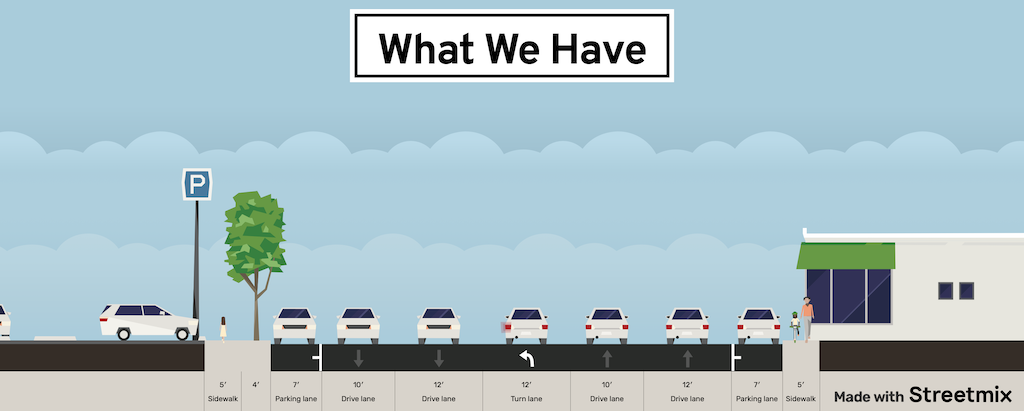
The northern section, between Sutterville Road to the east and Sutterville Road to the west, should look exactly like the traffic-calmed, complete street to the north. This project on Freeport was successful. There is no reason for five lanes in this section. One lane northbound, one lane southbound, and one left turn lane southbound is all it needs. If traffic backs up at the Freeport and Sutterville Road to the east intersection, then shorten the signal cycle.

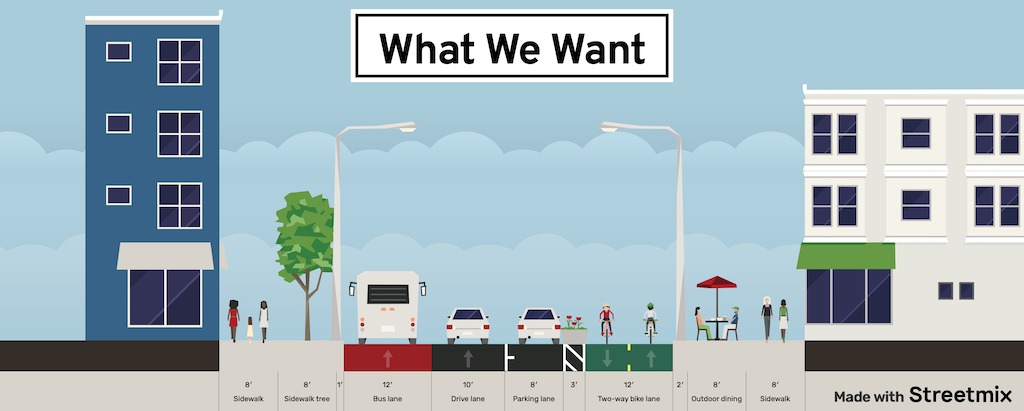
The emerging design document skips over the issue of whether four general purpose lanes are even needed. A concept should be presented that reduces general purpose lanes to two, and reallocates roadway width to other modes.

Dedicated right hand turn lanes should be removed everywhere. Dedicated left hand turn lanes should be provided only where traffic studies have shown a clear need, and should never reduce the roadway width for other uses.

Green lanes are shown behind protection for separated bikeways. Since the protection does or should prevent vehicle incursion, the paint is not needed.

Dedicated transit lanes should be considered. Though SacRT has not identified this as a high frequency route in the High Capacity Bus Service Study (Route 62 is 30-minute frequency), reconstruction of the roadway must consider the possibility of dedicated transit lanes and transit supporting infrastructure. Appendix A, available on the project webpage, provides a lot of detail about existing transit stops, which are mostly quite poor.

Some businesses along Freeport have multiple driveways, more than are justified by the amount of vehicle traffic access. Closure and narrowing of driveways should be considered. Since almost every business has parking fronting the street, no on-street parking is needed anywhere. This is poor urban design, but it is the nature of the corridor and could not be corrected without wholesale reconstruction of the corridor.

While separated bikeways are often a good solution, the frequency of driveways might make for poor quality infrastructure. Unless driveways can be closed or reconfigured, separated bikeways may not be the best solution.

Posted speed AND design speed should be considered for reduction. Posted speed is 30 mph from Sutterville Rd (to the east) to Arica Way, 35 mph from Arica Way to Fruitridge Rd, and 40 mph from Fruitridge Rd to Blair Ave. The section from Sutterville Rd (to the east) to Fruitridge Rd should be posted and designed for 25 mph, in recognition of the density of businesses and driveways. The section from Fruitridge to Blair Ave should be posted and designed for 30 mph, as it has a lower density of businesses and driveways, and is adjacent to the airport for a significant distance.

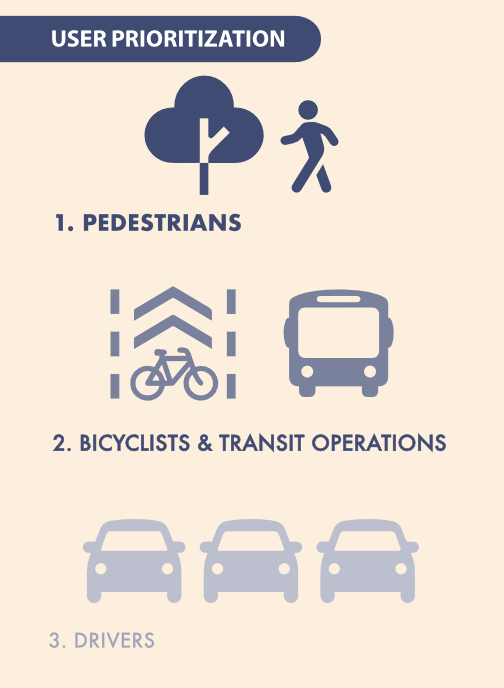
Prioritization of the modes for Sutterville (to the east) and Fruitridge Rd should be:

  • walking
  • bicycling
  • transit
  • motor vehicle

Prioritization of the modes for Fruitridge Rd to Blair Ave should be:

  • bicycling
  • transit
  • walking
  • motor vehicle

Crash/collision map of the Northgate Blvd corridor for pedestrians (walkers) and bicyclists. Data is from SWITRS for the years 2015-2019. (pdf)

map of Freeport Blvd Emphasis with pedestrian and bicyclist crashes