Intersection Control

Intersection control means the devices used at intersections to control the actions and behavior of motor vehicle drivers and others including walkers. The types of controls are:

  • none
  • 2-way yield
  • 2-way stop (or minor approach stop, MAS)
  • 4-way stop (or all-way stop, AWS)
  • roundabouts without signals
  • partial traffic control signals, such as flashing red or flashing yellow, and HAWK or RRFB
  • complete traffic control signals, with a cycle of green-yellow-red

It is often assumed, by traffic engineers and by the public, that safety increases moving down the list of intersection controls. However, there is research both supporting and contradicting this assumption.

Intersections may have features designed for people crossing, such as pedestrian crossing signals, with or without a countdown, and accessible pedestrian signals, compliant with PROWAG (Public Right-of-Way Accessibility Guidelines). Pedestrian signals may require user activation (the beg button) or may use automated pedestrian detection. Exclusive pedestrian phases allow people to cross when no motor vehicles are moving, thereby reducing the chance for crashes to near zero.

Other features may increase or decrease safety. Examples that may increase safety if properly designed and implemented, are curb extensions, refuge islands, automated red light cameras, near-side traffic signal placement, raised crosswalks or raised intersections, and roadway design that slows vehicles approaching the intersection. Examples that may decrease safety, particularly for walkers and bicyclists, are dedicated turn lanes, faded or non-existent crosswalks, pedestrian crossing prohibitions, and roadway designs that encourage speeding approaching the intersection.

Traffic Signals

Traffic engineers often try to solve known safety issues by adding new traffic signals. Little attention is paid to alternative solutions such as adding traffic calming features, or removing hazardous features. New or enhanced traffic signals are VERY expensive, ranging up to $1,000,000 per intersection. The addition of new signals ensures that money will not be available for traffic calming solutions that would be less expensive and more effective.

Traffic signals do not decrease the speed of motor vehicles in between intersections. Drivers immediately accelerate to the speed they had before stopping at the signal (if in fact they do stop). But signals do delay drivers, leading to frustration and increased violation of motor vehicle codes, particularly in yielding to walkers in the crosswalk. Red light running has become epidemic in the Sacramento region, perhaps worse than other regions, so it is not safe for anyone to proceed on a green signal or a pedestrian walk signal. This indicates a failure of traffic signals to control driver behavior, and that they may no longer be effective for safety.

The fact is, traffic signals are largely intended to smooth and ease traffic flow, and are often not safety features at all. Safety is used to justify new or upgraded signals, often without evidence.

Traffic signals are a classic example of ‘orderly but dumb’. Intersections should be ‘chaotic but smart’. (Strong Towns concept and Carlson’s Law)

Traffic engineers often claim that existing traffic signals were installed based on meeting warrants defined in the Manual for Uniform Traffic Control Devices (MUTCD, and the California version CA-MUTCD), but generally can’t produce those warrant documents. Many signals were installed based on politician requests and were not and are not justified by intersection characteristics. The warrant process emphasizes traffic flow and de-emphasizes safety for walkers and bicyclists.

All existing traffic signal locations should be analyzed every ten years, and signals which did not meet, or no longer meet, warrants, shall be removed. As roadways are modified or rebuilt with traffic calming features, far fewer traffic signals will be necessary.

When are traffic signals justified?

  1. At the intersection of two major roadways.
  2. Where the flow of traffic on one roadway does not provide gaps in traffic for crossing that roadway.
  3. At offset or skewed intersections where visibility or understanding may be difficult.

Most existing and proposed traffic signals do not meet any of these criteria. Major roadways, almost always designed as stroads, which are roadways designed for higher speed but with land use or design features that require slower speed, including driveways and turning movements, should be uncommon in urban areas.

Signals should never be installed to serve driveways, including shopping centers.

For any new traffic signal installed, it must include:

  • Signal cycles no longer than 90 seconds. Longer cycles are biased against walkers, and encourage walkers to cross against the signal.
  • Leading pedestrian interval (LPI) which provides the walk sign three or more seconds before the green light for drivers. Leading pedestrian interval (LPI) should be installed at ALL traffic signals in the city within five years. Bicyclists may proceed on the walk signal.
  • Elimination of slip lanes, dedicated right-hand turn lanes, and dedicated left-hand turn lanes more than one. Turning movements constitute the greatest danger to all roadway users.
  • No right (or left, for one-way roads) turn on red. No right on red should be installed at ALL traffic signals in the city within ten years.
  • Automated pedestrian detection to eliminate the need for beg buttons while achieving compliance with PROWAG. No person walking or rolling shall be required to manually actuate a pedestrian signal.
  • Implementation of exclusive pedestrian phases at any intersection with significant pedestrian flow. This phase may be achieved with turn prohibitions during pedestrian movement, or by all-way pedestrian crossing, called pedestrian scrambles.
  • Demand-responsive operation so that the signal cycle responds to demand by drivers, walkers and bicyclists, rather than set to an unchanging cycle.

Existing signals should meet the same criteria when upgraded.

HAWK and RRFB signals

HAWK (High intensity Activated crossWalK) and RRFB (Rectangular Rapid Flashing Beacon) are partial signals installed to allow walkers to cross roadways which would be difficult or unsafe to cross. However, HAWK signals are violated by some drivers, and RRFB signals are violated by many drivers. These signals are often justified by traffic engineers as ‘safer than nothing’, but it only takes one violating driver to kill a walker. RRFBs should not be used on roadways with a posted speed limit over 30 mph, and HAWKs over 35 mph.

Other Intersection Control

Intersections without signals can have stop signs, yield signs, or no signs at all.

The intersection of two low-speed (20 mph or less), low volume streets do not need any sign. They can be left uncontrolled, with drivers and bicyclists negotiating right of way at intersections, based on the universal first-come/first-served principal.

Intersections of moderate-speed (up to 30 mph), moderate volume streets may justify some signing. In order of increasing regulation, these are:

  • Two-way yield
  • Two-way stop
  • Four-way stop

The lowest level of signing that can provide safety for the intersection is the right level of signing. Stop signs should not be installed based on neighborhood or politician request, but rather based on observation of user behavior and the intersection, and crash history. The objective should not be to eliminate all possibility of crashes but to eliminate any possibility of fatal crashes.

With roadways designed for safety and placemaking rather than motor vehicle speed and throughput, intersection control can be the minimum necessary rather than the maximum control and expense.

Roundabouts

A roundabout is a circulatory intersection in which motor vehicles and bicyclists yield to others already in the roundabout, but otherwise do not need to stop. By eliminating traffic signals and stop signs, they ease traffic flow (and therefore driver frustration) and reduce crashes, particularly fatal and severe injury crashes. Other than low speed, low volume local streets that require no traffic control but do require user negotiation, roundabouts are the safest sort of intersection. Multi-lane roundabouts should really not be called roundabouts at all, and are generally no safer than signalized intersections.

References

Previous Getting Around Sacramento posts

SacATC April 18 notes

These are my notes from the April 18 meeting of the Sacramento Active Transportation Commission (SacATC). The official minutes are not available until the agenda for the next meeting is released, about three days before the meeting.

City staff announced that due to hiring a consultant and the project timeline, the updated Vision Zero Action Plan would not be available until sometime in 2025, not this year.

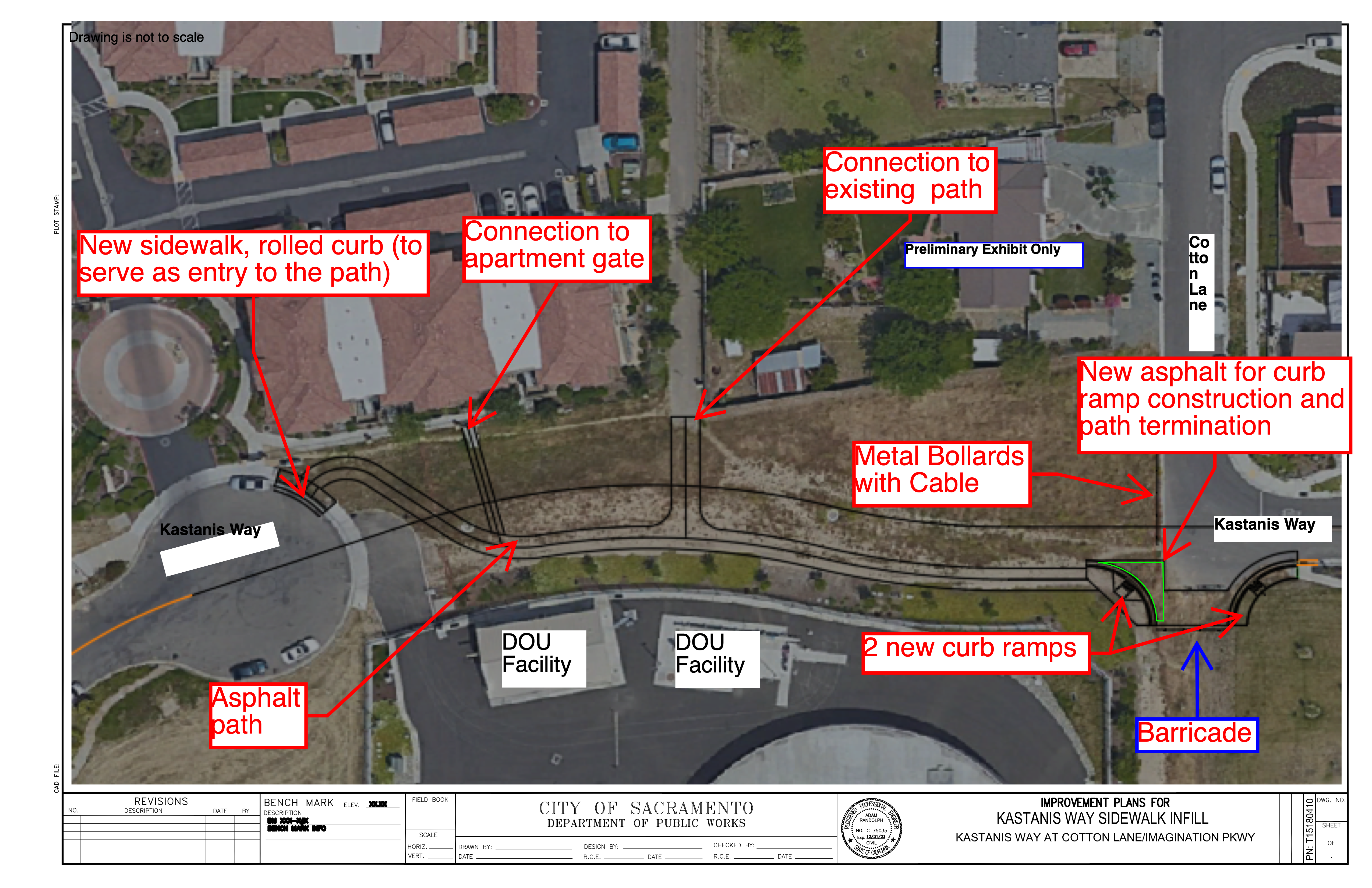
Agenda 4: Kastanis Shared Use Path. This is a wonderful project, connecting two ends of a dead-end street for walkers and bicyclists. It received my support and the full commission. Commissioners asked about lighting and trees, but as a sidewalk infill project from a very limited program, those could not be included.

Agenda 5: Grand Avenue Sidewalk Infill. Another wonderful project, adding sidewalks on Grand Aveue adjacent to the Sacramento Northern Trail for better neighborhood access included ADA ramps on all corners. A SacRT bus stop location will also be improved. Again, my support and the full commission. Commissioner Harris, who represents District 2, spoke about the lack of sidewalks throughout much of the district, and the benefit of any infill projects.

I spoke on items ‘not on the agenda’, asking that the slide presentations be made available before the commission meeting whenever possible. There is often information in the presentations not available in the staff report, which can make a project look better, or worse. I also suggested that the commission ask for a presentation on how the city views its responsibility for bus stops, since this came up many times in discussion of the Grand Avenue project.

I hope that more people will attend the SacATC meetings and comment on projects (on online via eComment). This is the only real chance for public input on projects, other than going to your council member. Most Public Works projects are a black box without public input, so when there is the chance, it is time to speak up for safer and innovative solutions.

And now on to the more complex project, which took up the majority of the meeting time.

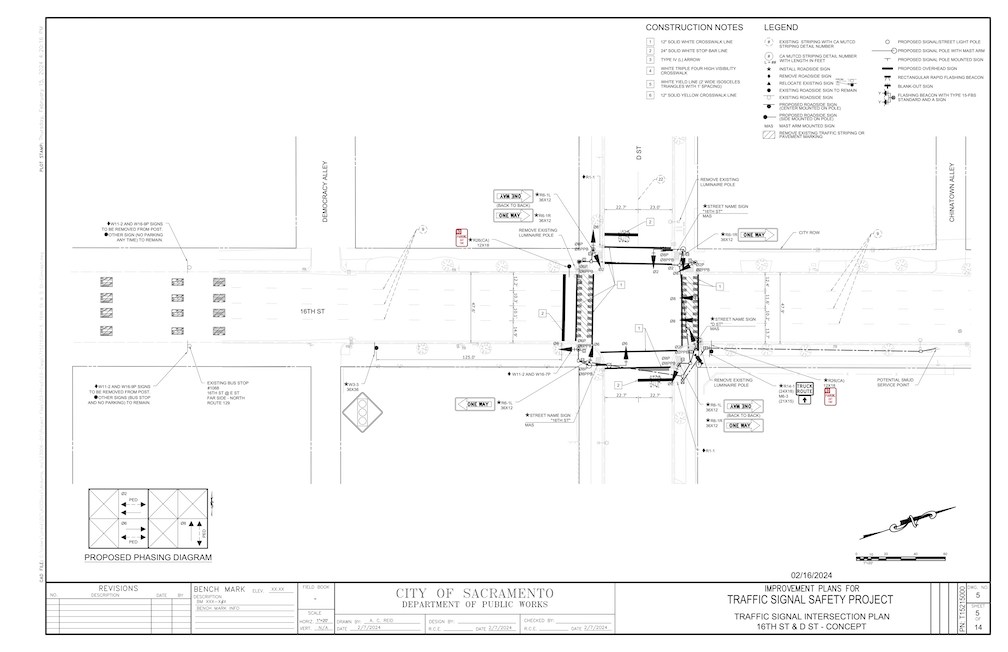
Agenda 3: Traffic Signal Safety Program. There was a staff presentation with a slide deck that was not available to the public (this is an ongoing problem, see below). Though the diagrams in the presentation were much more detailed than the ones in the staff report, they still left out a lot about the context of the intersection. What is it close to? Are there already a lot of walkers? How far is it to the next safe crossing? Is a traffic signal the best solution? It was clear from answers to commissioner questions that a lot of information was missing. Apparently this project is the result of a SACOG grant made to the city in 2017. Presumably there was a resulting document on the project, but that was not made available. The staff person said site selection was based on traffic warrants, but then exhibited a lack of knowledge about warrants. The question came up about whether the city could install a signal of any type that didn’t meet designs in the CA-MUTCD (California version of the federal Manual for Uniform Traffic Control Devices). The initial answer was no, but this was revised to yes, however a grant would be unlikely to be obtained that included non-MUTCD designs.

Overall, the entire traffic signal project is disappointing. The traffic engineering section of Public Works seems to have a very simple view of the world, to wit, a street with an unsafe design > a traffic signal. Changing the street design? Nah. Calming traffic to make the crossing safer? Nah. Shortening the crossing distance? Nah.

Traffic signals are expensive! Though no budget detail was provided, it is reasonable to assume from the overall $7.9M budget, which includes four full traffic signals, three pedestrian signals, and two RRFB (rectangular rapid flashing beacon) that full traffic signals cost about $1M each. That kind of money could fund a lot of traffic calming with lane reductions and curb extensions. Please take a look at my agenda post, and a comment from Sean Rogers that provides a much lower cost alternative for the Monroe Street and Latham Drive intersection.

Traffic signals do not necessarily create safer streets. Certainly, they don’t promote safety in between signals, as drivers accelerate to previous, often egregious, speeds as soon as the light turns green. With rampant red-light running, stop signs are probably much safer than signals. Though drivers also run stop signs, they do so at much slower speeds, whereas drivers running red lights often accelerate into the red light, ensuring the death of anyone in their path. If there are no gaps in traffic on a roadway, then it is necessary to create gaps with some sort of control, but a traffic signal is often the dumbest and most expensive way of doing that.

California has two years from the adoption of the federal MUTCD, which was December 2023, to either submit its own version, or the federal version will be the version for California.

The federal MUTCD (2023) has some interesting text (Section 4B.03 Alternatives to Traffic Control Signals): “Since road user delay and the frequency of some types of crashes are sometimes higher under traffic signal control than under STOP sign control, consideration should be given to providing alternatives to traffic control signals even if one or more of the signal warrants (see Chapter 4C) has been satisfied”, followed by 14 alternatives to traffic signals.

Section 4C.01 Studies and Factors for Justifying Traffic Control Signals provides a list of nine possible warrants to justify a traffic signal:

Warrant 1, Eight-Hour Vehicular Volume
Warrant 2, Four-Hour Vehicular Volume
Warrant 3, Peak Hour
Warrant 4, Pedestrian Volume
Warrant 5, School Crossing
Warrant 6, Coordinated Signal System
Warrant 7, Crash Experience
Warrant 8, Roadway Network
Warrant 9, Intersection Near a Grade Crossing

It is unknown which of, or any of, these were used to justify the signal locations. There are very detailed (and hard to understand) explanations of each of these warrant types.

My comments on the project, which I did not quite finish (two minutes is a short time), included:

  • Signals are not necessarily a safety feature for people walking, unless there are no gaps in traffic, the more important issue is to calm traffic on the approaching streets
  • We already have a lot of unneeded signals, where the traffic volume and context of the intersection does not justify a full traffic signal, perhaps 60 of them just in the central city
  • 16th & D: traffic on 16th St needs to be calmed, signal will probably not shorten wait time for crossing
  • Rio Linda at Roanoke: lacks a connection to Sacramento Northern Trail, which would make it a great deal more useful, posted speed 40 mph is too high for an RRFB
  • Monroe and Latham: traffic calming through lane reduction and curb extensions would be as effective as a signal (Sean Rogers comment)
  • At about $1M for a full traffic signal, there are much less expensive alternatives, and much better ways of spending limited funds

SacATC April 18

The monthly meeting of the Sacramento Active Transportation Commission (SacATC) will be this Thursday, April 18, 2024, starting at 5:30 PM in the city council chambers. You can comment on these items, or on topics not on the agenda, ahead of time via eComment, or in person at the meeting. I encourage people to attend these commission meetings. There are usually very few members of the public in attendance, which means that your voice is important. Though eComments are valuable, in-person comments carry a lot more weight. The city’s planning staff is usually progressive and innovative, but Public Works in general is not, so it is important the citizens show up to push for progressive and innovative projects and policies. With some new appointments to the commission, and support of the public, the commission itself has been much more progressive than in past years.


The agenda includes three discussion items:

  1. Traffic Signal Safety Project
  2. Kastanis Way Shared Use Path
  3. Grand Avenue Sidewalk Infill

Kastanis Way Shared Use Path looks like a great project, connecting two dead-end streets for walkers and bicyclists, but not motor vehicles. These are the kinds of projects that should be implemented everywhere the opportunity exists.

diagram of Kastanis Way shared use path
Kastanis Way shared use path

Grand Avenue Sidewalk Infill also looks good, providing improvements to the crossing Grand Avenue by the Sacramento Northern multi-use path.

diagram of Grand Avenue Sidewalk Infill project
Grand Avenue Sidewalk Infill project

The Traffic Signal Safety project is questionable. There are nine locations:

  1. 16th Street at D Street (Traffic Signal)
  2. Franklin Boulevard at 36th Avenue (Traffic Signal)
  3. Freeport Boulevard at Kitchner Road (Traffic Signal)
  4. Fruitridge Road at 60th Street (Pedestrian Signal)
  5. Rio Linda Boulevard at Harris Avenue (Rectangular Rapid Flashing Beacon)
  6. Stockton Boulevard at 11th Avenue (Pedestrian Signal)
  7. 24th Street at 25th Street (Pedestrian Signal)
  8. Munroe Street at Latham Drive (Traffic Signal)
  9. Rio Linda Boulevard at Roanoke Avenue (Rectangular Rapid Flashing Beacon)

I haven’t had a chance to look at each of these proposals, though I will note that the city traffic engineers love to install traffic signals. At $100K to $500K per intersection, these are major investments. Many of the new signals the city has installed, for example on 5th Street and S Street, are unneeded, and waste of money. They have also converted a number of pedestrian signals from auto-recall (the pedestrian signal comes on at every signal cycle) to beg buttons (the person walking or rolling must activate the sensor, or the pedestrians signal will never come on). The city has a number of unnecessary signals, 60 in the central city alone. Maybe a one-for-one program is called for, install a new signal, take out an existing signal.

I don’t trust city traffic engineers. They label projects as safety projects for walkers and bicyclist, when they are really motor vehicle infrastructure projects. So-called pedestrian and bicyclist safety projects are often motor vehicle enhancements in disguise.

I cross 16th Street at D Street several times a week on bicycle, and occasionally walking, most often to access the American River bike trail via Sacramento Northern path over the river. Yes, I have to wait for a gap in traffic on 16th Street, which sometimes takes a while. But rarely longer than I would have to wait for a traffic signal, given that the arterial street (16th Street) always has a long green and the cross street (D Street) has a short green. I think that funds would be better spent slowing motor vehicle traffic on 16th Street, or adding bike facilities to 16th Street, or reducing the travel lanes on 16th Street, which is a four-lane traffic sewer. Traffic signals do not calm traffic. They irritate drivers, and cause them to quickly accelerate out of the signal to make up for time lost at the signal. They may allow for safer pedestrian crossing, or at least would if red light running were not an epidemic in Sacramento. The fact is, many drivers do not stop for red lights, and certainly don’t stop for people walking in crosswalks. Measures other than traffic signals are necessary to solve the issue.

diagram of traffic signal at 16th St & D St
traffic signal at 16th St & D St

The proposal for an RRFB (Rectangular Rapid Flashing Beacon) for Rio Linda Blvd at Roanoke Avenue is inappropriate. The posted speed limit in this section of Rio Linda Blvd is 40 mph, meaning that actual speeds are more like 50 mph. This is too fast for an RRFB to have any effect on drivers. Even at slower speeds drivers often ignore RRFBs. If there is to be a safe crossing at Roanoke, there must be a HAWK signal, or a full traffic signal. Again, funds would be better expended slowing traffic on Rio Linda. At this time, there is no connection between Roanoke Avenue and the Sacramento Northern Bike Trail, so it isn’t clear why this location has been picked for a signal.

diagram for RRFB for Rio Linda Blvd & Roanoke Ave
RRFB for Rio Linda Blvd & Roanoke Ave

I will leave it to others to examine the other seven locations. Are signals needed? Are they the right kind of signal for the context, particularly the speed and volume of motor vehicle traffic? Are there projects that would improve safety for walkers and bicyclists more than expensive traffic signals? Are these the best locations, the ones that best serve routes of travel for walkers and bicyclists? I have doubts that these questions were considered.

Note: Readers Sean Rogers has suggested a better, and less expensive, solution for Monroe and Latham, in comments. The solution may be calming traffic, not just installing a signal.

wasted signals

This is Central City Mobility Project update #29.

I have written before about excess signals in the central city: too many traffic signals?. The fact that these exist is bad enough, but as part of the 5th Street conversion project, one-way to two-way, the city is replacing unnecessary old signals with very expensive and unnecessary new signals.

At 5th Street and S Street, a new signal is being installed. S Street is a low volume street that never needed and never should have had a traffic signal. A four-way stop sign, maybe, or maybe only stop signs for S Street. A fully signalized intersection, no way. There is nothing wrong with the existing signal for northbound traffic. Of course, a new signal is needed for southbound traffic. But the city is replacing northbound. Why?

Why is the city putting in a new signal here? Because there was one here before. If this intersection were studied for whether it needed a signal, the answer would be no. A warrant is a study indicating a need for a signal, as is simply explained at http://www.apsguide.org/chapter3_mutcd.cfm (this is much easier to read than the MUTCD). The 5th Street & S Street intersection does not meet any of these criteria. So, the city is putting in a new signal because they want to, not because it is necessary.

photo of new and unnecessary signal at 5th St & S St
new and unnecessary signal at 5th St & S St

The current cost of a fully signalized intersection is $200K to $500K. Half a mil per. Your tax money. For intersections like 5th Street and P Street, a signal probably is necessary, particularly since the P Street and Q Street traffic sewers encourage high speeds.

It is likely that the signal at T Street is similarly unnecessary, however, T Street is busier than S Street, so might be justified by traffic volume. I’d like to see the city do a new traffic warrant study on this intersection. The city always uses warrants as an excuse for something it does not want to do, but seems to ignore these for things it wants to do. A typical traffic engineering misuse of MUTCD guidance.

red-light-running bullies

If you go stand at any busy intersection in Sacramento, you will see drivers running red lights on almost every single signal cycle. Of course this problem is not unique to Sacramento, but it is where I live and walk and bicycle, and I see it every day, at every signalized intersection. I am not talking about drivers entering the intersection on the yellow light, and not making it through before it turns red. I am talking about drivers entering the intersection when the light is already red. And quite often, they accelerate into the red light, making sure they can get through.

I call this bullying behavior. It says that I (the driver) is more important than anyone else. Me (the driver) making this light is more important than anything else in the world, which translates to my (the driver’s) convenience is more important than anyone else’s life. I (the driver) know that this is dangerous behavior, but I (the driver) don’t care.

My preferred word for this is actually terrorism. Terrorism, however, implies actions by individuals against states, or more often by states against individuals (state-sponsored terrorism). This is not that. But the intent is the same, to change other people’s behavior by the threat of violence, or actual violence. This is traffic violence perpetrated by entitled drivers against everyone else on the road. Terrorism may not be technically correct, but it sure sounds right.

Most drivers have adjusted to this by not starting into the intersection on the green, but waiting until the run light running driver has cleared. Same for people bicycling and walking. Most walkers know it is not safe to enter the crosswalk until all the cars have stopped, because usually they will not stop. But not all drivers, walkers or bicyclists know, and these are the people being killed or seriously injured at intersections.

Red light running has always been a problem, but it has gotten much worse. It accelerated, I think, during the pandemic, when there was less traffic, and drivers started to gamble with running red lights. Now that the traffic is mostly back, they are still doing it. In my observation, it gets worse by the month.

Many people think that the solution to traffic violence is to change road designs so as to prevent dangerous driver behavior. I’m of course in favor of this. But in this instance, re-design does not prevent this bullying behavior.

Having near-side traffic signals, as many advanced countries do, would help a little because a driver who chose not to stop loses information about how late on the red they are and therefore is less likely to run the red light. See Near Side Signals: Thinking Outside the Pedestrian Box for more info on near side signals. But this alone would not solve the problem.

Slowing speeds would help, as the red light running driver would be a little less likely to kill the walker, bicyclist, or other driver and passengers than at higher speeds. But the red light runners are in my observation the same people who are driving well over the speed limit, adjusting their risk tolerance for to the highest possible level that won’t get them killed. Of course, these are not drivers who are much concerned about killing other people.

The City of Sacramento has a Red Light Running Program. The page says there are 11 cameras in the city. Out of 4000 plus intersections. This is not a serious response to a serious problem. It is in fact the typical city response to any transportation issue, to do the absolute minimum possible to avoid being called out for doing nothing.

I believe from extensive observation (I walk a LOT), though I have no data to prove it, that red light running is done by a fraction of drivers, and those drivers do it again and again and again. They’ve gotten away with it, so far, and will continue. At least 3/4 are drivers of expensive cars, high income, entitled people. If that is so, it would not take much to greatly reduce this behavior. Ticket them again and again and again, whether directly by law enforcement officers or by automated cameras, and their behavior would gradually change. Of course if we set ticket fines based on the value of the vehicle rather than flat rates, and impounded and/or confiscated vehicles upon repeated infractions, it would change even quicker.

Law enforcement is complicit in this red light running. I have never seen a driver stopped for running a red light. Ever. And in fact, law enforcement drivers are just as likely to run red lights as any other. Law enforcement doesn’t like automated enforcement, because it reduces the opportunity for them to do pretextual stops. It also is seen as reducing the need for officers, though since they don’t do this enforcement anyway, I can’t see how it actually reduces the need.

Many people have called on the city to install more leading pedestrian interval (LPI) lights in the city, where the pedestrian indicator turns to walk 3 seconds or more before the parallel traffic signal turns green. These of course help, but even where they already exist, the interval is now taken up by the time a walker must wait for the red light running drivers to clear the intersection before proceeding. Much less effective at promoting walking and safety than it could be.

Solutions:

  • The city could recognize that this is a serious traffic violence issue, and respond forcefully, with more enforcement and more automated cameras. The city’s Vision Zero policy obligates them to take traffic violence seriously, but they do not.
  • The CA-MUTCD could be changed to require near side traffic signals instead of far side traffic signals.
  • The state legislature and judicial council could change fines for violation of California Vehicle Code (CVC) to be based on the value of the vehicle. People often talk about basing fines on income, as some first world countries do, but income is not easily available to the law enforcement officer or processor of the red light camera mailed ticket, whereas the value of vehicles is available in the DMV database. If you run a red light in your $1000 clunker, the fine would be $1, and if you run a red light in your $200,000 trophy car, it would be $2000. To start.
  • Along with higher fines for drivers of fancy cars, the vehicles of these drivers should be impounded for the third violation of the same CVC within a year. Impound means you get the vehicle back after a certain period of time, maybe three months. And for those drivers that doesn’t control, then the vehicle should be confiscated, meaning you don’t get it back and the agency sells it. Maybe for more than six violations of the same CVC within a year, or ten within three years.
  • Walkers and bicyclists could equip themselves with paint ball guns so as to mark the vehicles of these bully drivers, so at least other people could see them coming. And perhaps other drivers would them start enforcing social pressure on them. It worked for smoking, when people who smoked in buildings and on transit were publicly shamed.
  • And of course, in the long run, we do need to re-design streets to that red light running is less likely, and less likely fatal due to lower speeds.

too many traffic signals?

I just finished reading Confessions of a Recovering Engineer by Chuck Marohn of Strong Towns. I’ll have more to say about the book soon. The reading reminded me of a number of things I’ve wanted to write more about, and one of those is traffic signals. Chapter 7, Intersections and Traffic Flow.

“Traffic signals are the most mindless and wasteful thing Americans routinely install to manage traffic. Removing nearly all of them within cities would improve our transportation systems and overall quality of life.”

Chuck Marohn, Confessions of a Recovering Engineer

I have long wondered what the value of traffic signals really is. As a walker, they make me wait for the signal cycle when there is no traffic coming. As a bicyclist, they stop me at almost every location, because they are set for the speed of cars, not the speed of bicyclists. There are places that set signals to work for bicyclists, but nowhere in the Sacramento region. Of course as an enlightened walker and bicyclist, I wait only for gaps in traffic and not for the signal to change. As a driver, which I once was, they make me sit at an intersection when I could be moving, and slow overall travel time.

Most signals do not sense traffic loads and respond. They are on a cycle, no matter what. Rush hour, midnight, same cycle. Signals are timed to preference one direction of traffic over the cross-traffic. And they are often very slow cycles. In the county, many of the signals are on a 2.5 minute cycle, and even in urban areas they are on a slow 1.5-2 minute cycle. Drivers have come to accept the long wait, but for walkers and bicyclists for whom a red signal can increase overall travel time by 1-1/2 to two times, they make us crazy.

Signals do not slow the speed that drivers drive. Drivers wait at the red light, and then accelerate on the green to make up for wasted time, always going over the posted speed limit. Of course these days many drivers don’t stop for red lights at all, they go through intersections on stale reds (meaning it was red before they even entered the intersection). This has become a very common behavior over the years, and is almost routine since the pandemic.

One of the things that signals seem to do is shift unsafe driving behavior from intersections to corridors, the street parts in between signals. Instead of misbehavior at intersections, causing lower speed crashes, we get misbehavior in between, with higher speed crashes.

Everyone who walks knows that signalized intersections are not safe places to cross the street. Drivers turning right look only for opposing traffic, almost never for people in the crosswalk. When the light turns green, drivers accelerate into right hand turns, across the crosswalk and any walkers in it. For intersections that permit left turns on green lights, the threat of a left turning driver crossing the crosswalk at high speed is constant. So people who value their life tend to cross mid-block, where one only has to look for two directions of traffic instead of 12.

The Confessions book suggests several alternatives to traffic signals, including roundabouts, traffic circles, and shared space intersections.

  • Use roundabouts rather than traditional intersections. Of course in place where the size of intersections is constrained by right-of-way and adjacent buildings, a real roundabout may not be possible, but traffic circles, of which the central city already has a number, can fit. Traffic circles are not as effective as roundabouts, but can replace signals.
  • Slow traffic enough that people can cross streets without having to have signals to interrupt traffic.

I realize that many people associate signals and stop signs with safety, and often demand signals and stop signs when the streets are dangerous. So what I am going to say here will be controversial. For people who think traffic signals make things safer, please spend some time observing at both signalized intersections, and unsignalized intersections. Are the ones with signals really safer? For anyone?

One of my (not) favorite signals is at 15th Street & E Street. At this point, 15th Street is not a collector or arterial, it only becomes one-way a block earlier at D Street, and has very little traffic at this point. It does not become a higher volume street until H Street and I Street to the south. E Street is a collector, though not a very busy one. Yet the signal cycles all day long, with almost no traffic at it. A perfect location for a traffic circle. Not the point of this post, but 15th Street at this location does not need two lanes, one lane would be plenty, and the excess lane can be converted to diagonal parking and/or a bike lane. A photo of the intersection is below, showing a typical amount of traffic.

What about all the signals on 14th Street? This is a low volume, fairly low traffic speed street, at all times of day. It dead-ends at the convention center, so it is not really even a through street, yet it has five signals. There are a lot more such examples. You can add yours in the comments!

15th St & E St intersection, Sacramento

All the signals in the central city that are not at the intersection of collector and/or arterial streets should be slated for removal. If the city wishes to do so, it could do a traffic study before removal, or just go ahead with removal, but it should not be leaving these signals in place without action. There are options short of complete removal. Signals could be made into signalized pedestrian crossings, so that when people walking need to cross, they still have (some) protection of a red light. (Some protection. Again, many drivers to not stop at red lights.) Curb extensions can be installed to shorten crossing distances. Traffic diverters (modal filters) can be installed so that only bicyclists have a thru route. And of course roundabouts and traffic circles. At the intersection of two collector streets, a four-way stop might be appropriate. Each intersection is unique, but each one is also a candidate for change that makes travel safer and less frustrating no matter the mode of travel.

I’m not suggesting, at this time, the removal of signals at the intersection of collector and/or arterial streets. Someday.

The map shows these signal locations, with a red X (pdf). The intersections of collectors and/or arterial streets, not marked here, are not being challenged at this time. The purple streets are designated collectors or arterials by the city (part of the Functional Classification System).

signals in Sacramento central city for possible removal

More Sac county nonsense

MUTCD-2012_Figure9C-7The Bicycle Detector Pavement Marking (CA-MUTCD Figure 9C-7, shown at right) is placed to show a bicyclist where to stop so that they can trigger a traffic signal. When installed properly, they prevent the all-too-common scenario where bicyclists cannot trigger signals and must either cross against the red light when a safe gap is available, or wait until a motor vehicle arrives. They are also a clear signal to motorists that there is a reason why the bicyclist is positioned where they are. Of course “bicycles may use full lane” is true approaching any intersection where right turns are permitted, however, most motorists do not know or remember this law unless there is a sign there to remind them. The sharrow serves a similar purpose. However, these markings are often not installed in properly.

Mission southbound at Marconi, bike detector placement

Here is another fresh Sacramento County mistake, where the marking was not placed properly. On Mission Ave southbound, approaching Marconi Ave, there is a Bicycle Detector Pavement Marking in the bike lane, but not in the regular through/right turn lane. This marking is on new pavement placed in a complete streets project along Marconi from Mission westward to Fulton, and was installed within the last two years. If a bicyclist is to trigger the signal, they have to stay in the right hand edge bicycle lane, where they are at risk of getting right hooked. If they adopt a merge position between the two lanes, where they should be in order to make clear to motor vehicle drivers to either get in front or fall in behind, not beside, then the signal won’t trigger.

The solution is to place a marker in the regular lane, and adjust loop sensitivity if necessary, so that the bicyclist can choose which lane position to use.

green wave

A “green wave” is a traffic signal sequence set so that vehicles will encounter green lights for some distance, so long as they are traveling at the selected speed. A green wave can also be set for bicycle speeds, though it very rarely has been, and never in Sacramento.

To some degree, all signals are set this way, though the degree and distance of sequencing varies widely. Many of the east-west streets in the Sacramento grid have signals set for motor vehicles, and when traffic is not congested, it may be possible to go all the way across downtown and midtown on green lights, for example on J Street. Very few north-south streets are set this way, I can think of only the 15th & 16th couplet, and the 9th & 10th couplet. At intersections with the east-west couplets, these north-south couplets seem to have their green wave broken. Only if the grid spacing and the selected speed calculate out is it possible to have a green wave in all directions. Sadly, many signal sequences in the Sacramento region are set above the posted speed limit, encouraging drivers to speed so that they make all lights.

Read More »