SacATC review of work zone policy

Please see previous posts in category ‘Work Zones‘.

The City of Sacramento is hosting a webinar on the draft Work Zone and Event Detour Policy Update, today, January 24, 6:00PM. You can register for the Zoom webinar here(registration is not available on the Work Zone webpage).

I have neglected to post on the SacATC (Sacramento Active Transportation Commission) review of the Work Zone and Event Detour Policy. Commission members had several good ideas and questions, which are worth capturing. You can view the meeting video at https://sacramento.granicus.com/player/clip/5786. Note that the sound quality is very poor, with many dropouts. Since I was at the meeting, I have filled in some details on the comments.

Comments/questions from commissioners:

  • Houpt: advocates should have a chance for input, is that part of the noticing process?
  • Hodel: Old Sac boardwalk (promenade) has been completely closed to bicycles for events; should be consequences for blocking access; supports rerouting motor vehicles is necessary; hefty fines for non-compliance
  • Moore: Class 2 bike lanes are already dangerous so reproducing them as diversions or detours is still dangerous; provide physical safety; rely on automated enforcement, not police presence
  • Gonzalez: is there a definition for ‘short pinch point’?; concerned about monitoring, suggested QRcode at location for immediate report of dangerous situation
  • Gibson: asked for details on enforcement at events; should be separate for short term events versus long-term construction project
  • Banks: how will the city get word out about events and construction that impact access; suggested more photos, particularly for events
  • Erasmus: assistance for event sponsors who may not have the resources to post events
  • Doerr Westbrook: could longer term projects be reflected in Google maps?; there may be some more recent Caltrans info on bicyclist detours; is there a database for locations and TCP documents? Can the document refer to federal guidelines on bicycle facilities for ADT levels, rather than city? (Reply was that the Streets for People Active Transportation Plan will update that guidance, and replace old Bicycle Master Plan at that time)

The Community Development AgencyCounter map (https://sacramento.agencycounter.com/) could be one location to store TCP locations. It does not appear to have document links, but would at least allow people to find locations and request documents.
9th St fixed, sort of

Following on to the post 9th St blocked by construction, the city has partially fixed the issue.

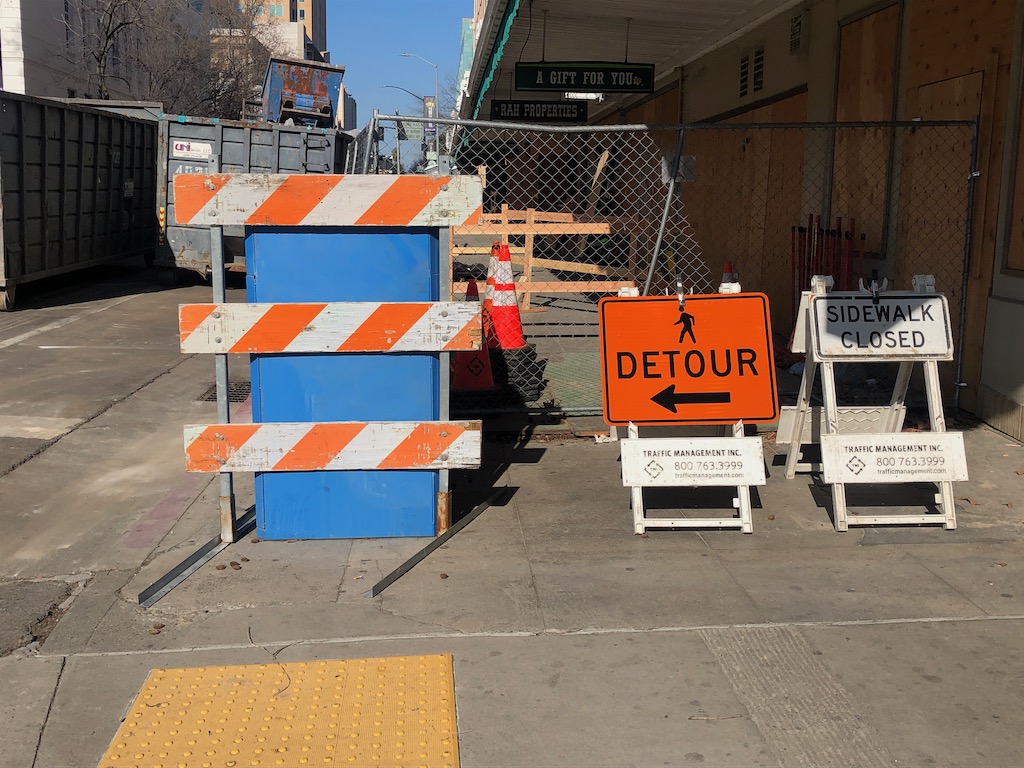
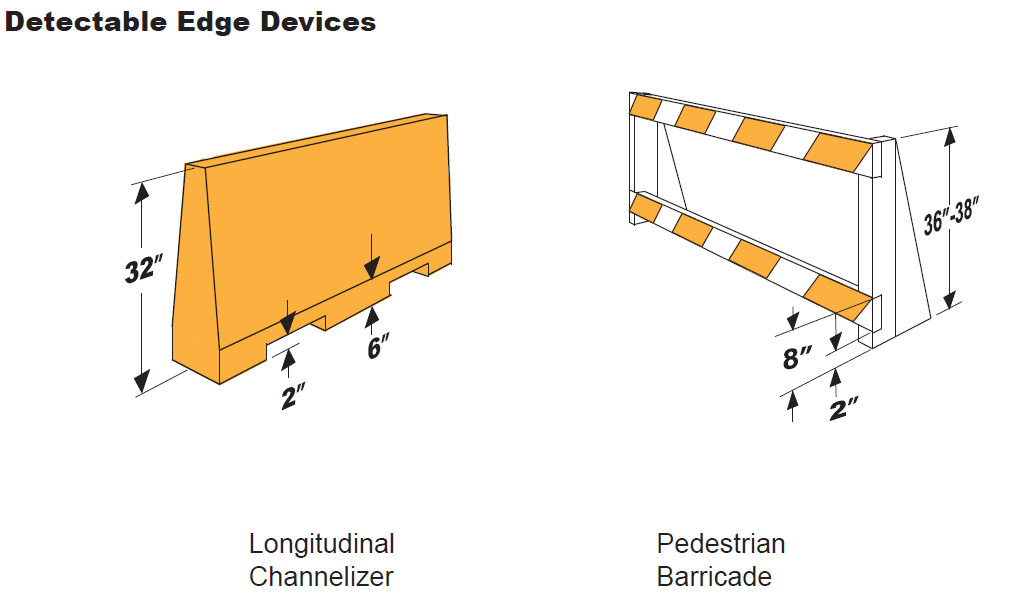
At the south edge of the sidewalk and bikeway closure, at L Street, there is now some signing, below. However, the signing and fencing do not meet ADA detectability requirements. Though there is more than one way of meeting detectability, an example graphic follows, showing a low bar across the entire width, detectable by canes used by vision impaired people. See my earlier post signs and diagrams for construction zones and construction zone solutions for more information on signing and barriers.

9th St at L St sidewalk closure signing

What would otherwise be a reasonable route and signing for northbound pedestrians is blocked by an open construction gate. This open gate was not being actively used in any way, it had just been left open. A person walking is forced to walk outside the crosswalk to get to the bypass.

9th St at L St bypass entrance and signing, blocked by construction gate

For southbound bicyclists on 9th Street at K Street, the diversion starts suddenly, pushing bicyclists into the traffic lane without warning. This is not necessary, the construction cone placed blocking the separated bikeway should not be there. This is just plain sloppiness. The bikeway could remain open, with a half block available to place signing that explains there will be a diversion and bypass ahead.

9th St blocked separated bikeway

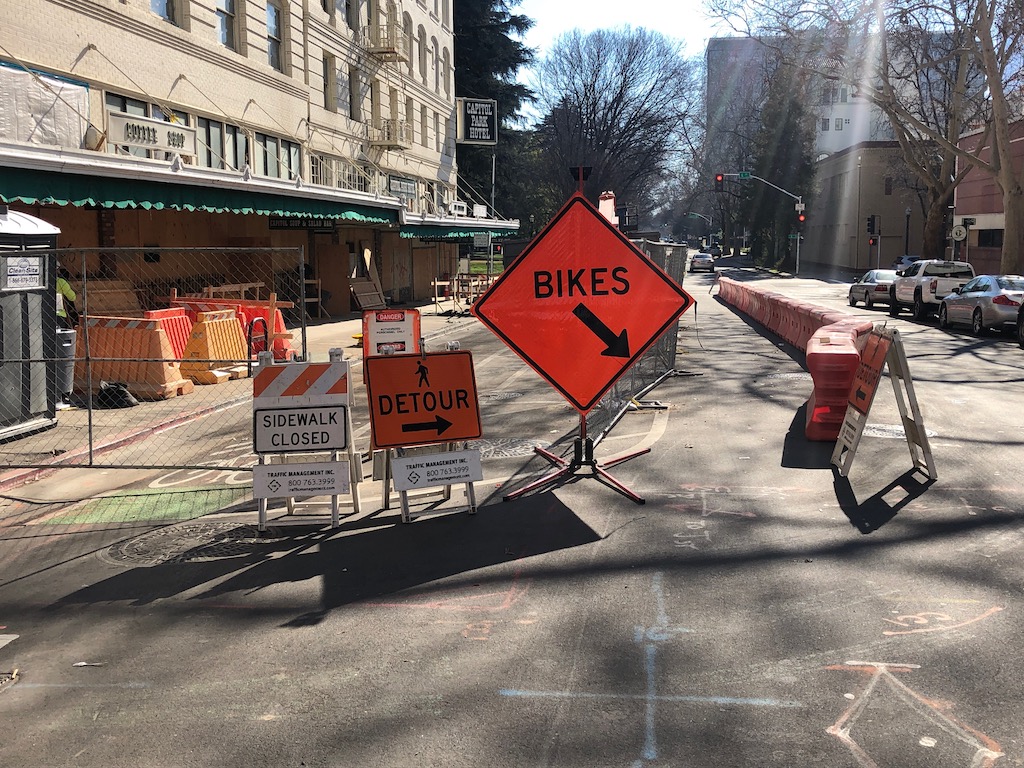
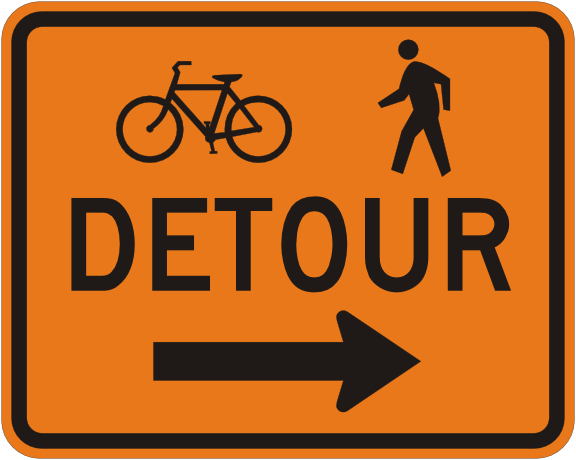
Then there is the entrance to the walking and bicycling bypass, below. The same lack of detectable barriers as in the first item also exists here. If a vision limited walker encountered the construction fencing across the sidewalk, they would have no idea where the bypass is. The ‘sidewalk closed’ and ‘pedestrian detour’ signs are MUTCD compliant signs, MUTCD R9-9 and MUTCD M9-4b respectively, but they need to be placed on or above a detectable barrier, not on sawhorses which do not meet detectability requirements. The ‘bikes’ sign is a made-up sign, and because of its size, it intrudes into the shared bike and pedestrian space. I can imagine bicyclists hitting the sign on their way into the bypass. The correct sign for the location is actually MUTCD M9-4a, shown below.

9th St pedestrian and bicyclist bypass
MUTCD M4-9a right

It took about four weeks for the city and construction company to come up with and implement a new traffic control plan, which is ridiculous. If there had been a problem with motor vehicle traffic instead of for walkers and bicyclists, it would have been solved in less than a week. And it would have been done right. Either the new traffic control plan does not really meet ADA requirements, or the signing and barricades placed do not follow the traffic control plan. Remember, this is a city project, reconstruction of Capitol Park Hotel, so not only is the city responsible for managing streets, but also for managing the construction project. Take a look at the photos, or go walk or bicycle the section of 9th Street between K Street and L Street. The sloppiness of the work is glaring. As I’ve said before, the city does not care about walkers and bicyclists, and is not fulfilling its legal responsibilities.

Why is that I, a private citizen, continually have to tell the city when they are doing things wrong, and how to do it right?