serious concerns about Broadway

The Broadway Complete Streets project, to reallocate the street from 3rd Street to 24th Street, is underway. I have been walking this section recently, and I see several things that greatly concern me. To be honest, I was not paying much attention when this project went through public review, and attended only one meeting. I had not looked closely at the project documents. The page linked above confuses me. There are no final design documents, yet I have several documents more recent, including one that says final. Did the city unlink these newer documents? Lose them?

It appears from the work I see being done currently, that parking will be preserved along the entire length of the project. While this makes complete sense where there are small businesses, there are also several blocks where there are large buildings that provide off-street parking, or fast food chain restaurants that that have ample off-street parking. Parking can be a good thing, but not when it takes the place of wider sidewalks and sidewalk buffers.

One positive is that vertical curbs are being installed, replacing the rolled curbs that exist along much of the street at this time. But a negative is that apparently curb lines are not being moved as part of the project, meaning that under-width sidewalks and under-width sidewalk buffers will remain so. A diagram from the planning process shows eight foot sidewalks.

diagram of proposed roadway allocation

Here is an actual constructed section, north side between 18th and 19th Streets. The sidewalk is six feet, and a completely useless sidewalk buffer of about 18 inches is included. A sidewalk buffer this narrow cannot provide planting space, and does not provide any physical or visual separation from the street. The street width could have been reallocated to a wider sidewalk, and a sidewalk buffer wide enough to host trees, but it was not.

photo of Broadway narrow sidewalk and narrow buffer new construction
Broadway narrow sidewalk and narrow buffer new construction
Read More »

SacCity sidewalk design standards

I’ve written about existing sidewalk buffers or lack thereof (sidewalk buffer widths), and a solution for areas without sidewalk buffers (street trees in the parking lane), and now on to sidewalk standards. Sidewalk areas are composed of the sidewalk, sidewalk buffer (also called planting strip or furniture zone), and pedestrian scale lighting.

Design criteria:

  • All new or reconstructed streets will have sidewalks, sidewalk buffers, and pedestrian scale lighting
  • Reallocated or mitigated streets will have sidewalk buffers added if right-of-way can be reallocated
  • Sidewalk areas may also include sidewalk-level bicycle facilities
  • Attached sidewalks (sidewalk adjacent to the curb) will not be used for new or reconstructed streets
  • Sidewalk width:
    • Minimum sidewalk width will be six feet in areas of 85% of more residential
    • Minimum sidewalk width will be eight feet in all other areas
    • Sidewalks must be completely free of obstructions, encroachments, or driveway aprons into their minimum width
    • Sidewalks adjacent to and within 1/8 mile of schools will be a minimum of 8 feet; sidewalks used for drop off/pickup will be a minimum of 10 feet
  • Sidewalk buffer width:
    • Minimum sidewalk buffer width will be eight feet in order to accommodate a canopy of mature trees; if a lesser width is available, parking areas will be considered for tree placement
    • Sidewalk buffer may also accommodate street related infrastructure and utilities, street furniture, bike and scooter parking, dining areas, bioswales, and other related uses
  • Sidewalks will receive priority use of right-of-way; travel and parking lanes, and bike facilities, will be placed in remaining right-of-way
  • Bus stop amenities will not be placed within the sidewalk minimum width; the sidewalk buffer may serve as clear sidewalk abutting the curb, with appropriate design and transition; transit amenities may also be placed on transit islands away from the sidewalk and sidewalk buffer
  • Sidewalks will be continuous over driveways and alleys, without interruption of design or materials
  • Pedestrian scale lighting will be provided along the street length; motor vehicle scale lighting will not be considered sufficient; intersections and crosswalks may be lit with motor vehicle scale lighting

Design diagrams:

  • Sidewalks of six or eight feet, with sidewalk buffers of at least eight feet
  • Tree planters or wells in the parking lane or curb extensions
  • Alley entrances and sidewalk crossings of alleys
  • Driveway crossings of sidewalk, with design indicating walking priority
  • Bus stop amenities (benches, shelters, etc.) with a sidewalk area clear of encroachment
  • Transit island diagram here or in the transit section
walkers at Capitol Park sidewalk N St & 15th

sidewalk buffer widths

One of the elements of street design is the width of sidewalk buffers, and how these are presented in design standards. The sidewalk buffer is the area between the curb and the sidewalk. The city calls sidewalk buffers ‘planting strips’, and this is often how they are used, but it is not the only use, and in more urban areas, there are often multiple uses of the sidewalk buffer.

I did a sampling of sidewalk buffer widths in the central city, and a few other parts of Sacramento. I am not claiming any insight into the overall pattern. The city does not have a publicly available database or GIS layer of sidewalk locations and widths, let alone locations and widths of the buffers. I have heard rumors that they are developing one, but I have been hearing that rumor for the last ten years, so I’ve become doubtful.

Typical buffer widths in the central city range from six feet to nine feet, with seven feet being the most common. With huge mature trees, the narrower buffers are too narrow of the trees, and the sidewalks have had to be modified. The photo below shows an example, and these situations are everywhere.

sidewalk narrowed for tree roots, Q St near 14th St
Read More »

sidewalk-level bikeways

Given the issues raised by the need for wider bikeways to accommodate wider devices and passing, the topic of my bike lane widths post, I am starting to think more and more about sidewalk-level bikeways, where the bikeway is at the same level as the sidewalk, and not at street level. The street-edge curb provides a good separation between motor vehicles and bicyclists and walkers (not perfect, drivers do ‘accidentally’ or intentional cross curbs). I am concerned that as street-level bikeways become wider, there will be more and more motor vehicle intrusions.

Here are are two diagrams from the Portland Bureau of Transportation (PBOT) Pedestrian Design Guide (2022), page 28. The first uses a tactile divider between the sidewalk and bikeway, the second a buffer similar to the regular sidewalk buffer, but with reduced width due to the greater separation from motor vehicle traffic as compared to regular sidewalks. Note that the street classification system that PBOT uses is interesting, but probably more than is needed in Sacramento for the Street Design Standards update.

Freeport trees and sidewalk buffers

Another post on the Freeport Blvd Transportation Plan. See the category Freeport Blvd for others.

So, given the need for trees to shade sidewalks along Freeport, where do they go? The answer is in the sidewalk buffer or planting strip. At one existing location along Freeport, there is an example of street trees in a sidewalk buffer, where the new Raley’s shopping center is. The photo below is from the photo essay. I don’t know whether the city required the developer to put in sidewalk buffers and wider sidewalks, or whether the developer knew this was the right thing to do and did it on their own. In any case, this is the only part of Freeport that has them, other than a short section along the airport north of Blair Ave.

The one situation in which sidewalk buffers may not be appropriate is where buildings come to the curb in dense retail areas. But there are virtually no instances of this along Freeport. Almost all buildings are set back from the sidewalk a little, or a lot. In several cases there are massive parking lots adjacent to the sidewalk, creating the kind of place where no one wants to be. So buffers and trees at least mitigate the blandness to some degree.

Freeport Blvd sidewalk buffer and trees
sidewalk buffer and trees along Freeport Blvd at Raley’s

As with any post, I look for example photos and diagrams. So I searched Google for ‘sidewalk buffer’. Lo and behold, the second item is my own post about this! It is experiences like this that make me realize the value of this blog, when other people are using my advocacy work in their advocacy work.

So, so rather than re-write the post, I’ll link to it here: sidewalk buffers. I encourage you to take a read. Trees, and the sidewalk buffers that would allow them, are probably the most important aspect of Freeport Blvd, and the most important topic that the city has neglected.

Walkable Sacramento #4: sidewalks

For a series on walkability, you might think sidewalks would come first, not later. The reason they are not first in the series is that sidewalks, relative to other issues, are in decent shape. Yes, vast areas are missing sidewalks, and in many areas that have them, they are not well maintained. But looking at the whole issue of walking, it is crossing roadways that is most dangerous and unpleasant, not walking along roadways.

I do not believe that low speed, low volume residential streets need sidewalks. It is OK that some have them, and it is OK to require them in new developments (to the degree that it is OK to have new developments, which is to say, this should be irrelevant because there should be no new developments). But to build sidewalks on quiet streets that do not have them is not the best use of funds.

The city has a lot of semi-rural areas without sidewalks. Do they not deserve sidewalks? Where sidewalks would provide a route to key amenities such as grocery stores and schools, sidewalks should be provided, or at least paved asphalt paths adjacent to roadways. Too many people die walking on the shoulders of rural and semi-rural roads, so shoulders are not a solution, there must be either sidewalks or separated paths.

The most important point of all about sidewalks is the first bullet, that it is the responsibility of the city to maintain sidewalks. It is irrational to propose that roadways are maintained by the city, but sidewalks are not. If this belief and legal fabrication persists, Sacramento can never be a walkable city.

  • Recognizing that sidewalks are an integral part of the transportation network, sidewalk repair will be the responsibility of the city and not of property owners, except where trees owned by property owners, or disturbance, change or widening is initiated by the property owner.
  • All streets with an ADT over 5000 will have continuous sidewalks of no less than four feet clear path, within five years.
  • All streets with an ADT over 10,000 will have a continuous sidewalk of not less than six feet clear width, within two years.
  • All streets with an ADT over 20,000 will have a continuous sidewalk of not less than six feet clear width, with a buffer of not less than six feet, within six years. Parallel multi-use paths can be used to meet this requirement.
  • Utility poles and other obstructions will not restrict sidewalk width below the minimums above, and where these exist, will either be removed or sidewalks widened. The expense will be borne by the utilities, not city taxpayers.
  • All sidewalks will be maintained in a state of good repair by the city. Any cracks with a vertical displacement of more than one inch will be fixed within two months. The city will evaluate and implement flexible sidewalks for locations with ongoing tree root heaving issues.
  • Timely leaf removal from sidewalks will be the responsibility of the property owner, except for sidewalks with a daily use of over 5000, which will be the responsibility of the city. 
  • All development which requires new sidewalks (greenfield development) will fund a maintenance fund so that existing city residents are not financially responsible for sidewalk maintenance on new sidewalks. 
  • Sidewalks will be continuous across alleyways, in concrete and not asphalt. Every alleyway that is reconstructed or repaved will have this implemented.

sidewalk buffers

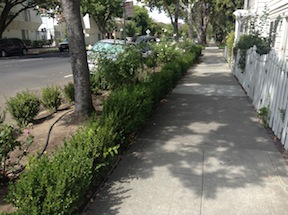
garden sidewalk buffer on Q Street

The purpose of sidewalk buffers, also called planting strips, is to isolate pedestrians from moving motor vehicles, where parking does not provide a sufficient buffer. Sidewalks adjacent to the curb are called attached sidewalks, while sidewalks with a buffer are called detached sidewalks.

Traditionally all residential, collector, and arterial streets had buffers. Retail areas often did not, in order to make getting from the car to the sidewalk more convenient.

Modern suburbs, however, usually eliminated the buffer strip from all streets in order to maximize the area available for development and roadways. Pedestrians do not like to walk next to fast traffic. In part, the elimination of buffers is why there is much less walking in the suburbs. The lack of buffers also makes an area look harsh, with a bland expanse of pavement rather than the welcoming and beautiful strip of nature. The planting strips and their vegetation require maintenance, and responsibility for those areas is another question of responsibility.

Read More »