transportation and May is Bike Month thoughts (guest)

This is a guest post from reader Sonya Hendren. Sonya is a bike advocate and educator in the Sacramento region.

In looking back at this year’s May is Bike Month, two comments during meetings have left an impression, informing my current opinions on the efficacy of our bike advocacy.

During a neighborhood association meeting about walking/biking safety, a panelist emphasized that transportation projects are funded by competitive grants. It’s a fixed-sum game: if Sacramento gets a grant, all the losing cities’ projects are left unfunded. If another city’s project wins, Sacramento’s project doesn’t happen, at least not in this funding cycle, from this source. Of course our first instinct, mine included, is to cheer for Sacramento; we get funding, we do projects.

My revelation is that I don’t want Sacramento to win competitive grants. In the Freeport Blvd Transportation plan, the city never considered a road diet (reduction in lanes), despite it being a prominent request during the community input phase, because their goal is to maintain previous ADT (average daily traffic count.)The city works to maintain current levels of private-car use. The city’s Climate Action and Adaptation Plan, companion document to the General Plan, reduces the MCCC (Mayors’ Commission on Climate Change) goal of 30% Active Transportation, down to 6%. Under these practices and policies, Sacramento would use transportation funding to further cement car-dependency. Grant funding would be better spent in another city that is actually trying to shift transportation mode share away from private-cars, trying to reduce VMT (vehicle miles traveled). The project in another city would do more good to Sacramento by serving as a positive example, than spending the money in Sacramento under Sacramento’s current practices and policies.

Second, during a debrief-and-next-steps meeting on school “bike buses,” I learned that after Safe Routes to Schools programs end, feedback of continued walking/biking is the rare exception, not the norm. The norm is that Safe Routes to Schools programs are funded for one to three years, they get a group of kids walking or biking during those years, and when the funding ends, all the families go back to driving. Current infrastructure and incentives are such that without a paid person there helping, even students/families who have been taught how to walk/bike to school and practiced it for years, do not. That’s so discouraging: if “holding people’s hands,” not just teaching them the routes, but traveling those routes with them regularly, sometimes for years, doesn’t convert people to using the routes, how can any of our encouragement projects have any affect??

Read More »
SacATC recommendations supported by city council

Agenda item 11 on the Sacramento City Council agenda last night (2023-08-29) was ‘Active Transportation Commission 2022 Annual Report Regarding the Status of Walking and Bicycling in the City of Sacramento and Activities of the Commission‘. Twenty members of the public and organizations spoke in support of the recommendations, no one against, and all council members spoke in support. Comments of both the public and council focused on the need for more funding to make infrastructure changes to our roadways, in order to fix the unsafe roadway network we have.

I have written twice before about the SacATC recommendations: support SacATC status on walking/biking (now!) and SacATC meeting Jan 19 with report, Northgate, Freeport. I recommend you read the full set of recommendations. Do they go far enough? No. Do they miss some important issues? Yes. But these recommendations are beyond anything that the city has considered before, and deserve the support of everyone in the city (and county and region).

Several representative from Land Park talked about how much they loved the slow streets in the park, and how disappointed they were when the city nixed them. They want them back! So do a number of other speakers. Grace Bartley talked about how she was hit by a driver while riding her bike to McClatchy High on Freeport, probably the most impactful speaker of the evening. Several speakers mentioned the imperative to control motor vehicle speeds, by whatever means necessary. (The ultimate solution to this issue is not any action of the city, but speed-limited motor vehicles.)

Eric Guerra mentioned again, as he has other times, that many parents seem to care about only their own children, once their children are safely dropped off at school, they speed away, endangering other people’s children. And some not ever their own children, encouraging their kids to run across the street at drop-off and pick-up. There was general agreement that there needs to be more money in next year’s budget for active transportation, though no one said what would be cut to accomplish that. SacATC had wanted their recommendations to go to the council for consideration in adopting this year’s budget, but a roadblock (intentional?) was thrown up by requiring that the report go first to the Personnel and Public Employees Committee, which meant that it did not come to the council until August. Katie Valenzuela suggested that Public Works come up with guidelines for citizen-initiated ‘tactical urbanism’ projects so that quick-builds can happen now, when the city does not have the funds or materials or personnel to complete in a timely manner. Jennifer Donlon Wyant was open to the idea, but I’m sure it would get nixed in Public Works. Darrell Steinberg talked about his proposal for a housing and transportation measure in 2024, that would provide some of the additional funding needed. This will be the topic of my next post.

I spoke along with the other 19 people, and my comments are below:

I strongly support all of the recommendations included in the 2022 report from the ATC to the city council. In particularly, I would like to address two of those, 3. Develop a Citywide Safe Routes to School Program, and 4. Finalize the Construction Detour Policy. 

I was the Safe Routes to School Coordinator for San Juan Unified for 10 years. Having that position funded through federal and ATC grants, and district funding, allowed the completion of many infrastructure project though collaboration with the City of Citrus Heights and Sacramento County. Most of these would not have occurred without the position. We also offered an extensive program of walking and bicycling education to students, and to the community. Civil Thread/WALKSacramento was a key partner in these efforts. I recommend that Sac City schools and the city create and fund a Safe Routes position to head an ongoing program in the support of students and their families.

It is long past time for a policy to accommodate walkers and bicyclists during construction projects. Nearly every construction project that has occurred in the central city has violated ADA guidelines, which require accommodation. City staff is on record as saying that walkers and bicyclists would be accommodated when it does not remove capacity from motor vehicles. So every project presents dangers to walkers and bicyclists. The are poorly signed and do not provide detectable barriers. I spend a lot of time reporting these violations, and over time many though not all of them are corrected. However, it should not be the responsibility of citizens to hold the city to ADA requirements. A progressive city would develop traffic plans that accommodate all travel modes, and would then inspect and enforce those plans.

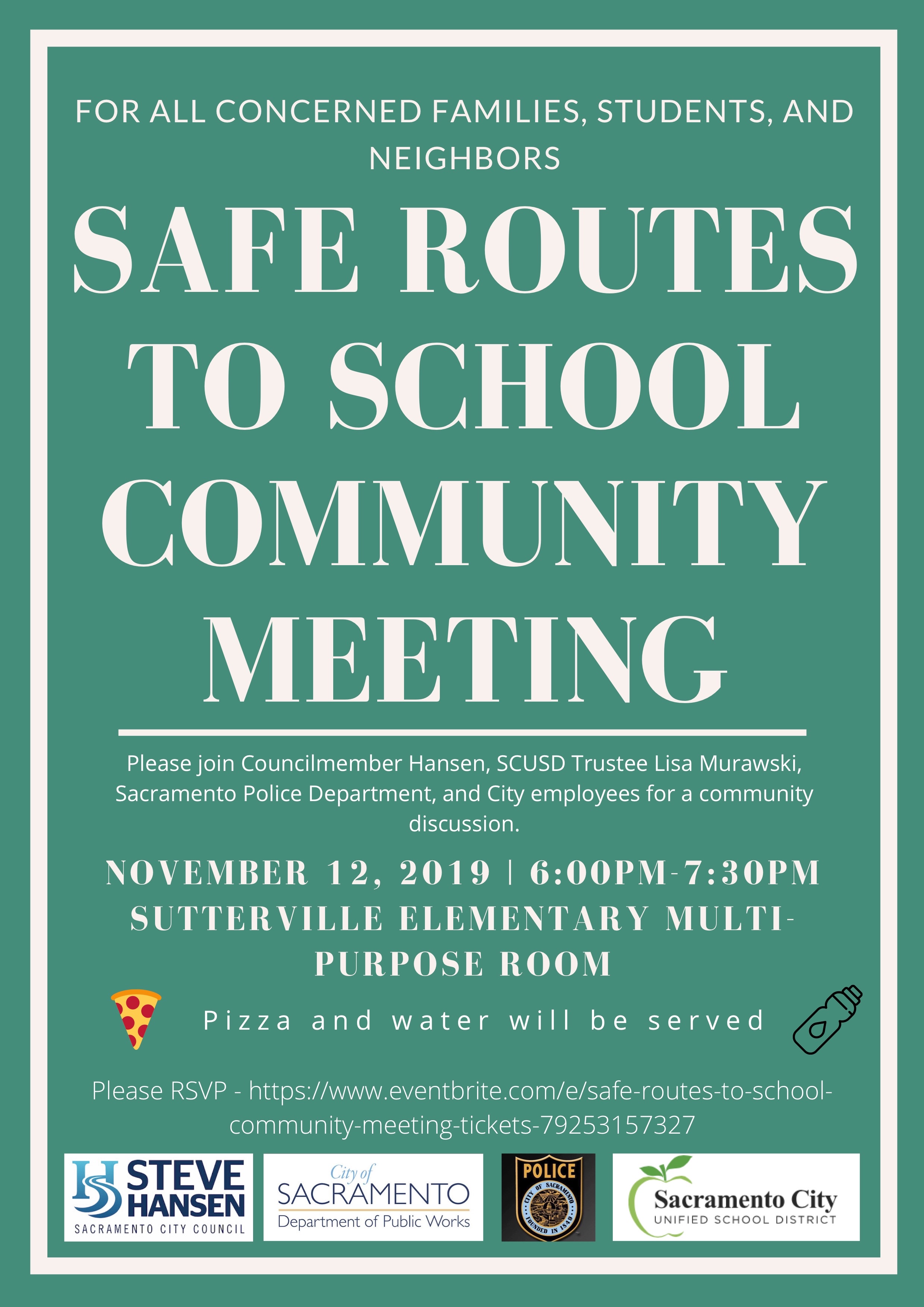
Safe Routes to School Community Meeting Nov 12 (Sutterville)

From Councilmember Steve Hansen’s newsletter: 

Please join Councilmember Hansen, SCUSD Trustee Lisa Murawski, Sacramento Police Department, and City employees for a community discussion where the main topics include traffic safety and traffic enforcement. Our office will provide pizza and water (while supplies last). Please RSVP through the Eventbrite link pasted below. We look forward to hearing your thoughts.

Please click here to RSVP for the Community Meeting. 

If you have any questions, please contact our office and ask for Morris Thomas (916) 808-7004.

https://www.eventbrite.com/e/safe-routes-to-school-community-meeting-tickets-79253157327

Bike to School Day

Mariemont Elementary, full bike racks on Bike to School Day

Today, May 9, is the first official Bike to School Day (BTSD).

Mariemont ES in San Juan USD had 78 bicyclists, all wearing helmets.

I’ll be posting more local information as it becomes available, but here are some national posts to get started.

League of American Bicyclists blog: Happy Bike to School Day

Fastlane blog (US Department of Transportation Secretary Ray LaHood): First-ever National Bike to School Day gets kids on two wheels–safely