SacTA Board 2025-09-11

The Sacramento Transportation Authority (STA or SacTA) Board of Directors is meeting this Thursday, September 11, at 1:30 PM in Sacramento County Board of Supervisors chambers, 00 H St, Ste 1450, Sacramento.

Comments may be made in person, or via email ahead of time to BoardClerk@saccounty.gov. If you want board members to see your comment before the meeting, send it at least 24 hours in advance.

The meeting may be viewed online at Metro Cable 14. It will be the video on the home page, at the time of the meeting. Comments may not be made through the live stream.

For more information about the SacMoves Coalition presentation, see SacMoves to present at Sacramento Transportation Authority. I strongly encourage people interested in transportation and transportation funding attend the meeting, or at least view it online. SacMoves Coalition is being offered the opportunity to present before the stakeholder engagement process has started because it is a coalition of 25 organizations with interests in transportation funding and related issues.

Documents not linked below are available on the SacTA website: https://www.sacta.org/2025-09-11-board-meeting.


Agenda (pdf)

COMMENT ITEMS

  1. Comments From The Public Regarding Matters Not On The Agenda

CONSENT ITEMS

GENERAL

  1. Approve Action Summary: August 14, 2025, Sacramento Transportation Authority Governing Board Meeting
  2. Adopt Resolution Amending STA Personnel Rules And Regulations For The CALPERS 457 Loan Program Provision

MEASURE A

  1. Receive And File A Contract With Lucas Public Affairs For Community Listening Sessions On Transportation
  2. Amendment To Ongoing Annual Programs Memorandum Of Understanding – Reporting Frequency Change ◄
  3. Receive And File Capital Project Status Reports Fourth Quarter Fiscal Year 2024-25
  4. Receive And File Measure A Ongoing Programs Annual Report – Fiscal Year 2024-25

SACMETRO FREEWAY SERVICE PATROL

  1. SacMetro Freeway Service Patrol Zones 3, And 4 Request For Bids Result And Authorize The Executive Director To Award And Execute Contracts ◄

SEPARATE ITEMS

  1. Receive A Presentation Regarding Coordination Of State Transportation Improvement Program And The Results Of The Four-County State Funding Program
  2. Receive A Presentation From The SacMoves Coalition On Principles To Consider For Future Ballot Measures (note: the SacMoves presentation is available: SacMoves presentation for STA 2025-09-11
  3. Executive Director’s Report
  4. Comments and Reports From Authority Members
    • Capital Area Regional Tolling Authority (CARTA)
    • New Transportation Funding Subcommittee
    • STA’s Role in the Region Subcommittee

Is sales tax for transportation the wrong approach?

There are three ideas for transportation funding floating around, for the 2026 ballot, though none have been formalized. All rely on sales tax.

  • Sacramento Transportation Authority (SacTA) may create a ballot measure to fund transportation. It would be in addition to the existing Measure A, and might fund transportation infrastructure for infill housing, which has not been done before. As an agency-sponsored measure, it would require 2/3 vote to pass.
  • Sacramento Metro Rail and Transit Advocates (SMART) and Mayor Darrell Steinberg have drafted measure that would fund active transportation, transit, and housing. It would probably be for the county, but could be just for the City of Sacramento. As a citizen initiative, it would require only 50% + 1 to pass, a much more achievable vote.
  • SacRT it considering a measure for transit and related active transportation that might cover only a part of Sacramento County, the more transit-supportive part, probably the cities of Sacramento and Elk Grove. As an agency-sponsored measure, it would require 2/3 vote to pass.

Sales taxes are regressive, meaning that low-income people pay a much larger percentage of their income to sales tax versus high-income people. Most organizations which lead with equity are opposed to further sales tax increases, feeling that enough is enough.

In Sacramento County, with a strong anti-tax voice in the low density unincorporated county, it is difficult though not impossible to reach the 2/3 threshold. The 2016 transportation sales tax fell short of 2/3. Measures to fund schools districts are more likely to pass. A complicating issue is that Elk Grove recently passed a sales tax measure to fund many purposes, one of which is transportation. Folsom and Rancho Cordova have sales taxes for which it isn’t clear to me whether any goes to transportation.

General purpose sales tax measures, which may list uses but are not required to follow those lists, only require 50% + 1 to pass. That flexibility is both a feature and a danger, since a government may shift sales tax income from what they said it would be spent on to other purposes.

Though I have not heard parcel taxes being discussed, they are another source of funding, though they are also regressive because they are a flat rate per parcel, not based on the value of the parcel.

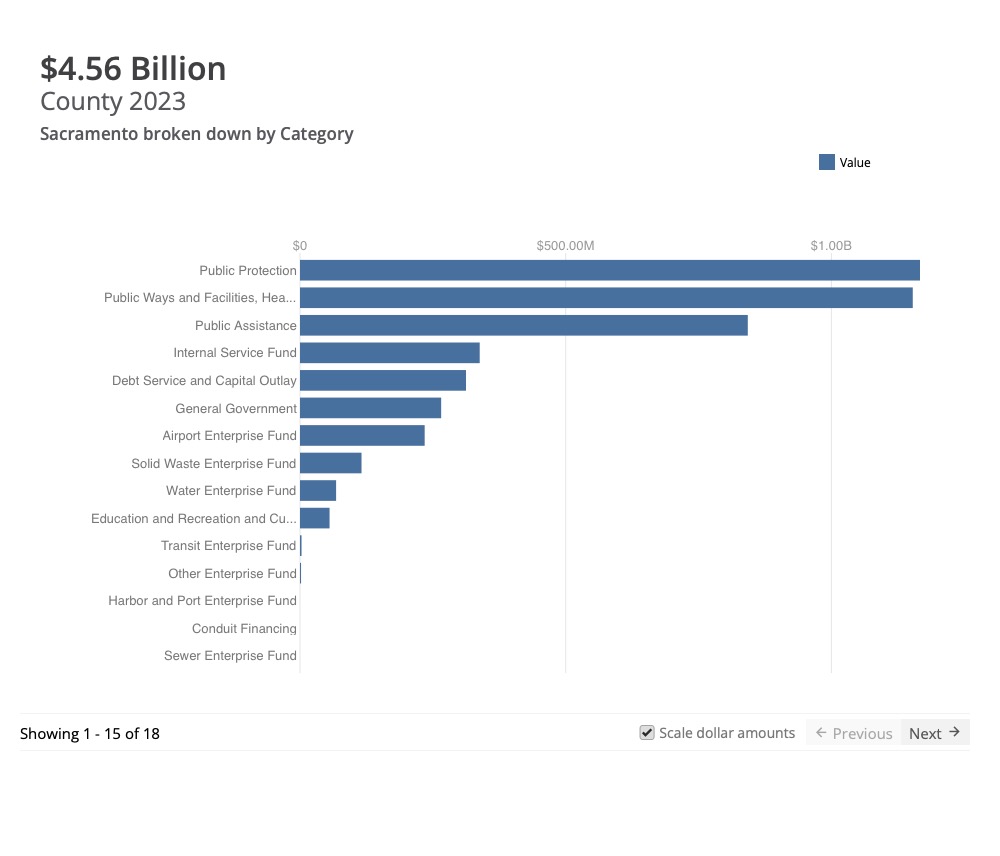
Two other types of tax which are progressive, meaning that high-income people pay a higher percentage of income than low-income people, are income tax and property tax. Income tax does fund transportation at the state level, but income taxes are not available to cities, counties, and special districts. Property tax can fund transportation, though due to Prop 13 which limits property tax, it mostly goes to schools and public safety. For Sacramento County in 2023, the chart below shows allocations. The ‘Public Ways and Facilities, Health, and Sanitation’ category goes mostly to Health, with Public Ways and Facilities being less than 20% of that category. This chart does not include school districts within the county, which also rely on property tax.

Transfer taxes, which are based on the value of a property when it is sold, are progressive. These have been discussed in a number of places in California, though not locally so far as I have heard. I am not aware of any existing transfer taxes that fund transportation, though they do fund a number of other government functions. The state levies a transfer tax throughout the state, and that income goes into the general fund.

Any county, city or special district can bond against property tax, meaning that they can expend money now and pay it back over time from future property tax income. Again, Prop 13 limits the usefulness of this by suppressing property tax income, but does not preclude it. If Prop 5 on the 2024 ballot passes, cities, counties, and special districts will be able pass bond measures with a 55% vote rather than 2/3 vote, though the proposition raises the bar on transparency and types of expenditures. Though Prop 5 is intended primarily to fund housing, it could fund transportation, and there is a logical nexus with transportation that supports housing.

For other posts on transportation funding, see category Transportation Funding.

tolling authority at SacTA

At the Sacramento Transportation Authority (SacTA) board meeting today, SACOG gave a presentation on the tolling authority and governance, as part of agenda 9, Receive Information on the creation of the Capital Area Regional Tolling Authority (CARTA) and the Yolo 80 Managed Lane Project and provide direction as appropriate. The two presentations, one by SACOG staff and the other by Executive Director Kevin Bewsey on possible SacTA role, are available: SACOG, SacTA role. SACOG estimated in the current MTP/SCS (not the update being worked on) that about 70% of the expected tolled lanes will be in Sacramento County. See map at bottom.

In my public comment, I spoke on these points, similar to the points I’d also made at the SACOG Transportation Committee meeting:

  • Support creation of regional tolling JPA
  • Support governance options with one Caltrans voting member, but not two
  • Support inclusion of Sacramento Transportation Authority as the Sac county agency
  • Tolling advances user pays concept, which transportation advocates support
  • If the JPA had been in place, Fix50 project would have had toll lanes rather than HOV: HOV lanes don’t work for management because they are routinely violated
  • Support does not indicate that I support adding lanes in Yolo, but if lanes are added, they should be tolled
  • Questions about JPA membership, board members and voting are probably best answered by proportional representation based on tolled lane miles rather than county representation, which is more consistent with citizen representation; this would also entice counties to add or convert tolled lanes so they could be part of the process and benefits
  • Conversion of HOV lanes and general purpose lanes to tolled lanes will be required in the future to maintain our very expensive highway system, so this is a start

Brian Abbanat of YoloTD also spoke.

Several board members spoke, and to summarize and paraphrase their comments:

  • Rich Desmond and Eric Guerra supported a lanes miles voting idea
  • Karina Talamantes expressed concern but seemed satisfied by the answers
  • Bret Daniels expressed the standard ‘I don’t want to pay anything’ and tolling is for rich Tesla people
  • Phil Serna asked about safety of adjacent lanes, SACOG responded that safety can be part of the infrastructure and/or tolling design; I don’t think the idea of separation on the causeway has come up before; also asked about detection and enforcement
  • Eric Guerra said benefit or presentation is raising awareness
  • Patrick Hume actually said that eventually we will need to toll not just lanes but entire facilities

Overall, the concerns of the board were mainly that Sacramento County be treated equitably in terms of tolled projects, design of tolls, and distribution of toll revenue; several people also commented that the focus on excess revenue may be premature since it isn’t clear that there will be excess revenue, and some of it is already dedicated to mitigation measures.

Kevin Bewsey presented on SacTA’s role in the JPA, including how votes would be handled.

Though no motion was made on the issue, nor any vote taken, the consensus of the board seems to be:

  • Support for creation of the JPA
  • Support for creating tolled lanes in Sacramento County
  • Yes to SacTA being the agency for Sacramento County
  • Yes to appointing members of the SacTA board to the JPA board, probably with one county representative and one city representative (under the staff recommended governance structure, SACOG would appoint another from its own board, and from Sacramento County or a city within)
  • Concern about the governance model treatment of Sacramento County, and concern about a voting methodology that is equitable for Sacramento County, but willingness to allow some uncertainty here for the time being (the voting document created by SACOG was not presented, but was discussed since several SacTA board members are also SACOG board members)
map of potential tolled lanes in the SACOG region

Note: I am unsure of the source of this map. It was referred to as being in the 2020 SCS, but I don’t find it there. Apologies for the low resolution, it was extracted from the SACOG presentation today, not from an original source.

For additional posts on managed lanes in general, this regional tolling authority, and the Yolo 80 project, see category ‘managed lanes‘.

followup on SacTA hears voter survey

I attended the Sacramento Transportation Authority (SacTA) last Thursday (2023-09-14). Though I really wanted to complain about the continuing funding of the climate arson Capital Southeast Connector, I held my tongue, to concentrate on the voter survey presentation. The presentation was a brief version of the whole document (see SacTA hears voter survey), highlighting the most critical parts. The jist of the presentation is that a measure on the 2024 ballot would probably fail at about 55%, well below the 67% necessary for passage of an agency-sponsored measure.

The SacTA board members accepted the bad news, and were discouraged, but seemed fairly fatalistic about it. There was a recognition for some board members and a staff person that the failed 2022 Measure A (‘citizens measure’ sponsored by developers) had lessened the chances for future transportation measures even though this one was not sponsored by SacTA. A board member expressed hope that maybe a new and true citizen measure might come up, and other board members nodded. There was general agreement that another ‘same old, same old’ measure was never going to pass. There was also voiced resistance from at least two board members against any taxes, though that is not the consensus of the board. The item was up for presentation and discussion, not for decision.

I encouraged, and several board members supported, looking in more detail at Mayor Steinberg’s proposal once there is enough detail to clearly understand.

My statement to the board was (not word for word):

  • Transit needs more funding in order to meet air quality and GHG reduction targets in MTP/SCS, so doing nothing is not a good answer. SacRT is the lowest funded transit agency in California for a city of its size.
  • Low public support is due in part to the horrible 2022 Measure A, which the public recognized was designed as a gift to greenfield developers and freeway builders, and did not address the transportation needs of the county
  • The public has never seen a measure or proposed measure that was designed to establish and meet goals for transportation investment, so they are leery of any new measure
  • Mayor Steinberg’s proposed housing and transportation measure is something different, it addresses real needs in the county, with 1/3 to affordable housing, 1/3 to transit, and 1/3 to active transportation and safe streets
  • If the public were aware of an innovative and progressive measure, I believe voters would be much more supportive
  • Though no organizations have formally come out in favor of the mayor’s, it is likely that support would be present. At the same time, if another business as usual measure is proposed by SacTA, it will be opposed. The transportation advocacy community knows how to kill bad measures, and will again.

SacTA hears voter survey

This afternoon (2023-09-14, 1:30PM), the Sacramento Transportation Authority (SacTA) will hear from consultants about a survey of likely voters and attitudes toward a transportation sales tax measure. Agenda item 13 is available (the entire agenda packet is so long that it is hard to find this item; this is a low resolution version).

The survey indicates that only 54% would vote yes, which is less than the 67% required for passage, assuming that the measure is sponsored by SacTA, and not a citizen initiative.

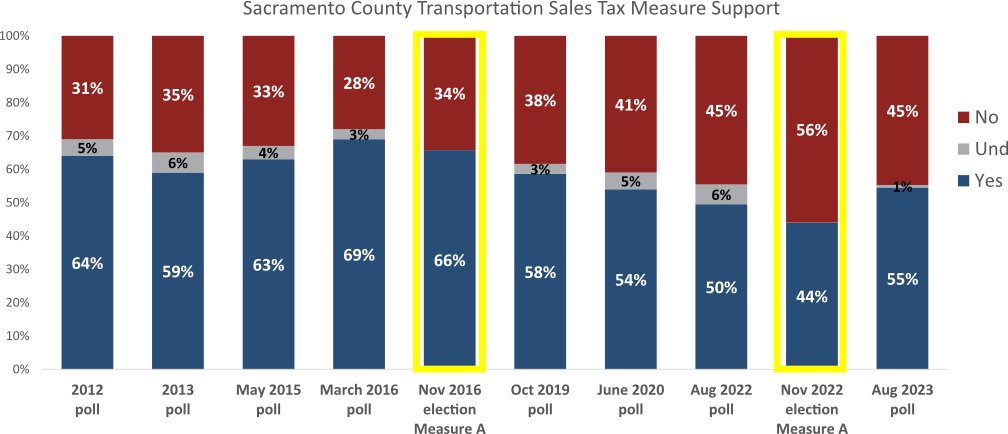
There are a lot of interesting bar charts, in the presentation. Below is just one, showing the level of support in various surveys and actual elections over time. I recommend you take a look at the whole document to see what jumps out for you.

bar chart showing Sales Tax Measure Support over time
Sales Tax Measure Support over time

The presentation does not really address what I think is a key factor, which is the cynicism developed by voters over time when the same failed policies get presented again and again. The 2016 Measure A, the withdrawn 2020 Measure A, and the landslide failure of 2022 Measure A presented transportation investments that are more of the same: more highways, more interchanges, more roadway capacity, more air pollution, more greenhouse gas emissions. The voters have never been offered an alternative that does not represent the interests of traffic engineers who always want more: more cars, more concrete, more ribbon cuttings, more money. Particularly after the 2022 developer-sponsored ‘citizen initiative’, voters don’t trust that sales taxes will be spent on what they actually need for livability and economic vibrancy. 2022 Measure A was just more money in the pockets of greenfield developers and highway builders. Money out of the voters pockets.

But there is now an alternative, Mayor Darrell Steinberg’s proposal. I wonder if that were presented to the public, what the level of support would be. More about that in the next post.

Measure 2022: SacTA buys in

The Sacramento County Transportation Maintenance, Safety, and Congestion Relief Act of 2022—Retail Transactions and Use Tax (Measure 2022) by the Committee for a Better Sacramento came before the Sacramento Transportation Authority (SacTA) last week, 2022-07-27.

Agenda item 6 was to have the authority accept responsibility for implementing the measure if it passes in November. This item did not generate much discussion, and passed unanimously. I will note that the measure sets up a gotcha that will be very difficult for the authority to work through – it basically says that if a project sponsor claims that a project meets air quality criteria, they do not have to prove that it does, and may proceed to spend tax funds on it, no matter what anyone else says. Not only will this likely make it impossible for the SACOG region to meet the greenhouse gas (GHG) reduction target of 19% set by the state, but likely make it imperative that other projects both in Sacramento county and the other five counties in the SACOG region make up for (mitigate) the GHGs generated by the project. This is largely about the Capital Southeast Connector, but applies to every capacity expansion project in the measure.

Agenda item 7 (presentation), to direct the SacTA Executive Director to negotiate an memorandum of understanding (MOU) with SACOG that would set us criteria for having SACOG review the GHG impact of the entire measure, using SacTA funds (presumably Measure A funds, since tax collection would not start until January 1 if the measure passes). A review would also be done by a third party, not specified in the MOU, but likely a consultant more amenable to discounting the GHG contribution of roadway expansion projects. SacTA or the third party may challenge the SACOG analysis, but the MOU doesn’t make clear what happens then. It is worth noting the several SACOG board members, particularly David Sander of Rancho Cordova, who is also, conveniently, on the board of the Capital Southeast Connector JPA, said the the SACOG analysis of the impact of the connector on GHG and the likely failure to meet the target, was so flawed that it should be discarded. Several board members accused SACOG staff of lying. I assume that the new review of the Transportation Expenditure Plan will be challenged in the same way, by the same people. It is likely that the measure, and the MOU, and the signing agencies will end up in court.

There was considerably more discussion on item 7. It passed, but with three no votes and one abstention (of the sixteen votes on the board, some of whom were absent).

The MOU is only between SacTA and SACOG. It does not include the Capital Southeast Connector JPA, nor the tax measure proponents (the greenfield developers), nor the county, nor any of the cities, nor the other five counties. So it is not legally binding on anyone beyond SacTA and SACOG. That means that the connector JPA can do what it wants to do, which is to avoid responsibility for GHG emissions.

There was an earlier promise that there would be ballot language in the pro argument that explained the MOU and what it would accomplish, but it is not clear that this is any longer on the table. The MOU itself is far longer than could be included, so if there is anything there at all, it would be a summary, and would be written by the measure proponents, hardly an unbiased source.

I will repeat that it was the specific intention of the measure proponents to bully SACOG and SacTA into supporting the measure and specifically excepting GHG-inducing roadway capacity expansion projects from air quality review. The intentional removal of the GHG language from the 2020 version of the measure (which was withdrawn before going on the ballot) makes this absolutely clear. The claim by many politicians that the measure proponents think that the MOU clarifies that the intent was not to violate GHG goals is laughable. They intended to bully, and they succeeded.

For more on the measure, see Measure 2022 posts. The use of this name and category is not meant to confuse. A lot of people are referring to this as Measure A, but the measure letters are assigned by county elections after they have qualified, so this is in no sense Measure A at this time. Sacramento County Elections has verified signatures for the measure, but has not assigned a measure letter.

Transportation tax coming?

A group calling themselves A Committee for a Better Sacramento is sponsoring a citizen-initiated ballot measure for the November election, titled “Sacramento County Transportation Maintenance, Safety, and Congestion Relief Act of 2022—Retail Transactions and Use Tax”.

Citizen-initiated measures require only 50%+1 to pass, whereas government-initiated measures require 2/3 to pass. So this is an effort to pass the Sacramento Transportation Authority ‘Measure B’ which failed in 2016 and the ‘Measure A+’ which was never put on the ballot in 2020 because research indicated it would also fail.

You can see the proposed measure. It may also be useful to look at just Exhibit A: Expenditure Plan.

This is the first in what will be a series of posts on the measure, which I’m giving the category of Measure 2022. Search for category Measure 2022 to see the posts as they are added.

How to fund transit in Sac county

This post is a follow-on to three previous posts, in particular:

and many other posts on this blog (category Measure B) and on Sacramento Transit Advocates and Riders (categories Measure B 2016 and Measure A 2020).

It is quite possible that Sacramento Transportation Authority (SacTA) will decide to float a new transportation sales tax measure in 2022 or 2024. The transit, walking and bicycling advocacy community, which worked hard but largely unsuccessfully to improve the 2020 Measure A, which never made it to the ballot, will have to decide what to do between now and then. I argue that efforts to improve the newest measure will not significantly improve it because: 1) the SacTA board is resistant to including policy and performance goals in the measure; 2) the list of projects is and probably will always be a wish list of the engineers in each of the government transportation agencies in the county, which will always be weighted towards cars-first and ribbon cutting projects; and 3) SacTA gave strong lip service to the idea of maintenance (fix-it-first) in the measure, but there was nothing to guarantee that the expenditures would actually reflect that. One has only to look at the condition of our surface streets, sidewalks and bike lanes, and bus stops and light rail vehicles, to know that has never been the priority.

I would like to suggest three major alternatives to a new transportation sales tax measure put forward by SacTRA:

  • a citizen-initiated measure that reflects the values of the residents and businesses of Sacramento County, and not the preferences of engineers
  • a transit-only measure (with first/last mile walking and bicycling improvements), either for the county, or the actual service area of the transit agencies where residents support transit
  • other sources of income rather than a regressive sales tax

Citizen-initiated Measure

A citizen-initiated funding measure only needs to pass by 50%+1, whereas agency-initiated measures need to pass by 2/3. The 2/3 level is hard though not impossible to achieve – several transportation and transit measures in California have achieved that level, but certainly 50% is easier. This 50% is not based on a specific state law, but on a court ruling about San Francisco’s tax measures which passed with more than 50%. It will probably be subject to further court cases as anti-tax organizations try to overturn the ruling, but for now, it stands. The 2016 Measure B had a yes vote of 64%+, but needed 2/3, and therefore failed. The polling done for the 2020 Measure A was also less than 2/3, which is why Sacramento County and SacTA declined to put it on the ballot.

I have no illusions about how difficult it would be to engage the community, write a ballot measure, and then promote it strongly enough to receive a 50% plus vote. The recent experience the community organizations that supported a measure for stronger rent stabilization and eviction protection in the City of Sacramento, that failed to pass, gives pause. The SacMoves coalition spent thousands of hours of individual and organization time, basically writing a good measure for SacTA to use, but very little of that effort was included in the measure proposed by SacTA. A successful citizen-initiated measure would require more than double the amount of work, and a broader coalition. Nevertheless, it is an option that I think should receive serious consideration.

I doubt that the structure of SacTA, which is board members that are elected in each of the jurisdictions, without formal citizen or organization representation on the board, combined with a Transportation Expenditure Plan that is and will alway be a wish list for roadway engineers, can ever lead to a good measure. We could of course wait to see what SacTA comes up with, or again try the largely unsuccessful attempt to improve the measure, or just oppose any measure from SacTA.

Transit-Only Measure

The percentage of 2020 Measure A allocated to transit was actually lower than in the 2016 Measure B, and lower than in the existing Measure A. Some of the difference in 2020 was due to the regional rail allocation being subtracted from the transit allocation, but there was more to it than just that. Sadly, SacRT accepted this reduction as ‘the best they could get’. To citizen advocates, though, it was unacceptable. Since the 2020 measure was not placed on the ballot, it was not necessary for advocates to formally oppose passage of the measure, but I believe most of them would have.

A transit-only measure would avoid this competition between maintenance, roadway capacity expansion, and transit (notice that walking and bicycling are not really in the competition at all), by allocating all funds to transit and related needs. The amount of course would not be the half-cent sales tax of the 2020 Measure A, but more likely a quarter-cent sales tax (or equivalent in other incomes sources, see the next section). Certainly the advocacy community would support first/last mile walking and bicycling improvements in the measure, though I’m not sure exactly how it would be defined or whether the percentage would be specified ahead of time.

A transit-only measure would more easily allow the SacRT to determine how much to allocate to capital (bus and light rail vehicles and rail, and related items such as bus stops and sidewalks) versus operations, and to change that allocation over time as needs changed. The three counties that are members of Caltrain passed 2020 Measure RR for a eighth-cent sales tax to fund operations, with 69% of the vote, and at least 2/3 in each county, precedence in California for transit-only measures.

For a transit-only measure, a decision would have to be made about the geographical area it covers. Sacramento County, only and exactly, or Sacramento County plus the YoloBus service area, or just the transit-using areas. It was clear that the strongest support for 2016 Measure B was in the transit-using parts of Sacramento County, and if these areas were the only ones, it would have passed easily. There has also been a lot of opposition to transit expenditures on the part of the county supervisors who say they represent the rural and semi-rural areas of the county (it is statistically impossible that three of the five supervisors represent rural, given that the population of the county is mostly urban and denser suburban). A lot of advocates then said, well, if they don’t want transit, then let’s exclude voters and their tax income in the future. Of course the projects defined in the measure, mostly capacity expansion, could not be funded off sales tax from only the rural and semi-rural areas, so most of these would never happen. And I think that is a good thing.

Other Sources

The sales tax rate in Sacramento County is 7.75%, and ranges up to 8.75% in the City of Sacramento and some other locations. I am not opposed to sales tax, but I think we are at or close to the point of diminishing returns on sales tax income versus impact on people and businesses. Sales taxes are regressive, in that lower income people pay a much higher percentage of their income for sales tax than do higher income people. It is not the most regressive of taxes, that award probably goes to flat rate parcel taxes where people with a lot of land and expensive buildings pay the same as anyone else. For more detail on possible funding sources, please see my earlier post: transportation funding ideas.

California under Prop 13 has an intentionally biased tax base, where property tax depends more on when you purchased than on the value of the property. I really hoped that 2020 Prop 15 would pass, undoing part of the tremendous damage that Prop 13 has done to California, but it did not. So while small and gradual increases in property tax income can occur, it is probably not enough to finance our transportation system. This saddens me, because I believe property tax would be the best, most equitable source of funding.

If property tax can serve only part of the need, and further sales tax increases are not my preference, what then? First, I think that both federal and state funding of transportation should move away from any and all roadway capacity expansion. Overall federal and state transportation funding should be greatly reduced so that it only funds needs that are more than county or regional level. And yes, federal and state taxes should be commensurately reduced, so that the money does not simply go elsewhere. State prohibitions on the type of taxes and fees that can be levied at the city and county level should be mostly or entirely removed, so that cities and counties can then recover the foregone state and federal taxes for whatever transportation uses they deem.

Local transportation needs would still exist, and should be locally funded. Yes, I want Sacramento County to provide most of the transportation funding for Sacramento County. It is necessary that local people pay for transportation, and see the benefit of what they pay for, so that they can make rational decisions about what they want and how to pay for it. Getting state and federal grants to meet local transportation needs is just a game that agencies play, hoping that they will somehow get more than they give. We know that states with strong economies, such as California, subsidize transportation in other places, and that regions with strong economies such as Los Angeles area, Bay Area, and maybe Sacramento, subsidize transportation in other regions. No reason for that to be happening, unless the need being addressed is regional or greater. If you don’t agree on this, I’d ask that you read Strong Towns Rational Response #1: Stop and Rational Response #1: What it means to STOP. And everything else by Strong Towns, for that matter.

We have spent trillions of dollars on a motor vehicle transportation system, with the biggest accomplishment being destruction of communities of color, impoverished economies and communities, pollution-caused health problems, climate change, and death, injury, and intimidation of walkers and bicyclists. It is time to stop. All future funding should go to maintenance, transit, intercity trains, walking, and bicycling. Those who want to bring ‘balance’ by making a small shift are asking that we continue the madness. We should not.

Examples of projects or maintenance that should come from the state or federal level? The Interstate highways that are actually dedicated to national defense and interstate commerce. In Sacramento region, that means Interstate 5 and Interstate 80. No, not the current freeways that have been bloated to serve local and regional commuters, but the highways. Two lanes in each direction would be sufficient to meet the legitimate needs of these highways. All additional lanes, if any, should be completely funded at the local level because they serve local needs. Long distance and regional rail should also be funded. In the case of Sacramento, that means the Amtrak Coast Starlight and California Zephyr, and the Capitol Corridor and San Joaquins regional rail. That’s pretty much it. There might be some argument for funding freight rail infrastructure and maintenance, not sure. No, I don’t think airports should be funded at the any level, they are a transportation mode that benefits primarily high income travelers and shipping corporations. If they want that infrastructure, they should pay for it.

So, how to fund transportation in the county?

First, charge for parking everywhere, even in residential areas. A residential parking permit should reflect the part cost of maintaining all streets. Quite possibly, people would reduce their use of the public street to store their personal vehicle, and might reduce their ownership of vehicles so that they don’t need to park on the street, and those would be good side effects, but would also limit the income from those permits. When there are fewer vehicles parked, there is less resistance to re-allocating space to sidewalks, sidewalk buffers, and bike lanes. Metered parking should be raised to ‘market rates’ which means what it would cost to park in a private garage or lot, AND achieves the Shoupian ideal of at least one open parking space on every block. Of course all parking revenue should go to transportation, not to other uses (such as paying off the Golden 1 Center). The Pasadena model of using some parking income to improve the street and surrounding areas is compatible.

Second, charge for entry into congested areas. In Sacramento County, that would primarily mean the central city. The purpose of this fee is not to reduce congestion, though the fees are often called congestion fees, but to obtain the income necessary to build and maintain our transportation network. The fee would be for each entry, so that people who live in the central city but don’t use their car much would not be paying a lot, while people who commute into the central city for their own convenience would be paying a lot.

These two sources alone might well not meet the need for transportation funding in the county, and I don’t have a ready solution to that. I don’t want development impact fees to go to transportation because I think they should be used to upgrade utilities and fund affordable housing. Same with title transfer taxes.

So, those are my thoughts of the moment. Comments and other or additional ideas are welcome.
Missing the message on Measure B

This is a letter I sent to my representative on the Sacramento Transportation Authority (SacTA) board of directors.


I read the Measure B report from Executive Director Jeffrey Spencer, item 12 on Thursday’s agenda, and I have to say I’m rather disturbed by it. (here, or page 41 of the SacTA agenda packet)
In paragraph one, he is completely incorrect about the voter turnout. It was 74.5%, similar to past elections, both on-year and off-year.

In paragraph three, he claims $35K spent by Measure B opposition, and though he doesn’t provide any reference for this, I will give him the benefit of the doubt that he did an FPPC records request and used that info. However, he does not mention political spending by the pro-B group, as well as “educational” spending by SacTA, SacRT, Sacramento County, and the cities such as the glossy mailers that clogged my mailbox. His implication is that pro-B got outspent, but that simply cannot be true.

In paragraph three, he also stated “These news releases and reports are not always factual and can rely on conjecture. Although providing untrue statements, the general public cannot decipher the facts and may rely on this group’s opinions.” That is a pretty amazing statement coming from a public official. Is he really accusing anti-B of lying? He fails to mention that the pro-B glossy mailers had a number of factual errors, mis-statement, straw-men, and questionable implications.

In paragraph four, he says “Discussions with voters after the election…” What voters, whose discussion? I would think there would be documentation here. Though I’m certainly not claiming anything but anecdotal evidence, I heard two things from voters after the election: 1) anti-tax sentiment, and 2) opposition to a measure that spent so much on roadway expansion and so little on transit. Voters got that there was a focus on fixing roadways, and the pro vote was probably in large part due to that, but they also recognized that there was unnecessary roadway expansion larded onto the measure.

You can’t solve a problem if you misidentify what that problem is, and in my opinion, Mr. Spencer has failed to admit failure, has mis-identified the reasons for that failure, and therefore, cannot solve the problem.

If SacTA is to have any chance of moving forward WITH the community to address transportation issues, they need to a) listen to the public, and b) come up with innovative solutions rather than the 1970s thinking represented by the failed Measure B.