ESC workshop, and initial reading

Sac_ESC-DEIR_workshop2The Workshop

The Draft Environmental Impact Report (DEIR) for the Entertainment and Sports Complex (ESC, or arena) was released a few days ago, and this evening there was a public workshop on the DEIR. About 70 people were in attendance, perhaps 1/4 of them city and consultant staff, and about 1/4 were wearing Kings supporter T-shirts or other Kings clothing. I recognized a few faces from the active transportation world, but many I did not know. A speaker gave a quick run-through of the DEIR, sort of executive summary of the summary section of the DEIR.

Following the introduction, people went to the stations on the topics covered in the DEIR to ask questions (and of course make comments, though that was not the purpose of the workshop). At least half the people gravitated to the transportation section, as it seemed to be their area of most interest. Probably parking is the issue most on the minds of Kings fans, but for many, the issues of pedestrian, bicyclist, and transit access to events, and the potential impact on these, are of great interest.
Read More »
streetcar moves forward

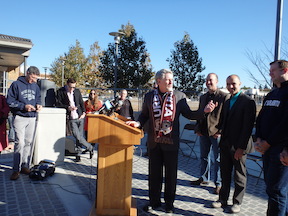
Steve Cohn, Christopher Cabaldon, Steve Hansen, and other streetcar supporters

The Downtown/Riverfront Streetcar is moving forward. Today there was a demonstration of a Siemens S70 streetcar (made in Sacramento, but unfortunately on its way to Atlanta) at the Township 9 (Richards & 7th St) SacRT light rail station. Mayor Christopher Cabaldon (West Sacramento), Councilmember Steve Cohn (Sacramento) and several others spoke about the future of the streetcar linking West Sacramento and downtown/midtown Sacramento. After the speeches, there was a ride downtown and back so people could see the streetcar in action, and informally discuss the project on the way.

Siemens S70 streetcar at Township 9 station

Yesterday the SACOG (Sacramento Area Council of Governments) board allocated $5M in funding for phase 1 of the project, which is the initial planning, route selection, and environmental review of the system. SACOG is one of the project partners, along with the City of Sacramento, the City of West Sacramento, Sacramento Regional Transit (SacRT), and Yolo County Transit (Yolobus). The remainder of the project costs totaling $12.3M are being provided by the partners. (Details of the SACOG application are at the bottom.)

Read More »

Lights at Arden-Del Paso, not

I was at the Arden – Del Paso light rail station this evening after seeing a play at Big Idea Theatre, waiting for the last Blue line train back downtown, and in walking around noticed a big problem with lights. Of the lights at the station, 40% were out. But there is a thicket of video cameras, more than ten. It seems strange to me that RT spent a considerably amount of money on video cameras, presumably to enhance security, but doesn’t spend money on replacing light bulbs, which would have a far more beneficial affect on security. Or, if the light standards need repair, then repairing them.

The Arden – Del Paso station is quite busy during the day, serving as a secondary transit hub with five bus routes as well as light rail. But it does not have the schedule messaging boards that many less busy stations have. With 40% of the lights out, none of the schedule boards can be read at night, so not only is there no indication of the time, there is no information available about the length of wait for the next train.

a thirst for working water fountains

non-functioning water fountain at Sunrise light rail station

On Wednesday evening, I rode from Woodside K-8 School in Citrus Heights to the Sunrise SacRT light rail station, and then caught light rail home. As I passed Sunflower in Fair Oaks, I thought of stopping for a drink of water, but decided to just head on down the hill to the drinking fountain on the north side of the red Fair Oaks bridge. It was not working, covered with plastic. I continued on to the Sunrise station, where both water fountains are not working. I suspect these have not been working for years, they look abandoned. By this time, I was pretty darn thirsty, and the long wait in the evening for the next light rail train was not pleasant. Even if I’d wanted to go to a convenience store for something to drink, there aren’t any close to that station.

Read More »

bike storage at light rail

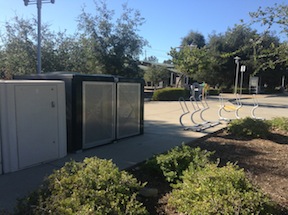
bike lockers at SacRT light rail Glenn station in Folsom
bike lockers at SacRT light rail Glenn station in Folsom (SacRT rental, BikeLink, bike racks)

If you are a light rail user, you may have noticed bike storage lockers at some of the stations. Two types of lockers exist:

  1. rental lockers at 19 SacRT light rail stations, which are listed on the SacRT “Biking with RT” webpage
  2. on-demand lockers at 3 SacRT light rail stations in Folsom, plus the Folsom Pedal Stop bike station

The rental lockers work well for people who routinely commute the same route to and from work, and are leased for 6 months or 13 months at pretty reasonable rates. The downside to rental lockers is that they can be used by only one person, and are empty when not in use by that person. Mike Mattos, SacRT Chief of Facilities & Business Support Services Division, said that these lockers were mostly purchased at the time of rail extensions, and they are repaired and replaced from operating funds. They move lockers from one station to others as demand changes. They have explored on-demand systems, but have not installed any because they don’t feel that any vendors so far meet their criteria. He pointed out that the downside of on-demand systems for typical commuters is that they don’t then have a guaranteed space at their station.

Read More »

Transit projects in Sacramento region

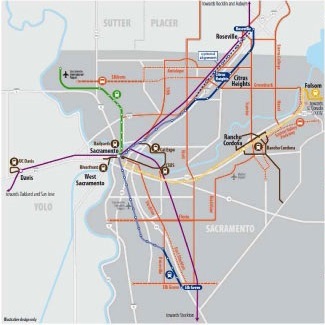
SacTransitActionPlanScenarioC-map-onlyReconnecting America, a transportation advocacy organization, just published Transit Space Race 2013. To see the Sacramento area projects, click on the < 3 million tab, and then sort by state. The eleven projects will be at the top of the list. The transit agency link in the right-most column links back to a page or website about the project.

Though the south corridor extension is shown as engineering in the status column, construction is underway on parts of the extension, the two bridges, and will start soon on other parts, with the help of a recent federal grant as well as regional funds. The airport extension and streetcar projects also have their own webpages.

Most of the other projects link to the Sacramento TransitAction Plan, which show all possible projects in Scenario C (map at right, more detail in the plan starting on page 50). This plan does not give much detail on each project, but the name of the project gives you an idea.

Bike capacity on light rail

Sportworks Interlock transit bike rack

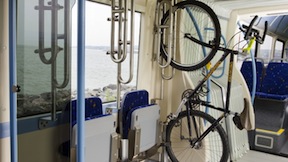
The other item I want to talk about at the Unmet Transit Needs meeting today is bicycle capacity on SacRT’s light rail system. I’ve written about bikes on light rail previously, and won’t repeat that detailed post here, except to say again that SacRT is not meeting the needs of transit users with bicycles on the light rail system.

Sportworks makes two types of transit bicycle racks that could be used on SacRT light rail, the SwingLock and the Interlock. The SwingLock is basically an improvement to the bike rack hooks installed on the 200 series light rail cars, while the Interlock is a more complicated, more expensive, and more effective rack. I spoke to a Sportworks employee at ProWalk/ProBike last year, and he said they also design custom racks for transit systems where off-the-shelf solutions won’t work. I have family in Las Vegas, and when I’m visiting, I use the RTC-Southern Nevada transit system which has the Interlock installed in many of its newer articulated buses. The racks work great!

SACOG Unmet Transit Needs Hearing

I attended the SACOG final hearing on unmet transit needs. Apparently the process is repeated every year, so this is just the last one for this fiscal year. I spoke, as planned, on the unmet needs of bicyclists on light rail and level boarding with low floor light rail cars. Board member Steve Cohn welcomed me to attend the regular SacRT board meeting to talk about these concerns. He said that SacRT is working on these very issues, but since they haven’t publicized anything yet, I’m not sure what they are thinking and where in the process they are.

Only one other person spoke, mostly about disability access and connectivity between the many transit systems in the region.

I’m not sure whether the lack of testimony indicates that people think all the issues were addressed in the earlier hearings, or whether people didn’t know of the opportunity, or if there is a lack of interest. Though SacRT has clearly improved since the low point of 2010 when the system and service were decimated, there is a long ways to go to get back to base level and then to improve on it.

Level boarding with low floor light rail cars

SacRT light rail steep steps for bicyclist

Today in Sacramento will be the last of SACOG’s Unmet Transit Needs meetings. It will start at 9:30AM in the SACOG board room at 1415 L St, Ste 300, in downtown Sacramento, near the northeast corner of Capitol Park. In preparation for that meeting, I’m thinking about the things I’d like to talk about, particularly issues that I’m not sure that others will bring up. Those two are bicycles on light rail, and level boarding for light rail. I’ve said a bit about level boarding in my Portland post, but there is plenty more to say.

The SacRT light rail system has high floor cars. Both the older 100 series cars by Siemens Transportation Systems and the newer 200 series cars by Construcciones y Auxiliar de Ferrocarriles (CAF) have high floors. People must navigate steep stairs from the ground to the car. Disabled people are accommodated by a high boarding platform, but with only one platform at each station (and none for southbound blue line at 12th & I station), those needing level boarding are restricted to one end of the lead car, and all other doors and cars exclude them. Many people who use the train don’t consider themselves disabled enough to use the high boarding platforms, yet struggle with getting up and down the steps. Many bicyclists also struggle with these steps. The handrails which are provided in the middle of the stairs to assist people with the steep steps are themselves part of the problem, as they block people who are carrying items such as strollers, groceries, luggage and bicycles.Read More »

TransitRenewal and Route 1

Sacramento Regional Transit (SacRT) is working on a project that they call TransitRenewal. It is an effort to rebuild the transit system that existed prior to 2010 when it was decimated by cuts. People who live in the downtown/mid-town/EastSac area mostly notice that the system stops running very early in the evening, but people who live in the more outlying area of the regional suffer from the full extent of the decimation. Signs that say “temporarily no bus service” are found along arterial streets everywhere, as many the routes simply don’t exist anymore. SacRT wants to bring back the most useful of these routes, as well as to extend the schedule by about two hours, ending soon after 11 instead of soon after 8.

The next event in the TransitRenewal process is a hearing on Monday, March 26, starting at 6:00PM, at the RT Auditorium at 1400 29th St, Sacramento. I encourage you to take a look at the website, pick one or a few routes of importance to you, and then go to the hearing and speak about these routes. SacRT hearings are often lightly attended, so your voice has a impact than you’d think. If you can’t attend the hearing, you can comment online, by phone, or at some less formal outreach opportunities.

SacRT was also involved in an effort by Sacramento Area Council of Governments (SACOG) to document Unmet Transit Needs. As part of both these processes, I investigated the current situation and possible improvement of several routes that I am concerned about. I recently posted about how to improve bicycle access on light rail, and below are my thoughts about Route 1, which runs from McClelland to Sunrise Mall in the northeast suburbs of Sacramento county.Read More »