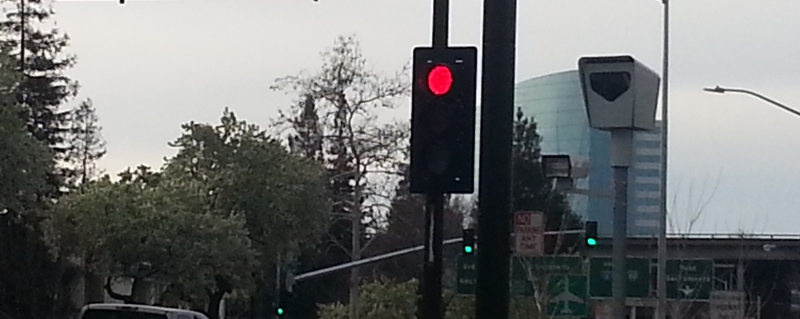
The City of Sacramento’s Vision Zero Action Plan update will very likely include two elements related to automated enforcement:
- #11: Implement red light running camera program.
- #25: Support legislation on Automated Speed Enforcement allowances in Sacramento.
The city had automated red light cameras under a program operated by the county, and a private contractor. When the county dropped its program, supposedly because they were not gaining enough income from tickets to pay for the program, the city also dropped its program (the end of red light enforcement). Not confirmed, the cameras may still be installed, though not in use. SB 720 (2025) established new guidelines for red light cameras, which the city will follow in implementing a new program. The Streetsblog California post SB 720 and What You Need to Know about Red Light Cameras, written before passage, is a good summary of the program. Fines are reduced for low-income people, there are provisions for more equitable implementation, and fines may be used for traffic calming.
At this time, the city has no authorization to implement automated speed enforcement, so ‘support legislation’ means supporting adding Sacramento to the list of pilot cities under AB 645 (2023), or creation of a statewide program after the pilot. There are varying opinions about when the state will move to a permanent program, but I remain hopeful.
The advocacy and equity community has long had concerns about bias in in-person law enforcement, and some of these concerns also apply to automated enforcement. Views range from ‘automated enforcement is worth it to save lives’ to ‘automated enforcement must be carefully designed and implemented to prevent bias’. There are a few advocates that don’t believe that an equitable automated enforcement program can be designed, and are opposed until proven otherwise.
Conversations among transportation and equity advocates, and with the city, will continue during development of the Vision Zero Action Plan update.
The best single summary I have found is How To Improve Social Equity in Automated Traffic Enforcement (Elovate, 2024-11). This is a commercial company that sells automated enforcement, but the post seems unbiased. A search for ‘equitable automated enforcement’ will surface many, many articles and posts.
Another great source is Fair Warnings: Recommendations to Promote Equity in Speed Safety Camera Programs (Vision Zero Network, 2024-12). It includes a section, ‘Recommendation 1: Consideration & Placement of Speed Safety Cameras
Issues addressed by SB 720 and AB 645:
- reduction of fines: .“..a designated jurisdiction shall reduce the applicable fines and penalties by 80 percent for indigent persons, and by 50 percent for individuals up to 250 percent above the federal poverty level.” This provision is present in both.
- use of fines: “Program costs include, but are not limited to, the construction of traffic-calming measures…” and “Traffic-calming measures” include, but are not limited to, all of the following: (A) Bicycle lanes; (B) Chicanes; (C) Chokers; (D) Curb extensions; (E) Median islands; (F) Raised crosswalks; (G) Road diets; (H) Roundabouts; (I) Speed humps or speed tables; (J) Traffic circles.” This provision is present in both, though the speed camera program also requires that cities implement traffic calming in several situations. The legislation strongly encourages but does not require that income be spent on traffic calming.
- relation to existing expenditures: “Jurisdictions shall maintain their existing commitment of local funds for traffic-calming measures…” This provision is present in both, though more restrictive in the speed camera program.
- bias reporting: “A racial and economic equity impact analysis, developed in collaboration with local racial justice and economic equity stakeholder groups.” in the speed camera program, and “… jurisdiction shall consult and work collaboratively with relevant local stakeholder organizations, including racial equity, privacy protection, and economic justice groups…” in both. However, it is not clear whether the selection of locations requires analysis of geographic bias beforehand.


 Getting Around Sacramento