There have been rumors for years of a curb management policy or program for the City of Sacramento, but nothing has surfaced. The Mobility and Sustainability Division of Public Works has a Mobility, Parking, and Curb Management page, but there is nothing on it about curb management.
I spend a lot of time in other cities, and am in San Francisco as I write this. Sacramento has much less of a problem than many other places. Ride hailing is all over San Francisco, both driver and automated, and traffic and bike lanes and bus lanes are blocked by ride hailing. San Francisco has a much greater density of retail business in many areas, and delivery vehicles do the same blocking. But Sacramento does have a problem, and that problem can be mitigated or eliminated by curb management.
As to curb colors, these are the patterns. California has much less clear code about curb colors than do most states, but to the degree it does, these are the colors.
- red = no parking. Parking means getting out of your vehicle. Whether it is one second or hours, it is still parking. Red curbs may also be more restrictively signed as no standing or stopping.
- yellow = commercial loading
- white = passenger drop-off/pick-up
- green = time limited parking. The amount of time is marked on the curb and/or signed
- blue = disabled
Sacramento has recently added some painted curbs, some with marking or signing, and some simply painted. One example below, on 3rd Street at The Bernice Apartments. It is not clear whether this is a city or developer installation. The time frame is unusual, but might make sense if loading is limited to certain times (see below). I suspect that this is a white curb passenger drop-off/pick-up situation that was mis-painted and mis-labeled as yellow loading. The distinction between white and yellow is often misunderstood.
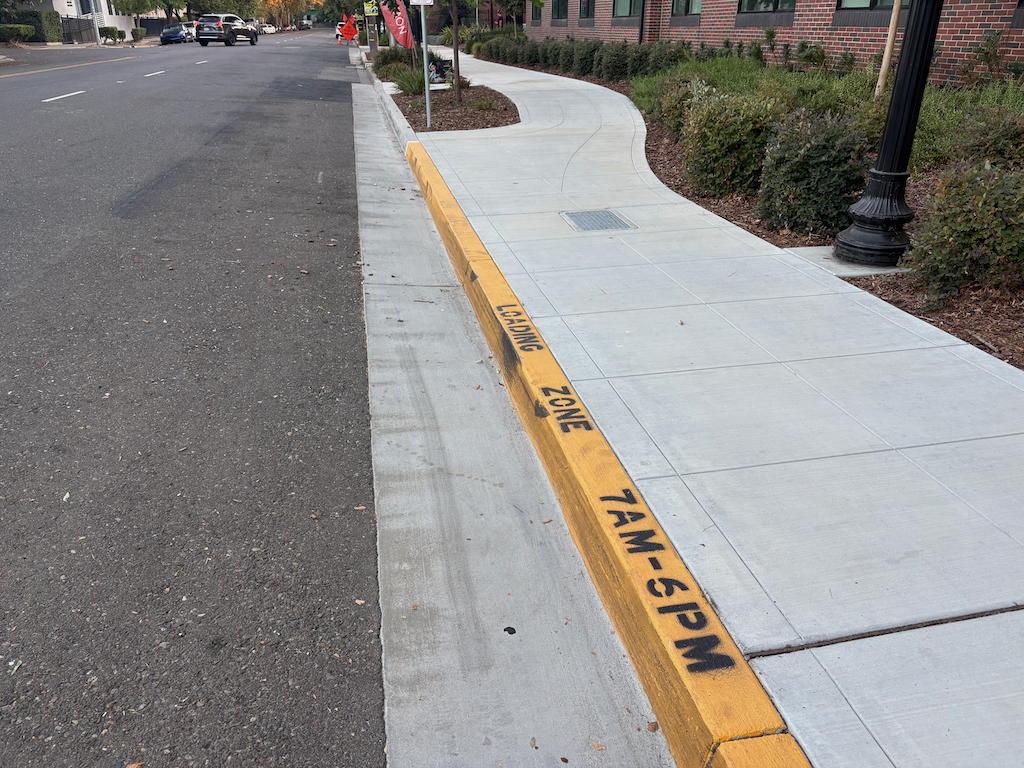
But the rate of painting curbs is far slower than is needed. The city is not managing curb use as it should.
Whenever the city does come up with curb management policies or programs, here is what I’d like to see:
- One blue disabled parking spot per block. This should not be a free spot, as is common practice, but a paid spot just like any other. Though there are certainly low income disabled people, there are also a whole lot of upper income people that park in these free handicapped spots for hours, precluding use by other handicapped users.
- At least one green time limited spot on any block with retail business that cater to come and go customers, such as coffee shops. The limit should be 10 or 15 minutes. And it should be enforced! I often see drivers parked on green curbs for long periods of time, and when I report it to 311 for enforcement, the parking officers almost alway fail to ticket. The common city view of parking is that only staying over time paid for, or blocking a private driveway, is a violation, and nothing else is.
- One long yellow curb spot on any block with retail business, which does not have alley access (if alley access is available, there should not be any commercial loading on the street, at all). I don’t mean ‘long’ like semi-truck long, but long like delivery truck and van long. Semi-trucks have no place in urbanized areas, and should be prohibited. Instead, there should be transfer to smaller vehicles at logistics locations.
- One white passenger drop-off/pick-up spot on any block that has residential or retail. Both ride hailing and private vehicles should be required to use these spots, and be ticketed if they double park.
- Limited hours for commercial deliveries. Though this could be adjusted for the characteristics of a particular block, delivery times should be limited to 3:00 AM to 10:00 AM. 3:00 AM is after the entertainment use and parking clears out. 10:00 AM is when most businesses open, and curb space is needed for other purposes.
- Regular use of yellow curbs should require a permit, with permit fees going to the same purposes as other parking fees. Yes, this needs to be changed to parking benefit districts, but no need for a separate account. Though there may be occasional instances of a delivery that is not a regular user, almost all use is regular and repeated.
- Regular commercial use (ride hailing) of white curbs should require a permit, with permit fees going to the same purposes as other parking fees.
These changes would result in less regular parking on each block. I am not against regular parking, but I see these other uses as higher uses that should be accommodated. Less regular parking means less driving, which is a good thing.

