RRFBs are being ignored

I was a strong supporter of RRFBs (rectangular rapid flashing beacon), where a safer crossing of the street is intended mid-block. I worked with transportation agencies in a number of locations to get them installed, and was very happy to see them go in.

They are used where multi-use trails cross roadways, and at intersections where additional traffic calming and safety are needed, but where the transportation agency does not want to add stop signs, or is unwilling or financially unable to install a traffic signal. The cost savings of an RRFB over a traffic signal are significant, about $25K for a RRFB, and upwards of $1M for a full traffic signal.

But…

Driver behavior has rendered RRFBs untenable for protecting people walking. I have observed a number of RRFB locations over the last few months. All of them are failing. Between 25% and 50% of drivers are failing to yield to people using these crossings, bicyclists or walkers. I have seen several people almost get hit by car drivers. Some drivers are slowing but failing to stop, or yield, and some drivers are not even slowing. Apparently the attitude of many drivers is that the RRFBs are only advisory and do not require yield to people in the street. Of course the law requires yielding to people crossing the street in a crosswalk, whether there is any type of signing or signaling, or not. But drivers don’t see it that way.

So, I find myself having to withdraw support for RRFBs. I will not support them as freestanding safety improvements, not as part of project. It is sad that driver behavior has erased the benefit of a safety enhancement, but it is a fact, and driver behavior gets continuously worse, never better.

Drivers are terrorists.
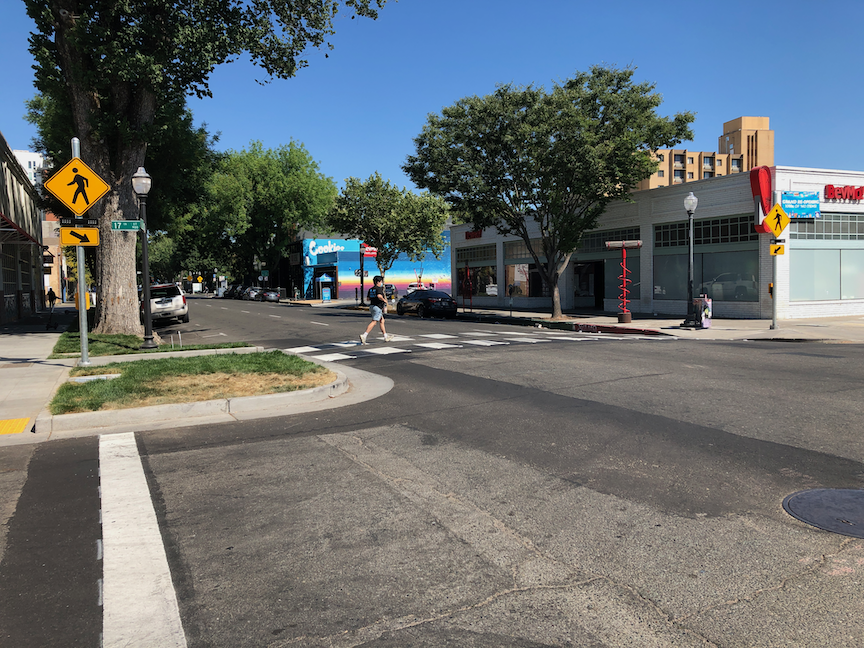
photo of RRFB on J St at 17th St, Sacramento
RRFB on J St at 17th St, Sacramento

RRFB on J St at 17th St

Last week I walked over to the new Target store at J Street & 17th Street in midtown Sacramento. On my way there, I was thinking to myself that with the additional people walking to the store, the crosswalk over J Street was going to need some sort of additional protection, since I knew from experience that most car drivers don’t yield to people walking at that location.

Lo and behold, a RRFB (rectangular rapid flashing beacon) was installed!

RRFB on J St at 17th St

The person walking presses a button which triggers flashing lights mounted on the pedestrian crossing signs. A curb extension on the north side of the crosswalk was installed when the sidewalks around the Target store were installed, so the crossing distance has been shortened somewhat, which also helps.

There are signs with the buttons, below. These are not MUTCD compliant signs, which is ironic, because the city had refused at the beginning of the pandemic to install pedestrian crossing signs that indicated the actual effect of the button, whether it was necessary to press it, because there is no MUTCD sign that does that. Maybe the city is reconsidering it’s signing – unlikely.

RRFB button

A word of warning to anyone who thinks signs and flashing light make it safe to cross. What they do is make is safer than it would be without, but not safe. J Street is a three-lane traffic sewer, on which drivers seldom yield to people walking, whether there is a marked crosswalk or not. Anytime a roadway has multiple lanes in a direction, the multi-lane threat exists, that one driver will stop and others will not. I see this routinely on all the streets in Sacramento that are multi-lane. So, cross with caution no matter what. What I do is step into the street to remind drivers that I have the right-of-way, but walk very slowly until the drivers in all lanes have come to a complete stop. Of course that frustrates the driver who originally stopped, that I am crossing so slowly, but my job is to keep myself safe, not to please drivers.