Is sales tax for transportation the wrong approach?

There are three ideas for transportation funding floating around, for the 2026 ballot, though none have been formalized. All rely on sales tax.

  • Sacramento Transportation Authority (SacTA) may create a ballot measure to fund transportation. It would be in addition to the existing Measure A, and might fund transportation infrastructure for infill housing, which has not been done before. As an agency-sponsored measure, it would require 2/3 vote to pass.
  • Sacramento Metro Rail and Transit Advocates (SMART) and Mayor Darrell Steinberg have drafted measure that would fund active transportation, transit, and housing. It would probably be for the county, but could be just for the City of Sacramento. As a citizen initiative, it would require only 50% + 1 to pass, a much more achievable vote.
  • SacRT it considering a measure for transit and related active transportation that might cover only a part of Sacramento County, the more transit-supportive part, probably the cities of Sacramento and Elk Grove. As an agency-sponsored measure, it would require 2/3 vote to pass.

Sales taxes are regressive, meaning that low-income people pay a much larger percentage of their income to sales tax versus high-income people. Most organizations which lead with equity are opposed to further sales tax increases, feeling that enough is enough.

In Sacramento County, with a strong anti-tax voice in the low density unincorporated county, it is difficult though not impossible to reach the 2/3 threshold. The 2016 transportation sales tax fell short of 2/3. Measures to fund schools districts are more likely to pass. A complicating issue is that Elk Grove recently passed a sales tax measure to fund many purposes, one of which is transportation. Folsom and Rancho Cordova have sales taxes for which it isn’t clear to me whether any goes to transportation.

General purpose sales tax measures, which may list uses but are not required to follow those lists, only require 50% + 1 to pass. That flexibility is both a feature and a danger, since a government may shift sales tax income from what they said it would be spent on to other purposes.

Though I have not heard parcel taxes being discussed, they are another source of funding, though they are also regressive because they are a flat rate per parcel, not based on the value of the parcel.

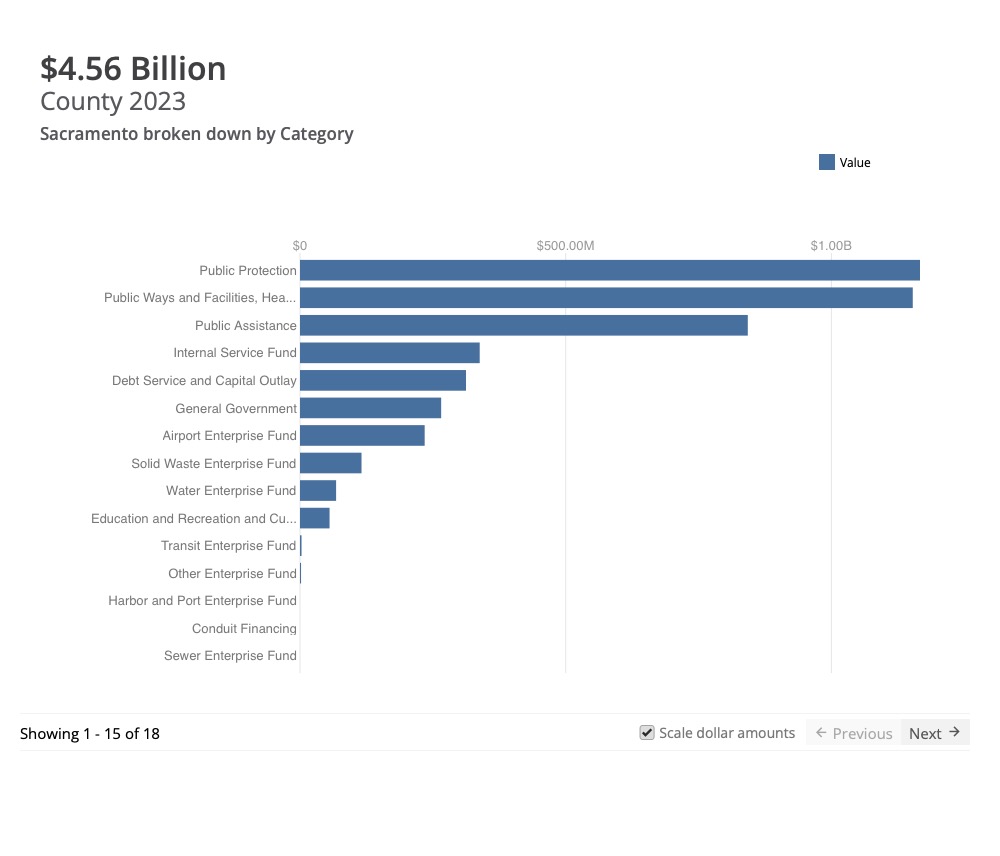
Two other types of tax which are progressive, meaning that high-income people pay a higher percentage of income than low-income people, are income tax and property tax. Income tax does fund transportation at the state level, but income taxes are not available to cities, counties, and special districts. Property tax can fund transportation, though due to Prop 13 which limits property tax, it mostly goes to schools and public safety. For Sacramento County in 2023, the chart below shows allocations. The ‘Public Ways and Facilities, Health, and Sanitation’ category goes mostly to Health, with Public Ways and Facilities being less than 20% of that category. This chart does not include school districts within the county, which also rely on property tax.
Transfer taxes, which are based on the value of a property when it is sold, are progressive. These have been discussed in a number of places in California, though not locally so far as I have heard. I am not aware of any existing transfer taxes that fund transportation, though they do fund a number of other government functions. The state levies a transfer tax throughout the state, and that income goes into the general fund.

Any county, city or special district can bond against property tax, meaning that they can expend money now and pay it back over time from future property tax income. Again, Prop 13 limits the usefulness of this by suppressing property tax income, but does not preclude it. If Prop 5 on the 2024 ballot passes, cities, counties, and special districts will be able pass bond measures with a 55% vote rather than 2/3 vote, though the proposition raises the bar on transparency and types of expenditures. Though Prop 5 is intended primarily to fund housing, it could fund transportation, and there is a logical nexus with transportation that supports housing.

For other posts on transportation funding, see category Transportation Funding.

Prop 5 bonding for transportation?

Proposition 5

A Yes on 5 website offers details in support of the proposition. The arguments against, on the voter information guide, are just the standard anti-tax voice, so isn’t useful to this post, but you can read your guide if you are interested. Prop 5 was placed on the ballot by the legislature, as a result of two legislative resolutions. The proposition is entitled “Proposition 5: Allows Local Bonds for Affordable Housing and Public Infrastructure with 55% Voter Approval.

The proposition would change the voting threshold from two-thirds, 67%, to 55%, for ballot measures by cities, counties and special districts (does this include SacRT?) that bond against property taxes for the purposes of affordable housing and public infrastructure. The proposition does not directly raise property taxes, nor would local bonding measures directly raise taxes, though since the bonds have to be repaid with interest, property taxes could eventually go up within the limits sets by other legislation. This has nothing to do with sales tax, which remains at two-thirds for govenment proposed sales taxes, and 50%+1 for citizen proposed measures.

The history of the proposal development indicates that it is more about affordable housing than public infrastructure, but infrastructure is definitely allowed, and could easily be justified when that infrastructure supports affordable housing. It can also apply to transportation infrastructure. The specific language in the ballot measure related to infrastructure is “construction, reconstruction, rehabilitation, or replacement of public infrastructure”, which is pretty open-ended. More specifically, the proposition lists the following infrastructure uses:

(I) Facilities or infrastructure for the delivery of public services, including education, police, fire protection, parks, recreation, open space, emergency medical, public health, libraries, flood protection, streets or highways, seaports, public transit, railroad, airports, and
(II) Utility, common carrier or other similar projects, including energy-related, communication-related, water-related, and wastewater-related facilities or infrastructure.
(III) Projects identified by the State or local government for recovery from natural disasters.
(IV) Equipment related to fire suppression, emergency response equipment, or interoperable communications equipment for direct and exclusive use by fire, emergency response, police, or sheriff personnel.
(V) Projects that provide protection of property from sea level rise.
(VI) Projects that provide public broadband internet access service expansion in underserved areas.
(VII) Private uses incidental to, or necessary for, the public infrastructure.
(VIII) Grants to homeowners for the purposes of structure hardening of homes and structures, as defined in state law.

The reason for raising this issue is that taxes based on property are progressive, meaning that people with higher incomes and therefore higher value property, pay more in taxes. Sales taxes are regressive, meaning that low-income people pay a higher percentage of their income on taxes than do higher income people. Proposals to increase the sales tax in Sacramento County have been resisted by many who think we have runs out that option and need to turn to options that are not regressive, like property tax.

I prefer pay-as-you go expenditures from most transportation projects, except for a few which are very expensive and of clear benefit to everyone. There are few transportation projects that would or should quality for this. The transportation projects we most need going forward are many small fixes, not the mega-projects done in the past which tend to be motor vehicle projects. But some transit projects could be or should be bonded. The problem with bonding is that interest payments raise the cost to about 1-1/2 times the project cost, depending on the bond length and bone rates, and that money goes to wall street investors, not to the project.

I am in favor of the proposition. It gives local governments, and therefore citizens, control over how they spend their property tax, rather than being constrained by statewide controls that were implemented by anti-tax interests.

If the proposition passes, would it be the solution, or a solution, to funding affordable housing and transportation infrastructure instead of or in addition to sales tax or other taxes and fees? I don’t know, but I do think it is worth exploring. Though the proposition applies to local measures on the same ballot, there are no transportation measures of any sort on the 2024 ballot in Sacramento Couny. There may be in 2026, as a Sacramento Transportation Authority new Measure A transportation sales tax, or a SacRT sales tax for transit with a limited geography, a citizen measure sales tax for housing, transportation, and active transportation (the SMART/Steinberg proposal), or other ideas that have not yet come forward. A property transfer tax has been discussed, which is another progressive tax. The state has a property transfer tax, as do other entities. It isn’t clear to me whether Sacramento County or any of the cities within the county have transfer taxes.

land value tax and housing

Alex Lee introduced, in the last legislative session, AB 362, ‘Real property taxation: land value taxation study’. “This bill would require the California Department of Tax and Fee Administration to conduct or commission a study on the efficacy of a statewide land value taxation system as an alternative to the current appraisal methods utilized for real property taxation.” It got to the Assembly Committee on Revenue and Taxation, but no further. It is, I believe, a two year bill and can be considered in 2024 session.

So what is land value tax? It is a property tax assessed on the value of the land itself, and not on the improvement to the parcel such as buildings. Current property tax in California is based on both, called split-roll, but strongly weighted towards the value of the improvements, not the land. A pure land value tax would shfit entirely to taxing the land, but blended taxes with a shift towards land value would have some beneficial effects.

Why tax the land? Speculators often leave property undeveloped or vacant in hopes of future high profits at development or sale. There are many such parcels in Sacramento, many of them undeveloped or vacant for decades. Why? The owner pays property taxes, but the value of the property is a small fraction of the value of the improvements, and the improvements are zero, so the property tax paid is a fraction of what it would be if the parcel were in productive use.

The result of improvements-based property taxes is that parcel remain unused. If there were a true land value tax, the owner would want to develop their parcel right now, so that they would receive income from the use to offset their property tax. But with the current mixed property tax, there is almost no incentive whatsoever to develop or redevelop. The result? Far less housing that we would otherwise have.

A shift to valuing the land as a greater percentage of the allocation between land and improvements would help. I have searched for the percentage allocation in Sacramento County (the counties, not cities, administer and collect property taxes, but haven’t been able to find it. It may be one of those black boxes that assessors want to keep from the public.

I am not sure whether a land value tax could be implemented at the county level without changes to state law. It seems that state law tightly controls adjustments to total valuation and tax rates, but so far as I’ve found, does not control the allocation to land value and improvements value. If you can point me to resources for better understanding this, please comment.

NY Times: The ‘Georgists’ Are Out There, and They Want to Tax Your Land, Conor Doughherty

transportation funding ideas

First, some background. The California Department of Transportation (Caltrans) publication: Transportation Funding in California (2019), documents what funding is currently available in the state, but mostly serves to reflect how complicated the whole funding stream is. I don’t think this is an unintended consequence, but a design feature, as a complex system benefits engineers, planners and politicians by obscuring inputs and outputs.

Next, there are many useful sources of information on potential funding, but two I find useful are: Key Local Funding Options, by Transportation for America, and A Guide to Transportation Funding Options, by Texas Transportation Institute.

I don’t claim any expertise in transportation funding, but I am reading and thinking, and am presenting some ideas for your consideration.

This exploration is both the result of Sacramento Transportation Authority (SacTA) to pull the ordinance and request for ballot measure for the 2020 Measure A transportation sales tax, as well as an ongoing dissatisfaction with our current funding models. The current Measure A is a 30-year (2009-2039) transportation measure for the county of Sacramento which implements a half-cent sales tax. Though there are minor amounts of funding from other sources at the county level, and in the cities, this measure is the main source of local funding for transportation.

Sales taxes are regressive, in that lower income people spend a higher percentage of their income on sales tax than do higher income people. Of course most of our tax system is set up this way, as the higher income people, particularly the top 1%, buys politicians with political donations who will make sure that their tax burden remains as low as possible. The Trump tax cuts are just one example, where nearly all of the benefits went to high income individuals and large corporations. The huge income and wealth disparity in the US is no accident, it is the design of the taxation system. Nevertheless, it is worthwhile to talk about less regressive taxes.

A few alternative potential sources are listed. This is not meant to be an exhaustive list, please see the leading documents if you want a fuller list. Rather, it is ideas that appeal to me.

  • Income tax: While. in theory, income taxes are progressive, they have been made less and less so over time, and in fact are currently regressive because high income and high wealth individuals, and large corporations, write tax code that reduces their obligations. In fact many large corporation pay no taxes at all. Because California largely follows the federal tax law, California’s income tax is also regressive. Nevertheless, income tax is less regressive than sales tax. However, California does not allow local income taxes.
  • Property tax: Property tax is based on the value of land and improvements (at least theoretically, though assessment practices actually muddy the waters). This is the least regressive tax available, since the value of the property being taxes correlates highly with income and wealth. It is what should be funding most of our government services. But as you well know, Prop 13 corrupts that by holding the taxation rate on some properties to artificially low values. Proposition 15 (2020) will remove that limitation on commercial properties, but does not touch residential properties. Most of the billions in income from Proposition 15 will go to education, as it probably should, but some can be made available for transportation.
  • Property tax increment: When the value of property increases due to a specific transportation investment, the additional property tax collected can be used to pay for the investment, usually through bond repayment. Sounds good, but in California the tax increment has been so corrupted by giving tax breaks to large corporations that almost no one trust the funding mechanism anymore.
  • Property tax assessment: Taxes are raised on parcels that are expected to benefit from a transportation investment. This seems like a great idea, but from my understanding Prop 13 limitations mean that this is rarely done, and special assessments default to parcel taxes. Worth learning more about.
  • Parcel tax: These are flat rate taxes on property. Because every parcel pays the same amount, these taxes are incredibly regressive. Unfortunately schools and many other local taxing districts use parcel taxes. Their regressive nature should preclude their use for transportation.
  • Vehicle registration fee: These include a number of related fees, see https://www.dmv.ca.gov/portal/vehicle-registration/registration-fees/ if you want more details. These fees are based in part on vehicle value, so they are more progressive than many fees/taxes. It is not clear whether counties/cities/regions can charge vehicle fees. As a highly visible fee, this one tends to get a lot of attention from anti-tax people.
  • Fuel tax (or mileage fee): This tax, or fee, relates to fuel used or miles traveled. These taxes/fees are therefore a user fee, the user of the transportation system pays for the transportation system. However, I don’t think California allows such taxes/fees at the local level.
  • Parking fees: Parking charges are a variety of user fees, but instead of based on the vehicle when moving, based on when the vehicle is still. Parking fees are collected and expended at the local level, so this a strong nexus. In California, parking fees are theoretically only allowed to cover the cost of administering the parking, and not even the cost of constructing and maintaining the parking space, however, this is widely violated and is probably a ripe are for reform. Parking is in many ways a wasted part of our transportation system, socialism for car owners, so this one should be at the top of the list.
  • Congestion pricing: A fee changed to vehicles entering a defined area of the city where there is congestion of some sort. I think the term ‘congestion’ is unfortunately in this context, as it implies that congestion is something to be solved, but it is, for now, the commonly used term. Transportation use fee or something else might be better. At any rate, sometimes the fee is per vehicle, and sometimes it is adjusted by the weight (= pavement damage) or pollution output of the vehicle. Congestion fees have been criticized for having an inequitable impact on lower incomes, but this idea has been widely rebutted by the realization is that the most inequitable transportation system is on that requires people to own and use private vehicles.
  • General Funds: Cities and counties may of course, spend general funds, raised by any variety of taxes and fees, on transportation. But they rarely do. Part of the reason has to do with federal and state grants being a ‘free’ source of funds, that the local entity doesn’t have to raise or be blamed for, but flows freely from a higher level of government to the local. I would argue that at least some general funds should be spent on transportation, to provide at least a basic level of services and infrastructure.

This is just a quick run-through. Next post is about what I think should be emphasized for Sacramento county.

property taxes and blight

dead zone on 1000 block of J Street, downtown Sacramento

Why do buildings and lots sit empty for years throughout downtown Sacramento and beyond? Because there is little consequence to the property owner of leaving them empty. They continue to pay property taxes while waiting for some development scheme that will make them so much money that the years of property tax are a drop in the bucket. Occasionally, a property is taken for non-payment of property taxes, but that is rare.

While the building or lot remains empty, the city (I’ll use “the city” for the cities and counties and utility providers) still has costs associated with the property. The cost of electrical, water, sewer, telephone, the street network, and transit in an area has more to do with the capacity of the system and the network passing by a property than the specific connection to the property, so the city still has costs even though they are receiving only a pittance of property tax. Fire and police services are actually higher for empty building and empty lots because they attract vandalism, crime, illegal occupancy. They drag down the property values of everything around them, and therefore the property tax income from everything around them. They are in large part the very definition of blight.

Ironically, many of the empty buildings and empty lots in downtown Sacramento are owned by the city itself. So the city is costing itself money by letting these sit, and of course that means that it is costing us taxpayers.

When the economy slowed, those big projects that would make a lot of money evaporated, and so more and more property sat unused. But it did not need to be unused. Smaller scale projects were always possible. I think one of the big differences between downtown and midtown in the downturn was that midtown had a large number of small properties owned by people with moderate dreams of development and redevelopment, while downtown had a few large properties owned by people with grandiose dreams. Those dreams crashed, and so did downtown. A number of successful businesses were dragged down by the failures around them. Midtown went through a slow time, but lost far fewer businesses, and is now picking up in a way that downtown has not.

So, what to do? As always, I have some outside-the-box (or off-the-wall, some would say) solutions to propose.

1. Assess property tax on all government entities. What purpose would this serve? Wouldn’t it just be moving money from one pocket to another? Yes, but it would make the cost of maintaining empty buildings and empty lots show up on the balance sheet as a direct expense. As with all things financial, we pay it no attention until it shows up on the balance sheet and affects the bottom line.

2. Assess empty lots at the value they would have if developed, based on typical properties surrounding it. Seems unfair? Not in my mind. The empty lot is costing the city, and all of us, directly in terms of services needed, and indirectly in creating blight that lowers property values and depresses economic activity. This higher level of property tax would encourage the owner to move forward with development. In a few instances, these empty lots could be converted to public purpose such as a park or farmers market location, but the number of those conversions would be small relative to the number of properties

3. Double property taxes every four years for both empty lots and empty buildings. This would give the owner a strong incentive to do something. While regular property taxes can largely be ignored, when it goes up 2X, then 4X, then 8X, then 16X, no property owner will leave the property unused.

I have no illusions that even these radical proposals would bring vibrancy back to downtown, but along with many other policies and actions, they would certainly help.

I think something needs to be done about surface parking lots, which are another unproductive use of land that costs us all money, but that is another topic for later.

I’ve uploaded a few photos to Flickr of abandoned downtown, along J and K streets. It would take days and thousands of photos to document it all.