Parking reform for Sacramento

Note: Added item to Parking fees below, in italic, based on an idea from an article in Streetsblog USA.

Following on to the discussion group topic this week of Walkable City this week, Part 3: Get the Parking Right, here is a list of my thoughts about parking reform in the City of Sacramento. Almost all applies to parking anywhere. I think nearly every one of these has been mentioned in previous posts, but I’ve not brought them together in a single place.

The City of Sacramento has a Parking Services website. Parking Services is part of Public Works.

  • Parking management:
    • Parking must be managed under a city-wide parking management plan, and the plan must be consistent with city and state policy for reducing motor vehicle use and vehicle miles traveled (VMT). The city does not have a parking management plan, so far as is known.
    • Parking mandates must be removed city-wide, not just for the central city and transit oriented locations.
    • The city should foreswear any new structure parking (parking garages or parking decks). Though the city does not have any active plans for new parking, it has had recently, and they may come back.
    • Require all new housing or mixed use developments to unbundle parking, meaning that no free parking is provided for residents, and all parking is available to any person who wants to rent the space. Unbundling should be phased in over five years for all existing parking.
    • Prohibit commercial parking lots adjacent to sidewalks, meaning the buildings must face sidewalks and not parking lots.
    • Property assessment of surface parking lots will be at the same value as the productive land use that existed there before, to discourage building removal and and to keeping of land in less productive or unproductive uses; this requires cooperation from the county
  • Parking fees:
    • A base rate for all parking will be set such that it covers installation, maintenance, and management of all public parking; this rate might vary by whether parking is metered or not, or might be uniform throughout the city.
    • Charge at least the base rate for all street parking, everywhere in the city, via meters or permits, that recovers base rate; NO FREE PARKING!
    • Set variable rates for residential parking permits based on the size, weight, and fuel source of the vehicle
    • Formally implement variable pricing of street and structured parking to achieve Shoup’s 85% utilization
    • Charge for handicapped spaces (this eliminates the motivation for non-handicapped drivers to illegally use handicapped spots)
    • Eliminate all holiday or promotional free parking; research indicates that free parking actually reduces business customers by reducing parking turnover
    • Pilot ideas for charging for delivery use of street parking
  • Parking revenue:
    • Parking revenue will not go into the general fund or to pay off bonds not related to parking, but be used for specific purposes related to parking and neighborhood improvement
    • 50% of parking revenue (above base rate) will be spent on neighborhood improvements on the same streets or within parking districts
    • 50% of revenue (above base rate) will be allocated to transit operations and transit amenities
  • Parking conversion to higher uses:
    • Add trees in the parking lane on all streets without sidewalk buffers; many of the lower income neighborhoods in the city lack sidewalk buffers and private trees, making walking unpleasant and hazardous
    • Do not charge for conversion of street parking to dining space, and minimize permit costs for street dining
    • Provide one or more short-term (20 minutes or less) parking spaces on every block with retail
    • Provide one or more delivery spaces per block with any retail, and enforce against double-parking for delivery where delivery spaces are available
    • Replace parallel parking with diagonal parking on overly wide streets, to slow traffic; most streets in the city are overly wide
    • Where sidewalk or sidewalk buffer space is not available for micro-mobility (bike share, scooter share) parking, street parking will be converted in sufficient quantity
    • Modify development standards to allow only one-side parking in new residential developments
    • Allow conversion of parking to bike facilities where a reduction of travel lanes is not practical (on streets 30 mph or higher)

I strongly believe that the single city action most responsible for the renewal of midtown Sacramento, all the infill development and successful business, is the removal of parking minimums (mandates) from the central city in 2012. Since that time, the city has removed parking mandates from land near major transit stops, and in 2022, the state prohibited cities from establishing mandates near major transit stops (the definition of a major transit stop is fuzzy, however).

The city has proposed, in its draft 2040 General Plan, to remove parking mandates city-wide. It remains to be seen whether pressure from politicians and suburban protectors of ‘their’ street parking spot will subvert this recommendation. 2040 General Plan draft, Chapter 8 Mobility, Goals and Policies M-2.17 Parking Management Strategy, page 8-18.

Other resources:

transportation funding ideas

First, some background. The California Department of Transportation (Caltrans) publication: Transportation Funding in California (2019), documents what funding is currently available in the state, but mostly serves to reflect how complicated the whole funding stream is. I don’t think this is an unintended consequence, but a design feature, as a complex system benefits engineers, planners and politicians by obscuring inputs and outputs.

Next, there are many useful sources of information on potential funding, but two I find useful are: Key Local Funding Options, by Transportation for America, and A Guide to Transportation Funding Options, by Texas Transportation Institute.

I don’t claim any expertise in transportation funding, but I am reading and thinking, and am presenting some ideas for your consideration.

This exploration is both the result of Sacramento Transportation Authority (SacTA) to pull the ordinance and request for ballot measure for the 2020 Measure A transportation sales tax, as well as an ongoing dissatisfaction with our current funding models. The current Measure A is a 30-year (2009-2039) transportation measure for the county of Sacramento which implements a half-cent sales tax. Though there are minor amounts of funding from other sources at the county level, and in the cities, this measure is the main source of local funding for transportation.

Sales taxes are regressive, in that lower income people spend a higher percentage of their income on sales tax than do higher income people. Of course most of our tax system is set up this way, as the higher income people, particularly the top 1%, buys politicians with political donations who will make sure that their tax burden remains as low as possible. The Trump tax cuts are just one example, where nearly all of the benefits went to high income individuals and large corporations. The huge income and wealth disparity in the US is no accident, it is the design of the taxation system. Nevertheless, it is worthwhile to talk about less regressive taxes.

A few alternative potential sources are listed. This is not meant to be an exhaustive list, please see the leading documents if you want a fuller list. Rather, it is ideas that appeal to me.

  • Income tax: While. in theory, income taxes are progressive, they have been made less and less so over time, and in fact are currently regressive because high income and high wealth individuals, and large corporations, write tax code that reduces their obligations. In fact many large corporation pay no taxes at all. Because California largely follows the federal tax law, California’s income tax is also regressive. Nevertheless, income tax is less regressive than sales tax. However, California does not allow local income taxes.
  • Property tax: Property tax is based on the value of land and improvements (at least theoretically, though assessment practices actually muddy the waters). This is the least regressive tax available, since the value of the property being taxes correlates highly with income and wealth. It is what should be funding most of our government services. But as you well know, Prop 13 corrupts that by holding the taxation rate on some properties to artificially low values. Proposition 15 (2020) will remove that limitation on commercial properties, but does not touch residential properties. Most of the billions in income from Proposition 15 will go to education, as it probably should, but some can be made available for transportation.
  • Property tax increment: When the value of property increases due to a specific transportation investment, the additional property tax collected can be used to pay for the investment, usually through bond repayment. Sounds good, but in California the tax increment has been so corrupted by giving tax breaks to large corporations that almost no one trust the funding mechanism anymore.
  • Property tax assessment: Taxes are raised on parcels that are expected to benefit from a transportation investment. This seems like a great idea, but from my understanding Prop 13 limitations mean that this is rarely done, and special assessments default to parcel taxes. Worth learning more about.
  • Parcel tax: These are flat rate taxes on property. Because every parcel pays the same amount, these taxes are incredibly regressive. Unfortunately schools and many other local taxing districts use parcel taxes. Their regressive nature should preclude their use for transportation.
  • Vehicle registration fee: These include a number of related fees, see https://www.dmv.ca.gov/portal/vehicle-registration/registration-fees/ if you want more details. These fees are based in part on vehicle value, so they are more progressive than many fees/taxes. It is not clear whether counties/cities/regions can charge vehicle fees. As a highly visible fee, this one tends to get a lot of attention from anti-tax people.
  • Fuel tax (or mileage fee): This tax, or fee, relates to fuel used or miles traveled. These taxes/fees are therefore a user fee, the user of the transportation system pays for the transportation system. However, I don’t think California allows such taxes/fees at the local level.
  • Parking fees: Parking charges are a variety of user fees, but instead of based on the vehicle when moving, based on when the vehicle is still. Parking fees are collected and expended at the local level, so this a strong nexus. In California, parking fees are theoretically only allowed to cover the cost of administering the parking, and not even the cost of constructing and maintaining the parking space, however, this is widely violated and is probably a ripe are for reform. Parking is in many ways a wasted part of our transportation system, socialism for car owners, so this one should be at the top of the list.
  • Congestion pricing: A fee changed to vehicles entering a defined area of the city where there is congestion of some sort. I think the term ‘congestion’ is unfortunately in this context, as it implies that congestion is something to be solved, but it is, for now, the commonly used term. Transportation use fee or something else might be better. At any rate, sometimes the fee is per vehicle, and sometimes it is adjusted by the weight (= pavement damage) or pollution output of the vehicle. Congestion fees have been criticized for having an inequitable impact on lower incomes, but this idea has been widely rebutted by the realization is that the most inequitable transportation system is on that requires people to own and use private vehicles.
  • General Funds: Cities and counties may of course, spend general funds, raised by any variety of taxes and fees, on transportation. But they rarely do. Part of the reason has to do with federal and state grants being a ‘free’ source of funds, that the local entity doesn’t have to raise or be blamed for, but flows freely from a higher level of government to the local. I would argue that at least some general funds should be spent on transportation, to provide at least a basic level of services and infrastructure.

This is just a quick run-through. Next post is about what I think should be emphasized for Sacramento county.

Parking thoughts

Applicable to the City of Sacramento, but also to any urbanized area:

  • Any block on which parking capacity regularly fills on any day of the week and any time of day should charge parking fees.
  • The price of parking should be managed so as to always have at least one free space per block (the Shoup criteria)
  • Any block with mixed use should have one spot per block for bike racks and scooter parking, and one spot for ride-hailing and delivery use. These spots could be in the space daylighted by red curbs for crosswalk visibility.
  • The fees paid for by residents for parking permits should be sharply increased so that they more closely reflect the cost to the city of providing car storage space for car-owning residents.
  • The income from all new parking fee areas should go into a fund to be spent on the neighborhood that generated it, to enhance livability. It should not go into the general fund, and not be used to bond against. (again, the Shoup criteria)

Free and underpriced parking is one of the largest subsidies the city provides to car owners, but everyone who doesn’t own a car or has on-property parking pays for the subsidy. Which is not fair, and which encourages car ownership and car use.

I’m not suggested we get rid of on-street parking, it is a good use for some of the space we’ve set aside for it, but we do need to manage it more intentionally for the benefit of everyone and all modes of transportation, and charge for what it really costs.

Much more could be said, but that is enough for today.

Hansen’s community meeting on parking

timed parking and residential permit

On August 12, Steve Hansen sponsored a community meeting on parking issues. This is a report and reaction. The meeting was actually quite civil, not often the case when neighborhood people get involved in issues. There was clapping for things they liked but no booing and no angry outbursts.

Matt Eierman, parking manager for the City of Sacramento, presented on the current proposals and a bit about future ideas, what the city is calling “parking modernization.” He addressed concern that there would not be enough parking for the arena by showing a map of downtown parking spaces overlaid with walking distance at the Sleep Train Arena (ARCO), with sufficient parking available.

Eierman claimed that credit card fees at parking meters cannot legally be charged back to the credit card holder, however, San Francisco and many cities outside California are doing just that.

Eierman said dismissively that he hates the idea of “dynamic” parking fees, the idea that parking rates would change with location, time of day or day of week. He said “no wants to drive up to a meter and not know how much it is going to cost.” This is an absurd statement, and I’ll provide an analogy. Would a person say they are never going to buy apples at the store again because they don’t know ahead of time whether they are $0.89 or $1.19 this week? Of course not, people make decisions based on changing information, and parking is no different. With a smart phone, the person would know the fee even before pulling into the space.

The two things being proposed to go the the city council in the near future are:

  1. An increase in the parking rate from $1.25 per hour to $1.75 per hour, at all on-street metered parking in the central city. The city pointed out that fees have not increased in some time, though costs have gone up, and that an increase for on-street parking would shift longer term parking off the streets and to city parking garages and lots, some of which are very underutilized.
  2. A SPOTZone (Special Parking Over Time) pilot in Old Sacramento and one location in midtown that would allow people to pay for time beyond the set time limit, at a higher price. The pricing would discourage long term parking, causing more spaces to be open, but through payment mechanisms (smart meters and smart phone payment) would reduce the number of parking citations.

Read More »

parking fees

The Sacramento News & Review published this week Parking Nightmare: Major changes in Sacramento could mean higher prices, stiffer restrictions, following up on a earlier blog post  (https://www.newsreview.com/sacramento/pageburner/blogs, scroll down to July 15). SacBee also had an article on Friday, Downtown Sacramento parking rates likely to rise. Apart from the SN&R click-bait headline, the article provides more depth than anything else available at the moment, and provides me a chance to review parking fees and consequences. First, I would not for a moment counter the claim that an increase in parking charges is due at least in part to the city’s need to increase revenue to pay off arena bonds. But beyond that, it is possible to evaluate how parking should be priced.

My views on parking are all based on two concepts:

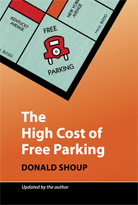
  • TheHighCostOfFreeParking_coverThere is no such thing as free parking. If parking is free, it is being subsidized by someone. The seminal thinking on this issue is The High Cost of Free Parking, by Donald Shoup, as well as writings by others. The objective of managed parking pricing should be to ensure some free parking on every block so that people do not circle looking for parking, and that some of the parking fee income be returned to the neighborhood for improving the right-of-way, including sidewalks and pedestrian amenities.
  • On-street parking is not, as some people think, a bad thing. It slows traffic by generating “friction.” On street parking might be removed when there is clearly a higher use for road right-of-way, such as bike lanes or sidewalks, however, in almost all cases, removal of a travel lane is better for everyone than removal of on-street parking. I don’t support on-street parking because I want to see more space devoted to motor vehicles, but because of the traffic calming effect and because I think on-street parking creates a more livable environment than do parking garages, which I consider to be the lowest use (or mis-use) of urban land, only exceeded by off-street surface parking lots. Our streets would in fact be safer if there were more on-street parking on weekends and evenings, when most of the extremely dangerous  and egregious speeding occurs.

Read More »