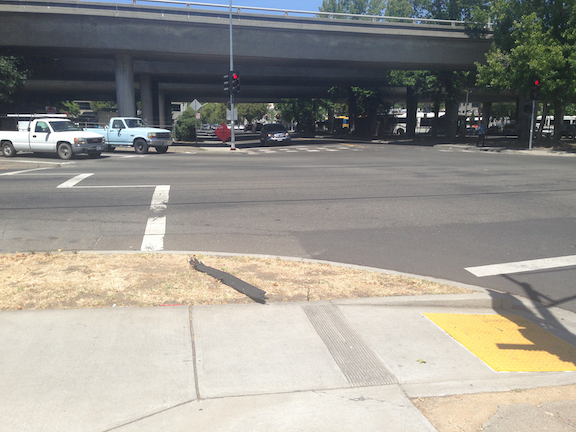
I wrote about the SacRT project to upgrade Watt/I-80 light rail station and bus transit: SacRT: Watt/I-80 station upgrade, and more recently about the freeway and traffic noise issue at Watt/I-80. But I went there not just for the noise issue, but to look at some other issues.
The project included changes to the freeway on-ramps/off-ramps to the north and south of the Watt/I-80 station and bus areas. They were reconstructed to make on-ramps closer to right angles, in order to slow traffic which presents an ongoing danger to people walking to and from the buses and light rail, or anywhere, for that matter.
I-80 on-ramp/off-ramps at Watt Avenue, north side, westbound traffic
The former configuration is shown in the Google map capture, below.
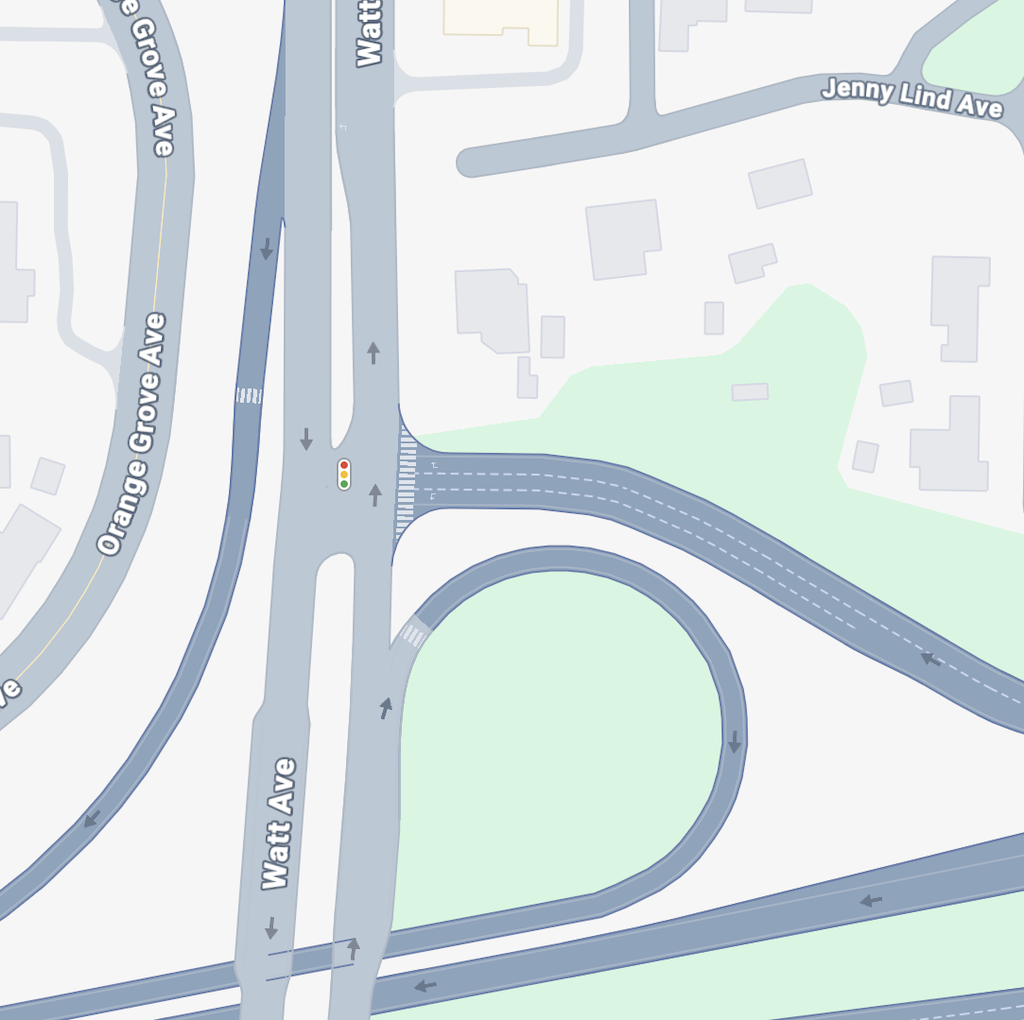
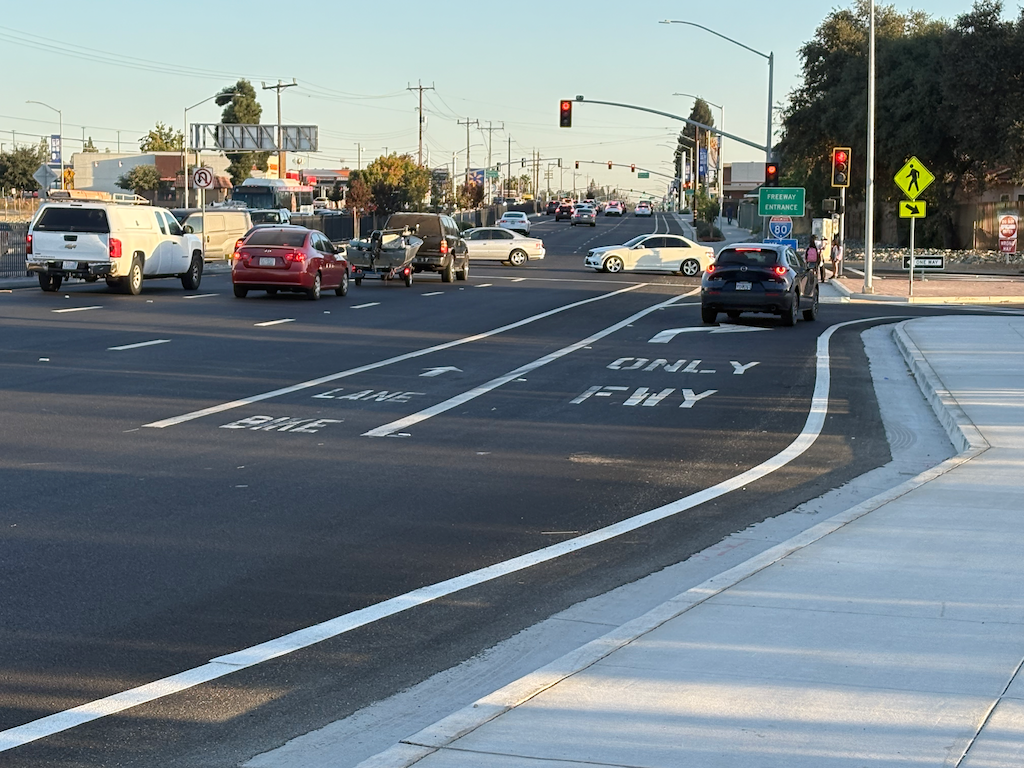
The sweeping cloverleaf on-ramp that encourages high-speed traffic and no attention to people walking and bicycling has been changed to a more right-angle turn, shown below.
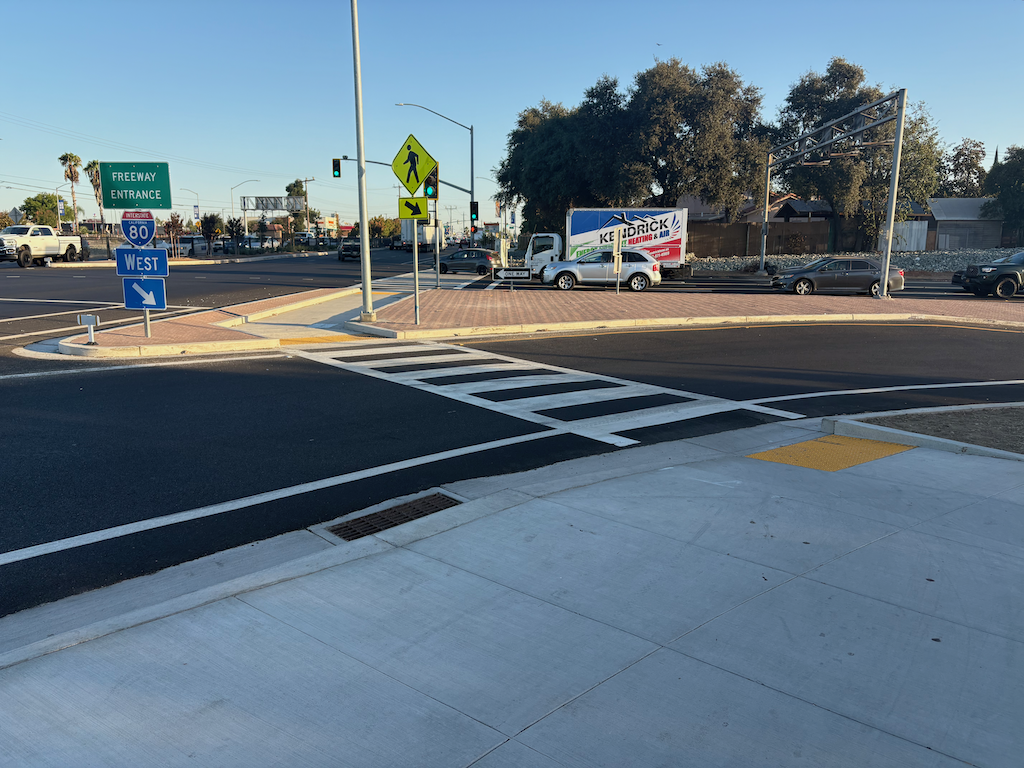
The first shows a bicycle lane that was not present before, and the second a crosswalk over the on-ramp that is more prominent and somewhat safer than before. However, the bike lane lacks marking for the merge zone. There should be skipped green marking that highlights the conflict area in the merge. The current marking implies that motor vehicles have the right of way over bicyclists, when in fact this is a merge area where neither has precedence. Note that Watt Avenue north of this on-ramp/off-ramp has been reconstructed and now has bike lanes, but this is a different project.
The crosswalk over the on-ramp is better marked and better signed than what was there before. However, the implication again is that motor vehicles have the right of way over pedestrians. Though drivers are moving slower than before, there is no indication that they must yield to walkers. Drivers entering a freeway don’t think of these crosswalks as having the same rules as surface streets, if they even are aware that walkers have the right-of-way in crosswalks (many drivers do not know this, and many more know it but don’t follow it). Better, but still not safe.
The off-ramp has not been improved. There are three lanes. I am sure that Caltrans would not have allowed a change that reduced stacking capacity on the off-ramp.
I-80 on-ramp/off-ramp at Watt Ave, south side, eastbound traffic
The former configuration is shown in the Google map capture, below.
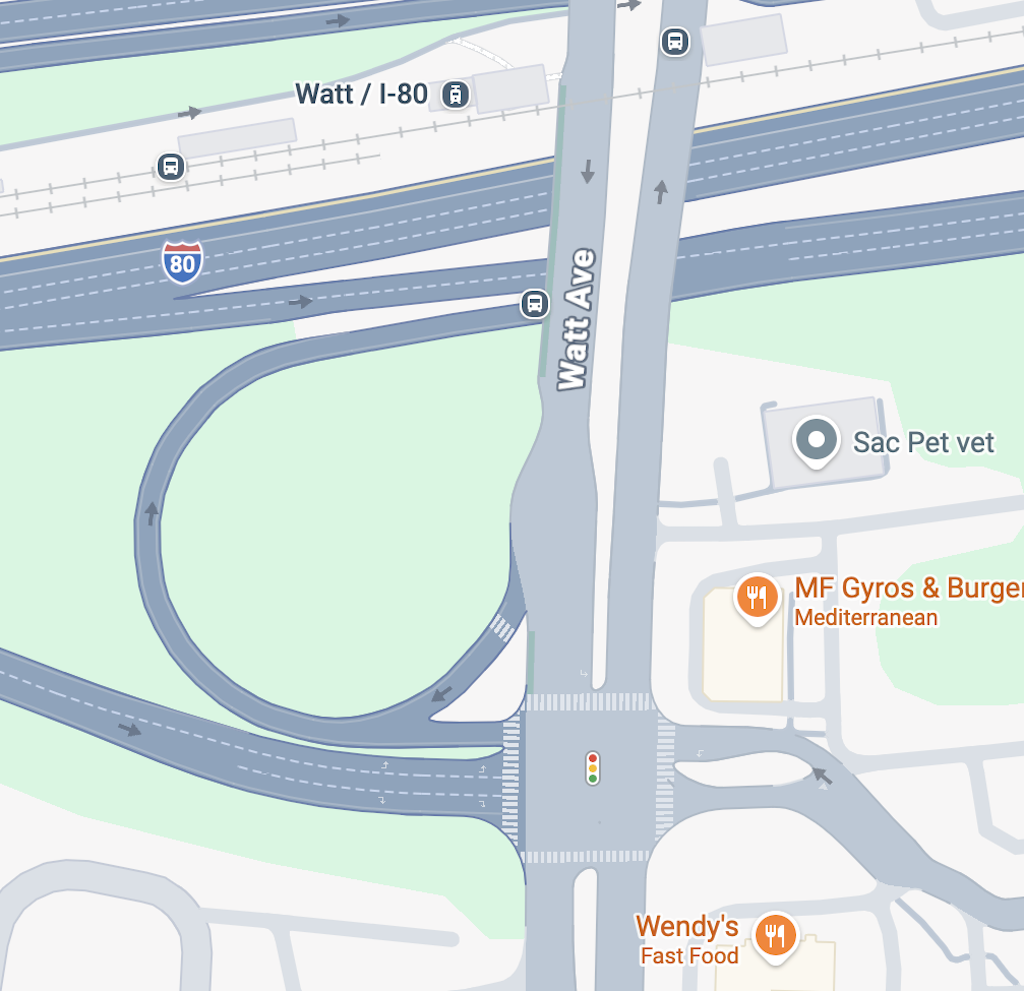
The eastbound I-80 on-ramp/off-ramp from Watt Avenue has also been improved. The sweeping cloverleaf on-ramp has been modified so that the turn is closer to right angle, slowing motor vehicles. The former on-ramp was also a barrier for people with mobility issues, as the sidewalk was extremely steep and awkward. This is a considerable improvement. However, there is no signal or signing control that prevents drivers southbound on Watt from turning across the crosswalk when it is occupied.
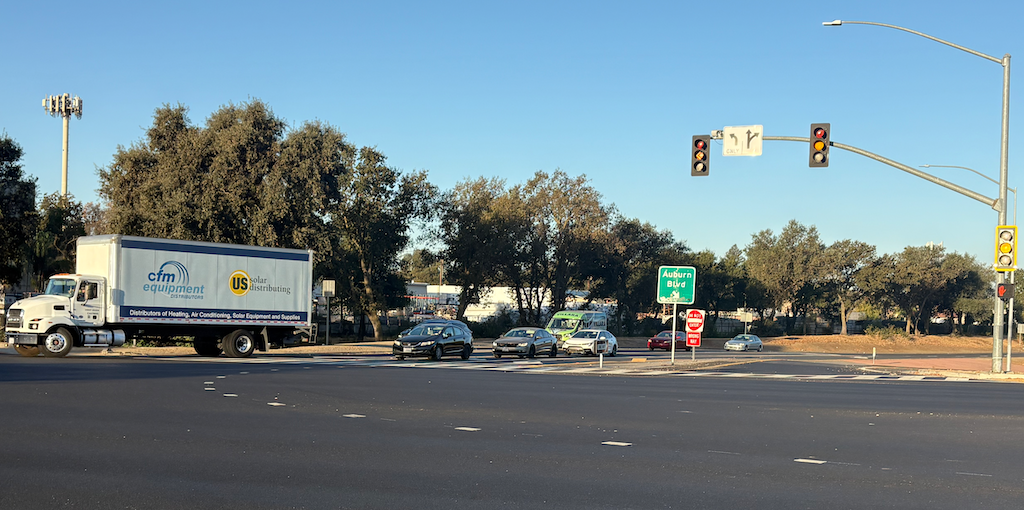
The off-ramp has not been improved. There are three lanes. I am sure that Caltrans would not have allowed a change that reduced stacking capacity on the off-ramp.
I will comment that these freeway interchange improvements should not have been funded by SacRT, but by Caltrans. Caltrans designed and constructed on-ramps that it knew to be unsafe for people walking. It is legally and morally obligated to fix them, on their own dime.
The stair on the west side for accessing southbound buses is closed while bus shelters are being installed for the three southbound bus stops. Construction is underway, so it should not be too long before it is opened again. In the meanwhile, riders who want to board southbound buses must still walk to the bus stop adjacent to the Sacramento Inn & Suites, which has a very constrained waiting area with no shelter, and accumulates trash. At least there are now better crosswalks to access that stop. The elevator on the west side is out of service, for an indefinite period of time while a part is being ordered.
The stair on the east side for accessing northbound buses is open. The elevator on the east side is in service, but has the same issues it has always had: strong smell of urine, graffiti inside and outside the elevator, trash in the elevator, and damaged glass. SacRT made the decision to not add publicly accessible restrooms in the station upgrade, though it was a strong request of the public and transit advocates. As long as there is no restroom, urination in the elevators will continue. The other issues are vandalism, which may or may not be reduced by the better station design and aesthetics.
Though the platform at Watt/I-80 light rail was fairly clean, the track area had large quantities of litter, which has clearly been there for some while. The abandoned San Diego light rail train definitely doesn’t add to the aesthetics of the station, though it may serve some purpose in reducing freeway noise at the platform.
Since SacRT has committed itself to the freeway median for this terminus station, the most important improvement that could be made, after publicly accessible restrooms, is sound walls to block the oppressive freeway noise. The first one should be on the north side of the station, where the walkway between the east stair and elevator and the station platform is oppressively and dangerously noisy. The second would be the south side adjacent to the platform, where the noise is oppressive but not dangerous.
On this trip, I also visited the new Dos Rios light rail station, which I’ll write about soon.