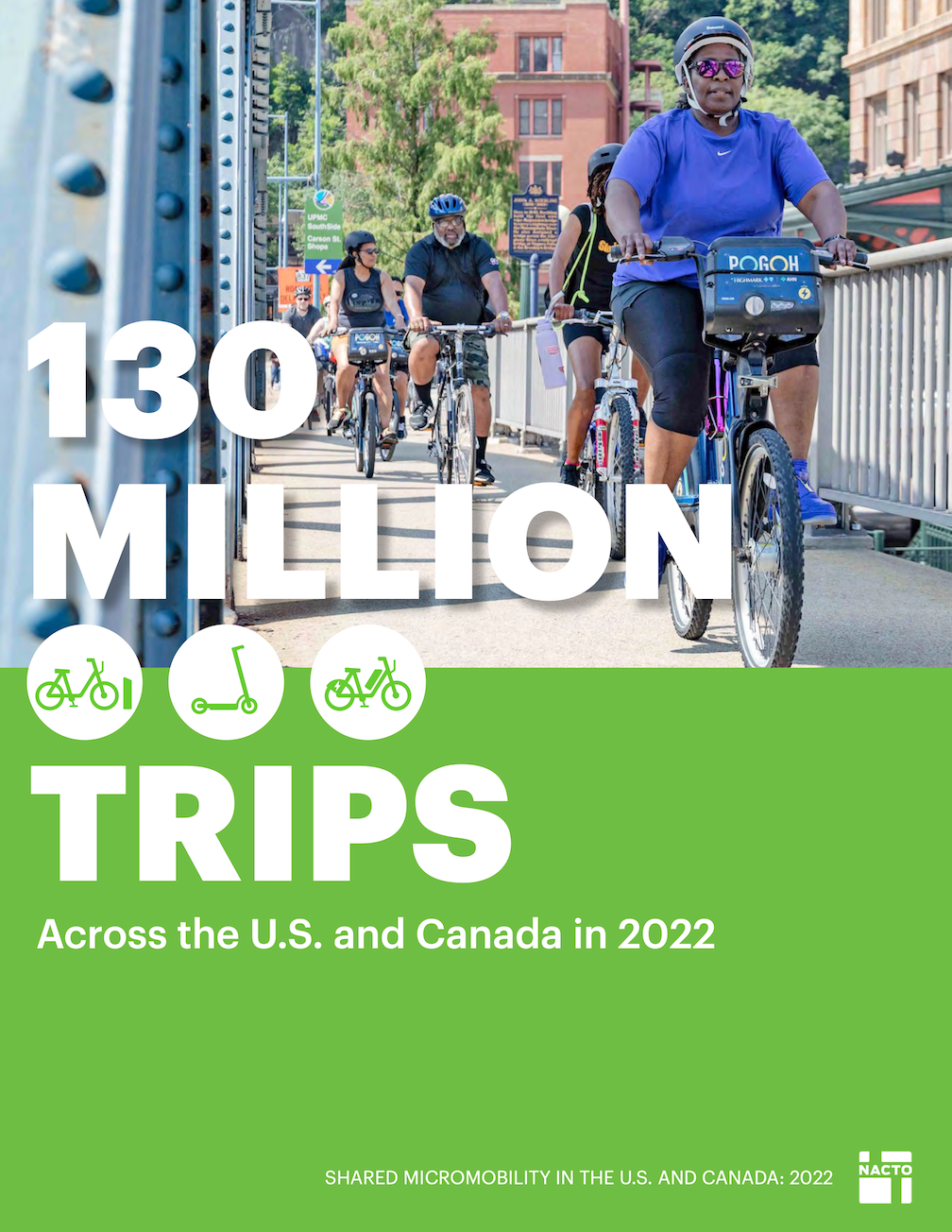
NACTO released it’s Shared Micromobility in the U.S. and Canada 2022 ‘130 Million Trips’ report in September 2023, and the report has a summary webpage at https://nacto.org/publication/shared-micromobility-in-2022/. The report is interesting throughout, but one paragraph in particular is important for the Sacramento situation in which Lime has removed its bikes from the region, and Bird is offering few bikes. Bike share in Sacramento is more or less dead. It is clear that the model of privately owned and managed bike share does not work here. If we are to have bike share, we need a new model. I’ll have one or more posts on that shortly.
From the report (page 10):
“Shared micromobility systems that see consistent growth and equitable outcomes are typically municipally-owned or closely managed through long-term partnerships with private operators. Long-term contracts have resulted in more sustainable results for ridership and the durability of systems. The enduring viability of private sector operators remains uncertain, especially as companies with short-term permits respond to financial troubles by pulling out of cities–often abruptly–altogether. Shared bikes and e-scooters can and should be integral parts of a city’s transportation network, but that is only possible if they are consistently available and resistant to the volatility of market conditions. Partnership models where local governments have greater involvement in their shared micromobility programs generally lead to better outcomes, like more equitable pricing structures, greater investment in historically underserved communities, and ultimately, a greater likelihood of long-term viability.”
Another issue for the Sacramento area was that rental prices for bikes saw several increases during the JUMP and Uber times, and a huge jump when Lime took over. The system had become unaffordable for many former users. Lime originally offered a free for a low monthly fee rental program for people in CalFresh or similar programs, but this year changed to a half-off discount, helpful but hardly affordable. Bird has a similar half-off program. Again, from the NACTO report (page 14):
“The cost to ride a shared bike or scooter continues to rise in numerous cities, posing a threat to affordability. In a year of widespread consumer price increases–including public and private transportation modes–shared micromobility was no exception. Annual membership hikes, alongside rising e-bike surcharges, led to a 70% increase in average per-trip costs for members of station-based bike share systems from the previous year. Pay-as-you-go trips on e-bikes or e-scooters were the most expensive, with average per-trip costs more than double the typical fare of a one-way trip on public transit in the U.S. and Canada.”
I have not yet used the Spin bike share in Davis yet. I’m always in Davis with my own bike, so haven’t been motivated, but I should test it out.
I noticed on the evening of Friday, November 10, that there were no bike-share bikes available on the Lime app, anywhere in the Sacramento region. This is still true on the morning of Thursday, November 16. The red-orange Lime/JUMP bikes had been available throughout the center of Sacramento and West Sacramento. Where have they gone? I don’t know. I’ve received no communication from Lime about the issue, and no one has shared any information with me.
Since there were no Lime/JUMP bikes on the 10th, I looked at the Bird app for their blue bike-share bikes. There were none. As of this morning, there are a few Bird bikes available in the app, but far fewer than there used to be.
I don’t know if the disappearance of bikes from these two vendors was related, or just happenstance.
Bike-share from Lime and Bird are privately owned and operated, under permit from the City of Sacramento and City of West Sacramento. But the permits apparently do not require notification to the cities of major service interruptions or issues. JUMP pulled its bikes from the entire region, without notice to any of the agencies, or the users, at the beginning of the pandemic. Users were left in the lurch, with fewer transportation options that before. The withdrawal, which was not necessitated by the pandemic, was probably a business decision. It killed off the most successful bike-share system in the United States (in terms of rides per bike per day). Sacramento continues to be a second class bike-share market to this day.
I believe that bike-share must be controlled in some way by the transportation or transit agencies. The systems might be contracted out to vendors such as Lime and Bird, but control would be with the agencies. Again, we see the flaws in the privately owned and operated model.
Below is a photo of a Lime/JUMP bike that has been abandoned for three weeks now, parked on my street, P Street, between 13th St and 12th St. It has been reported to the city, twice, and to Lime, three times. And it is still there. Of course the battery has depleted so that GPS no longer works. But Lime knows the last reported location of the bike, before it died.
Let me be clear and blunt. Lime does not give a shit.
This kind of neglect will continue until: 1) the city (and SACOG) holds Lime accountable for managing the bike share fleet, 2) the city or the region gets a real bike share operator, or 3) the city or the region changes to a publicly owned system. The third option is probably the best, because then the city and/or region can manage the bike share system as part of the transportation network, and SacRT can take on some responsibility for the bike share system as a first mile/last mile solution with transit.
The JUMP/Lime bikeshare bikes in Sacramento and West Sacramento say “Available on Lime and Uber” on the bikes. They are not available on Uber. After many months of the Uber app offering only ride-hail car services, they finally added back shared devices under the ‘2 Wheels’ option. The app offers to rent bikes, showing them on the map for selection, or allowing the user to scan the QR code on the bike. It goes to ‘starting ride’ and then… nothing. The bike is not unlocked, and the ride terminates after a few moments, without any message.
I have of course reported this issue to Lime. The support people insist that it works correctly, referring me to or reading from the support article “How does renting a scooter through Uber work?”. When I insist that this is incorrect, their response is, well, just use the Lime app. The reason I want to use the Uber app rather than the Lime app is that I have a large credit in Uber Cash, accumulated from rebalancing bikes in the past, that I want to use.
I’m not a scooter user, so I can’t report whether scooter rental works or not. I’m also not an Android user, so can only report on the iOS app.
The size of the bike fleet continues to be smaller than it was under JUMP. Friends who live outside the central city tell me there are rarely bikes available close to them. even in the central city it may be some distance to a bike. Under JUMP, the system did not work well until the number of bikes deployed reached a critical density of about 900 bikes, and then it worked great, being the most successful location in the country. Lime doesn’t seem interested in achieving this critical density.
I see a lot of dead bikes around, ‘dead’ meaning that the batteries are too low to rent, or the battery has completely run out. For a few of these bikes in my neighborhood, I’ve reported them to both Lime and to the city, but Lime was very slow to pick the bikes up. One dead bike was there for a week before it was picked up; others have been there for several days after being reported.
JUMP unceremoniously pulled out of Sacramento (the Sacramento region program that included West Sacramento and Davis) in the very early days of the pandemic. The bike and scooters disappeared, except for those few that are still out there, abandoned and never picked up. Though the company claimed that the devices weren’t being used, that is not true. Despite people not commuting to work (the stay at home was not yet clearly defined), they were still getting used, at perhaps half the rate as before. I’ve suspected that Uber/JUMP was already planning a pull-out, and saw the pandemic as a convenient excuse. Sacramento had been the most successful JUMP system in the US, in terms of rides per bike per day. Some argue that means they would not have pulled out unless they had to. But I see exactly the opposite reason, that they pulled the bikes and scooters because they were so successfully competing with what Uber considers (and has now demonstrated) to be its core business, ride hailing.
Lime also had scooters here for a while, but they disappeared as well. Spin had a program based on the campus of Sacramento State, and I saw a few of the scooters off campus, but they were never widespread. I’ve heard rumors of other scooter companies, but never saw any of the scooters. There were also some short-lived or planned but not implemented bike and scooter share programs in other cities around the region.
JUMP is now out of the bike and scooter business altogether. They sold the business, and apparently some of the bikes, to Lime. There are stories on the Internet from locations all around the US about Uber recycling the batteries and scrapping the bikes, so this is apparently widespread, and either already has or will shortly erase most of the bike fleet from existence.
Lime had an electric bike share bike for a while, though never in Sacramento. I saw them but never rode one, as the places they were available had alternative vendors that I was already using. The reviews I read said they were much better than the pedal bikes Lime was famous/infamous for, but nowhere near as good as JUMP bikes.
So, what does this have to do with re-opening from the pandemic? I have not heard anything from any of the agencies involved in the bike share program about how bike share can be brought back. SACOG (Sacramento Area Council of Governments), the original sponsor of the Tower Bridge pilot program (remember the white SoBi bikes?), SMAQMD (Sacramento Metropolitan Air Quality Management District), which provided some of the start-up funds, the City of Sacramento, the City of West Sacramento, and the City of Davis. Not a peep. There may be discussions going on, just not public, or there may not be.
This region, not just the area covered by the JUMP program, must have a bike share program. I am less certain that scooters must be part of the program, but I’m sure many feel they should. As people who were using transit but are not willing to right now, for an unknown but hopefully not too long period of time, search for alternatives, the choice to drive, and often to purchase a vehicle in order to drive, would be disastrous for the region. Our air quality has been wonderful for three months, but has already returned to the ‘unhealthy for sensitive individuals’ level even with only a fraction of the pre-pandemic traffic levels. If 80% of those who were using transit now drive, air quality will likely be in the ‘unhealthy’ for all category for much of the summer, and jump into the ‘very unhealthy’ category from time to time. We can’t let this happen. We must provide alternatives for people who cannot and will not drive, and that must include bike share. Of course the impact of motor vehicles, more than 40% of carbon emissions in the state, go far beyond current air quality to civilization-changing climate change, but my biggest concern right now is the short term impact on air quality.
Beyond air quality and climate, there are equity concerns about how we re-open. Yes, I know the JUMP system was not perfect. Even after expansion, it covered only part of the low income communities in Sacramento. JUMP had a low income uer discount program, but it was almost a state secret, and they never solved the issue for unbanked people.
We know that most transit users right now are essential workers and people who have no other way of getting to essential destinations. Those who can have been driving, but many can’t. They are not of a driving age (too old or too young), the have valid reasons they are unable to drive, and they simply do not want to be a part of the planet-destroying car obsession. What are we doing to do for these people? Are we going to put all our transportation eggs (funding and projects) into the cars-first basket, as we have done for too long, or are we going to change our futile ways and provide real alternatives? Are we going to commit low income people to a descending spiral of debt as they try to keep old cars running, or buy cars that barely run, just so they can get where they need to go?
The solution is bike share. Here is what I think needs to happen:
Equity concerns must be predominant in rolling out the new bike share system. Who really needs this option? How can we make sure it works for them? As one of my favorite people, Tamika Butler (and many others) has said, we don’t want to return to normal, because normal was never acceptable. High income state office workers are not the people the new system should be designed for, though certainly it should work for them too.
We must discard the idea that a privately owned and operated system can work to meet the transportation needs of the region. It could be a public system, or it could be a public/private system, but it cannot ever again be solely private.
Bike share is identified as a critical transportation service, and as a logical part of the transit system. This does not mean that it is operated by transit agencies, though it could be, but that transit agencies are a core partner in the program.
Major traffic attractors will not reopen until a bike share system is in place to handle the additional car traffic that might otherwise be generated. This most definitely includes shopping malls, and probably includes government offices in downtown Sacramento. Universities and colleges are not an issue, for now, as they will be online and not the trip generators they usually are.
Funding for bike share infrastructure (bikes and bike racks) will be diverted from road building projects. If the emergency powers of the state and county have any meaning at all, this is well within their power to do. When transportation agencies talk about the ‘color of money’, what they generally mean is that they don’t want to make the effort to justify different uses, and they are happy with the current mode share. Time to end that malfeasance.


 Getting Around Sacramento