I previously wrote about the possible alternative 2 alignment of the Stockton BRT north of Broadway on Stockton, west to T Street and then on 29th/30th streets, and then on L/J streets to Sacramento Valley Station. The big advantage, and it is a big one, is that the BRT would then serve Aggie Square, and all the medical, office, and housing developments along Stockton between Broadway and T Street. Those developments already produce ridership on Route 38, and would in the future produce a large number of riders. However, as previously stated, this alternative is only workable and equitable if SacRT and the city commit to a high frequency route serving Broadway between Stockton Blvd and at least 19th Street. Though residential density drops off after 19th Street, the low-income housing of Alder Grove southwest of Broadway and Muir Way, and the developing area of The Mill southwest of Broadway and 5th Street (which is beyond the current route) should have service. How a replacement route would navigate to downtown is a decision for SacRT planners.
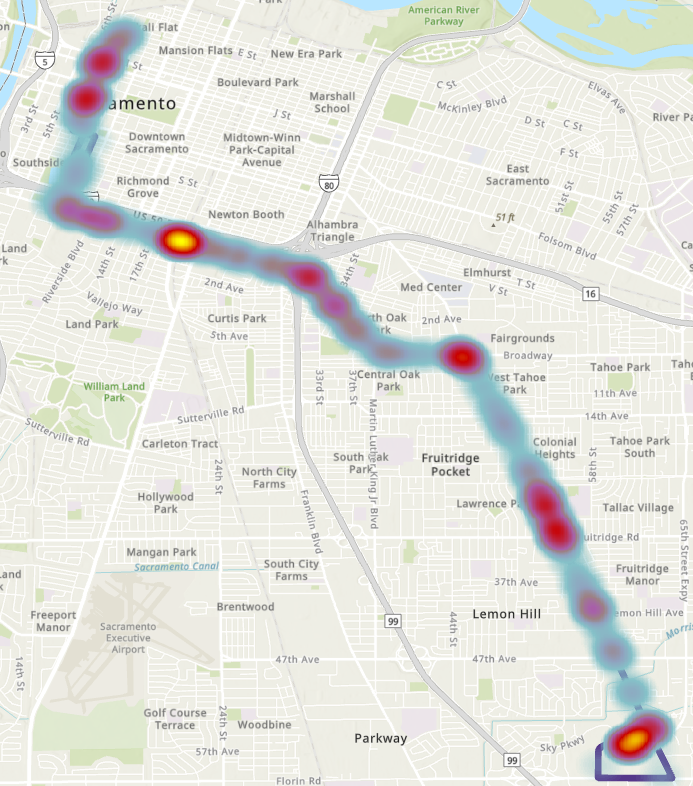
SacRT provided the heat map below of boardings along the existing Route 51. The two highest locations are 19th St/21st St, which is not surprising since this is a transfer point for Blue Line Light Rail at the Broadway Station, and Florin Towne Centre Transit Center at the south end of the route. This high point surprises me since when I’ve been on Route 51, there are few riders south of Fruitridge Rd, but there must be patterns that I’ve not observed. Other clusters are at J Street and N Street, which are most likely state workers and support workers, at Alhambra, at Broadway and Stockton, and on Stockton in the vicinity of 21st Avenue.
Route 51 ridership heatmap (from SacRT)
SacRT also provided weekday ridership data (xlsx). Out of a total weekday ridership of 4787, stops in downtown and along Broadway have a total ridership of 2638 (about 55%), along Stockton 1890 (about 39%), and at Stockton & Broadway 260 (about 1%). Clearly, Broadway and downtown stops along the existing Route 51 are critical to riders, even more so than Stockton Blvd. Therefore, bus service along Broadway must be maintained as frequent service, 15 minutes or better, if a new alignment for BRT is implemented.
No high frequency service on Broadway, no alternative route 2. Period.
For additional posts on Stockton Blvd, both the current STEP project and earlier iterations, see category: StocktonBlvd.
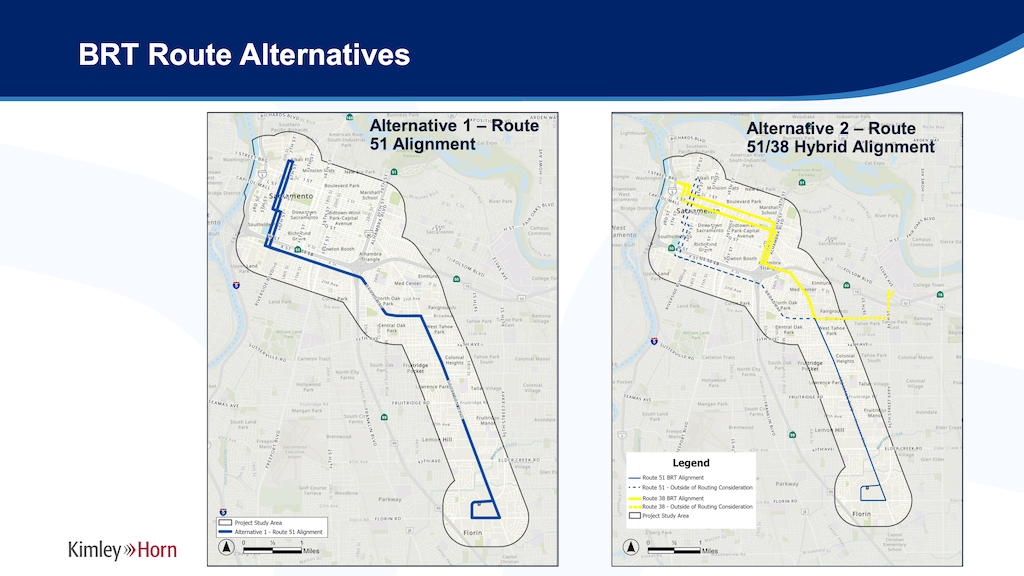
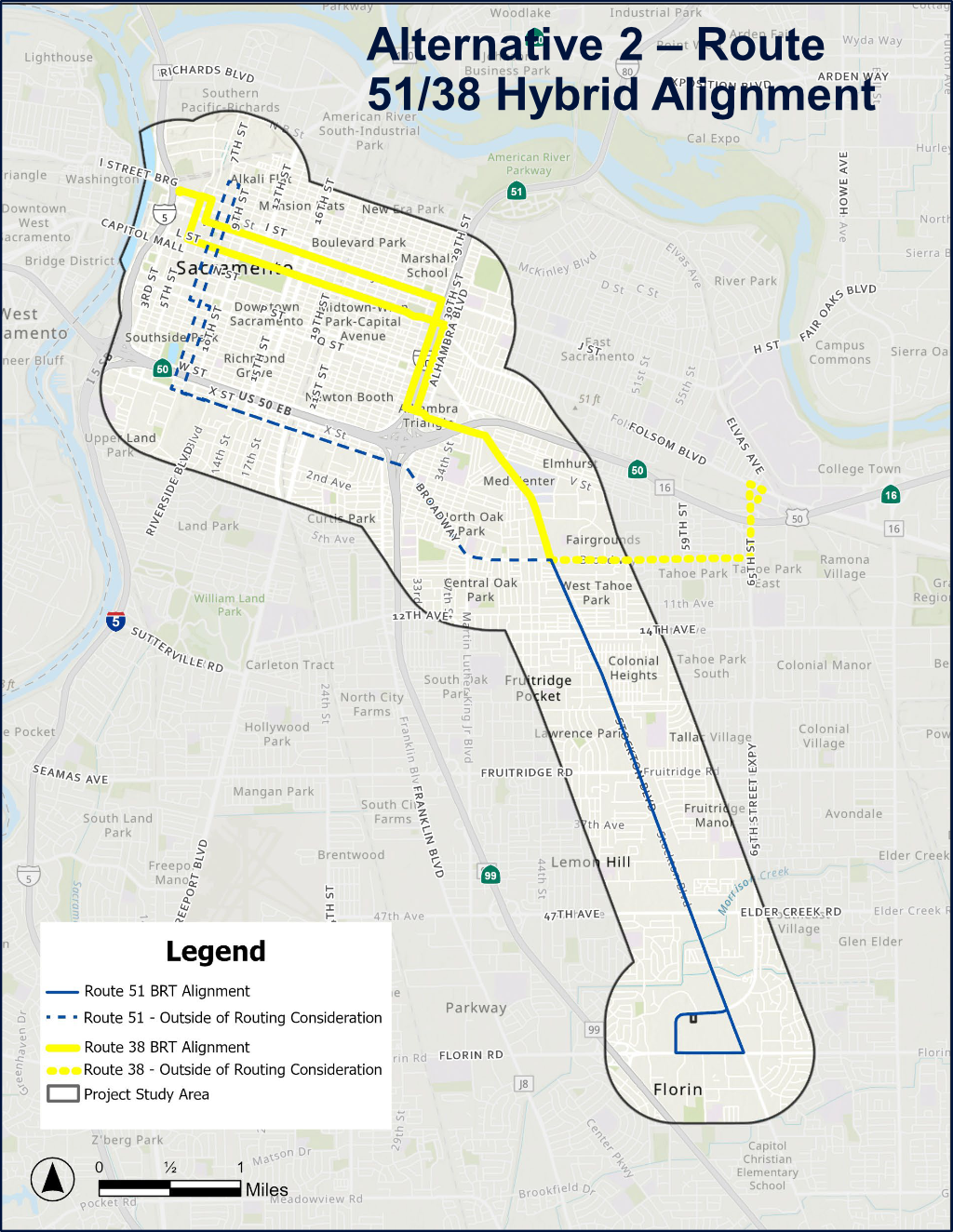
Part of the Stockton Boulevard Safety and Transit Enhancement Project (STEP) is consideration of changing the BRT (bus rapid transit) route north of Broadway to part of SacRT Route 38. In a presentation at the STEP stakeholder meeting on February 19, and in the similar presentation to SacATC on March 12, this alternative was presented by a slide (page 7) and additional discussion. That slide is below, followed by a slightly more detailed Alternative 2 – Route 51/38 Hybrid Alignment.
STEP BRT Route Alternatives, from SacATC presentationSTEP Alternative 2 Route 51/38 Hybrid Alignment
At SacATC, Commissioner David Moore raised the issue that the existing Route 51 along Broadway is also a very high ridership corridor, serving to connect equity neighborhoods to downtown and to Stockton. Replacing Route 51 high-frequency (15 minute) service with a moderate-frequency (30 minute) route, as Route 38 currently is, would be a disservice to these riders and raise major equity issues.
The segment of Broadway from Stockton Blvd to 8th/9th Streets, and probably into downtown, MUST have high-frequency (15 minute) service.
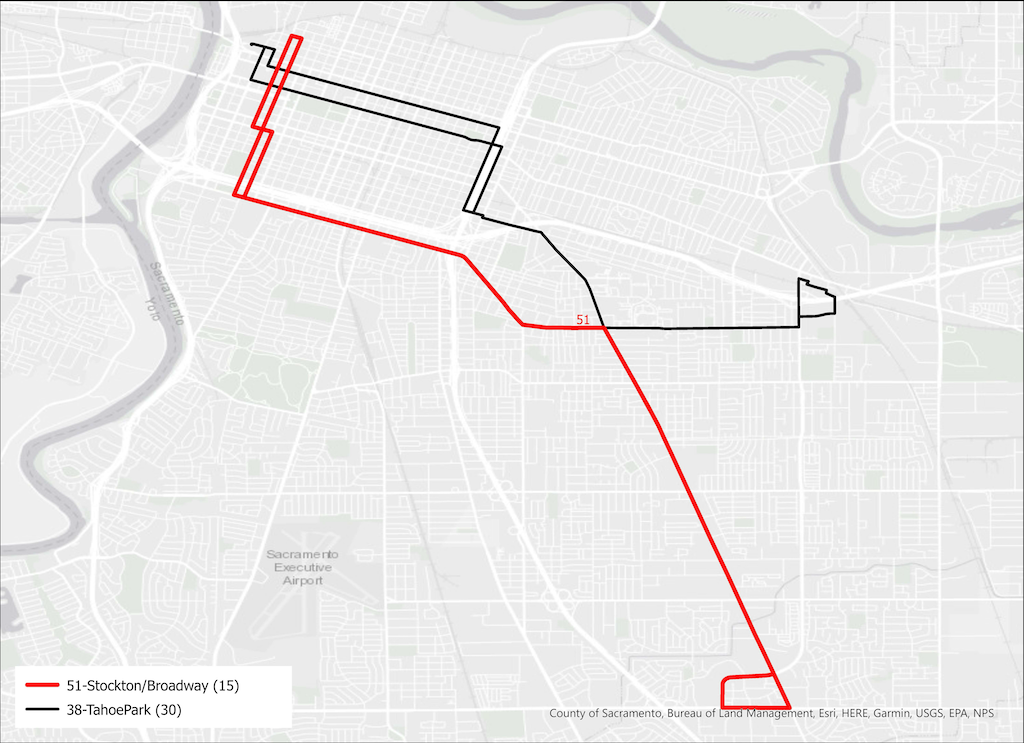
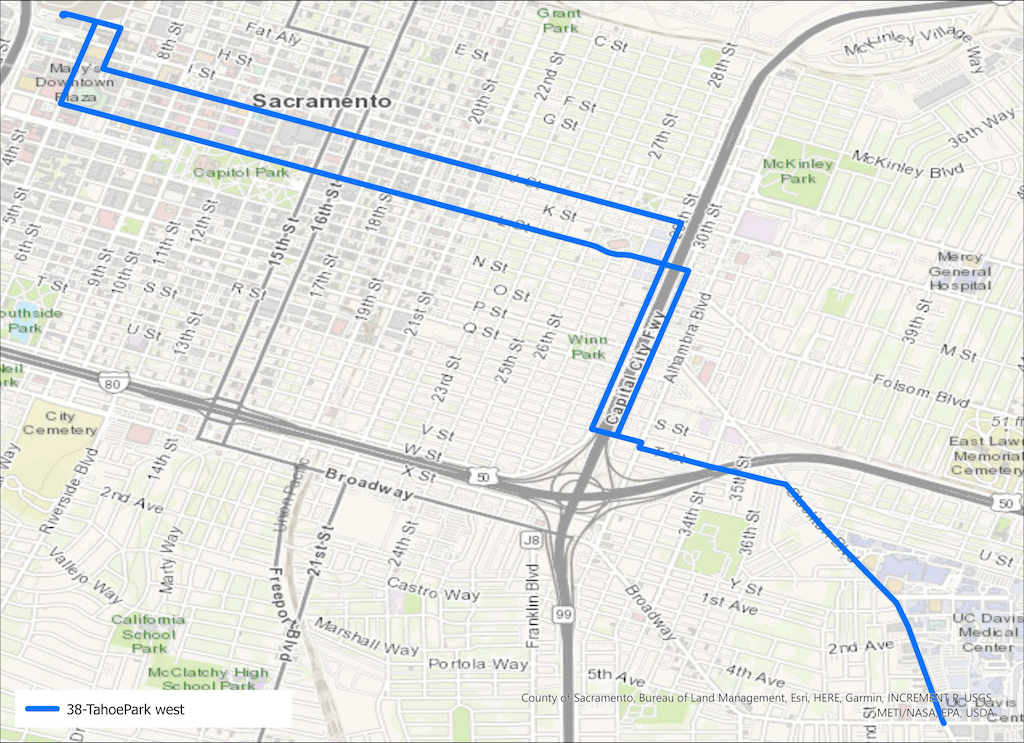
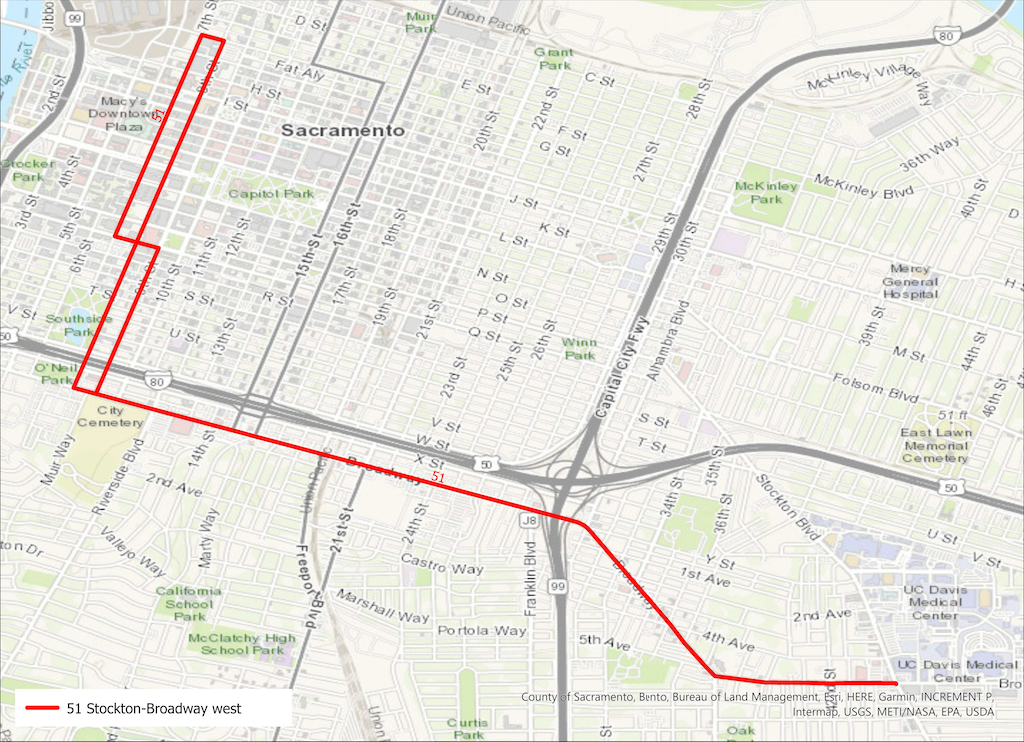
The two existing routes, 51 with a high-frequency (in SacRT terms, though this would be considered moderate frequency in major cities), and 38 with a moderate-frequency, are shown below (pdf).
SacRT Routes 51 and 38 existing
Though it is not stated anywhere, the STEP alternative 2 map implies that the BRT route would end at Sacramento Valley Station rather than 8th St & F St as Route 51 currently does.
The western part of Route 38, which would become Stockton BRT under the alternative 2 51-38 hybrid, follows Stockton from Broadway north to T Street, then northbound on 30th Street or southbound on 29th Street, then west on L Street or east on J Street, and thence to Sacramento Valley Station.
SacRT Route 38 west segment, potential Stockton BRT
The west portion of the existing Route 51, from Stockton Blvd to 8th/9th Streets, is the segment that must have high-frequency (15 minute) to continue to serve the present high ridership. It is possible that this route would terminate at Sacramento Valley Station as well. It is unknown whether ridership on the existing Route 38 to the east, terminating at 65th Street light rail station, would also justify high-frequency service, and whether it this would be combined with existing Route 51 west. Map below (pdf).
SacRT Route 51, west segment, from Stockton Blvd to downtown
All-lanes tolling means that all lanes of a freeway or bridge are tolled, or priced. Freeways and bridges are incredibly expensive to build and maintain, even if they are not way over budget as most bridges and many freeways are. Gas tax or road charge (road charge) will never be enough to pay for these infrastructure projects and maintenance. Therefore, more than half of the cost is shifted onto taxpayers who use less of these facilities, or don’t use them at all. In the future, either more and more taxpayer funds will go to keeping these facilities in state of good repair, or they will deteriorate, which is already happening in many places. The solution is to have the users of such facilities pay the full price of such facilities.
Caltrans approach to transportation is to continually build more and to under-maintain what they already have. Anyone who says the era of big, expensive bridge and freeway projects is at an end doesn’t know Caltrans. Caltrans is like the heroin addict who needs ‘just one more hit, and then I’ll quit’. The only solution is to have Caltrans go ‘cold turkey’, ceasing all freeway expansions and focusing on maintenance. Of course most Caltrans engineers would be suddenly superfluous, and that it the real issue, that freeway and bridge building is just an employment program for engineers, having little to do with meeting the needs of the traveling public.
Note: This post was rushed out and not well written, so I’ve revised it.
The Caltrans-led Yolo 80 Managed Lanes Project suggests adding roadway capacity to the Yolo Causeway in a number of different configurations. The project alternatives listed are:
No build: Alternative 1: This alternative does not address the purpose and need of the project by not making corridor improvements and relieving traffic congestion.
Build Alternative 2: Add a High Occupancy Vehicle (HOV) lane in each direction for use by vehicles with two or more riders (HOV 2+).
Build Alternative 3: Add a High Occupancy Toll (HOT) in each direction for use by vehicles with two or more riders (HOT 2+).
Build Alternative 4: Add a HOT lane in each direction for use by vehicles with three or more riders (HOT 3+) Lane in Each Direction.
Build Alternative 5: Add an Express Lane in each direction (everyone using the lane pays to use the lane, regardless of number of riders.).
Build Alternative 6: Add a Transit-only lane in each direction.
Build Alternative 7: Repurpose the current #1 general purpose lane to HOV 2+. No new lanes would be constructed.
Build Alternative 8: Add a HOV 2+ lane in each direction with I-80 connector ramp.
Of these alternatives, the only one which would not increase VMT (vehicle miles traveled) is #7, converting an existing general purpose lane to HOV 2+. Caltrans has on many projects claimed that state law does not allow this, but Yolo County forced Caltrans into including this option. All the other alternatives (except no build) would increase VMT ranging from a little to a lot.
It is true that the bulk of the motor vehicle traffic between Sacramento and Davis is not commuting traffic, but it is also true that the addition of commuter traffic to the background bay area to Sacramento and beyond is what causes the worst congestion episodes. Actually, the worst episodes are caused by traffic crashes, which none of these alternative would address. Caltrans sees traffic crashes as just part of the cost of doing business, and does not see reducing these as their responsibility.
The alternatives identified are missing two important ideas.
One alternative not mentioned is to increase service on Capitol Corridor between Sacramento and Davis to hourly or better, all day, over a longer range of hours. The trip on the Capitol Corridor takes only 15-minutes, about the same as the freeway when it is free-flowing, and far better than the one hour bus trip.
Many people have said that increasing passenger service on Union Pacific-owned tracks is impossible, because UP won’t allow more passenger trains without substantial taxpayer subsidies for track improvements. The Sacramento-Roseville third track project is basically a bribe to UP to allow some more passenger service. I don’t see this as a valid argument. Though freight railroads are regulated by the federal government, not the state, there are dozens of ways in which the state can put pressure on UP by withdrawing support and permission unless there is cooperation. UP net worth is $139B, large for a transportation company but very small in the world of corporations, while California is the fifth largest economy in the world. Are you saying that California has no leverage over UP? California could even buy out all UP tracks in the state, thereby solving the passenger vs. freight issue.
The second missed alternative is to subsidize high frequency bus service, 15-minute or 30-minute, on all weekdays, with a long range of hours, at least 5:00AM to 11:00PM. Service on weekends might be only hourly, but it would be a 30 minute trip without stops, rather than the hour-long Yolobus service. If Yolobus could afford to offer high frequency service between Sacramento, West Sacramento, and Davis, they would already be doing so. High frequency service could be offered for years on the same amount of money that will be wasted on capacity expansion for motor vehicles. The project alternatives do offer some support for buses, as buses can use HOV (high occupancy vehicle) and HOT (high occupancy toll) lanes, and alternative 7 even has dedicated bus lanes. But there is no mention of how this would be taken advantage of. If funding for buses is not increased, buses will not be a significant solution for the corridor.
Caltrans of course has no desire to fund non-motor vehicle transportation, despite slapping the ‘multi-modal’ label on everything they propose. As always in Caltrans District 3, walking, bicycling and transit are an afterthought, crumbs added if it doesn’t seem to interfere with private vehicles and commercial freight, not part of the project design criteria.
The Caltrans presentation on the project does not mention bicycles at all. There is an existing bike route all the way from Davis at Olive Drive offramp to West Sacramento at the Capitol Avenue onramp. There is a 3-mile Class 1 path from Olive Drive to county road 32A, then a shoulder on 32A, then a 4-mile Class 1 path to the edge of West Sacramento. There portion of the path on the elevated causeway bridge is in decent shape, but the asphalt part is seriously deteriorated. Whether the project means to improve the path or not is unanswered. To Caltrans, ‘multi-modal’ is just a catch phrase, not meant to be taken seriously. Even if this path is improved, the ride alongside the freeway will still be very unpleasant. The ultimate solution is to move the path north of the railroad, far away from the freeway.
Check the City of Davis, City of West Sacramento, and Yolo County pages on the project. Note that the alternatives listed, project description, and maps are somewhat different on each of these pages, because they were created at different point in time of the project planning.
It is not clear from any of the pages whether there is a still a chance for public input. Workshops were conducted in 2022. Whether or not there is still an open process, you can email Caltrans (Yolo80corridor@dot.ca.gov), City of Davis, City of West Sacramento, and Yolo County with your opinions.

 Getting Around Sacramento