City of Sac blind adherence to ADT

Another post on the Freeport Blvd Transportation Plan. See the category Freeport Blvd for other posts.

“We are designing for the traffic we have, not for the traffic we want.”

Ali Doerr Westbrook, Chair of Sacramento Active Transportation Commission

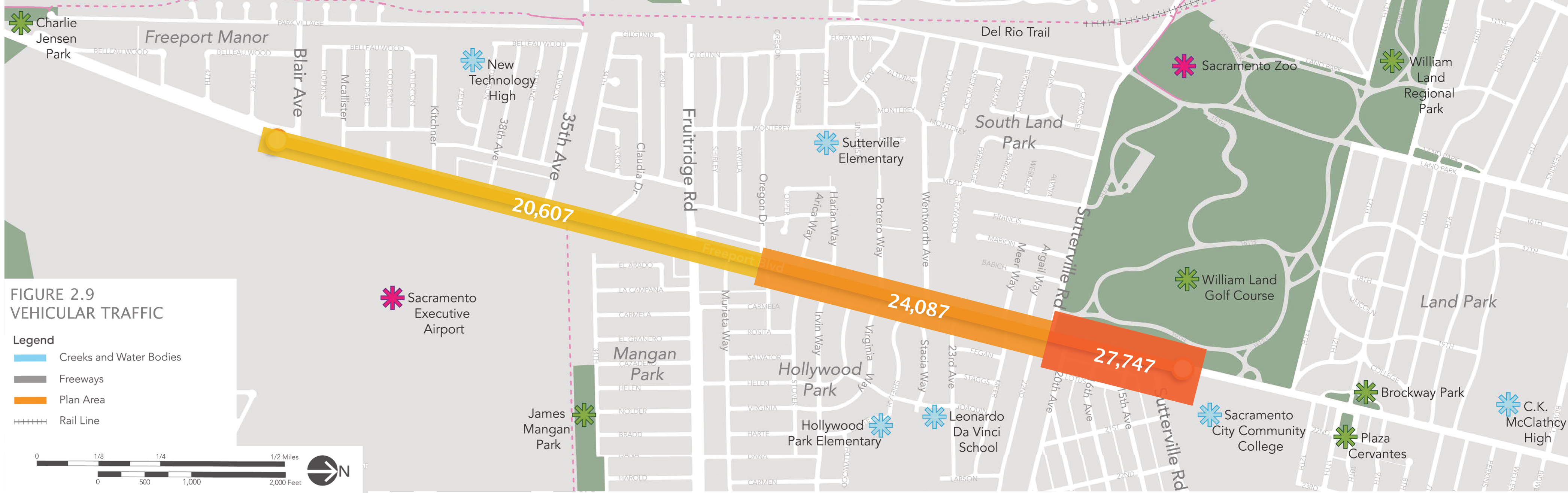
I could stop at that, but perhaps you’d like some more detail. This comment was made during the Sacramento Active Transportation Commission (SacATC) meeting on January 18, 2023. The context was the admission by the two city planners, Leslie Mancebo and Jennifer Donlon Wyant, that the city eliminated the possibility of a road diet (roadway reallocation) before even starting planning for Freeport Blvd. The reason expressed is that the ADT (Average Daily Traffic count) is above 20,000 for Freeport, and that requires more than two lanes (one each direction). Interestingly, ADT counts for various locations along Freeport are nowhere to be found in the plan or appendices. In a different location on the City of Sacramento website, Traffic Counts, the ADT for various locations along Freeport Blvd, rarely exceed 20,000, and have not exceeded 20,000 since 2011. There is no indication that the city even did new traffic counts in preparation for this planning effort. So far as can be determined, they just decided to not consider a road diet from four lanes to two lanes, or two+one lanes, 3/2 configuration) because they wanted to prioritize motor vehicle traffic over all other uses of the roadway.

The city planners also acknowledged that a road diet was a prominent request of the community during the planning process. But, community input be damned, the city is going to serve car drivers before anyone else.

A reduction of lanes from four to two is the single most important traffic calming effort that can be made on a roadway. That does not mean it is the appropriate solution for Freeport Blvd, or for all of Freeport Blvd in the planning area. What is does mean is the that city should have considered it in the planning process.

Back to Ali’s comment. The city is planning for a roadway configuration that should have already been in place years ago, before the city over-widened the roadway, and in several cases narrowed sidewalks to accommodate the widening. They are not planning for a roadway which would reduce vehicle miles traveled (VMT) or increase safety and access for those outside cars. The city’s responsibility, under the Mayors Commission on Climate Change report, is to reduce VMT in order to reduce greenhouse gas emissions (GHG), not to maintain VMT at current levels. But this Freeport plan is a plan to guarantee current VMT for at least 30 years in the future, which is about the length of time before the city will be able to reconstruct the roadway again, and correct the mistakes they made this time around.

The intent of the city in this plan is made very clear in the common design principles: “10. Maintained necessary travel lanes, turn lanes, and parking: Maintaining travel lanes and turn lanes ensures that drivers traveling along the corridor will not be compromised, and preserving parking spaces where 5 the utilization is higher so it serves better adjoining businesses.” Though this is the last item in the list of ten, it is clear that this is the highest priority for the city.

The refusal to consider a road diet/lane reduction/roadway reallocation is a fatal flaw in this plan. The effort should be sent back to staff to re-do. It should not be adopted by city council. If the city council does not reject this kind of flawed planning, city staff will continue to make the same mistake, again and again and again.

I’ll post on some of the other flaws in the plan, but this is the most important, not just because it misses the best opportunity for traffic calming, but because it retains roadway width for the exclusive use of motor vehicles that could be better used for walking, bicycling, trees, and even parking for businesses.

Added graphic below, which I had not noticed in the plan, that documents vehicular counts on sections of Freeport Blvd. Is it suspicious that half of the plan area is ‘just’ over the city’s criteria of 20,000 ADT? Remember, the plan itself and the city’s traffic counts website do not indicate this level of ADT.
Measure 2022: Southeast Connector exceptionalism

A group calling themselves A Committee for a Better Sacramento is sponsoring a citizen-initiated ballot measure for the November election, titled “Sacramento County Transportation Maintenance, Safety, and Congestion Relief Act of 2022—Retail Transactions and Use Tax”. (Note: Some people are referring to this as Measure A, but measure letters are assigned by county elections, not by the sponsors. I’ll continue to refer to it as Measure 2022, for now.)

One of the major projects in the measure is the Capital Southeast Connector, a new freeway from Folsom to Elk Grove. Future posts will talk about what a bad transportation idea this is, but for now, what a bad part of the measure it is.

The measure essentially makes the Capital Southeast Connector JPA the judge of whether the project meets air quality requirements – the fox watching the henhouse. It is somewhat obscure what the language means, and takes a close reading, but the gist is that if the project fails to meet air quality requirements and therefore is not included on the project list in the MTP (SACOG Metropolitan Transportation Plan), the JPA can go its own way and decide for itself that the project meets requirements.

K. Metropolitan Transportation Plan & GHG Reduction Targets. The Sacramento region Metropolitan Transportation Plan/Sustainable Communities Strategy (MTP) currently requires that the region meet a 19% per capita greenhouse gas (GHG) reduction target. Expenditure Plan projects that are planned or programmed for construction in an MTP, as may be amended from time to time, shall be eligible for Measure funds. Expenditure Plan projects not planned or programmed for construction in an MTP shall be eligible for Measure funds if the construction phase of the project is exempt from project-level and regional level air quality conformity.

For any non-exempt projects that are not planned or programmed for construction in an MTP, as may be amended from time to time, the following requirements will apply:

For any non-exempt projects that are not planned or programmed for construction in an MTP, as may be amended from time to time, the following requirements will apply:

1. In order to meet the then applicable regional GHG reduction target for the MTP, project sponsors (parties) shall develop mitigation measures for any project(s) that increases GHG emissions.

2. If the parties can mitigate any such project impacts to maintain adherence to the then applicable regional GHG reduction target, the project(s) shall be eligible for Measure funds.

3. If the GHG impacts are not mitigated to meet the region’s then applicable GHG reduction target, and as a result the region cannot meet its applicable GHG target, the funds planned for the non-exempt project(s) may be used by the corresponding Implementing Agency at their discretion, for other than the originally intended project(s), provided any alternative project(s) are consistent with the Expenditure Plan and included in an MTP, as may be amended from time to time, that meets the then applicable target. Per above, alternative project(s) not planned or programmed for construction in an MTP shall be eligible for Measure funds if the construction phase of the project(s) is exempt from project-level and regional-level air quality conformity.

Measure 2022, Exhibit A, Chapter 1, Section K

This treatment of the JPA might very likely be found to be unconstitutional, but the measure proponents have thought of that too:

If any portion of this Measure is held by a court of competent jurisdiction to be invalid, we the People of the Sacramento Transportation Authority indicate our strong desire that: (i) the Authority use its best efforts to sustain and re-enact that portion, and (ii) the Authority implement this Measure by taking all steps possible to cure any inadequacies or deficiencies identified by the court in a manner consistent with the express and implied intent of this Measure, including, to the extent permitted by law, adopting or reenacting any such portion in a manner consistent with this Measure.

Section XII, Paragraph B, of the potential measure

In other words, if we, the sponsors included something illegal or unconstitutional in this measure, we expect the Sacramento Transportation Authority to defend the measure and make sure it all gets implemented.

To mitigate the immense GHG/VMT (greenhouse gas emissions / vehicle miles traveled) generated by the Connector, the measure proposes Transit and Rail Congestion Improvement Projects. With somewhat less money allocated to this than the Connector, these expenditures might make up for the harm of the Connector, but would not address any other needs in the county. It also proposes BRT features for the Connector, which is ridiculous as this is the last place in the county that a transit agency would propose BRT.

If the Connector, as a whole or in the piecemeal projects by which is has already been partially constructed, causes the region to not meet its legally required greenhouse gas reduction target of 19%, the entire region would therefore be under non-compliance, and therefore ineligible for federal grants.

The proponents see the value of the Connector as enabling greenfield development in the southeast area of the county. Though touted as a solution to congestion on Hwy 50 and Hwy 99, it will not be. What it will do is encourage long distance commuting between El Dorado County and Elk Grove, and generate VMT trips due to the greenfield developments along the corridor. The Connector will not turn out to be a boon to Folsom, Rancho Cordova, and Elk Grove, but yet another congested highway, sucking value away from the cities and citizens.

Search for category Measure 2022 to see posts as they are added.

I’m tired of the electric vehicle conversation

Warning: Grumpy old man mode.

I am really, really growing tired of the electric vehicle boosterism that pervades the environmental community. It is sucking all the air out of organizations and meetings, diverting attention away from solutions that would have a much greater impact on greenhouse gas emissions (GHG). The transportation sector is responsible for 41% of GHGs in California (2020), and that percentage will continue to climb as we work to reduce the other sectors. Except for this pandemic period, GHG emissions from vehicles have continued to climb every year, and they will probably go back to their rise when the pandemic is over, and that is already happening in some places.

Do electric vehicles have a lower emissions impact than fossil fuel vehicles? Yes, but the difference is not enough to justify the boosterism. Until our electricity supply is 100% renewable (with storage of course needed for peak periods), and we are not importing electricity from other states, the impact from electric vehicles will be unacceptably high.

And there is the other impact of vehicles. You’ve all seen the images, a take off on the old one showing the number of and space used by cars, buses, bicycles and walkers, showing congestion from electric vehicles being exactly the same as fossil fuel vehicles. But congestion is actually a friend to walkers and bicyclists, so mostly a concern to transit and drivers.

The biggest problem with cars is that they dominate our cities, and make compact, walkable development and neighborhoods impossible. I live in a place (downtown Sacramento) where nearly all of my needs are within walking distance, and the few that are not are within bicycling distance. I’m car free and have been for ten years (I had written care free instead of car free, but you know, it is much the same thing).

Yet car drivers through downtown, many but not all of them people who don’t live in downtown, challenge me for right-of-way every time a use a crosswalk. Crossing the street should not require either yielding my right of way to drivers, or trying to intimidate them into stopping (which most walkers are too afraid to do, rightly so). When I’m bicycling, drivers running red lights and not coming close to stopping at stop signs are a constant danger, meaning I have to be on high alert rather than enjoying my place and my ride. The nature of the majority of drivers is that they willingly intimidate walkers and bicyclists. People driving electric vehicles are not any better. Tesla drivers are giving BMW drivers a run for their money in competition for the worst drivers on the road.

Because of the space taken up by cars, the roadway, on-street parking, off-street parking, everything is further away. Downtown and midtown, things are still within a reasonable distance, but that is not true anywhere else in the region except downtown Davis, old town Folsom, and old town Roseville. The amount of land devoted to cars is truly amazing, and sad, and criminal. Six lane or more arterials, with parking lanes and turn lanes. Six lane or more freeways, with the ever present threat to widen them. Katy Freeway (26 lanes in Houston area), coming to your community, courtesy of Caltrans!

I suspect a lot of the energy behind electric cars is just people who really don’t want to give up their car, at all, ever. They are the same people who bought Prius cars because they were more environmental, and continued driving the same or more, and then bought Tesla cars because they are even more green, and continued driving the same or more.

Car drivers kill more than 40,000 people every year in the US, and it looks like 2020 is going to be 43,000 when the official data is in. Motor vehicle fatalities are usually a bit above gun-related deaths. Cars are the leading cause of death for children and young people. Many people tolerate this as just part of the way things are, but it is not the way things are. It is the result of our American car addiction, and the design of our roadways (engineers are morally and legally responsible for this), and the choices of drivers.

Here is my suggestion. We remove one-half of all cars from service, by whatever means necessary, with whatever funding it takes. There should be criteria that prioritizes: 1) the most polluting cars; and 2) cars owned by drivers who drive a lot, 3) cars that are not used but still take up space on the street. I realize that there are homeless people living in vehicles, and I’m not talking about those, but the ones just gathering dust and leaves and cobwebs. I am not suggesting that the government pay going prices for these vehicles, but something quite a bit less. If necessary to induce the change, we can simply refuse to renew registration on vehicles in these categories.

Then, and only then, we start subsidizing replacement of the remaining internal combustion cars with electric, starting with the lowest income people. If we devote X amount of dollars to this, and X amount only gets us up to 40% of the median income, that is just fine with me. As many studies have shown, it is high income people that are receiving almost all the benefits from electric vehicle incentives. That is classist and racist, and must stop. We might eventually get to higher income levels, but only after replacement in the lower income levels has been achieved. That means we need to immediately end the programs as they exist and revise them to be equitable. If you are an electric car booster and and not working to achieve equity, you are just being an entitled jerk.

Please, let me not hear anything about electric vehicles the next time I go to a meeting or jump on Twitter. Please.

Rangeland conversion threatens GHG goals

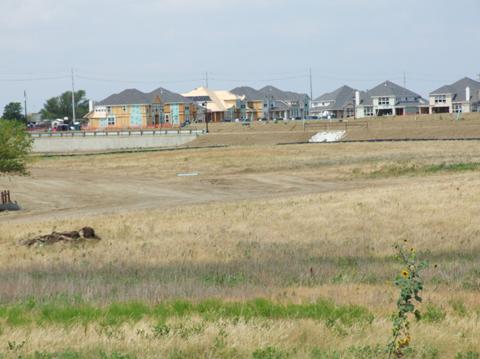
rangeland to exurbs, USGS photo

A research paper posted on PLOS entitled Whither the Rangeland?: Protection and Conversion in California’s Rangeland Ecosystems highlights the problem that exists everywhere but is a particular concern in the Sacramento area. Though the paper is pretty science-y, and does not emphasize the carbon impact of rangeland conversion, it is worth a read for all the other impacts and loss of public resources and ecosystem services entailed when rangelands are converted. It say this about Sacramento:

“The vast majority of the development in the Sacramento Metro region occurred in the grasslands and woodlands leading to the Sierra Nevada foothills east of Sacramento, with large conversions directly adjacent to the existing urbanized area (Figure 5).”

The SacBee article “Lost California rangeland is said to pose greenhouse gas risk” puts this rangeland loss in the context of greenhouse gas (GHG) reduction goals required by A.B. 32, the California Global Warming Solutions Act of 2006. From the SacBee article:

A study by UC Davis plant scientist Louise Jackson found that conversion from rangeland to irrigated cropland correlated to a threefold increase in greenhouse gas emissions per unit of land. When rangelands were converted to development, that number increased exponentially. Urban areas account for 217 times more greenhouse gas emissions.

I’ve asked Louise Jackson for more information on this statistics quoted, but so far no response.

My take on all of this is that we cannot possibly meet our climate change goals if we continue to convert rangelands to exurbs. This development form, which Sacramento so dearly loves, and the surrounding counties like as well, is simply not tenable if we are to have a future free of traumatic climate instability and warming. Every greenfield development, which in this area is almost always a conversion of rangelands, must be stopped. Now.

Cordova Hills on Tuesday

The Sacramento County Board of Supervisors will consider the Cordova Hills sprawl development again on this coming Tuesday, January 29. The issue is agenda item #44, which will not be considered before 2:00PM, but may be considered later if the meeting is behind schedule. I don’t know whether this will again be a marathon meeting going on for hours, but if you wish to comment or observe, it is better to be there on time.

On the request of Phil Serna, SACOG considered the Greenhouse Gas (GHG) implications of the development, with and without a university. You can read the full letter SACOG_MikeMcKeever-on-CordovaHills (1.6MB), but the summary statement on page one is enough:

Cordova Hills will face challenges being included in the next MTP/SCS (to be adopted spring, 2016) largely based on market feasibility considerations, with or without a University. Those challenges are greatest if it is not clear when the University is likely to be built.

On a per capita basis (the relevant performance metric for SB375) Cordova Hills will create higher transportation greenhouse gas emissions relative to other development opportunities in the region, with or without a University. Per capita emissions will be significantly greater without a University than with a University.

An updated Air Quality Mitigation Plan has been provided, with approval from the Sacramento Metropolitan Air Quality Management District, which reflects their midnight conversion to accept the project. The primary added mitigation is the reduction of natural gas combustion through the use of tankless water heaters. As I’ve said before, if it was so easy to achieve these reductions, why were they not included in the project to begin with? [If you want to look at this and other documents (there are now about 72), go to the agenda page and download them. Some are huge.]

There have been several letters and comments in the Sacramento area media since the last hearing, urging that the development be approved because we can trust that the developer will obtain a university. There is no evidence for this, but I guess if you have enough friends in high places, you can make such claims.

I remain absolutely opposed to this project. If we can stop this one, there is hope that there won’t be any more of these sprawl-inducing, urban-services-boundary-busting proposals, but if this one goes through, the floodgates are open and quality of life in Sacramento County for all of us is down the tubes.