Sacramento open streets for eating

With the removal of blockages to motor vehicle travel on Capitol Avenue, a few weeks ago, and R Street, recently, Sacramento no longer has any streets closed to motor vehicles for the purposes of encouraging outdoor dining. There are still a few locations with sidewalks diverted to the street for outdoor dining, and parking lanes dedicated to outdoor dining, but many fewer than there were.

Following onto the SacBee article and tweet this morning (https://twitter.com/sacbee_news/status/1554800490478796801), a number of other people have commented on the issue today, on Twitter. Unfortunately, there weren’t tags on the tweets, so it is hard to find those twitter threads.

The city says that the end of the closure (to cars) was the decision of the business owners. Did the city talk to them to find out what they needed? To negotiate with them? I doubt it.

The city, of course, says that they are working on a permit system for outdoor dining, but the discussion of the permit system that I’ve seen is that it will only be for sidewalk diversions and parking lane dining. The city does not envision ever closing a street (to cars) for dining again, ever, anywhere. Why wasn’t the permit system in place before these dining areas disappeared? I believe it is because the city slow walks (pun) everything that has to do with creating a more livable, less car dominated city. There are powerful forces, in Public Works in particular, but other places as well, that don’t believe in walking and bicycling, or public spaces, and will do everything they can to make sure those things don’t happen. The pandemic reversed this, temporarily, because there was such a strong demand from the public, but the city has now slid back into its anti-livability comfort zone.

The city (I think) went to the trouble and expense of installing bollard anchors along much of R Street, from 15th Street to 10th Street, and the cross streets, but seems unwilling to use them.

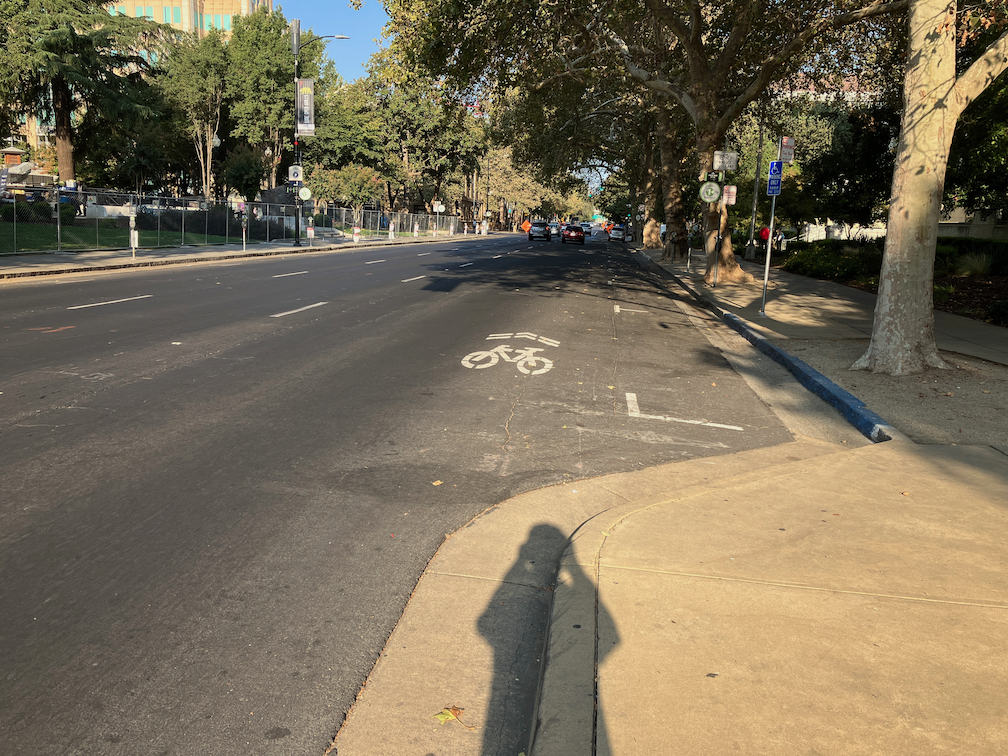
R Street now, car dominated
R St Sacramento street dining
R Street then, people dominated

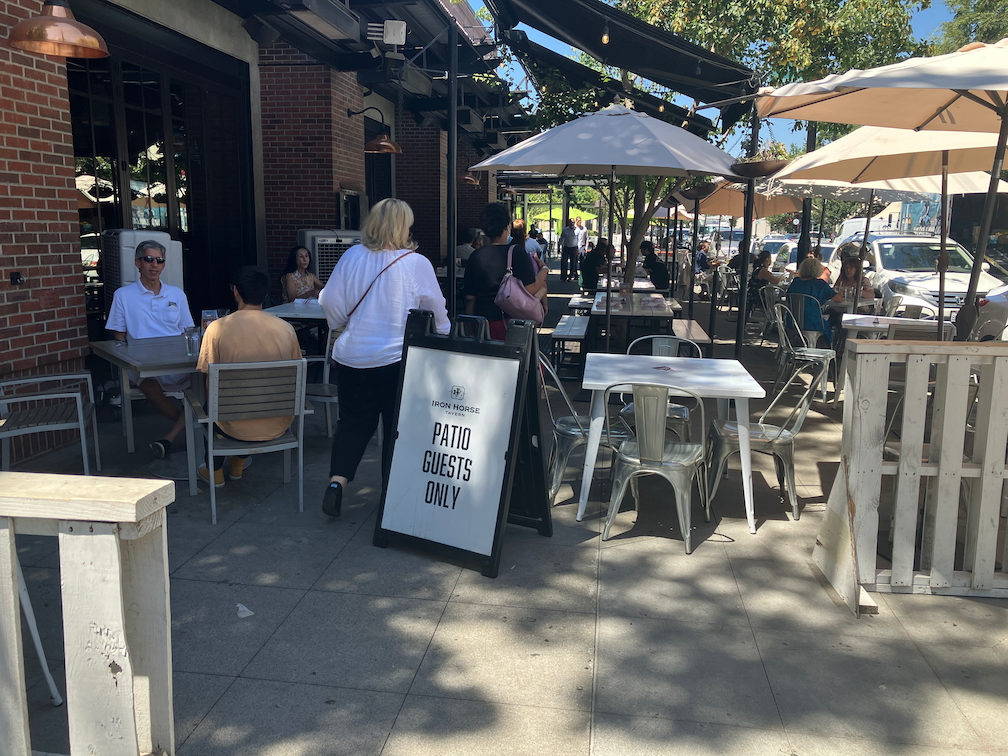
When I went by today to get a current photo of the street, I noticed that Iron Horse Tavern has blocked the sidewalk on the south side of R Street, leaving no alternate route or ADA accommodation. I suspect that this is one of the businesses here that thinks all its customers arrive by car, and they don’t need to serve anyone else. Please make their wishes come true, if you are a walker or bicyclist, and avoid this business.

Iron Horse Tavern on R Street, blocking the sidewalk

what Sacramento did wrong

I’m reviewing the City of Sacramento’s Climate Action and Adaptation Plan (CAAP), preliminary draft. I’ll have several more posts on this, but what immediately comes through to me is that the plan doesn’t acknowledge what the city did wrong in the past to create such a carbon-intensive city.

So, let me help with that:

Transportation

  • focusing the transportation network on continuously expanding capacity for motor vehicles, ignoring and more frequently being hostile to other modes; this has changed slightly, but is still the dominant approach
  • spending almost all funds on roadway capacity expansion (more lanes and interchanges) instead of maintaining what we have; every pothole is a policy failure
  • refusing to accept responsibility for sidewalks, which are a critical and core component of the transportation network
  • refusing to spend any general funds on transportation improvements, other than required matches, depending instead almost entirely on grant funding from the state and federal levels
  • providing free and below market rate parking throughout the city, which not only subsidizes but increases motor vehicle use
  • going all-in on motor vehicle electrification, while nearly ignoring electric bikes; there are no electric bike incentives, and no electric bike charging facilities
  • failing to update the outmoded 2006 pedestrian plan, and/or to combine it with the bicycle plan into an integrated active transportation plan
  • refusing to develop policy around transportation solutions, as though every project were unique and had nothing to do with other projects or with the overall pattern; the bicycle and pedestrian master plans are examples, laying out individual routes but not creating policy that determines what kind of facilities are appropriate for what kinds of streets and intersections
  • refusing to innovate and pilot new ideas, as every peer city has been doing; despite accepting the progressive NACTO guidelines, the city has actually not implemented anything that does not comply to the letter with the regressive MUTCD guidelines

Housing and Land Use

  • zoning which prevented multi-family and mixed use throughout most of the city; this has changed a little, and will change more with the 2040 General Plan, but the legacy of this will be with us for generations, and yes, the intent was largely racist; zoning of this sort makes everything further away, requiring more driving
  • setting development standards which make inefficient use of land, with setbacks and height limits, which again, spreads everything out
  • eliminating inclusionary zoning without creating a viable method of funding affordable housing through development impact fees or other mechanisms; for example, the city only contributed pittance $2.8M of the $40 or so that the newly opened Lavender Courtyard cost
  • supporting and celebrating large residential greenfield developments while ignoring infill development, and placing requirements on development that are easy for large developers and onerous for small developers; this has changed a bit, but not much
  • bending over backwards to promote and subsidize very large projects, such as the arena and Delta Shores, while paying no attention to small businesses; every empty storefront is as much a failure of the city as it is of that business

None of this is to say that the city is not doing some good things, or that it is not light years ahead of the county, and ahead of most of the cities in the region. But overcoming carbon addiction requires admitting that you have a problem, and largely created the problem, and can’t overcome the problem until you stop doing the wrong things.

I think it is important that the CAAP not only state what the city will do, but also what it will STOP doing.

public restrooms are a transportation issue

Car drivers can zip between places with restrooms. Bicyclists, to a lesser degree. Transit users and walkers, not at all. This is a transportation issue. If people cannot find restrooms, they can’t make their way through the city. They can’t afford to wait at a transit stop for a transfer. People with urinary issues (count me among them) have to plan carefully around not just their movement, but around restroom access. A city without public restrooms is a city that biases transportation against walkers and transit users, and in favor of vehicle drivers. Access is denied to an entire class of citizens.

In Sacramento, public restrooms are scarce. Cesar Chavez Plaza downtown has a Portland Loo type restroom, but it took years to get it done. So far as I know, there are no plans for additional locations.

Cesar Chavez Plaza restroom Portland Loo model

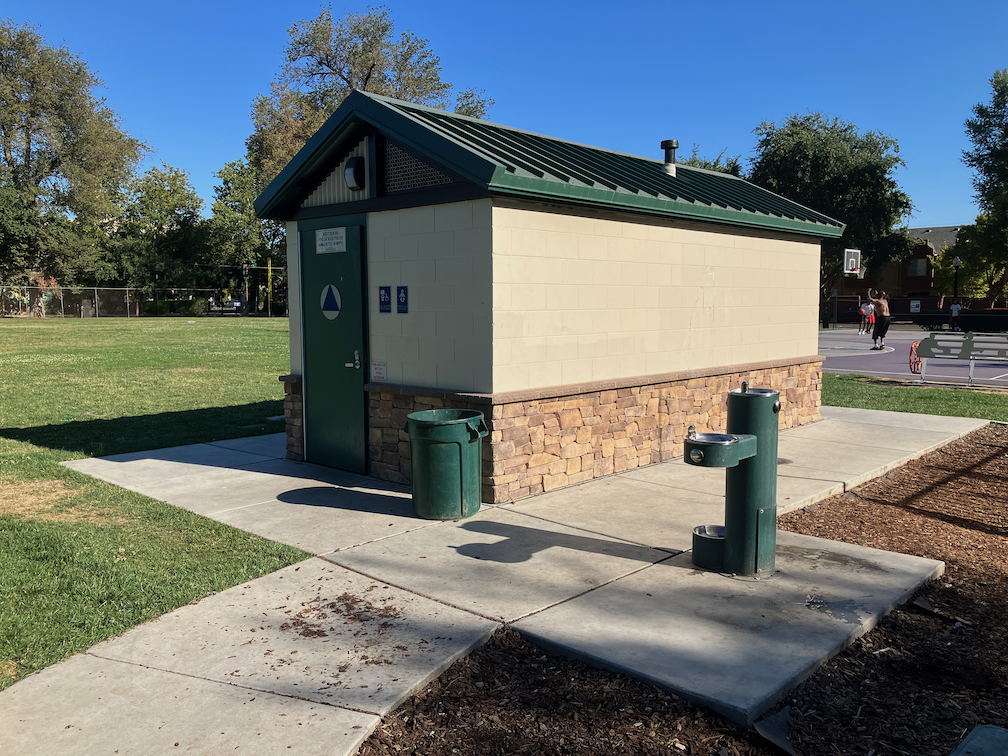
Roosevelt Park downtown has a new restroom, replacing the old one. There are two single-use, all-gender units, which is the current trend and probably much better than the older multi-user, gendered restrooms.

Roosevelt Park new restroom

The restroom in Fremont Park, right across the street as I type, has been closed for years, and despite the sign, is never open during events. Porta-potties are used for events at this park.

Fremont Park restroom closed

I have not traveled to all the city parks to see which restrooms are open, which are open but with limited hours, and which are closed, but my impression is that about half the park restrooms in the city are closed. The city has a GIS map of park restrooms, but no indication of whether the restrooms are actually open or not: https://data.cityofsacramento.org/datasets/b9e7fa6d1d104833b3f04268d7f682dc_0/explore. Park restrooms are valuable for walkers, but very few are located on transit routes.

There are no public restrooms at transit hubs. No restrooms where people are waiting for the next train or next bus. The next bus, at transfer points for low frequency routes, can be quite a long wait, up to 45 minutes assuming the buses are on schedule. Even at Sacramento Valley Station, where a number of modes converge, you can only use the restroom by showing an Amtrak train ticket. Using light rail or bus, or just walking or bicycling, you are out of luck. (Note: Many people assume that Amtrak or Capitol Corridor owns the train station, but it is owned and managed by the city.)

Some light rail stations and a few bus stops have restrooms for the transit operators, but not for the public.

The city should:

  • re-open or replace all park restrooms, within two years
  • install public restrooms at every city park which does not currently have them; this would include Muir Children’s Park, Grant Park, Winn Park, and several others
  • install a public restroom at the bus layover point on L St & 14th St
  • install a public restroom at the 16th St light rail station (where the Gold Line and Blue Line diverge, and the most used transfer point)
  • install a public restroom at 7th St & Capitol Ave light rail station (where the Blue Line, Gold Line and Green Line diverge; the 8th St & Capitol Ave stop is a block away)
  • identify locations throughout the city where walkers and transit users congregate, and install public restrooms there

You might wonder why I’m asking the city to install transit restrooms rather than SacRT. The reason is that I see it as the responsibility of the city to provide restrooms everywhere they are needed, not of the transit agency, though of course the projects could be joint projects.

keep Sacramento N St narrowed

Note: As is not unusual, I had forgotten that I’d written about N St before: N Street bike route to cycle track, 2015. Seven years have passed, the city has taken no action.

The construction for the Capitol annex project has narrowed N St to two lanes eastbound, from 10th St to 14th St, and parking has been removed from the south side to shift the lanes over. Now is the time for the City of Sacramento to implement its long-delayed (if not deep-sixed) plans for re-allocating space on N St. There have been ongoing utility projects over the last few years that have narrowed N St to two or even just one lane. At no time did that create significant congestion, during the pandemic or before the pandemic. I live two blocks from N St, and both travel along it and cross it frequently. I’ve never seen more than momentary congestion, in 11 years. What that means is that N St, in its three-lane configuration, has grossly excess capacity for motor vehicles.

While the street has been narrowed is the time to redesign the street so that it has no more than two general purpose lanes, and has a curb-protected or parking-protected bikeway. Probably on the left. This is in fact the perfect setting for a separated bikeway, five blocks from 10th St to 15th St with no intersecting streets from the north side, which is Capitol Park.

It is true that the sidewalk on the north side of N St is a designated bikeway, so bicyclists may use the sidewalk to avoid riding in the street. But bicyclists on the sidewalk are often in conflict with people walking on the sidewalk. The sidewalk has pretty continuous use by walkers, particularly during the lunch time – walk time for state workers, but a lot of people also include a circuit of the Capitol Park on their runs and walks. This conflict is easy to solve: create a safe, welcoming, protected (separated) bikeway on the street. And do it now!

On N St eastbound, the leftmost lane is a designated left turn lane at 10th St, which is what makes possible the two-lane configuration beyond 10th St. As a temporary measure, this works well, and forcing turns off three lane streets is a good solution for so many overbuilt arterials roads in Sacramento, but here it is only temporary, and would be obviated by the conversion of all of N St from 3rd St to 15th St. N St becomes a two-lane street at 15th St, and then becomes a two-way street at 21st St. N St from 15th St to 21 St would probably be a good candidate for a separated bikeway as well, but with paint bike lanes existing, would be a lower priority.

Below is a StreetMix sketch of what N St might look like. Note that the width of the street and the elements are estimated, not measured. I don’t believe parking is needed on both sides, but the diagram shows it for people who think it is necessary. Left side is north, Capitol Park in this case, and right side is south, mostly state buildings.

N St Sacramento between 3rd St and 15th St

As a reminder, I feel strongly, and it is backed up by evidence:

  1. Three-lane streets are significantly less safe than two-lane streets, primarily for the muli-lane threat (one vehicle stops for walkers and the others do not). They are also a clear sign of poor land use planning, which puts residents and the things they need to reach (jobs, stores, recreation and entertainment, medical, etc.) far away. Narrowing all such roadways in the city from three to two, or less, would increase safety, increase livability, and encourage people to make different choices about where they live and visit. Maps of collisions (vehicle vs. vehicle, vehicle vs. walker, vehicle vs. bicyclist) align almost perfectly with overbuilt arterials.
  2. One-way streets are significantly less safe than two-way streets, for the same multi-lane threat, and because there isn’t any friction to slow drivers. However, I think that the only valid argument for one-way streets is to accommodate separated bikeways, bus lanes, or rail transit. That may be true of N St.

And, sorry, can’t resist, get rid of the worthless palm trees while they are at it. We need shade trees, not poles.

Freeport Boulevard Transportation Plan Emerging Design Concepts

City of Sacramento staff (Drew Hart) presented to the Sacramento Active Transportation Commission last Thursday on the Freeport Boulevard Emerging Design Concepts. The presentation slides are here. The city’s Freeport webpage has a lot of background material. A link to the virtual open house on April 28 (tomorrow!) is available. This project and the Northgate project are being supported by the same consultant, so you will notice similarities in the process and graphics.

The northern section, between Sutterville Road to the east and Sutterville Road to the west, should look exactly like the traffic-calmed, complete street to the north. This project on Freeport was successful. There is no reason for five lanes in this section. One lane northbound, one lane southbound, and one left turn lane southbound is all it needs. If traffic backs up at the Freeport and Sutterville Road to the east intersection, then shorten the signal cycle.

The emerging design document skips over the issue of whether four general purpose lanes are even needed. A concept should be presented that reduces general purpose lanes to two, and reallocates roadway width to other modes.

Dedicated right hand turn lanes should be removed everywhere. Dedicated left hand turn lanes should be provided only where traffic studies have shown a clear need, and should never reduce the roadway width for other uses.

Green lanes are shown behind protection for separated bikeways. Since the protection does or should prevent vehicle incursion, the paint is not needed.

Dedicated transit lanes should be considered. Though SacRT has not identified this as a high frequency route in the High Capacity Bus Service Study (Route 62 is 30-minute frequency), reconstruction of the roadway must consider the possibility of dedicated transit lanes and transit supporting infrastructure. Appendix A, available on the project webpage, provides a lot of detail about existing transit stops, which are mostly quite poor.

Some businesses along Freeport have multiple driveways, more than are justified by the amount of vehicle traffic access. Closure and narrowing of driveways should be considered. Since almost every business has parking fronting the street, no on-street parking is needed anywhere. This is poor urban design, but it is the nature of the corridor and could not be corrected without wholesale reconstruction of the corridor.

While separated bikeways are often a good solution, the frequency of driveways might make for poor quality infrastructure. Unless driveways can be closed or reconfigured, separated bikeways may not be the best solution.

Posted speed AND design speed should be considered for reduction. Posted speed is 30 mph from Sutterville Rd (to the east) to Arica Way, 35 mph from Arica Way to Fruitridge Rd, and 40 mph from Fruitridge Rd to Blair Ave. The section from Sutterville Rd (to the east) to Fruitridge Rd should be posted and designed for 25 mph, in recognition of the density of businesses and driveways. The section from Fruitridge to Blair Ave should be posted and designed for 30 mph, as it has a lower density of businesses and driveways, and is adjacent to the airport for a significant distance.

Prioritization of the modes for Sutterville (to the east) and Fruitridge Rd should be:

  • walking
  • bicycling
  • transit
  • motor vehicle

Prioritization of the modes for Fruitridge Rd to Blair Ave should be:

  • bicycling
  • transit
  • walking
  • motor vehicle

Crash/collision map of the Northgate Blvd corridor for pedestrians (walkers) and bicyclists. Data is from SWITRS for the years 2015-2019. (pdf)

map of Freeport Blvd Emphasis with pedestrian and bicyclist crashes

Northgate Boulevard Emerging Design Concepts

Update: Added a crash/collision map at the bottom. Though prevention of pedestrian and bicyclist killed and severe injury is always a top priority, this is not a high risk corridor as compared to many arterials in the city.

City of Sacramento staff (Leslie Mancebo) presented to the Sacramento Active Transportation Commission last Thursday on the Northgate Boulevard Emerging Design Concepts. The presentation slides are here. The city’s Northgate webpage has a lot of background material. A link to the virtual open house on May 11 is available.

I rode Northgate Blvd yesterday to refresh my memory about the street, as I’d not gone that way in a while. So, some comments:

The section of Northgate from Rio Tierra to I-80 is a standard suburban arterial, with low quality development and a completely uninteresting place to be. Changes to the roadway may make it safer, but won’t make it any more interesting or economically successful. The city should not focus on this area. It is unpleasant, and not particularly safe, but leave it be.

The section of Northgate from Rio Tierra to Garden Hwy has serious issues, but I see it as a place that could be transformed into an interesting, welcoming, and vibrant place. The number of small businesses, each with a driveway, is a challenge, but also an opportunity. At least half of the businesses are locally owned. This is not the home of big box and chain stores like much of the suburbs. It IS a place where people could walk if provided a safe and encouraging environment, and there are multiple destinations used by local residents.

I think that this entire segment should have buffered and wide sidewalks. The bike facilities could provide some buffer, but the sidewalk buffer is critical because it allows street trees. This section desperately needs street trees! Of course to be successful, the buffer/planting strip needs to be at least six feet, and the sidewalk at least six feet, but eight-ten foot buffer and eight foot sidewalk would be better. I think that the walking mode should take precedence over all other modes, even bicycling and transit, so whatever right-of-way the buffer and sidewalk needs, it should get. Don’t compromise this away.

I realize this project is at the gathering community input stage. However, diagrams will be used, and I’d like to see the diagrams include significant improvement to the pedestrian environment, wide sidewalks buffered from other modes, with trees in the buffer.

The presentation resulted in a number of questions from commission members about bicycle facilities. One of the ideas that got support is a two-way separated bikeway (or cycletrack) to provide a connection between the Ninos multiple use trail and the American River Parkway multiple use trail (the ‘special section’ in the presentation). There was less agreement about bicycle facilities north of there. One of the ideas is separated bikeways (protected bike lanes). Though of course separated bikeways are the best solution overall, I’m not sure they make sense for the east side of the street. Separated bikeways work best when there are few or no driveways, but there is a huge numbers of driveways here. The west side of the street has far fewer driveways.

There are some opportunities on the corridor for reducing driveways, and certainly some of the driveways can be narrowed to reduce entry and exit speeds. But short of a wholesale revision of the area, most driveways will remain, so the street design must accommodate this fact.

Transit on the part of the corridor between Arden Way and San Juan Road is provided by SacRT Route 13 Natomas/Arden, with a 45 minute frequency on weekdays. The route has a fairly low ridership, but it is a long route of which the Northgate section is a small part.


Crash/collision map of the Northgate Blvd corridor for pedestrians (walkers) and bicyclists. Data is from SWITRS for the years 2015-2019. (pdf)

Take the information about fault below with a huge grain of salt. It is well known that law enforcement officers assume walkers and bicyclists to be at fault, without any serious investigation, and often on the sole word of the driver involved.

Pedestrian (walker):

  • Northgate near Rosin Ct: killed, 60 yo male, unknown detail, no fault, no alcohol
  • Northgate near Ozark Cir: severe injury, 74 yo female, crossing, at fault, alcohol
  • Northgate at Wisconsin: severe injury, 36 yo female with two children, crossing, driver fault
  • Northgate at Peralta: severe injury, 48 yo, crossing Peralta, at fault (very unlikely)

Bicyclist:

  • Northgate near Winter Garden: severe injury, 49 yo male, left turn, at fault
  • Northgate at Bridgeford: killed, 47 yo male, crossing, at fault, alcohol or drug
  • Northgate at Harding: killed, 31 yo female, left turn, at fault
  • Northgate at Garden Hwy: severe injury, 40-44 yo male, broadside, at fault CVC 21453

The intersections of Northgate and San Juan Rd, West El Camino, and Garden Hwy/Jefferson Ave are particularly problematic because they are flared out to accommodate turning lanes, thereby lengthening crossing distances for walkers and creating a walker-hostile environment. Fixing these intersections would probably do more to improve the safety and feeling of this corridor than changes along the corridor.

Sac Vision Zero intersections & red light cameras

I’ve written previously about Vision Zero high injury intersections in the City of Sacramento: Sac Vision Zero new intersections map, Sac Vision Zero top intersections all modes, Sac Vision Zero top ped intersections, Sac Vision Zero Top 5 Corridors and top intersections, and Sac Vision Zero flaws.

The City of Sacramento has red light cameras at the following locations:

  • Mack Road & La Mancha Way/Valley Hi Drive
  • El Camino Avenue & Evergreen Street
  • Howe Avenue & Fair Oaks Boulevard
  • Mack Road & Center Parkway
  • Exposition Boulevard & Ethan Way
  • Broadway & 21st Street
  • Folsom Boulevard & Howe Avenue/Power Inn Road
  • Arden Way & Challenge Way
  • 5th Street & I Street
  • 16th Street & W Street
  • Alhambra Boulevard & J Street

The top injury intersections are:

  • Stockton Blvd & Broadway
  • Stockton Blvd & Lemon Hill Ave
  • Stockton Blvd & 47th Ave & Elder Creek Rd
  • Watt Ave & Auburn Blvd
  • Del Paso Blvd & Evergreen St & Lampasas Ave
  • Julliard Dr & Kiefer Blvd & Folsom Blvd
  • Power Inn Rd & Fruitridge Rd
  • Freeport Blvd & Florin Rd
  • Center Pkwy & Cosumnes River Blvd
  • Bruceville Rd & Cosumnes River Blvd
  • Franklin Blvd & Mack Rd

Notice there is no overlap. One could optimistically say that the presence of red light cameras may be making drivers safer and reducing the crashes at these locations. But I doubt it. More likely, the city is just not prioritizing high injury intersections. Of course high injury intersections change over time, as traffic patterns change, and as the city redesigns intersections to be safer, so red light camera locations need not remain static.

I ask that the city install red light cameras at all the high injury intersections. I am not asking that the city move the existing cameras to the new locations. If someone thought a red light camera was necessary at an intersection, it probably still is, and should continue unless evidence indicates otherwise.

A lot of driver-apologists claim that red light cameras are not fair, that they are installed mostly to gain ticket revenue, and that they aren’t accurate anyway. Yes, some places have installed cameras for funding, but Sacramento is not one of them. Yes, sometimes the camera systems flag a vehicle that is not running a red light, but the photos are reviewed. Even if the city were making $1M a day on red light cameras, that would be just fine with me if it prevents one death. I value life more highly than do many drivers.

I worked in Citrus Heights for several years, which has a much higher percentage of traffic signals complemented by red light cameras. My perception is that it really did make a difference. I saw very little red light running in Citrus Heights. Other violations, sure, but not red light running.

photo from City of Sacramento Red Light Running Program page

too many traffic signals?

I just finished reading Confessions of a Recovering Engineer by Chuck Marohn of Strong Towns. I’ll have more to say about the book soon. The reading reminded me of a number of things I’ve wanted to write more about, and one of those is traffic signals. Chapter 7, Intersections and Traffic Flow.

“Traffic signals are the most mindless and wasteful thing Americans routinely install to manage traffic. Removing nearly all of them within cities would improve our transportation systems and overall quality of life.”

Chuck Marohn, Confessions of a Recovering Engineer

I have long wondered what the value of traffic signals really is. As a walker, they make me wait for the signal cycle when there is no traffic coming. As a bicyclist, they stop me at almost every location, because they are set for the speed of cars, not the speed of bicyclists. There are places that set signals to work for bicyclists, but nowhere in the Sacramento region. Of course as an enlightened walker and bicyclist, I wait only for gaps in traffic and not for the signal to change. As a driver, which I once was, they make me sit at an intersection when I could be moving, and slow overall travel time.

Most signals do not sense traffic loads and respond. They are on a cycle, no matter what. Rush hour, midnight, same cycle. Signals are timed to preference one direction of traffic over the cross-traffic. And they are often very slow cycles. In the county, many of the signals are on a 2.5 minute cycle, and even in urban areas they are on a slow 1.5-2 minute cycle. Drivers have come to accept the long wait, but for walkers and bicyclists for whom a red signal can increase overall travel time by 1-1/2 to two times, they make us crazy.

Signals do not slow the speed that drivers drive. Drivers wait at the red light, and then accelerate on the green to make up for wasted time, always going over the posted speed limit. Of course these days many drivers don’t stop for red lights at all, they go through intersections on stale reds (meaning it was red before they even entered the intersection). This has become a very common behavior over the years, and is almost routine since the pandemic.

One of the things that signals seem to do is shift unsafe driving behavior from intersections to corridors, the street parts in between signals. Instead of misbehavior at intersections, causing lower speed crashes, we get misbehavior in between, with higher speed crashes.

Everyone who walks knows that signalized intersections are not safe places to cross the street. Drivers turning right look only for opposing traffic, almost never for people in the crosswalk. When the light turns green, drivers accelerate into right hand turns, across the crosswalk and any walkers in it. For intersections that permit left turns on green lights, the threat of a left turning driver crossing the crosswalk at high speed is constant. So people who value their life tend to cross mid-block, where one only has to look for two directions of traffic instead of 12.

The Confessions book suggests several alternatives to traffic signals, including roundabouts, traffic circles, and shared space intersections.

  • Use roundabouts rather than traditional intersections. Of course in place where the size of intersections is constrained by right-of-way and adjacent buildings, a real roundabout may not be possible, but traffic circles, of which the central city already has a number, can fit. Traffic circles are not as effective as roundabouts, but can replace signals.
  • Slow traffic enough that people can cross streets without having to have signals to interrupt traffic.

I realize that many people associate signals and stop signs with safety, and often demand signals and stop signs when the streets are dangerous. So what I am going to say here will be controversial. For people who think traffic signals make things safer, please spend some time observing at both signalized intersections, and unsignalized intersections. Are the ones with signals really safer? For anyone?

One of my (not) favorite signals is at 15th Street & E Street. At this point, 15th Street is not a collector or arterial, it only becomes one-way a block earlier at D Street, and has very little traffic at this point. It does not become a higher volume street until H Street and I Street to the south. E Street is a collector, though not a very busy one. Yet the signal cycles all day long, with almost no traffic at it. A perfect location for a traffic circle. Not the point of this post, but 15th Street at this location does not need two lanes, one lane would be plenty, and the excess lane can be converted to diagonal parking and/or a bike lane. A photo of the intersection is below, showing a typical amount of traffic.

What about all the signals on 14th Street? This is a low volume, fairly low traffic speed street, at all times of day. It dead-ends at the convention center, so it is not really even a through street, yet it has five signals. There are a lot more such examples. You can add yours in the comments!

15th St & E St intersection, Sacramento

All the signals in the central city that are not at the intersection of collector and/or arterial streets should be slated for removal. If the city wishes to do so, it could do a traffic study before removal, or just go ahead with removal, but it should not be leaving these signals in place without action. There are options short of complete removal. Signals could be made into signalized pedestrian crossings, so that when people walking need to cross, they still have (some) protection of a red light. (Some protection. Again, many drivers to not stop at red lights.) Curb extensions can be installed to shorten crossing distances. Traffic diverters (modal filters) can be installed so that only bicyclists have a thru route. And of course roundabouts and traffic circles. At the intersection of two collector streets, a four-way stop might be appropriate. Each intersection is unique, but each one is also a candidate for change that makes travel safer and less frustrating no matter the mode of travel.

I’m not suggesting, at this time, the removal of signals at the intersection of collector and/or arterial streets. Someday.

The map shows these signal locations, with a red X (pdf). The intersections of collectors and/or arterial streets, not marked here, are not being challenged at this time. The purple streets are designated collectors or arterials by the city (part of the Functional Classification System).

signals in Sacramento central city for possible removal

Sac Transportation Priorities Plan update

Angela Heering provided some progress information and links on the City of Sacramento Transportation Priorities Plan. So here is an update to my previous Sac Transportation Priorities Plan post.

Start with the city’s Transportation Priorities Plan (TPP) webpage, if you haven’t been there before. A video brings an update from Jennifer Donlon Wyant on the completed Phase 1, and a the Phase 1 Community Engagement Summary report gives the details. Update: I hadn’t noticed the TPP Project Prioritization Recommendations.

There will be a presentation to city council on March 15, both on the results on Phase 1 and the plan for Phase 2. An earlier presentation to the ‘community consultants is here. The presentation to council will probably differ.

The presentation clarifies one of the questions that came up during the Big Ideas city council workshop.

How is the TPP different from the Transportation & Climate Big Ideas?
The TPP is a policy document that will prioritize all City Transportation investments in projects based on community values. It does not define new projects.
The Big ideas are a set of defined projects designed to think about mobility as a network and a network to encourage walking, bicycling and transit use. The Big Ideas will be prioritized with all other projects in the TPP.

I’m excited about this process. The city has never had public criteria for how projects are selected. It has been based in the past on the personal preference of the Public Works department, and sometimes, city council members. Making good investments in transportation requires criteria and performance measures for projects!

Reset for SacATC

The City of Sacramento Active Transportation Commission (SacATC) was established in 2018 as a replacement for the city/county Bicycle Advisory Committee (BAC). This was good, as the county’s unwillingness to consider innovative solutions, even when they were in the city, meant that very little ever happened there. There was a lot of hope in the bicycling and walking advocacy community that SacATC would turn a new page and accelerate necessary changes in the city. Unfortunately, that has not been the case. The commission has been reactive, not proactive. A number of people have resigned from the commission when they discovered that not much of importance was happening there.

Nothing here is meant to demean the contributions of city staff to seeking grant funding for critical projects. The city is paying much more attention to active transportation than it used to, but I and many other advocates believe that it is still paying too little attention, and certainly too little funding.

So, I believe it is time for a reset.

  1. SacATC is advisory to the city council. It should therefore be communicating with council on a fairly regular basis. That does not mean that it does not collaborate with staff, but it does not take direction from them.
  2. The primary job of the commission should be to review and to create policy. Reviewing projects is a secondary focus. That means at least half of every meeting should be spent talking about policy, not about projects.
  3. SacATC should be setting its own agenda, not letting staff set it. If staff wants to bring something to the commission, they would contact the commission chair to request that it be on the agenda. The chair should solicit agenda ideas from commissioners at the end of each meeting, and again, in advance of the next meeting to meet whatever deadline the city sets for its agenda posting.
  4. The purview of SacATC should be all city activities, when they may affect active transportation, not just Public Works. This would include, for example, construction traffic control plan permitting, city utility work in the streets, waste collection (trash cans in bike lanes), repaving plans, law enforcement, and parking enforcement.
  5. SacATC supported sidewalks where they are part of complete streets projects, but has not addressed sidewalk infill, closing gaps in this critical transportation infrastructure. I believe this should be a major focus of the commission this year, developing policy to recommend to the council that makes consistent and rapid progress towards a continuous sidewalk network, properly designed ADA ramps at every corner, and frequent safe crossings.

The next meeting of SacATC is Thursday, February 18. The agenda and eComment link will be available a few days beforehand at http://sacramento.granicus.com/ViewPublisher.php?view_id=21.

The commission is established under city code: http://www.qcode.us/codes/sacramento/view.php?topic=2-2_100&showAll=1&frames=on.