The City of Sacramento has announced that it will be enforcing the state intersection daylighting law, AB 413 (Lee, 2024), starting today. Tickets will be $25.
Higher income people will of course just see this as the cost of parking, and won’t care. An open spot at every corner, only $25? Yes! With the new parking rates, a person could park in a daylighted space for 8 hours for less than the cost of a metered space.
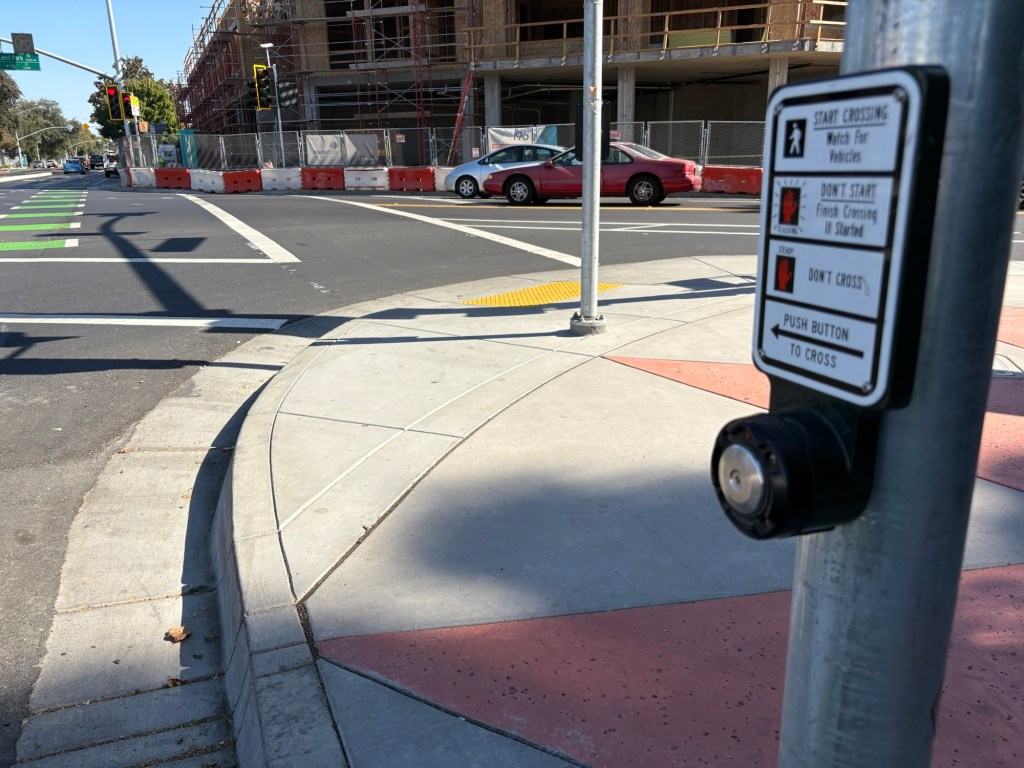
Daylighting increases safety for people walking by providing increased visibility between drivers and walkers crossing the street. As with all crosswalk laws, it applies whether the crosswalk is marked (painted) or not.
I’m a little cynical about this. Over the years, I have reported about 60 violations of drivers parked ON the crosswalk. Once, the driver was cited. Often I would wait to see if parking enforcement officers would show up, and what they would do. Sometimes, the vehicle was gone. Often, the vehicle was still there, but the 311 report closed without action. Sometimes, it was closed without the officer even showing up.
Traditionally, parking enforcement has only been concerned about drivers overstaying time at parking meters.
Administration of the parking and parking enforcement program has changed, so perhaps the city is serious about enforcing daylighting. Time will tell.
The city has confirmed that crosswalk daylighting, as required by AB 413 (2023, Lee), will not be a part of the Parking Strategies project. The city has also confirmed that it will not be a part of the Streets for All Active Transportation Plan, though that plan will recognize that where there is space created by daylighting, it may be used for bicycle and scooter parking.
So where will crosswalk daylighting be addressed? So far as can be determined, the city does not intend to address it at all. A search of the city website for ‘AB 413’ or ‘daylighting’ produces nothing. City staff seems to be suggesting that it will be addressed somewhere else, not part of the current projects, though that somewhere else has not been mentioned.
It is going to take public pressure to convince the city to take action on crosswalk daylighting.
San Francisco has been proactive in implementing the state law, with warning notices now being given, and enforcement starting January 1. Parking is far more contentious in San Francisco than Sacramento, so it is surprising that Sacramento is stalled while San Francisco is moving forward.
Additional posts on Broadway Complete Streets are available at category ‘Broadway Complete Streets‘.
The bicycle signal face for Broadway eastbound at Land Park Drive/16th Street did not work for several weeks after it was turned on. Then it was ‘fixed’ so that it was part of every signal cycle. Now it has been further ‘fixed’ by the installation of a beg button which the bicyclist must press to trigger the bicycle signal. The beg button is the standard pedestrian button, it says nothing about bicyclists.
This signal should detect bicyclists and trigger the bicycle phase, without requiring any action by the bicyclist.
This is yet another example of the incompetence of city traffic engineers, who not only cannot design a signal that works properly, but will actively make things worse for bicyclists. Their concern is foremost, and only, with the free flow of motor vehicle traffic.
Bike signal for Broadway eastbound requires button push
It is likely that council member Caity Maple, along with Mayor Darryl Steinberg and council member Karina Talamantes, will introduce an emergency declaration on traffic safety at the city council meeting tonight, starting at 5:00 PM. The item is not on the agenda, so I presume it will be introduced during the ‘Council Comments-Ideas, Questions’ part of the agenda, after all the numbered agenda items. Council members get their ‘matters not on the agenda’ time, just like the public does. None of the advocates I have asked have a clear picture of how emergency declarations work. I presume the idea will come back to council one to many times in the near future, but tonight is your first chance to hear what the council has to say and comment on the ideas.
Caity Maple has posted about the recent injury (now fatality) and the emergency response she wants the city to take:
I’m devastated to see yet another person critically injured after being struck by a vehicle on Sacramento’s roads. Even beyond our City’s commitments to eliminate traffic deaths through Vision Zero, we need to take immediate and urgent action. This coming Tuesday, alongside my colleagues Mayor Darrell Steinberg and Mayor Pro Tem Karina Talamantes, I will be introducing a proposal that:
Declares a state of emergency for the City of Sacramento regarding the road safety crisis
Directs the City Manager to identify funding for a public education campaign focused on driver education, pedestrian/ bicyclist awareness, and traffic safety
Directs the City Manager to work with SacPD to ramp up enforcement of traffic laws that protect pedestrians, including speed limit enforcement, crosswalk violations, and distracted driving, especially in high-injury corridors
Reaffirms our commitment to Vision Zero and directs staff to expedite safety projects
At the June 11 city council meeting at which the 2024-2025 budget was adopted, seven of the council members spoke strongly about the need to address safety on the city’s streets, acknowledging that the city leads California as the most deadly for roadway users. But no modification was made to the budget to reflect that priority, and the city manager refused to make any changes to the budget to fund street safety.
In the two months since that council meeting, nothing has shown up on the council agenda to move forward on street safety, nothing has shown up to allocate funds, except some minor grant applications.
The city has long had a policy that it does not fund street safety projects, except for the required grant matches. Other than grant matches, no city general funds are expended to make our streets safer. The city certainly has been successful in getting some grants, but also has not been competitive on many others.
The Sacramento Active Transportation Commission (SacATC) made a recommendation in their annual report to allocate $10M to safety projects. Council members spoke in support of the idea, but no action was taken to fund those ideas.
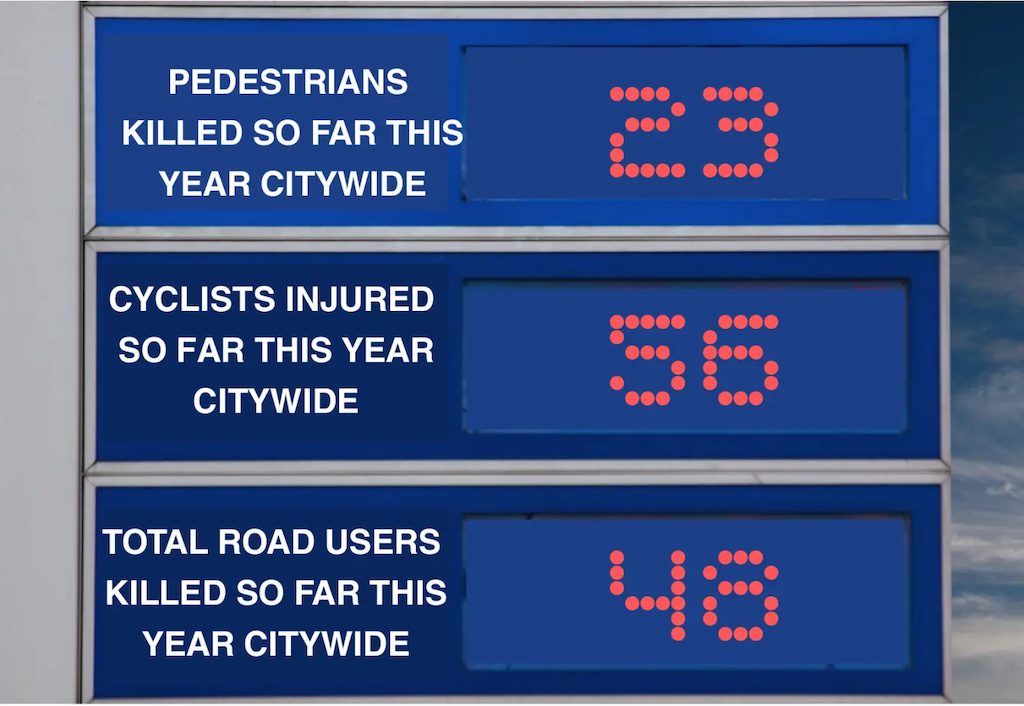
We have an epidemic of traffic violence in the city. Yet the city is doing almost nothing to address that. Walkers, bicyclists, drivers and passengers are all dying in horrible numbers. What is the city doing in response? Submitting grant applications and hoping for the best. This is unacceptable.
The council must take this public health crisis seriously, and allocate funds to start solving it. It must also stand up to the city manager, who does not believe in spending money on street safety. The city manager runs the city according to his own whims, and rarely follows the direction of council on anything. The council must either stand up to, or fire, the city manager. So long as he is in the position, the city will not move forward on saving the lives of vulnerable roadway users.
Additional posts on Streets for People Active Transportation Plan are at category: Active Transportation Plan.
The City of Sacramento held the Streets for People Citywide Virtual Workshop #1 yesterday. Though the city may eventually post the slideshow, it is not on the program page Streets for People Active Transportation Plan yet, so I’m posting them here. These are low-ish resolution screen captures, so you won’t be able to see detail in them, but I hope they are still useful to you. I did not capture every single slide, but I hope the ones of interest are here. Of course the slides do not capture the presenter comments that went with each slide, which are important.
The next workshop, Streets for People Citywide Virtual Workshop #2, will be tomorrow, July 11. Please see the program web page for registration link. I assume the presentation will be the same.
The first workshop was poorly attended. I don’t know how many people, but the presenters mentioned several times how few people were on the webinar. My question/comment is that the Traffic Calming tab of the Neighborhood Connections storymap has the best examples of traffic calming measures, with many of the photos local, whereas the visual glossary pedestrian and visual gallery bikeways examples provided as part of the interactive map are of poorer quality, not local, and in a few cases should not be recommended at all. These two sources should use the same examples, where they overlap.
The second workshop will be followed by a series of focus groups for particular neighborhoods or areas of the city, and walk audits in those same areas. I hope that people will participate in one or more of them.
You won’t be surprised, but City of Sacramento achieved a score of 34 out of 100 on the People for Bikes annual City Ratings. The scores are simplistic, using road width and bike lane mileage, but are still indicative of the relative ranking of cities and of the progress being made. Progress in the case of Sacramento is very slow.
I believe Sacramento’s poor ranking is due largely to the city’s policy of building bicycling infrastructure almost entirely with grant funding, and not with city budget. When you are competing nationally, statewide, or regionally for grants, funds will be limited and progress very slow. The city must spend more of its general fund on shifting our transportation system away from unsafe car dominated streets to streets that work for all users.
Strong SacTown Street Design Team will be posting a series to improve and promote the City of Sacramento update of their street design standards. This is the first. You can follow their website at https://www.strongsactown.org/, and the series at https://www.strongsactown.org/tag/street-design-standards/. Getting Around Sacramento / Dan Allison is participating in the team planning and writing, but these posts are the work of the team.
“We are Strong SacTown — Streets for People, a group of Sacramentans advocating for updated street designs that will rank safety, livability, and economic vitality above vehicle throughput or speed; where congestion relief will not be the goal in street design.
The City of Sacramento is updating the street design standards for the first time since 2009. The city is embarking on this effort as it is becoming increasingly apparent that the existing standards do not meet the needs of all users in the modern era.”
When a fatality or severe injury occurs for walkers and bicyclists, people often ask, what can we do right now to prevent or reduce the severity of the next crash? This topic has come up a number of times at the Sacramento Active Transportation Commission (SacATC), and communication from Slow Down Sacramento and the Safety Forum, Civic Thread, SABA, Strong SacTown and other organizations.
Based on the successful program from Oakland, I am proposing that the City of Sacramento develop a similar rapid response program.
The City of Sacramento would establish a pilot Rapid Response Program with an initial budget of $100K. The pilot program would address only fatal crashes. The budget will likely be insufficient, as Sacramento has a state-leading level of fatal crashes, but the pilot would allow the city to develop expertise and program structure, and formulate a future budget. The city might respond only to fatal crashes on the high injury network, in order to extend the budget.
A Rapid Response Team will include a city planner and city traffic engineer, and may include responding law enforcement officer and walking or bicycling advocate (Civic Thread for walking and SABA for bicycling, paid for their time). I intentionally say the law enforcement officer who responded to the crash. Other law enforcement officers would likely offer only uninformed opinions and victim blaming, though the experience could be useful for educating officers about street design.
The team will review existing documents and data, and then visit the fatal crash site within two work days of the crash, or the death of a person resulting from an earlier crash.
The team will make a report within five working days which identifies and proposes quick-build features (countermeasures) to reduce or eliminate infrastructure hazards, with prioritization based on effectiveness.
The quick-build features (countermeasures) may include:
Refreshed crosswalk
Refreshed pavement markings
Temporary curb extension with flex posts
Temporary modal filter (traffic diverter) with flex posts
Temporary traffic circle with flex posts
New marked crosswalk
Changed or added signing
Temporary new stop sign; permanent stop sign would require additional analysis
Changed signal timing
At least one quick-build feature (countermeasure) will be installed within 10 work days of the site visit. Additional temporary features will be designed and scheduled.
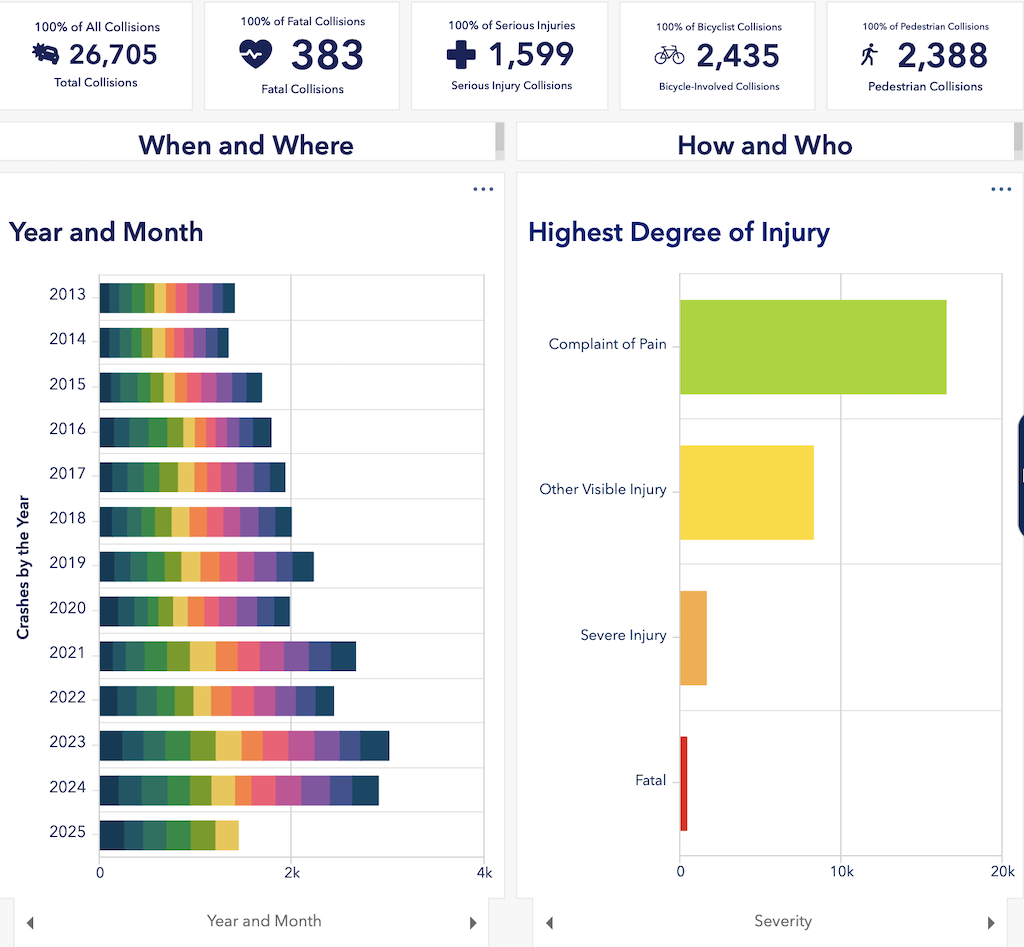
I had previously mentioned mapping of crashes and related data by the city, because the state SWITRS system is always too far behind. I had previously mentioned a dashboard on crashes. However, these would probably best be implemented after the pilot year.
The City of Sacramento does not make available to the public an inventory of sidewalks. The city does make available on the Transportation & Infrastructure page: Bike Master Plan, EV Chargers, Off-Street Parking, Signs, Street Lights, Traffic Counts, and Traffic Signals, and other datasets. Sacramento County makes available on the Transportation page: Posted Speed Limits. SACOG makes available on the Transportation page several other transportation datasets. None have sidewalk inventories.
I have heard, unofficially, that the city has a partial dataset of sidewalks, but it is not spatially complete. It may be that it has only more recent installations, or that it focuses on some parts of the city. I have done a PRA for sidewalk inventory, but the city couldn’t figure out what I was asking for, so I will have to determine how to describe the dataset in a way they will understand.
What would a good sidewalk inventory contain?
total width
unobstructed width
sidewalk buffer (planting strip) width
available right-of-way
condition
year of installation, or reconstruction
gaps
intersection corner design
ramps (compliant or not)
The soon to be adopted 2040 General Plan 8-Mobility Element mentions sidewalks a number of times, suggesting widening or improving. Probably the most important are:
M-1.9 Equitable Processes and Outcomes. The City shall ensure that the transportation system is planned and implemented with an equitable process to achieve equitable outcomes and investments so that all neighborhoods one day will have similar levels of transportation infrastructure such as sidewalks, marked low stress crossings, and bikeways.
M-1.14 Walking Facilities. The City shall work to complete the network of tree-shaded sidewalks throughout the city, to the greatest extent feasible, through development project improvements and grant funding to build new sidewalks and crossings, especially within the high-injury network, in disadvantaged communities, near highridership transit stops, and near important destinations, such as schools, parks, and commercial areas. Walking facilities should incorporate shade trees.
However, there is no mention of how locations needing improvement will be identified. Is this guesswork on the part of city staff, or is there a dataset being used but not shared with the public?
My request is that the city make available to the public whatever sidewalk inventory it has, even if it is not spatially complete nor has all the elements a sidewalk inventory should have.
A sidewalk inventory is the first step in meeting the city’s goal of a continuous, high quality sidewalk network. More about that soon.
deteriorated sidewalk on 24th St, near Capitol Ave
And while we are at it, a crosswalk inventory:
marked or unmarked
width
length
design
median island
material: paint or thermoplastic
condition
date of placement or refresh
traffic control (yield, stop, signal, actuated crossing)
crossing prohibition
It should be said that sidewalks and crosswalks in the City of Sacramento are in better condition than many similar sized cities in California, but that does not mean that there isn’t a need for great improvement. Every city and county neglects its sidewalks.