be the change?

I have a number of friends who are car free. Like me, they have flexibility in their lives, and time to plan traveling. But several of them also have families and manage to be car free. I recognize it is a challenge, and acknowledge them for the effort. I have a larger number of friends who are car light, own and use a car sometimes, or in some cases, do not have a car but rely on ride hail for many trips. They don’t usually drive, but do for several reasons: they are late, they have to haul more than is comfortable on a bike or walking, they have family members who need to get somewhere and don’t drive (kids and elderly), and they want to go to the mountains or the ocean, both of which are possible without a car but more awkward.

I’m not judging people for not being car free, or using a car sometimes. Life is what happens. I am privileged to lead a life where I do not want to drive, do not need to drive, and have the time to plan trips by other modes. I have no one dependent on me for transportation. I have not owned a car in 15 years, and have not driven a car in 6 years, and now I don’t even have a drivers license. I save a huge amount of money on not have a car and all the accompanying expenses, but I do spend quite a bit on train and transit travel. And I am happy with the additional time it takes to get places. I am not a stay-at-home person, I’m more active that most of the people I know.

But I challenge everyone to pause before driving. Am I driving because I am lazy, or tired? Am I driving because it seems to hot, or too cold, or too windy? Am I driving because it is more convenient or faster than other modes? Am I driving because I forgot to plan ahead to get there some other way? Am I driving because the car keys were right there by the door? Am I driving because I spent a lot of money on my car, and I feel like I need to get the value of that by driving it? Am I driving because it increases my visibility and stature with others (is my car part of how I define my worth)?

Most importantly, could I defer or cancel this trip? Is is really that important? Could I do it tomorrow, or next week, or not at all?

If you think that driving less is good for you, good for your family, good for your community, and good for the earth, then start now. One less trip a week. And another less trip next week. That is actually how I got to car free over several years, driving less and less each week, each month, each year. One attempt at a mode you don’t use, or don’t usually use. Make a plan and use transit. Plan ahead and bicycle or walk. Stay home and enjoy your home. Walk to the coffee shop or bar and enjoy the company.

Be the change you want to see.

street design from outside in

Streets should be designed from the outside in. They have traditionally and still are designed from the inside out, which means first deciding how much motor vehicle traffic to allow or encourage, and at what speed, then working outward to parking, transit, bike facilities, and sidewalks. This approach has given us the transportation system we have, which is rapidly changing the climate while not meeting the needs of most citizens.

If we plan outside in, we can have a better design, in every way. I don’t mean starting with the sidewalk, I mean starting with the land use. What land use is already there, or do we know will be there in 10-30 years, or most importantly, do we want to be there? What types of livable, economically vibrant places do we want? Then, and only then, what sort of design do we want to accommodate walkers (and rollers) who will access those land uses? What trees do we need to shade and shelter those walkers (and reduce utility bills for the buildings), and what other sidewalk-related amenities do we need for those walkers, and that land use? Benches, bioswales, dining, bike and scooter parking? What sort of bicycle facilities do we need to allow people using bicycles, bike-share, scooter-share, etc. to access that land use? What sort of transit facilities such as bus stops and dedicated transit lanes (bus or rail) do we need to serve those land uses? And lastly, what sort of motor vehicle facilities do we need? Do we need parking? What number and width and direction of general purpose travel lanes do we need? There may be some space left over for motor vehicles, once all the other needs have been met.

You might think I am being facetious, that motor vehicles should be accommodated in left over space. But I am serious. In most cases we don’t need motor vehicles on many streets. We think we do because we have designed streets that way, and encouraged people to think that way, that cars are the main mode of transportation. But there are examples of streets all over the world, and even a few in the US, that don’t allow motor vehicles at all, or if so, under very controlled circumstances. These include car-free or car-light boulevards, all the way down to woornefs, where motor vehicles are guest subservient to all other uses.

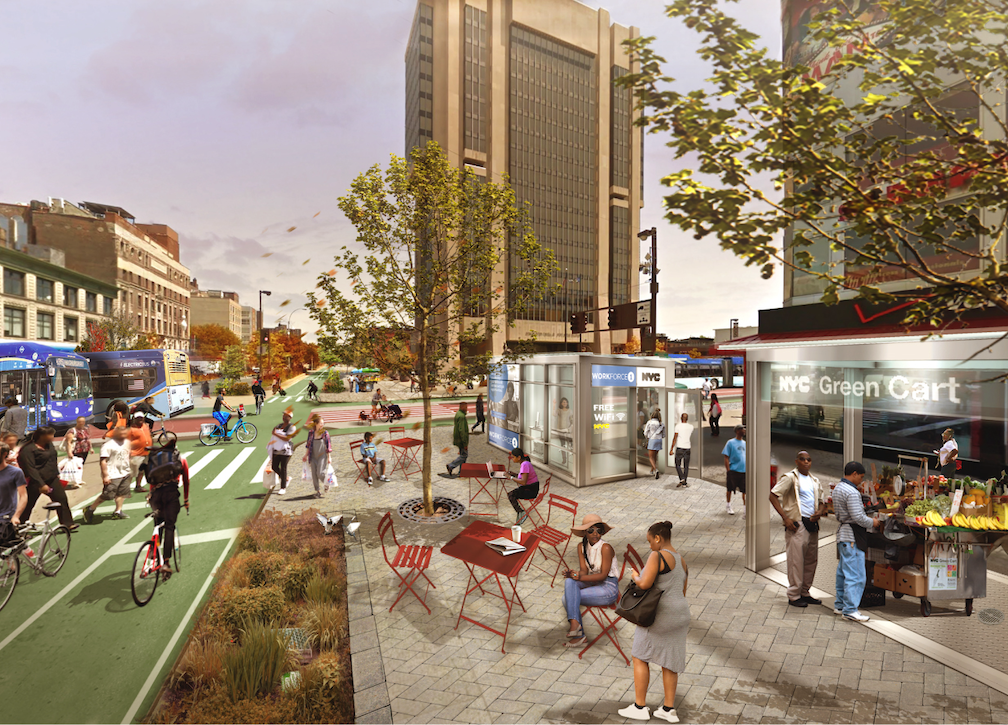
A Google search for ‘photos boulevards without cars’ interestingly produces hundreds of photos of streets with cars, and cars on streets, and mostly, car crashes. But Wikipedia has photos of woonerf, and Google did find one photo of a proposed street redesign for NYC produced by PAU architecture practice.

woonerf street in Utrecht, Netherlands
proposed people street design for NYC

car-free Sacramento

corecarfree

It is amazing what one can find going through drafts of posts that were composed but never posted. Here is one from 2017.

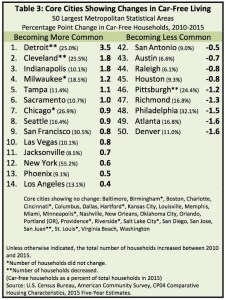
Recently reported research on car-free households in states, major metropolitan areas, and major cities, Car-Free Living in the United States: What the Data Says, indicates that Sacramento metropolitan area increased its car-free households by 0.5%, and the core city (mostly the city of Sacramento) from 9.7% to 10.7%, from 2010 to 2015. Sacramento is #6 in the list at right, not bad

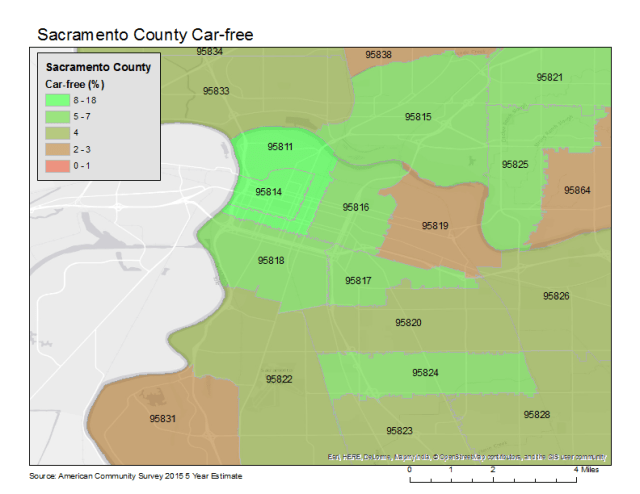
My previous post on car-free workers was Central city car-free workers (2016-04-24), which indicated a central city rate of 5% to 18%, depending on zip code. Since these statistics are workers rather than households, they are related but not directly comparable, since the number of workers per household is often more than one, but sometimes zero.

Central city car-free workers

And here is the last of the three census-related maps, before I move on to other topics. This one shows the percentage of workers who are car-free (zero motor vehicles owned). Again, the 95814 zip code nails it, at 18.4%, and 95811 is close behind at 14.5%. Yes, I’m one of them.

The near suburbs also show moderate car-free percentages, probably in this case due to low income as much as choice. College (Los Rios and Sac State) students, if they are working, probably also contribute in the near suburbs. Not surprisingly, the distant suburbs have almost no one car-free. Those people are locked into the driving life by the place they have chosen to live.

It is important to remember these percentages are of workers, people who are working somewhere. They do not include people too young to work, people who have retired, or just people not working. If those people are included, the car-free rates would be much, much higher. These people are just as entitled to transportation expenditures as car drivers, but our transportation systems is set up to give them crumbs rather than a fair share.

On the other hand, there large numbers of people in the distant suburbs who have three or more cars per worker. Not per family, but per worker. The 95615 zip code (Courtland) tops the list with 54% having three or more cars, but other zip codes are close behind. Yow!

Again, the Sacramento County map (car-free) is available.

Sacramento-central-car-free