What’s next: freeways

As I said in my post Slow Down Sacramento’s response to the initiative failure, I really like Slow Down’s thoughts about where to go after the failure of the Safer Sac Streets initiative to make the November ballot. But of course I also have some more radical ideas. It will probably take a few posts to get to them.

Our transportation system is broken. Seriously broken. It kills people on a regular basis, to a level that is unheard of in the developed world, and puts us solidly down in the third world statistics. It damages the earth, most prominently as the primary cause of climate change, but in many other ways as well. Perhaps most importantly, it has led to a society that is fragmented and unhappy, because we have turned much of our urban form into a lonely, sad place. Except for those lucky enough to live in diverse, walkable communities (I am one), the livability of our places is declining at an accelerating rate. I take that as a given, and it is not my purpose here to amplify that argument. If you don’t buy that, you probably won’t be interested in what comes next.

The interstate highway system was probably a plus for society, and for our economy, though it made the mistake of destroying central cities for the benefit of through traffic. But as Strong Towns has so well documented, we finished that project in 1992, and mostly earlier, The Interstate Was Finished. The Program Wasn’t (Mission Accomplished). See a local focus, End Highway Expansion by Strong SacTown’s Troy Sankey. Caltrans has not slowed down in its expansions of highway capacity, and despite the lip service of Caltrans headquarters, our regional District 3 has recommitted itself to the maximum number of new lanes miles, and a never ending supply of make-work projects.

Why is this important? Caltran’s mission is to supply all the highway capacity that anyone might ask for. If there is congestion, add capacity. If traffic slows below 65 mph, add capacity. If new interchanges are needed to support sprawl development, add capacity. This is really all District 3 knows how to do. Their world view is that the purpose of our transportation system is to ease and speed motor vehicle travel, and their constituency is people who want to drive more at a faster pace. The engineers, and particularly the leadership of District 3, is living in the 1950s.

So, highway capacity is increased. Yolo Causeway on Interstate 80, add a lane. Hwy 50, add one or more lanes. Interstate 80, add lanes (this was already done, but I’m sure they are planning more). Interstate 5, add lanes. Hwy 99, add lanes (this was already done, but I’m sure they are planning more). Sacramento is not really a city of trees, it is a city of highways.

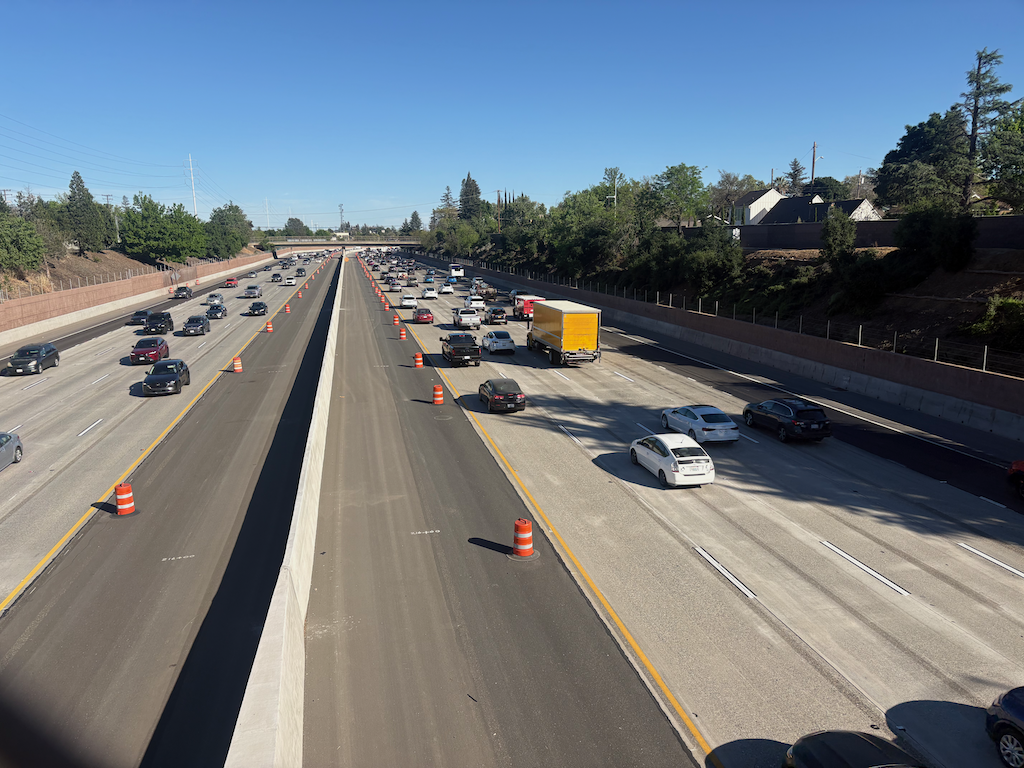
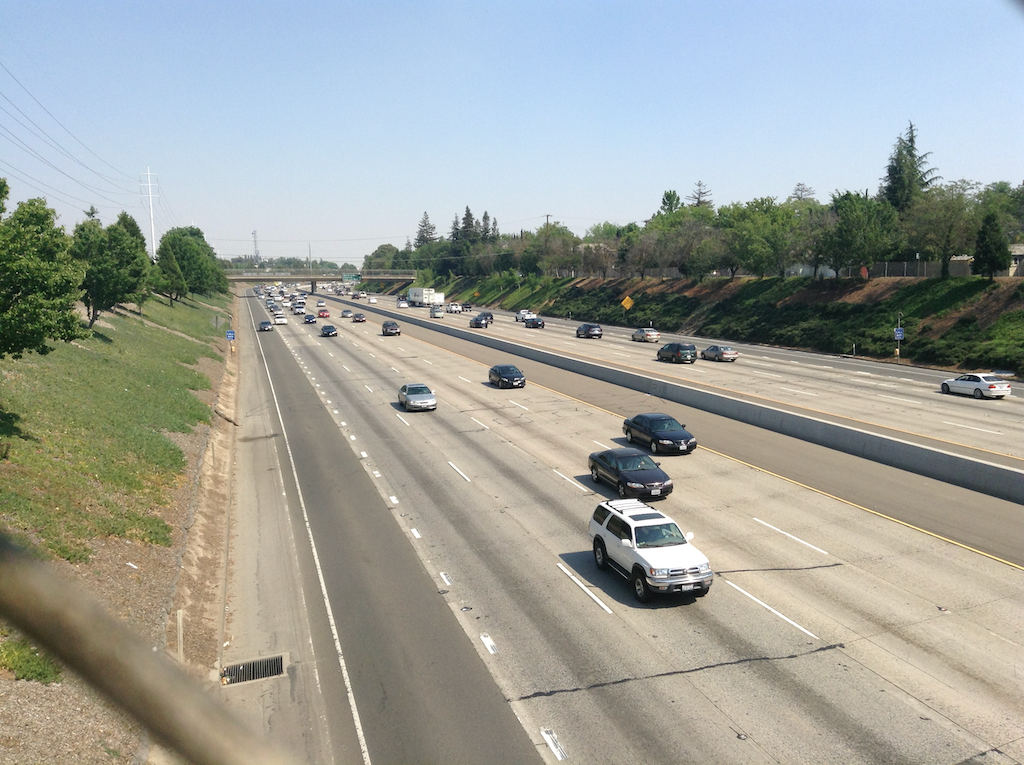
Each and every capacity expansion induces more traffic, and in particular encourages longer distance travel. Want to live far from where you work? Sure, Caltrans will accommodate. Want to get to the coast or Lake Tahoe with a short easy drive? Sure, Caltrans will accommodate. Want to develop agricultural lands into suburbs? Sure, Caltrans will accommodate. What Caltrans does not do, and seems uninterested in, is ensuring that freight traffic, which we all depend upon to some degree whether we drive or not, has the capacity to move. The freeways are full of commuters and travelers, with freight crawling along in the traffic. Stand on a bridge over any of our freeways, and notice who the freeway was designed for. For private cars, not for freight and commerce.

Why is this pattern so important? When highway capacity is expanded, it induces more motor vehicle traffic. That in turn induces more traffic on local roadways, particularly arterials and collectors. So the local agencies (SACOG, counties, cities) have to expand their roadways to accommodate all the induced traffic. And just as with the freeways, there is no apparent end to capacity expansion. In more urban areas, some cities are now moving in the other direction, reducing capacity for safety, but at the edges, capacity is still being increased, in many cases at a rapid rate. Caltrans has its hands deep in the taxpayers pockets, and gets essentially unlimited funds to expand capacity (with the complicity of California Transportation Commission (CaTC), the governor, and the legislature), while local agencies don’t have the money to even maintain what they already have, let alone expand capacity. Yet the actions of Caltrans forces them into expanding capacity and accumulating debt and deferred maintenance that they will never, ever be able to catch up on.

So, solutions. Discourage freeway use for commuting and non-essential travel. That would include:

  • stop current and planned capacity increases
  • all freeway lanes in excess of two per direction to be tolled (and eventually, all lanes)
  • convert all existing HOV lanes to tolled lanes

Stopping capacity expansion would free up the money (and more) to create the tolling infrastructure on all freeways in the region, including converting HOV (high occupancy vehicle) lanes to tolled lanes. The not yet finished Hwy 50 project, Fix50, added an HOV lane, which should have been a tolled lane. Now is the time to fix that. We already have a regional tolling agency, Capital Area Regional Tolling Authority, ready to operate the tolled lanes, and redirect income to maintenance and mitigation.

I have no illusions that this change would be easy. There are vast forces that will try to delay and subvert it. Not just Caltrans, not just commuters, but politicians who want to cut ribbons on increased capacity. The asphalt lobby, as it is called, though it includes concrete and everything that goes into a freeway. Suburban and exurban land developers. Owners of remote shopping malls who want an interchange just for their development. And the forces of status quo: ‘we’ve been doing this for 80 years, why would we change now?’

To make this change, it would take a strong, organized, and committed coalition of organizations that support equity, environment and financial solvency and transparency, and are willing to do whatever it takes to rein in Caltrans. And every citizen who knows we are on the wrong road, which is a continually growing group.

Caltrans District 3 is a rogue agency, not controlled in any significant way by anyone outside the district. Not Caltrans Headquarters, not the CaTC, not the governor, not the legislature. Bringing it under control might well be the hardest thing that could be accomplished, it will take years, and labor, and tears, and money. The best time to start was 50 years ago, the next best time is tomorrow.
CTC = the highway lobby

California OKs a lot of new freeway lanes during climate change-fueled heat wave (SacBee, Ariane Lange, 2026-03-21)

The California Transportation Commission (CaTC; CTC is Commission on Teacher Credentialing) has approved yet more of your tax dollars to serve a small segment of the population, those who commute long distances. Freeways will be expanded all over the state. Why is more highway capacity needed? Because more lanes equals more driving, equals more gas tax, equals more money for highways. It is a circular loop, also known as a growth ponzi scheme.

The CTC has long been in the pocket of the highway lobby, which is composed of the asphalt and concrete providers and construction companies, the fossil fuel companies, and the politicians who love ribbon cuttings over actually doing something to benefit their voters (of course, as we all know, most politicians first consider their campaign contributors, and only if it doesn’t conflict, citizens).

But because CTC continually funds highway expansion, basically giving Caltrans everything that asks for, so long as it is capacity expansion, and refuses to give serious discussion or attention to climate change and the evolved transportation environment, it has really become the highway lobby.

Because nearly all transportation funding (otherwise known as your tax dollars) goes to highway expansion, there is little left at the state level for maintaining highways. And little at the regional (SACOG) level. And almost nothing at the county and city level. Your street is likely falling apart, because the money is going elsewhere.

Caltrans has built a transportation system based almost solely on the needs of commuters and freight, though because of congestion induced by commuters, it no longer serves freight very well. Active transportation was not just an afterthought, but was actively planned against. The most dangerous roadway locations in the state are highway onramps and off ramps, which were designed for the highest possible motor vehicle speed, and usually have minimal or no accommodation for people walking and bicycling. As if the ramps were not bad enough, Caltrans retains control of overpasses and underpasses, though they spend none of their money on improving those, forcing local entities to spend their own limited funds to fix Caltrans mistakes. And there are plenty of Caltrans mistakes to be fixed. Billions of dollars worth. Instead of fixing things, Caltrans builds more. More problems to solve, more infrastructure to maintain, but without asking for very much for that maintenance.

Nine of the eleven members of the CTC are appointed by the governor. So our windshield governor owns the misallocation of taxpayer dollars. Of these members, only two could be considered advocates for active transportation, transit, and rail: Adonia Lugo and Darnell Grisby. A few others are not opposed to these, but not very supportive. Some are actively opposed to spending state money on anything but highways.

Strong Towns has addressed this travesty by documenting how the era of Interstate Highway expansion is and should be at an end:

Of course Caltrans and its enabler CTC is not just expanding the Interstate system, which they are, but the entire state highway system.

CTC is broken. Can it be reformed? It seems to me unlikely. Since CTC largely serves to give Caltrans whatever it wants, maybe it would be better to just give the budget directly to Caltrans. Nothing would improve, but at least active transportation, transit, and rail advocates would only have to monitor one agency instead of Caltrans and CTC.

Caltrans widening I-5 north of Sacramento

Yesterday I rode the bus to and from Sacramento International Airport, to see what the ride and buses and ridership were like. I noticed that there is significant construction occurring on I-5 between Arena Blvd and Airport Blvd, the entrance to the airport. The freeway width under overcrossings is being widened by one lane in each direction, and the roadway is being widened in between the overpasses and interchanges. I had not heard or realized that this work was already going on, but then, I rarely travel on I-5. This project is titled “SAC-5 Corridor Improvement Project – Phase 1”, and is being referred to as “Sacramento I-5 Auxiliary Lanes Project”. A fact sheet is available.

Caltrans claimed a categorical exclusion for this project, meaning that they claimed they did not need to do an environmental assessment or environmental impact statement for CEQA or NEPA because the project would not have a significant environmental impact. This is laughable. Capacity expansions ALWAYS have an environmental impact. It amazes me the number of agencies, including SACOG and California Transportation Commission, that sign off on this bullshit. The project number is 03-4H580, which means it is part of the Caltrans District 3 megaproject to increase the capacity of I-5 and I-80 in the Sacramento region. It may be that part of this widening is a separate project to add an auxiliary lane between Metro Airpark and State Route 99, using Trade Corridor Enhancement Program (TCEP). It appears that the main project is funded through Solutions for Congested Corridors Program (SCCP). The project also shows up on lists of State Highway Operation and Protection Program (SHOPP) projects, though it is not clear whether it actually received any SHOPP funding. This type of widening would be illegal as a SHOPP expenditure. There are literally 70 documents that relate to this project, and it is beyond me to figure out what they all mean, or how they relate to each other. Caltrans specifically does not gather these documents onto a project page. That would entail some transparency, which Caltrans District 3 is apparently opposed to.

The photo below shows the widening of I-5 at Airport Blvd, captured from Google StreetView. The freeway is being widened to the west to the Sacramento River crossing, and the widening appears to continue all the way to Arena Blvd. Caltrans calls these auxiliary lanes, meaning they extend only between interchanges but not through, but it appears to me that they will be continuous, and that is why the freeway is being widened beneath the overpasses. These modifications of the overpasses are called tie-backs by Caltrans, meaning the the original slope under the overcrossing bridge to the freeway is being truncated to add width to the freeway.

This is phase 1 of the project. Caltrans intends to add capacity to I-5 all the way from the Yolo County line to US 50, where the earlier project greatly expanded capacity from Elk Grove north.

If readers travel this section of I-5 and have comments about this project, or more knowledge of the project than I have been able to come up with, please comment or contact me.

SACOG Board on sales tax analysis

The SACOG Board met today, and agenda item 12 was on the SACOG Review & Analysis of Proposed Citizens’ Transportation Tax Initiative in Sacramento County. This was an information item, for discussion, not for action. This post is a brief summary of the discussion, to follow on to the earlier post on the analysis: SACOG analysis of Measure 2022. The analysis identifies 26 (or more) capacity expansion projects proposed in the measure’s Transportation Expenditure Plan, all of which would increase GHG/VMT, and most of which would also increase sprawl.

Nearly every representative of the cities and counties in Sacramento County rejected the analysis as being flawed, some even said it was unprofessional. They claimed that the analysis made so many assumptions that it could not be trusted, and that SACOG should not be in the business of producing documents like this. Despite that fact that planning for transportation and land use is specifically the purview of the MPOs, and that they instead support a measure that speculates about transportation needs for 40 years into the future. If you don’t like the message, blame the messenger.

I can’t resist pointing out that this has become a pattern for supporters of more of the same (more capacity expansion, more sprawl, more GHG/VMT):

Supporters of sprawl and the measure proponents: Show us the data!

SACOG: Here is the data.

Supporters of sprawl and the measure proponents: No, not that data. We don’t believe you.

On the other hand, every representative from the other five counties in the SACOG region expressed great concern that allowing the measure to go through would threaten their own transportation projects and funding due to the region not meeting GHG reduction goal of 19%. Don Saylor of Yolo County was the most succinct, saying that SACOG must consider the impact on the region as a whole, and that it is time to move past the limited vision of the past.

The out-of-left-field part of the discussion was that Darrell Steinberg talked about an ongoing negotiation with the measure proponents that would mitigate for the worst aspects of the measure. This apparently has been going on for six weeks, and is the reason the release of the analysis was delayed, even though it was completed a month ago.

Darrell talked about five elements of the negotiation (this is captured from his verbal report, and may not be accurate, no printed information was offered):

  • $300M in the measure for the connector would be contingent upon SACOG defining mitigation measures, and that the Capital Southeast Connector JPA accepted the mitigation.
  • SACOG would develop a scenario in the currently developing MTP/SCS that includes the connector.
  • SACOG would commit to putting the connector in the MTP if these other conditions where met.
  • An additional $300M would be provided for connector mitigation in the measure.
  • $100M will be added to the California Mobility Center, diverted from other projects.

It looks as though Steinberg is putting the onus on SACOG, not on the proponents. It is true that none of the government entities have any control over the measure, but if negotiations are going on, it should be from a position of strength, not weakness. If the City of Sacramento opposed the measure, it is very unlikely that it would pass.

The proponents intended to bully the agencies into supporting it, and to make sure that they got their message across, removed the climate protection language from the measure. They want the agencies to make their own decisions about whether and how to mitigate climate impacts, regardless of regional interests or the intent of the state legislature, or even the interests of the counties that would be impacted.

To my knowledge, no opponents of the measure, of which there are many, the majority of the transit, transportation, and environmental advocacy organizations, were asked to participate in the negotiations. Yet another example of excluding public engagement, just as the people who wrote the measure excluded public engagement.

SACOG said that the analysis would be presented to the various SACOG committees, and would come back to the board in June. It isn’t clear to me what, if anything will happen at that point. I assume the negotiations will have completed by then, successfully or unsuccessfully. It isn’t clear what kind of agreement could be reached that would actually be binding on Sacramento Transportation Authority and the other governments, since a measure, if passed and not found unconstitutional, has the force of law. Maybe there is a way.

For more on the measure, see Measure 2022 posts. The use of this category is not meant to confuse. A lot of people are referring to this as Measure A, but the measure letters are assigned by county elections after they have qualified, so this is in no sense Measure A at this time.