Caltrans gives the middle finger to walkers on 15th St

As part of the Fix 50 project, which has been going on for an indeterminate period of time, and may be complete sometime in this century, Caltrans tore up sidewalks and curbs under the freeway overpasses so that they could use the area under the freeways to store construction material and equipment. One locations was 15th Street under Highway 50. The sidewalk was replaced by uneven asphalt pavement, accessible for some people walking, but certainly not people with mobility devices.

15th Street under the freeway has never had sidewalks on the west side. As with almost all Hwy 50 underpasses, the design was for high-speed on-ramps and off-ramps which would have made walking there suicide. And bicycling as well. Cars first, cars only, the Caltrans motto.

Caltrans started to repair the damage to sidewalk and curb on the east side of 15th. Sometime before June 3, a fence was put up blocking the sidewalk. The result is that there is no path for people walking to follow 15th Street under the freeway. This is a violation of PROWAG, which Caltrans, along with every transportation agency, is legally mandated to follow. Though the regulations provide more detail, the summary says it well: “When an entity closes a pedestrian access route for construction, it must provide a temporary alternate pedestrian access route with basic accessible features. Alternate pedestrian access routes ensure that construction in the public right-of-way does not prevent pedestrians with disabilities from reaching their destinations.” Caltrans did not do so. It could have done so by closing one of the motor vehicle lanes and providing a protected pedestrian access route (and a bicyclist route as well, which is not required by PROWAG but is required by the California MUTCD).

So far as I can determine (remember, Caltrans has fenced off this area), the work remaining to be done is to patch the pavement between the curb and the existing roadway. This is something that would take one day, at most. But as of today, June 16, nothing had changed, nothing had been done. Two weeks. This is the middle finger that Caltrans is giving to people walking. Thirteen days, or more, of no access for people walking, for no good reason, just because Caltrans can’t get its act together to fix something it broke.

First, what it looks like going south to north on 15th Street. The detour is to… 16th Street, a full block away. That intersection is even more hazardous than this one, with two lanes with high volumes of high speed drivers turning left from 16th Street northbound to W Street westbound. You take your life in your hands there. Actually, you take your life in your hands whenever and wherever you use a facility designed by Caltrans, but 16th Street is one of the worst.
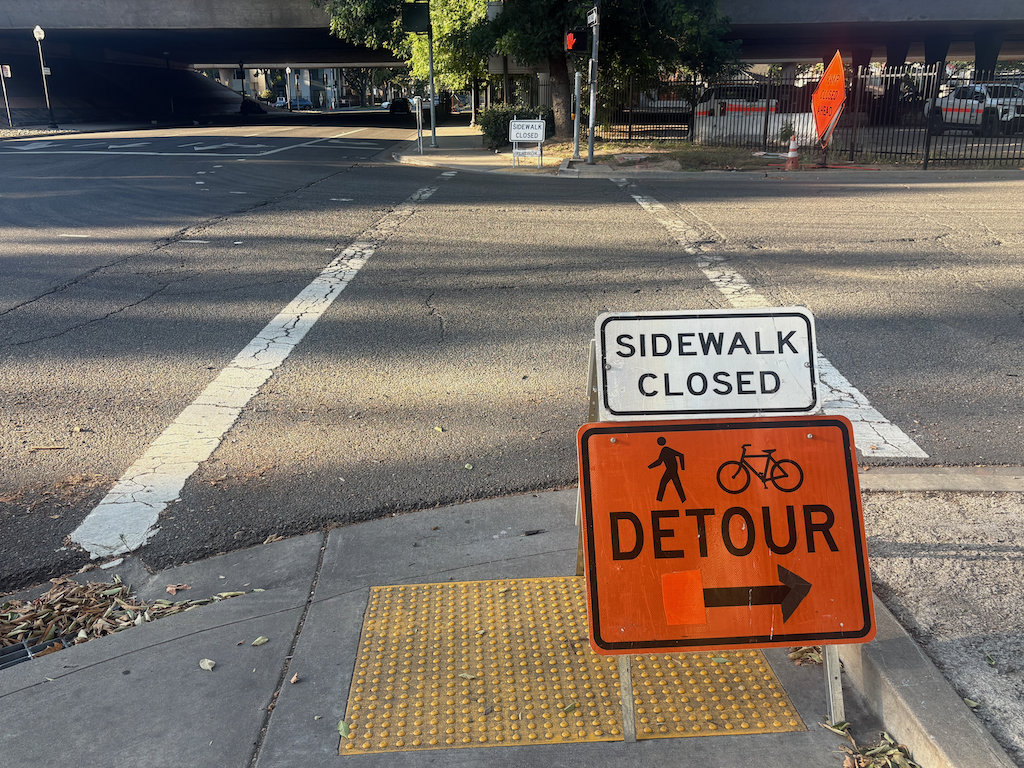
photo of 15th St at X St, pedestrian detour sign
15th St at X St, pedestrian detour sign

Second, what it looks like going south on 15th Street. You can see the fence that blocks access, but you can’t see, from here, the minor fix that would remove this problem. Apparently the person walking had gone around the fence, unwilling to go two blocks out of their way, to and from 16th Street. This is the target audience for Caltrans, and by ‘target’, I mean a person at risk of bodily injury or death at the hands of Caltrans. At least Caltrans put up a small ‘bicycles share the road’ at a locations where drivers are sure not to see it. This should be an illegal sign in any case, as drivers take it to mean, bicyclists should get out of the way and ‘share’ the road with cars. California MUTCD also required bicyclist accommodation in this situation.
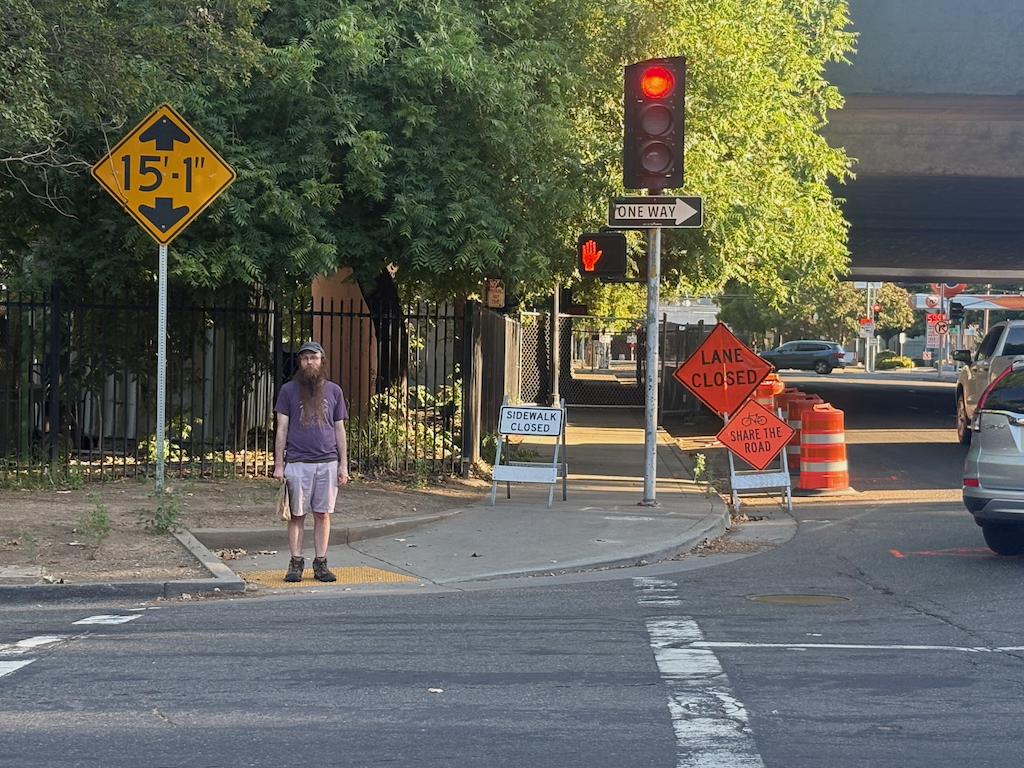
photo of 15th St at W St, pedestrian access blocked
15th St at W St, pedestrian access blocked

And this is what it looked like today, June 16. No change, except that the ‘bicyclists share the road’ sign is gone. Again, the suggested detour is to the even more hazardous intersection of 16th Street and the freeway.
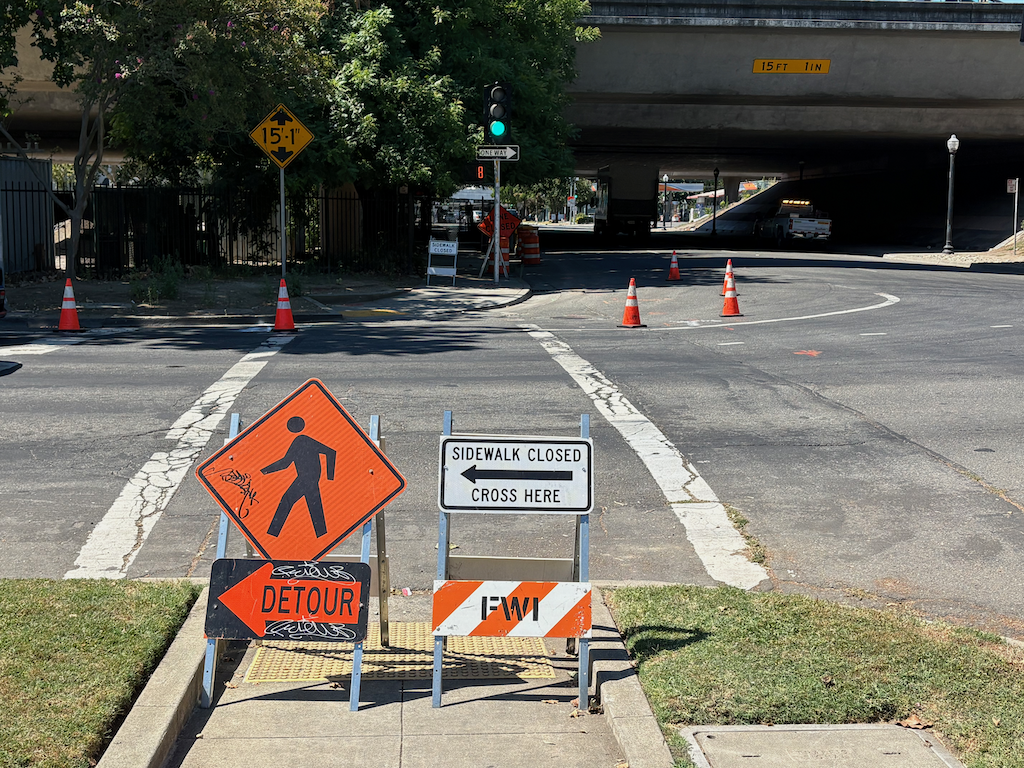
photo of 15th St at W St, pedestrian detour, sidewalk blockage
15th St at W St, pedestrian detour, sidewalk blockage

I have said before, but it bears repeating, that Caltrans District 3, which includes Sacramento county, is a rogue agency, funded by taxpayers (your tax money) but accountable to no one. Not Caltrans headquarters, not California Transportation Commission, not the governor, not the federal government. And most particularly, not the citizens of Sacramento. They do what they want, when they want. They want you to just accept that they are killing you, using your own money for the crime.

I sometimes wonder if the felon Trump got his ideas for grift, criminality and incompetence from observing Caltrans District 3.

Am I pissed? You bet.

HSIP grants for SACOG region

Caltrans has released a list of $300M in projects under the HSIP (Highway Safety Improvement Program) program of federal funds. See Streetsblog: State Announces Nearly $300 Million in Grants for Safe Streets for more information. The funds are a mix of federal and state, but the awards are selected by the state. Unlike most projects funded by the federal and state, these projects really do have a focus on safety, though the various signals in these grants may be as much motor vehicle focused as walker and bicyclist focused. The City of Sacramento has installed beg buttons, replacing auto-recall pedestrian signals, in an effort to ease traffic flow and only secondarily make it safer for people walking, so there is a concern about how signals will be implemented.

Twenty-three of the projects are in the SACOG region. A pdf of those is available. Presumably descriptions of each project are available somewhere, but I’ve been unable to locate them. If I do find them, I’ll highlight a few of particular interest.

lawsuits against Yolo 80

For earlier posts on Yolo 80 and managed lanes, see category ‘managed lanes‘.

Two lawsuits have been filed against Caltrans over the Yolo 80 freeway widening project.

Sierra Club and ECOS: Sierra Club, ECOS file lawsuit against Caltrans over I-80 project; Sierra Club and ECOS Sue Caltrans over Yolo I-80 Freeway Widening Project

“Caltrans’ Environmental Impact Report (EIR) grossly underestimates increased vehicular travel, which would emit far larger quantities of greenhouse gases (GHG) and air pollutants than claimed. The EIR fails to consider viable alternatives, such as increased public transit or alternate tolling strategies. Therefore, the project neither adequately manages demand nor produces adequate revenue to fund needed transit alternatives. Also, Caltrans’ proposed mitigation is woefully inadequate to offset the resulting increased GHG and air pollutant emissions.” – Sierra Club/ECOS Press Release

NRDC (Natural Resources Defense Council)/Planning and Conservation League/Center for Biological Diversity: Environmental Groups File Suit Against I-80 Highway Expansion; Environmental Groups Challenge Highway Expansion Project in Court

“First, Caltrans improperly chopped this project into two pieces to use funding in illegitimate ways and obscure environmental impacts, as documented by a Caltrans whistleblower. The first project, already underway, is using maintenance-only transportation dollars to strengthen the shoulders of the highway so they can accommodate heavy vehicle travel. The second project would restripe the road to accommodate the additional lane of traffic in each direction.” – NRDC

I tend to be cynical about the chances of stopping this widening project. However, the lawsuits can have several beneficial impacts:

  • requiring Caltans to supplement or revise its Environmental Impact Report, because it failed to consider several impacts, and failed to address induced demand
  • requiring Caltrans to allocate more funding to environmental and GHG mitigation; the existing project only partially mitigates impacts, and depends on income from a single tolled lane, which may fall short of projections
  • highlighting the failure of the California Transportation Commission, and in particular Chair Carl Guardino, to provide legally required oversight of Caltrans

I am in favor of tolling freeway lanes in order to recovered construction and maintenance costs, and to fund mitigation measures, not just for GHG but for other environmental impacts. A tolling authority (CARTA) has been set up to administer the added toll lane, but there are great uncertainties about how much will be raised, and the fee structure (vehicles and time of day) has not been developed.

“The EIR does not consider tolling existing lanes, which could be based on income, with funds used to provide clean public transit and bike and pedestrian options along the corridor, facilitating affordable infill development.” – Ralph Propper, ECOS Climate Committee Chair, from the press release

Senator Wiener introduces road safety bills

California State Senator Scott Wiener has introduced two bills to improve road safety in California.

The more important is SB 961, which requires changes to vehicles directly, including a first-in-the-nation requirement that all new vehicles sold in California install speed governors, smart devices that automatically limit the vehicle’s speed to 10 miles above the legal limit. The old name for these is speed governors, which limited speed with a physical device that disengaged the driver train when a certain speed was reached. They were required on all early motor vehicles before vehicle manufacturers managed to eliminate laws requiring them. Today, speed can be digitally read and limited. Already, almost all new vehicles have built in the ability to limit speeds to the posted speed limit, but it is not implemented. The bill would require it be implemented by 2027.

Speed is a contributing factor in all motor vehicle crashes. Whether it is driving too fast for conditions, or simply driving way over the speed limit, speed is a contributing factor to carnage on our roads. Of course there are other factors such as roadway design which encourages speeding. And speed limiters won’t prevent drivers from running red lights, as has become so common, but at least the resulting crashes will be at a lower speed, less likely to result in fatalities.

Speed limiting of vehicles also would remove law enforcement from most speed enforcement, which increases safety for everyone on the road, including officers.

SB 960 requires Caltrans to implement and report on a complete streets policy. In vetoing a Wiener bill to require complete streets, the governor implemented a executive order that purported to accomplish this, but Caltrans has done almost nothing since then, and has weakened and then delayed release of its complete streets policy directive. The bill also requires Caltrans to develop a transit priority policy with performance targets.

Caltrans headquarters has, to some degree, gotten on board with the idea of designing and re-designing roads for better safety and productivity, but the Caltrans districts, including our District 3, are still full speed ahead (pun intended) on building unsafe highways that kill walkers and bicyclists. They must be reigned in by the legislature.

CalBike is a sponsor of both of these bills, along with other organizations. Yay, CalBike!

Links:

a modest proposal to fix the budget deficit

I woke up this morning with thoughts about how Governor Newsom could largely solve the budget deficit. And shortly thereafter ran across the CalBike-led letter, co-signed by 25 organizations, to the governor about shifting budget priorities: Stop Fueling Climate Change: Coalition Challenges Governor to Shift Transportation Spending. In the Governor’s initial budget proposal, there is no reduction in highway building whatsoever. It is as though this is the sacred mission of the state, to fund and build highways at the level desired by Caltrans, and the asphalt lobby, no matter what else is going on in the state, with budget or climate. This is called the ‘Infrastructure Cult’ by Strong Towns.

The letter’s four asks are:

  1. Consider any proposed reductions in General Fund spending on transportation infrastructure in the context of our climate and equity goals
  2. Backfill any General Fund cuts by leveraging the existing statutory flexibility of federal highway formula funds as well as funding from the State Highway Account.
  3. Suspend California state investment in new highway capacity
  4. Develop a multi-year funding commitment that ensures at least 50% of the State Highway Account (SHA) funds go to VMT-reducing projects while prioritizing investments in California’s most burdened communities.

I support all of these ideas, but of course would go further:

  • Suspend SHOPP funding, the funding which is supposed to maintain and improve (but not expand) our highway system until an audit of the SHOPP program is complete. This would take at least a year, maybe more. SHOPP is the biggest part of the Caltrans budget, so the savings for this year would be considerable.
  • Suspend all STIP funding, the funding which is used to build new infrastructure, indefinitely, except for the TIRCP (rail and transit) and ATP (walking and bicycling) programs. This is much the same as the letter’s third action.
  • Propose to the legislature a bill that would convert all HOV (high occupancy vehicle) lanes (which are worthless in practice because so routinely violated), to tolled lanes, statewide, within five years. This effort would include state funding to accelerate creation of tolling authorities where they don’t exist, and to study merging of tolling authorities into regional entities.
  • Propose to the legislature a bill that would not only allow but encourage and/or require the conversion of general purpose lanes to toll lanes. For the time being, this would preserve two general purpose lanes on highways with more than two lanes per direction, but ultimately, all lanes would be tolled. Highways are incredibly expensive to build and maintain, and general funds should never be spent on highways because they are not used by a significant portion of the population. And if all users are tolled in all lanes, the tolls would be reasonable and equitable.
  • Propose a bill to the legislature that assigns CalSTA (California State Transportation Agency) a study of the charter and organization of Caltrans. Caltrans is an outmoded legacy agency which should be reoriented towards meeting the needs of citizen access and climate action, and most specifically maintaining what we have and not continuing to build new.

tolling authority at SACOG Transportation

The proposal for a tolling authority JPA for the Sacramento region came before a special meeting the SACOG Transportation Committee yesterday. Agenda item 2 was to recommend to the SACOG Board that the JPA effort move forward, and that was passed after a whole lot of information and even more discussion. The reason for it coming back is that several options for governance membership are now included, which were not available in December. The tolling authority would be called Capital Area Regional Tolling Authority (CARTA). The meeting can be viewed on YouTube, and the supporting documents are available from SACOG.

presentation page on tolling JPA governance options

For reasons that were not clear to me, SACOG staff added an addendum to the item at the last minute, Evaluation of Voting Options, about how votes might be allocated on use of excess revenue. At least one-third of the meeting time was taken up by discussing this issue, though it was not to be voted on, and is not even relevant in the near future. It will be years before there is any excess revenue to be spent, there will not likely be a large amount of excess revenue, and there is already a long list of mitigations to be funded by excess revenue that are part of the Yolo 80 project. Just when the committee was ready to move on from this topic, SACOG staff brought it up again. Argh!

It is typical of government councils or boards, when composed of more than one government agency, to spend an absurd amount of time haggling over membership. The situation is created when these boards adopt a one-member/one-vote policy, where the vote of each member weighs equally with each other. This sounds like representative government, analogous to one-person/one-vote that our democracy is founded on (with the exception of the US Senate, of course). But it is NOT analogous, and it is NOT representative. Smaller agencies have an outsized affect on the outcome, which is the case of transportation related boards means that smaller cities and rural areas have a much larger voice than they would have if voting were population weighted. We recognize this in creating city council districts, supervisor district, legislative districts, and US House of Representative districts, where each district has an approximately equal number of people. And it is why we do redistricting, so that this balance is maintained over time as population shifts. But for some reason, when it comes to transportation, the usual solution is to give each entity the same voice. I believe this is wrong. In most cases, voting should be population weighted.

In the case of the tolling authority, however, I believe that membership and voting should be weighted by tolled lane miles. This means that initially, only Yolo County, through YoloTD, would have that voice, and other counties would gain that voice over time as they added tolled lane miles. It would make sense to add membership and voting rights at the beginning of construction, not at opening of the toll facility, since decisions about tolling amounts, discounts or exceptions, and hours would start to be made at that point. Since Sacramento County has the largest number of freeways likely to be eventually tolled, it would end up with the highest membership and weighted voting, but not at this time.

Caltrans spend an inordinate amount of time in the meeting defending their right to one or two voting memberships. They had a long list of expertise they could provide, though when challenged to put a dollar value on in-kind or contracted work, was flummoxed. Though both Caltrans District 3 denied it, it was pretty clear to me that they had their eye on excess revenue for future capacity expansion projects. Caltrans has never really had to justify its work or existence to anyone, and when challenged to do so, is quite inept at it.

I spoke at the meeting, the only member of the public to do so. My points were:

  • Support creation of regional tolling JPA
  • Support governance options with one Caltrans voting member, not two
  • Support inclusion of Sacramento Transportation Authority as Sac county agency
  • Voting options for excess revenue can be deferred because there likely won’t be any for a while
  • Tolling advances user pays concept, which transportation advocates support
  • HOV lanes don’t work for management because they are routinely violated
  • Support does not indicate that I support adding lanes in Yolo, but if lanes are added, they should be tolled

For additional posts on managed lanes in general, this regional tolling authority, and the Yolo 80 project, see category ‘managed lanes‘.

California needs to drop Caltrans, and create a Department of Highway Maintenance

Caltrans has sliced and diced cities with highways, dancing to the tune of segregationists who wanted to isolate and destroy communities of color so that they could ignore the existence of ‘those people’. Caltrans is not likely to be building any completely new highways in the future, though many in Caltrans would still like to. What they will be doing is continuing to widen existing highways, increasing motor vehicle capacity and inducing more driving. It seems that nothing will cure them of this, except disbanding of the agency and firing most of the highway engineers. So that is what I am proposing. In it’s place, there would be a Department of Highway Maintenance. The purpose would be to maintain our existing infrastructure, and I mean actually maintain, not just use safety and maintenance as a cover for widening. If bridges were replaced, they would be required to have the same or less motor vehicle capacity as before.

The department could do projects which remove motor vehicle capacity. This might include removing freeways completely, but with guidelines that prevent the design of ‘boulevards’ that are just as much traffic sewers as the freeways. It might include converting existing general purpose highway lanes to managed lanes, but would never include constructing new managed lanes. It might include projects which reduce on-ramps and off-ramps from two or more lanes to one lane, shortening the crosswalk distance over on-ramps and off-ramps, and creating right-angle on-ramps and off-ramps which slow motor vehicle drivers by design, and it might include narrowing freeway lanes and posting lower speed limits.

All designated state highways which are actually surface streets would be transferred to local transportation agencies, so the state highway system would shrink to actual freeways.

So what would happen to the funds that currently go to widening highways? I propose that one-third be given to local transportation agencies, on a competitive basis, for active transportation projects. All of this funding would go through the California State Transportation Agency; Caltrans would have nothing to do with it.

The other two-thirds would go for rail and transit. A Department of Rail and Transit would be created out of the existing Division of Rail and Mass Transportation. The purpose of this new department would be to purchase rail right-of-way, by condemnation if necessary, from the freight railroads, so that passenger rail may run in California without interference from the freights. It would also fund infrastructure and operations for rail and transit throughout the state. With the movement of funds from highway widening to rail, it should be possible to complete High Speed Rail on schedule, and to greatly enhance the operating frequency of the three regional rail services (Capitol Corridor, San Joaquins/Altamont Commuter Express (ACE), and Pacific Surfliner). Once higher frequency service and modern ticketing are in place, the regional rails would separate from Amtrak and be operated completely by the state. The state already owns the equipment. Though the agency could fund other transit, the emphasis would be on rail.

this to that

I have been irritated by the Caltrans ‘Let’s Change This to That’ advertising campaign for litter pickup and highway cleanup. Certainly litter is a water quality issue, particularly when that litter is washed into the ocean. The really big problem is not the litter, however, but the roads and highways that Caltrans has designed. The highways and wide roadways seem especially adept at accumulating litter, and illegal dumping. Could it be that the highways are such horrible places that people feel compelled to litter them? The highways are overbuilt, incredibly expensive, destroyed and divided neighborhoods, inject air pollution straight into low income communities, and prevent real solutions to climate change and livability. Maybe litter is a comment on all this.

Inspired by the campaign graphics (second below is an example), I’ve created one of my own. I took a shortcut, using something that has already happened (without Caltrans cooperation), the Embarcadero Freeway in San Francisco which was damaged beyond repair in the 1989 Loma Prieta earthquake. When I have the time, I’ll look for other photos to pair, of actual changes or of potential changes. I’ve seen AI transformations that I think could play well for that, but a big part of my purpose here is to call out Caltrans greenwashing.

If this idea inspires you, I’d like to see your campaign graphics for highway removal. My ‘Let’s Change This to That’ graphic is available as a webp. Don’t know how to upload other formats.

'Let's Change This to That' for Embarcadero Freeway
‘Let’s Change This to That’ for Embarcadero Freeway
Caltrans 'Let's Change This to That' graphic
Caltrans ‘Let’s Change This to That’ graphic

ATP6 applications in SACOG region

Applications made for Active Transportation Program cycle 6 from counties and cities within the SACOG Region. So far as I know, no other details about these projects are available yet. The application period for the state-level program just closed. pdf version

See also Streetsblog California: Active Transportation Plan Update: $3.2 Billion in Requests

NoCountyApplication NumberImplementing Agency NameProject Name
260El Dorado3-El Dorado County-1El Dorado CountyPonderosa Road Bicycle and Pedestrian Improvements
294El Dorado3-El Dorado County-2El Dorado CountyEl Dorado Trail / Missouri Flat Road Bicycle/Pedestrian Overcrossing
254El Dorado3-El Dorado County-3El Dorado CountySouth Tahoe Greenway-Upper Truckee River Bridge at Johnson Meadow
253El Dorado3-El Dorado County-4El Dorado CountyMeyers Bikeway Connector – Pioneer Trail to Elks Club Project
303El Dorado3-El Dorado County-5El Dorado CountyFallen Leaf Road Recreational Access Project
290El Dorado3-Placerville, City of-1Placerville, City ofPlacerville Drive Bicycle and Pedestrian Facilities Phase 1
226Placer3-Placer County Nonurbanized Area-3Placer County Nonurbanized AreaNorth Tahoe Regional Multi-Use Trail – Segment 1
38Placer3-Placer County-1Placer CountySR 89 / Fanny Bridge Community Revitalization Project Complete Streets
56Placer3-Placer County-2Placer CountyKings Beach Western Approach Project
98Placer3-Rocklin, City of-1Rocklin, City ofRocklin Road Sierra College Corridor Multimodal Enhancements
40Placer3-Roseville, City of-1Roseville, City ofDry Creek Greenway East Multi-Use Trail, Phase 2
139Sacramento3-Sacramento County-1Sacramento CountyElkhorn Boulevard Complete Streets Project
265Sacramento3-Sacramento County-2Sacramento CountyBell Street Safe Routes to School
208Sacramento3-Sacramento County-3Sacramento CountyStockton Blvd Complete Streets Project
417Sacramento3-Sacramento, City of-1Sacramento, City ofFranklin Boulevard Complete Street – Phase 3
221Sacramento3-Sacramento, City of-2Sacramento, City ofEnvision Broadway in Oak Park
218Sacramento3-Citrus Heights, City of-1Citrus Heights, City ofOld Auburn Road Complete Streets – Phase 1
93Sacramento3-Citrus Heights, City of-2Citrus Heights, City ofCarriage/Lauppe Safe Routes to School Project
319Sacramento3-Elk Grove, City of-1Elk Grove, City ofLaguna Creek Inter-Regional Trail SR 99 Overcrossing and Gap Closure
295Sacramento3-Folsom, City of-3Folsom, City ofHistoric District Connectivity Project
413Sacramento3-Folsom, City of-1Folsom, City ofFolsom-Placerville Rail Trail Gap Closure Project
204Sacramento3-Rancho Cordova, City of-1Rancho Cordova, City ofZinfandel Drive Bicycle and Pedestrian Overcrossing
249Yolo3-Yolo County-1Yolo CountyCounty Road 98 Bike & Safety Improvement Project Phase II
219Yolo3-West Sacramento, City of-1West Sacramento, City ofI Street Bridge Deck Conversion for Active Transportation Project
26.Yolo3-Winters, City of-1Winters, City ofWinters/El Rio Villas Active Transportation Connection: SR-128/I-505 Over-cross
42.Yolo3-Woodland, City of-1Woodland, City ofWoodland Safe Routes to School & ATP Connectivity Project
195Yuba3-Yuba County-1Yuba CountyWest Linda Comprehensive Safe Routes to School Project
202Yuba3-Yuba County-2Yuba CountyOlivehurst Comprehensive Safe Routes to School Project
231Yuba3-Yuba County-3Yuba CountyEast Linda Comprehensive Safe Routes to School Project
150Yuba3-Yuba City, City of-1Yuba City, City ofYuba City Bicycle and Pedestrian Safety Improvements
272Yuba3-Yuba City, City of-2Yuba City, City ofYuba City Abandoned Railroad Corridor Conversion Project