Sac City Council 2025-05-13

The Sacramento City Council will meet Tuesday, May 13, 2025 (today!) at 5:00 PM. There are two items that might be of interest to transportation advocates.

Item 02 on the consent calendar is ‘Approve Criteria and Guidance to Accommodate Active Transportation in Work Zones Policy’. There is a staff report, and the policy itself. Though items on the consent calendar are not expected to be controversial, and will only be discussed by council if a council members pulls it from consent calendar, this is nevertheless worth supporting. This policy has been delayed for years. It is not perfect, but it is an immense improvement over existing policy and practice.

Item 09 on the agenda is ‘Fiscal Year (FY) 2025/26 Proposed Budget Overview‘. The budget should reflect the priorities of citizens in Sacramento, but it only partially does.

traffic violence emergency at Sac City Council

It is likely that council member Caity Maple, along with Mayor Darryl Steinberg and council member Karina Talamantes, will introduce an emergency declaration on traffic safety at the city council meeting tonight, starting at 5:00 PM. The item is not on the agenda, so I presume it will be introduced during the ‘Council Comments-Ideas, Questions’ part of the agenda, after all the numbered agenda items. Council members get their ‘matters not on the agenda’ time, just like the public does. None of the advocates I have asked have a clear picture of how emergency declarations work. I presume the idea will come back to council one to many times in the near future, but tonight is your first chance to hear what the council has to say and comment on the ideas.

Caity Maple has posted about the recent injury (now fatality) and the emergency response she wants the city to take:


I’m devastated to see yet another person critically injured after being struck by a vehicle on Sacramento’s roads. Even beyond our City’s commitments to eliminate traffic deaths through Vision Zero, we need to take immediate and urgent action. This coming Tuesday, alongside my colleagues Mayor Darrell Steinberg and Mayor Pro Tem Karina Talamantes, I will be introducing a proposal that:

  • Declares a state of emergency for the City of Sacramento regarding the road safety crisis
  • Directs the City Manager to identify funding for a public education campaign focused on driver education, pedestrian/ bicyclist awareness, and traffic safety
  • Directs the City Manager to work with SacPD to ramp up enforcement of traffic laws that protect pedestrians, including speed limit enforcement, crosswalk violations, and distracted driving, especially in high-injury corridors
  • Reaffirms our commitment to Vision Zero and directs staff to expedite safety projects

Read More »

SacCity fails to act on traffic violence

At the June 11 city council meeting at which the 2024-2025 budget was adopted, seven of the council members spoke strongly about the need to address safety on the city’s streets, acknowledging that the city leads California as the most deadly for roadway users. But no modification was made to the budget to reflect that priority, and the city manager refused to make any changes to the budget to fund street safety.

In the two months since that council meeting, nothing has shown up on the council agenda to move forward on street safety, nothing has shown up to allocate funds, except some minor grant applications.

The city has long had a policy that it does not fund street safety projects, except for the required grant matches. Other than grant matches, no city general funds are expended to make our streets safer. The city certainly has been successful in getting some grants, but also has not been competitive on many others.

The Sacramento Active Transportation Commission (SacATC) made a recommendation in their annual report to allocate $10M to safety projects. Council members spoke in support of the idea, but no action was taken to fund those ideas.

We have an epidemic of traffic violence in the city. Yet the city is doing almost nothing to address that. Walkers, bicyclists, drivers and passengers are all dying in horrible numbers. What is the city doing in response? Submitting grant applications and hoping for the best. This is unacceptable.

The council must take this public health crisis seriously, and allocate funds to start solving it. It must also stand up to the city manager, who does not believe in spending money on street safety. The city manager runs the city according to his own whims, and rarely follows the direction of council on anything. The council must either stand up to, or fire, the city manager. So long as he is in the position, the city will not move forward on saving the lives of vulnerable roadway users.

SacBee: city response to crashes

The SacBee published an article yesterday: After a deadly crash, Sacramento fixed a dangerous road. Why isn’t this the norm? Apologies for linking to a firewalled article; if you have a subscription or access to a printed newspaper, it is well worth reading.The article is quite in-depth, more like the investigative reporting that the SacBee used to do, but rarely does any more. The author is Ariane Lange.

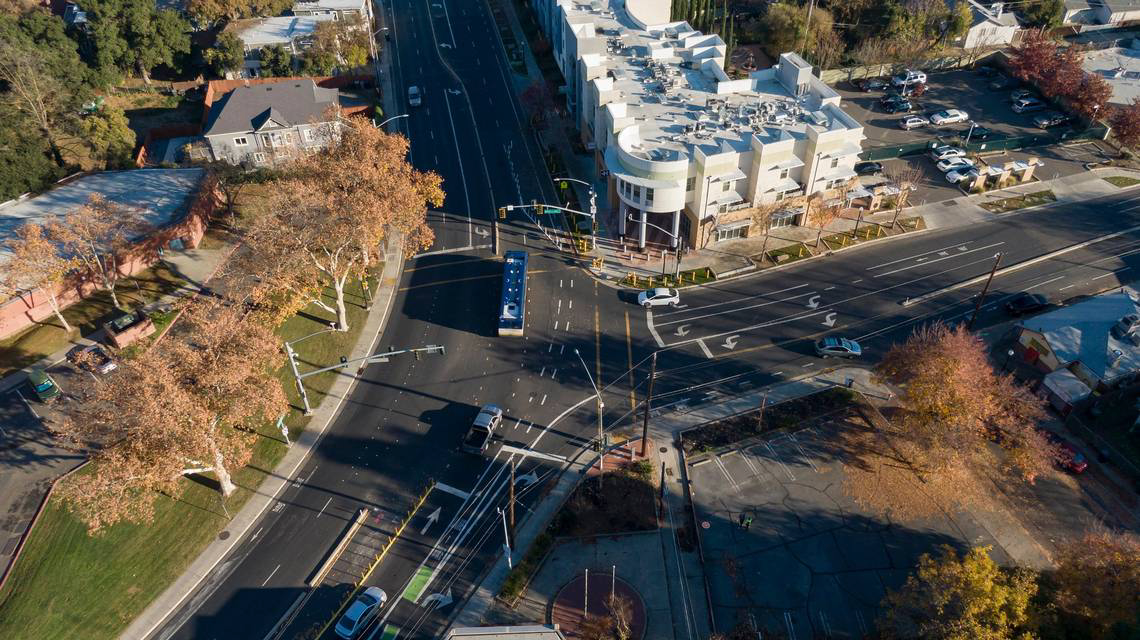
The article highlights changes made to the intersection of Broadway and Martin Luther King, Jr. Blvd (MLK) after a fatal crash single-vehicle crash in 2021. Though the article did not make clear, the driver was likely eastbound on Broadway and continued straight into the building. Google maps, below, does not show the changes, but a photo from the article does (second).

Broadway & MLK intersection, Google Maps (not up to date)
Broadway & MLK, SacBee photo (more recent)
Read More »

Sac City is transportation bankrupt

There is an insightful admission hiding in the City of Sacramento General Plan 2040 update. In the Mobility Element, A Multimodal System section, Maintenance and Funding subsection (page 8-8), “A key challenge for Sacramento is that existing revenue streams do not fully cover operations and maintenance costs, and this same funding is also used to support implementation of improvements for safety and mobility throughout the city.”

Revenue does not cover expenses. Liabilities exceed assets. The city is bankrupt, just as you would be in this situation. Some asset of yours, like your house if you own one, or your business if you own one, is deteriorating, and you do not have the income to fix it. In the case of the city, it has incurred debt in order to build a transportation network that it cannot possibly maintain under the current taxation regime. And it never will. Never. If the city raised taxes, of whatever type, to the point they would pay for debt service and maintenance of the existing system, people would revolt. And that does not even include the new transportation infrastructure that some people would want. The city’s transportation system is bankrupt. It always will be. The core of the reason is that the city asked developers to pay for transportation infrastructure within a development, but then the city takes on liability for maintenance of that infrastructure. It all looks good for about 30 years, until things start to fall apart. The streets need repaving. The sidewalks are cracked. Painted lines and crosswalks have long since faded to invisibility. Not to mention what lies beneath (water and sewer), which is even more expensive to fix. For an in-depth explanation of how cities and counties and states got into this situation, I can recommend Confessions of a Recovering Traffic Engineer: Transportation for a Strong Town, and Strong Towns: A Bottom-up Revolution to Rebuild American Prosperity, both by Charles Marohn of Strong Towns. In fact, just in time for my post, an article today on Strong Towns: Why Cities are Flying Blind When It Comes to Their Own Debt.

So, what to do?

  1. Don’t bond anything again. We don’t need more roadways, or wider roadways, or interchanges. We don’t need big projects. Pay for maintenance of what we have, out of current income. This also means that we would never again bond against future income for current funding, as the city has done with parking revenue.
  2. Figure out what we can’t afford to maintain, and have that discussion with the public. I’d suggest that we can’t afford to maintain parking areas, whether on street, surface lots, or structured parking. Parking has never paid for itself and never will, and if we have to triage our transportation spending, it should be the first to go. Next would be cut-de-sacs and intentionally dead-end streets.
  3. Change accounting and budgeting so that transportation infrastructure shows up as a liability in accounting and budget, because it must be maintained forever, rather than as an asset.
  4. Cease accepting responsibility for new roadways built by developers. If a developer wants infrastructure, they can pay for it, and maintain it, forever, by setting aside reserves to cover the necessary maintenance. This would result in gated communities, which I definitely do not like, but a gated community is better than fiscal bankruptcy. It would also result in far, far fewer greenfield developments, since the financial model for these is that society will take on maintenance responsibility, and will build the surrounding infrastructure of arterial roads and highways that the development must have to pencil out. That is all to the good.
  5. Wean the city off of federal, state, and regional grants. Not all at once, but decrease the percentage of transportation projects that depend on outside money. This would mean even less money for transportation in the city, but it would force the city and citizens to look at what is really important, to individuals and society, and spend on the things that are really important. I hope that safety comes out at the top, and that we spend on transforming out transportation system from the current one that kills and maims people to one that protects vulnerable users first and foremost.

Note that the city is bankrupt in many ways, not just transportation. But transportation is my thing, so that is what I focus on.

improving SacRT

The condition and future of Sacramento Regional Transit (SacRT), particularly the light rail system, has been much in the news recently:

Everyone these days seems to want a better transit system. The problem is that no one wants to pay for a better transit system. The business leaders who suddenly want a modern, appealing, well-maintained light rail are the same ones that have worked over the years to suppress efforts at increasing the tax base for operation of the system.

Read More »