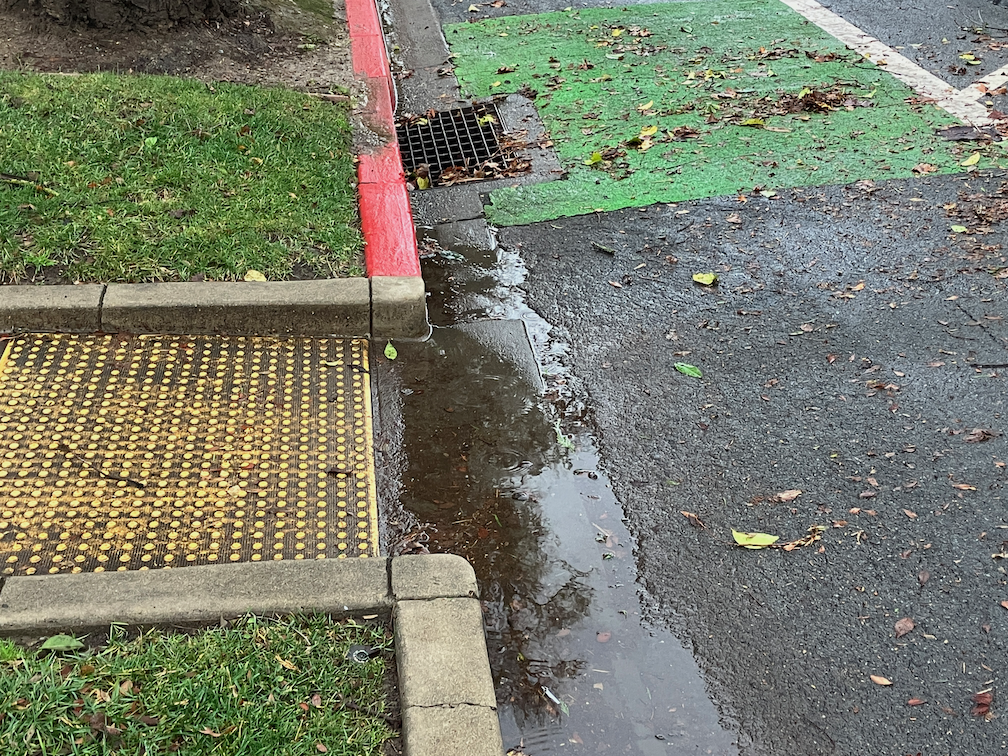
Beth Osborne, Director of Transportation for American (T4A) tweeted on July 20 about what news media gets wrong about crashes involving walkers and bicyclists. She solicited more ideas, and the ideas have been flowing! After just two days, there are 135 comments, 326 retweets, and 2026 likes.
I had assumed that the topic of news media bias and deference to law enforcement victim blaming was a niche concern, but apparently not. The diversity of people commenting is surprising but hopeful, and the list of things news media gets wrong could fill pages. Not that every media article is wrong, or that all parts are wrong, but the consensus seems to be that news media is more wrong than right.
I contributed my own two cents:
It is true that most law enforcement officers have a strong bias against bicyclists and walkers, and so what they say should be taken with a grain of salt, if not discounted entirely. But reporters usually treat LE with deference rather than challenge.
Almost all reporters simply repeat what the law enforcement officer or PIO or news release said. They rarely go to the scene to see what it actually looks like. I realize that not all crash locations can be visited, but current practice is none of them are.
But I really encourage you to follow this tweet thread to see how many ideas there are from so many people of different backgrounds.
The City of Sacramento (and the county, and the region, and the state) have created a very carbon-intensive transportation system, focusing on moving motor vehicles (more and faster) over all other uses of the public right-of-way. It has also created a carbon-intensive land use pattern, by allowing and encouraging sprawling development that places everything further away, and makes motor vehicle travel the only reasonable option for many people to get from one place to another. Sprawl not only makes transportation less efficient, but uses more water and more electricity, reduces agricultural lands, and isolates people. Freeways and the arterial street network that supports them are far more expensive than other roadways, so most of our transportation budget goes to those two types. There is little left over for streets, and little left over for maintenance. But you know all that.
If the city is serious about reducing greenhouse gas emissions (GHGs), it would focus most of the Climate Action and Adaptation Plan on these issues. Transportation and land use, and housing in particular, cannot be separated from each other. They should not be separated in the plan. If we change our transportation system without changing land use and housing, we fail. If we change land use and housing without changing the transportation system, we fail. They must both be changed, healed from the harms of past city action or neglect, together. What the draft plan proposes to do is make minor changes to housing and minor changes to transportation, but sets low goals for both. And it uses enough vague language that it is not even clear that those low goals will be achieved. Most importantly, it does not commit the city to spending any money to fix problems and do better. What it is basically doing is kicking the can down the road, in case future versions of the city government happen to be more committed to change and innovation.
I encourage you to take a look at the plan (yes, it is long and hard to read), and then contact your city council member to express your concerns. I’ll likely be gone by 2045, so won’t see the outcome, but for many of you and your children, the meek action and underfunding that the plan proposes will make your world unlivable. Time for leadership is now!
The City of Sacramento’s Climate Action and Adaptation Plan (CAAP), preliminary draft, sets a goal, in the Measure E-5: Support Infill Growth section to “Enable the development of 8,700 new affordable by design units by 2040 within 0.25 mile of public transit…”. Sound good, but.
This is a low goal. The city already has a deficit of affordable housing, and has no plan for raising the necessary funds to build this affordable housing (it killed inclusionary zoning, and replaced it with a completely insufficient development impact fee, and the $100 Measure U contribution to the housing fund is on hold). The city’s Housing Element, required by RHNA, specifies that 16,769 units of ‘Extremely Low- and Very Low-Income, and Low Income’ housing are needed. While it it true that some affordable projects have been, and will be, developed without any city help, setting a goal of only half what is already needed is meek.
Location within 0.25 miles of transit is a mixed bag. While it is clearly a good that affordable housing is accessible to transit (otherwise it is not truly affordable under the housing+transportation analysis), past practice has been to locate affordable housing projects on arterial roadways, those sources of pollution and noise and traffic violence that families living in affordable housing should be protected against rather than exposed to. Unless the city is making a real commitment to redesigning these roadways to reduce VMT, reduce traffic violence, reduce air pollution, and emphasize active transportation and transit, it would be better to place affordable housing elsewhere. I don’t think that CAAP is making that commitment. A strong argument made by many housing advocates is that we should be encouraging affordable housing everywhere, not just along arterial roadways (also known as stroads).
Stockton Blvd Plan, Community Working Version has been released for comment. It is open through October 15. I have not had time to look at it yet, so have no comments. I do wonder why, though, we are now in the third round of public input, and another round is promised. If gathering input stretches on long enough, perhaps the city won’t have to do anything.
The CAAP states (page 100) “This level of active transportation mode share by 2030 is consistent with outcomes of comparable case studies and peer-reviewed literature and anticipated level of investment through 2030, all of which are necessary factors to consider for quantifying evidence-based reductions for a qualified GHG reduction plan.” and (page 102) “Planning for at least an 11 percent transit mode share by 2030 is an evidence-based goal that the City considers achievable given current understanding of transit behaviors in Sacramento and comparable case studies, given that sufficient funding can be obtained to implement the necessary infrastructure.”
The justification for the mild targets is in the CAAP Appendix C – Community Measures GHG Emissions Quantification, page 20 for Active Transportation (TR-1) and page for Transit (TR-2). The document active transportation section cites work commute trips, which misses the point that all trips are an opportunity for GHG reduction, and that only about 15% of all trips now are work-related (pre-pandemic). It also states that we can’t be compared to European cities (nor does it even use up-to-date data from Europe), but implies that Sacramento won’t be taking the actions to significantly increase mode share, so therefore uses a much lower number. No actual research is cited. For transit, the document states that we could achieve a 21% mode share based on peer city Oakland, but then inexplicably sets the target of 11%.
Why is the city setting such low goals? Reading between the lines, it is because they don’t intend to spend the funds necessary to reach these goals, and they know they can’t fund this all with competitive grants. This is not climate leadership, in my opinion. The city should be doing everything it possibly can to shift trips aways from motor vehicles to active transportation and transit.
Some elements of the MCCC were included in the CAAP, some were not. I’ve found it valuable to compare the two. If you have the time, please do that yourself. The MCCC is a much stronger document.
The City of Sacramento’s Climate Action and Adaptation Plan (CAAP), preliminary draft, includes the graphic below, showing emissions by sector for the city.
Transportation is 57% of emissions (2016), and is likely higher now because other sectors are being reduced but transportation is expanding. One might assume that 57% of the document would be devoted to this primary source. But Chapter 6, GHG-Reduction Measures and Actions, devotes 15 pages to built environment, 14 pages to transportation, and 13 pages to other sectors (waste, water and wastewater, carbon sequestration). Transportation is the second sector to be addressed, after built environment, which I think represents that the city sees transportation as less important than built environment.
I’m reviewing the City of Sacramento’s Climate Action and Adaptation Plan (CAAP), preliminary draft. I’ll have several more posts on this, but what immediately comes through to me is that the plan doesn’t acknowledge what the city did wrong in the past to create such a carbon-intensive city.
So, let me help with that:
Transportation
focusing the transportation network on continuously expanding capacity for motor vehicles, ignoring and more frequently being hostile to other modes; this has changed slightly, but is still the dominant approach
spending almost all funds on roadway capacity expansion (more lanes and interchanges) instead of maintaining what we have; every pothole is a policy failure
refusing to accept responsibility for sidewalks, which are a critical and core component of the transportation network
refusing to spend any general funds on transportation improvements, other than required matches, depending instead almost entirely on grant funding from the state and federal levels
providing free and below market rate parking throughout the city, which not only subsidizes but increases motor vehicle use
going all-in on motor vehicle electrification, while nearly ignoring electric bikes; there are no electric bike incentives, and no electric bike charging facilities
failing to update the outmoded 2006 pedestrian plan, and/or to combine it with the bicycle plan into an integrated active transportation plan
refusing to develop policy around transportation solutions, as though every project were unique and had nothing to do with other projects or with the overall pattern; the bicycle and pedestrian master plans are examples, laying out individual routes but not creating policy that determines what kind of facilities are appropriate for what kinds of streets and intersections
refusing to innovate and pilot new ideas, as every peer city has been doing; despite accepting the progressive NACTO guidelines, the city has actually not implemented anything that does not comply to the letter with the regressive MUTCD guidelines
Housing and Land Use
zoning which prevented multi-family and mixed use throughout most of the city; this has changed a little, and will change more with the 2040 General Plan, but the legacy of this will be with us for generations, and yes, the intent was largely racist; zoning of this sort makes everything further away, requiring more driving
setting development standards which make inefficient use of land, with setbacks and height limits, which again, spreads everything out
eliminating inclusionary zoning without creating a viable method of funding affordable housing through development impact fees or other mechanisms; for example, the city only contributed pittance $2.8M of the $40 or so that the newly opened Lavender Courtyard cost
supporting and celebrating large residential greenfield developments while ignoring infill development, and placing requirements on development that are easy for large developers and onerous for small developers; this has changed a bit, but not much
bending over backwards to promote and subsidize very large projects, such as the arena and Delta Shores, while paying no attention to small businesses; every empty storefront is as much a failure of the city as it is of that business
None of this is to say that the city is not doing some good things, or that it is not light years ahead of the county, and ahead of most of the cities in the region. But overcoming carbon addiction requires admitting that you have a problem, and largely created the problem, and can’t overcome the problem until you stop doing the wrong things.
I think it is important that the CAAP not only state what the city will do, but also what it will STOP doing.
The draft City of Sacramento Climate Action Plan (CAAP) section MEASURE TR-1: Improve Active Transportation Infrastructure to Achieve 6% Active Transportation Mode Share by 2030 and 12% by 2045, includes the performance indicator “Deploy 20,000 feet of new/repaired pedestrian infrastructure by 2030”. The final CAAP will become part of the city’s 2040 General Plan.
This is less than four miles of sidewalk repair. The city has approximately 2300 miles of sidewalk. At this rate, 8 years to repair 4 miles of sidewalk, it would take 4600 years to address the sidewalks in the city. What does the city intend instead? That private property owners repair sidewalks, even though the sidewalks and the land they sit on belong to the city (in most cases, though some wider sidewalks in the central city are a mix of city and private). From the city’s Sidewalks, Curbs & Gutters page:
Q: Isn’t it the City’s responsibility to maintain the sidewalk? Isn’t it public property?
A: The sidewalk is in the City’s right-of-way. However, California Streets and Highways Code sections 5610 through 5618 allow cities throughout California to require property owners to maintain the sidewalks in front of their property. Sacramento City Code section 12.32 sets forth the City’s procedures under these sections. Sacramento is not the only city to require sidewalk repairs to be the property owner’s responsibility. However, curb and gutter maintenance is the City’s responsibility. As the property owner may bear civil liability for a person suffering personal injury or property damage caused by a defective sidewalk: it is in the property owners best interest to maintain the sidewalk and reduce the risk of a lawsuit.
Note the word ‘allows’. Nothing requires that the city shift the burden of sidewalk maintenance to private property owners. The city has simply decided to do so, so that it may shift responsibility of a critical part of the transportation infrastructure off the city and onto adjacent property owners (so that it may spend more on roadway capacity expansion, in case you were wondering). Though it would make sense to require property owners to repair sidewalk damage from root heaving due to trees on private property, it is ridiculous (and criminal, in my opinion) for the city to demand that private property owners repair sidewalks when the trees are in the city-owned sidewalk buffer area. This is the sort of action one would expect in a dictatorship, forcing citizens to take on individual responsibility for city actions.
Car drivers can zip between places with restrooms. Bicyclists, to a lesser degree. Transit users and walkers, not at all. This is a transportation issue. If people cannot find restrooms, they can’t make their way through the city. They can’t afford to wait at a transit stop for a transfer. People with urinary issues (count me among them) have to plan carefully around not just their movement, but around restroom access. A city without public restrooms is a city that biases transportation against walkers and transit users, and in favor of vehicle drivers. Access is denied to an entire class of citizens.
In Sacramento, public restrooms are scarce. Cesar Chavez Plaza downtown has a Portland Loo type restroom, but it took years to get it done. So far as I know, there are no plans for additional locations.
Cesar Chavez Plaza restroom Portland Loo model
Roosevelt Park downtown has a new restroom, replacing the old one. There are two single-use, all-gender units, which is the current trend and probably much better than the older multi-user, gendered restrooms.
Roosevelt Park new restroom
The restroom in Fremont Park, right across the street as I type, has been closed for years, and despite the sign, is never open during events. Porta-potties are used for events at this park.
Fremont Park restroom closed
I have not traveled to all the city parks to see which restrooms are open, which are open but with limited hours, and which are closed, but my impression is that about half the park restrooms in the city are closed. The city has a GIS map of park restrooms, but no indication of whether the restrooms are actually open or not: https://data.cityofsacramento.org/datasets/b9e7fa6d1d104833b3f04268d7f682dc_0/explore. Park restrooms are valuable for walkers, but very few are located on transit routes.
There are no public restrooms at transit hubs. No restrooms where people are waiting for the next train or next bus. The next bus, at transfer points for low frequency routes, can be quite a long wait, up to 45 minutes assuming the buses are on schedule. Even at Sacramento Valley Station, where a number of modes converge, you can only use the restroom by showing an Amtrak train ticket. Using light rail or bus, or just walking or bicycling, you are out of luck. (Note: Many people assume that Amtrak or Capitol Corridor owns the train station, but it is owned and managed by the city.)
Some light rail stations and a few bus stops have restrooms for the transit operators, but not for the public.
The city should:
re-open or replace all park restrooms, within two years
install public restrooms at every city park which does not currently have them; this would include Muir Children’s Park, Grant Park, Winn Park, and several others
install a public restroom at the bus layover point on L St & 14th St
install a public restroom at the 16th St light rail station (where the Gold Line and Blue Line diverge, and the most used transfer point)
install a public restroom at 7th St & Capitol Ave light rail station (where the Blue Line, Gold Line and Green Line diverge; the 8th St & Capitol Ave stop is a block away)
identify locations throughout the city where walkers and transit users congregate, and install public restrooms there
You might wonder why I’m asking the city to install transit restrooms rather than SacRT. The reason is that I see it as the responsibility of the city to provide restrooms everywhere they are needed, not of the transit agency, though of course the projects could be joint projects.
Note: As is not unusual, I had forgotten that I’d written about N St before: N Street bike route to cycle track, 2015. Seven years have passed, the city has taken no action.
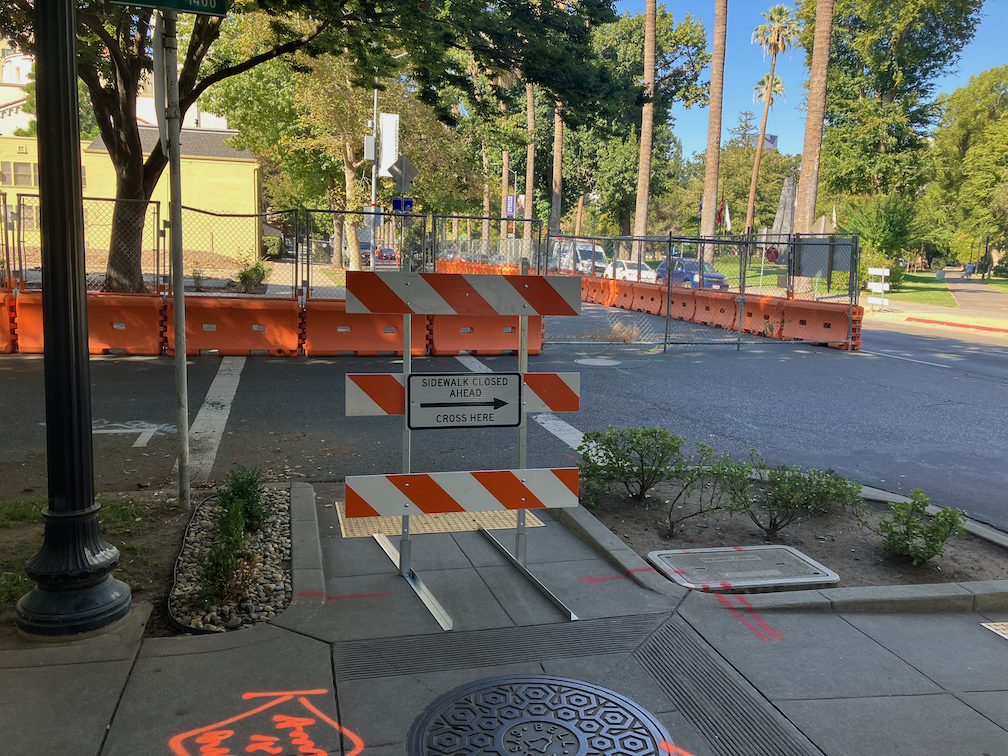
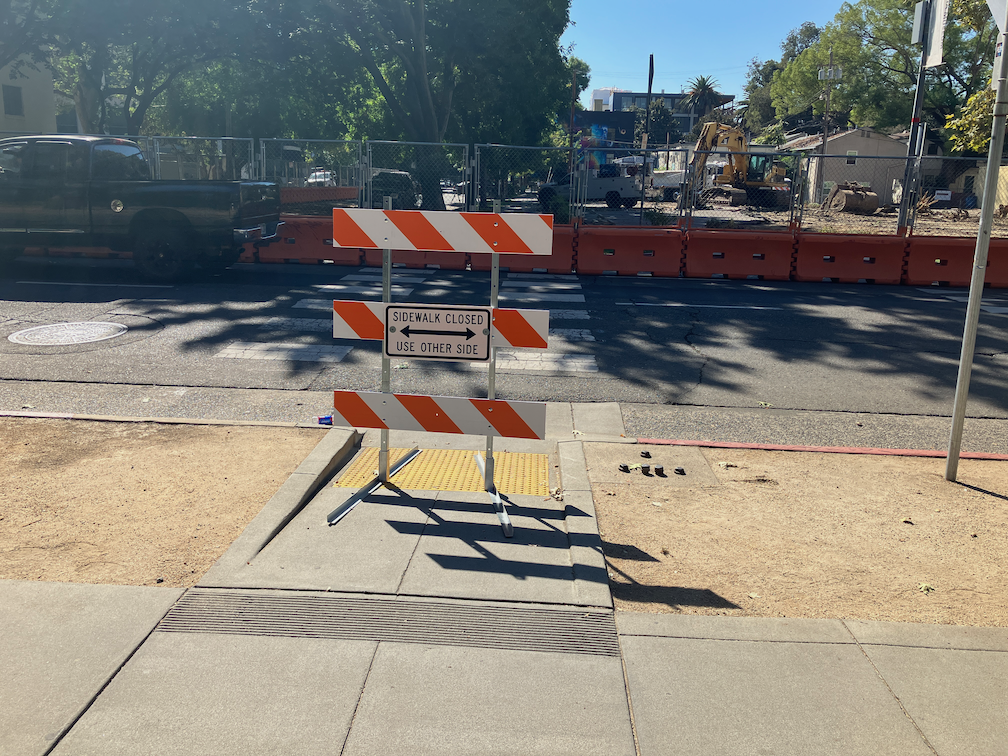
The construction for the Capitol annex project has narrowed N St to two lanes eastbound, from 10th St to 14th St, and parking has been removed from the south side to shift the lanes over. Now is the time for the City of Sacramento to implement its long-delayed (if not deep-sixed) plans for re-allocating space on N St. There have been ongoing utility projects over the last few years that have narrowed N St to two or even just one lane. At no time did that create significant congestion, during the pandemic or before the pandemic. I live two blocks from N St, and both travel along it and cross it frequently. I’ve never seen more than momentary congestion, in 11 years. What that means is that N St, in its three-lane configuration, has grossly excess capacity for motor vehicles.
While the street has been narrowed is the time to redesign the street so that it has no more than two general purpose lanes, and has a curb-protected or parking-protected bikeway. Probably on the left. This is in fact the perfect setting for a separated bikeway, five blocks from 10th St to 15th St with no intersecting streets from the north side, which is Capitol Park.
It is true that the sidewalk on the north side of N St is a designated bikeway, so bicyclists may use the sidewalk to avoid riding in the street. But bicyclists on the sidewalk are often in conflict with people walking on the sidewalk. The sidewalk has pretty continuous use by walkers, particularly during the lunch time – walk time for state workers, but a lot of people also include a circuit of the Capitol Park on their runs and walks. This conflict is easy to solve: create a safe, welcoming, protected (separated) bikeway on the street. And do it now!
On N St eastbound, the leftmost lane is a designated left turn lane at 10th St, which is what makes possible the two-lane configuration beyond 10th St. As a temporary measure, this works well, and forcing turns off three lane streets is a good solution for so many overbuilt arterials roads in Sacramento, but here it is only temporary, and would be obviated by the conversion of all of N St from 3rd St to 15th St. N St becomes a two-lane street at 15th St, and then becomes a two-way street at 21st St. N St from 15th St to 21 St would probably be a good candidate for a separated bikeway as well, but with paint bike lanes existing, would be a lower priority.
Below is a StreetMix sketch of what N St might look like. Note that the width of the street and the elements are estimated, not measured. I don’t believe parking is needed on both sides, but the diagram shows it for people who think it is necessary. Left side is north, Capitol Park in this case, and right side is south, mostly state buildings.
N St Sacramento between 3rd St and 15th St
As a reminder, I feel strongly, and it is backed up by evidence:
Three-lane streets are significantly less safe than two-lane streets, primarily for the muli-lane threat (one vehicle stops for walkers and the others do not). They are also a clear sign of poor land use planning, which puts residents and the things they need to reach (jobs, stores, recreation and entertainment, medical, etc.) far away. Narrowing all such roadways in the city from three to two, or less, would increase safety, increase livability, and encourage people to make different choices about where they live and visit. Maps of collisions (vehicle vs. vehicle, vehicle vs. walker, vehicle vs. bicyclist) align almost perfectly with overbuilt arterials.
One-way streets are significantly less safe than two-way streets, for the same multi-lane threat, and because there isn’t any friction to slow drivers. However, I think that the only valid argument for one-way streets is to accommodate separated bikeways, bus lanes, or rail transit. That may be true of N St.
And, sorry, can’t resist, get rid of the worthless palm trees while they are at it. We need shade trees, not poles.